
Thomas Lalor Cooke’s Picture of Parsonstown was first published in 1826 and a revised edition by his son William Antisell Cooke in 1875. So this year marks the 150th anniversary of the revised issue and in 2026 we mark the 200th anniversary of T.L. Cooke’s first and now rare book, the Picture of Parsonstown. A reprint of the 1875 greatly expanded history was issued by Esker Press in 1989 with a new introduction by Margaret Hogan. It is now also out of print. A reissue of the 1826 book is now under active consideration.
(more…)Category: Birr
-
Sharavogue Shinrone, County Offaly and the King’s County Polo Club. By Aidan Doyle. Blog No 710, 23rd April 2025
Polo traces its origins to the game of Chovgan, an equestrian team sport played by the aristocracy of the Persian Empire. It spread across Asia evolving along the way. By the 1400s it had arrived in India, supposedly introduced during the Muslim conquests of the subcontinent. During the Mughal period polo was dubbed the ‘Sport of Kings’ and the emperor Jalal ud-din Akbar introduced a set of rules governing the sport in the 1560s. In 1859, British soldiers and tea planters serving in India established the Calcutta Polo Club and the game was quickly introduced to Britain. When Carlow hosted Ireland’s first polo match in 1872, the local press referred to it as ‘Hurling on Horseback’. A year later the All-Ireland Polo Club was founded, with its grounds at the Nine Acres in the Phoenix Park. In 1875 the Hurlingham Polo Committee in London drew up a set of rules which would shape the polo in the century which followed. In the same year polo had migrated once again and in time the scions of Argentina’s richest families would establish that countries position as the global powerhouse of the game.
(more…)
-
George Petrie (1790–1866), a key landscape painter for Offaly’s ‘heritage of ruins on the landscape’. No 3 in a series on the paintings and drawings of County Offaly, 1750-2000, explored through the works of artists from or associated with County Offaly. Blog No 709, 15th April 2025
George Petrie was born in Dublin in 1790 and has a strong King’s/ County Offaly connection through his work at Clonmacnoise, Birr, Banagher, Clonony, Lemanaghan and Rahan. He may have been the most significant topographical artist so far as Offaly is concerned. He was certainly the greatest exponent of the heritage of Clonmacnoise first visiting the site in 1818–22. Dates differ as the visits to Clonmacnoise as was noted in the most attractive publication by Peter Murray and published by the Crawford Gallery in 2004.[1] The other great work on Petrie is that of William Stokes, The life and labours in art and archaeology of George Petrie (Longmans, London, 1868). Also important is Crookshank and Knight of Glin, Irish painters, 1600–1940 (Yale, 2002).
The Dictionary of Irish Biography (DIB) entry by David Cooper records that Petrie, was an artist, antiquary and collector of Irish traditional music, and was born on 1 January 1790 in Dame Street, Dublin, the only child of James Petrie, portrait painter, of Dublin, and Elizabeth Petrie (née Simpson) of Edinburgh, Scotland. James Petrie (d. 1819) was born in Dublin of Scottish parents and studied at the drawing school of the Dublin Society. Afterwards he practised as a miniature painter and a dealer in jewellery, coins, and antique objects at 83 Dame Street. The collecting instinct would stand Irish heritage in good stead with James Petrie’s son George performing an outstanding archival and museum service.
(more…)
-
Parsonstown/Birr Minor Model School.By Joseph Doyle. No 10 in the 2025 Anniversaries Series. Blog No 701, 15th March 2025
Between 1849 and 1867 a nationwide network of almost thirty Model Schools was established by the Board of National Education. These schools were under the exclusive control of the Board and it was expected that attendance would be drawn from the various denominations to be found in the area of each school’s location. The primary aim of these institutions was to provide a regulated system of training for candidate teachers. Due to a growing reluctance on the part of the Roman Catholic hierarchy and clergy to be associated with these institutions where they had no input into management, the establishments were decidedly skewed towards Ulster. This became even more pronounced when a scheme for the establishment of those schools termed Minor Model Schools – as opposed to the more prestigious District Model Schools – was put in train. Of the seven such schools, only one – Parsonstown Minor Model School – was located outside of Ulster. As such it was an exotic.
(more…)
-
The Morrison family, jewellers, creative artists and photographers, Emmet Square, Birr – prominent members of the Birr Methodist community. By Michael Byrne. No 9 in the 2025 Anniversaries Series. Blog No 699, 8th March 2025
The Changing face of Birr in the 1900 to 1920 period will be the focus of a talk arranged by the Birr Historical Society for Monday 10 March at 8 p.m. in the County Arms Hotel. The illustrated lecture will focus on change in that period and the record of it provided by the early photographers and other sources. Once such was George Morrison son of Edward, both were jewellers and in addition George was a trained photographer who had opened a studio in his Birr jewellery shop in 1894. He was grandfather to the now acclaimed documentary artist George Morrison of Mise Éire (1959) fame. Another neighbour, Archie Wright of nearby Cumberland House, Birr, had also trained in photography and would assist his father in producing photographs weekly for the local King’s County Chronicle newspaper from 1885. At the time an innovation in the provincial press.
(more…)
-
The Beginning of the Gas Supply in Birr/Parsonstown. By Martin Hoctor. No. 8 in the Offaly History Anniversaries Series. Blog No 697, 1st March 2025
The first indication that Birr/ Parsonstown (as often called in the 19th cent.) had used gas to illuminate the town during the dark winter months was an editorial comment that appeared in the King’s County Chronicle of January 9 1850[1] that extolled how the use of portable gas had made the town safer to move around at night.
(more…)
-
Mixing a Bazaar, Religion, Politics, Sport and Song in West Offaly during 1897. By Aidan Doyle. No 2 in the 2025 Offaly Anniversaries Series. Blog No 688, 15th Jan, 2025
Sometimes researching history is like trying to make a jigsaw that’s missing too many pieces. Sometimes, someone throws a few pieces from a different jigsaw in, just to complicate matters even more. This one such story.
New Arrivals in the neat little town
In May 1896 the Midland Tribune reported…
‘Tuesday last was celebrated by great festivity and rejoicing at Ferbane, the occasion being the arrival of four Sisters of the Order of St. Joseph to found a Convent in the neat little town. The nuns came at the invitation of the esteemed Parish Priest, Very Rev. Canon Sheridan who had prepared for their accommodation in the large vacant building beside the Brusna Bridge’
A Priest and his Parish
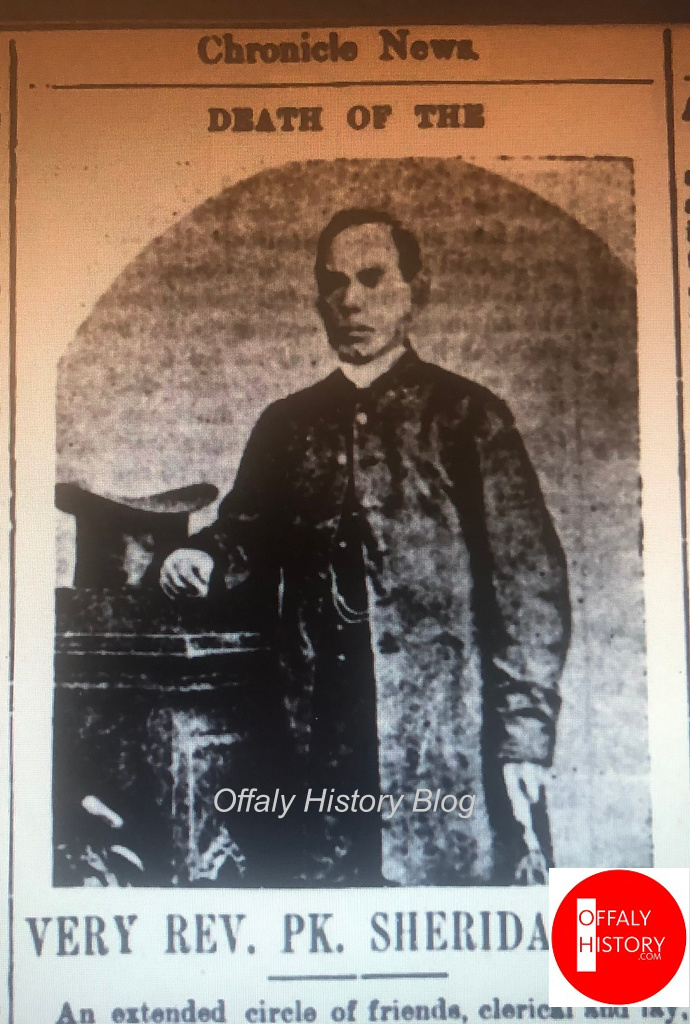
Canon Patrick Sherdian was a man who got things done, but he liked things done his way. Ordained in 1855 and stationed at Ferbane from 1875 until his death in 1899, the Canon interested himself in every aspect of his parishioners’ lives. His time in Ferbane was occasioned by conflict, be it with some members of the local home rule organisation, the Board of Guardians or his own curates. Nevertheless, his achievements were substantial. In 1894, he led the successful campaign to save the Clara to Banagher Railway branch line. Having built a national school in High Street, he set out to construct the Church of the Immaculate Conception at Ferbane. Work progressed quickly and the Canon set to work on raising the estimated £7,000 required to complete the job. To accomplish this, he organised a massive raffle and a Grand Bazaar to be held on the last week of May in 1897.
(more…)
-
The first public elections by secret ballot in King’s County/Offaly were held in Birr and Tullamore in October 1872. Offaly History Anniversaries Series, no. 1 of 2025. Blog No 687, 8th January 2025
The year 2024 saw the local and general elections held and, of course, voting was by secret ballot. The polling centres of 2024 were remarkably quiet as if one were attending confession in a quiet corner of a church. Long gone were the days when a glass of Birr or Banagher or Bernie Daly’s Tullamore whiskey would be proffered by candidates or their agents to thirsty voters. The right of secret ballot extends back to 1872 and the Ballot Act. Before that time voting was in public and held in the towns in Offaly of Tullamore, Birr and Philipstown (Daingean).The Birr-based Chronicle newspaper had thought to describe the polling booth as the voter having to go ‘behind a screen, a la Punch and Judy mode, and there make the sign of the cross with a pencil on the voting paper opposite the names of the favourite men’. This was 50 years before the STV (single transferable vote was used in parliamentary elections in 1922 (see note 5 below) The Chronicle had noted in 1872 the emergence of the polling districts and the practice before 1872 in parliamentary elections:
Formerly, [before 1800] the county sent six members to the Irish Parliament, two for the county at large, and two for each of the boroughs, Philipstown and Banagher; but since the Union its representation has been limited to the two members for the county, and in 1836 the number of registered votes amounted to 1700. The election under the new Ballot Act will, of necessity, assume a different form, and will not be confined to Tullamore, Parsonstown and Philipstown.
(more…)
-
New books on Offaly History in 2024: another good crop. Blog No 681, 15th Dec 2024
The year 2024 was another good year for publications on Offaly history with overviews of County Offaly towns, books on Tullamore, Birr and a musician from Killeigh who acquired fame in the United States. We also had Cloneygowan, canals, peat, a Feehan bibliography and natural history.
(more…)
-
The changing face of Offaly and Kinnitty in the early 1900s: launch by John Clendennen T.D. of a new book featuring Kinnitty at Giltraps’s, Kinnitty on Thursday 19 Dec. at 8 30 p.m. Blog No 680, 14th Dec 2024
Kinnitty Parish can now celebrate having two TDs, not to mention so many of of its young men on the first Offaly team to win an All Ireland back in 1924. All part of recent celebrations. What was the village like a generation earlier in the 1890s and earlier 1900s? To find out more come to the launch of The Changing Face of Offaly towns in the early 1900s published by Offaly History and for which local woman Grace Clendennen contributed an essay. Please note the launch time of 8 30 p.m. (ed.)
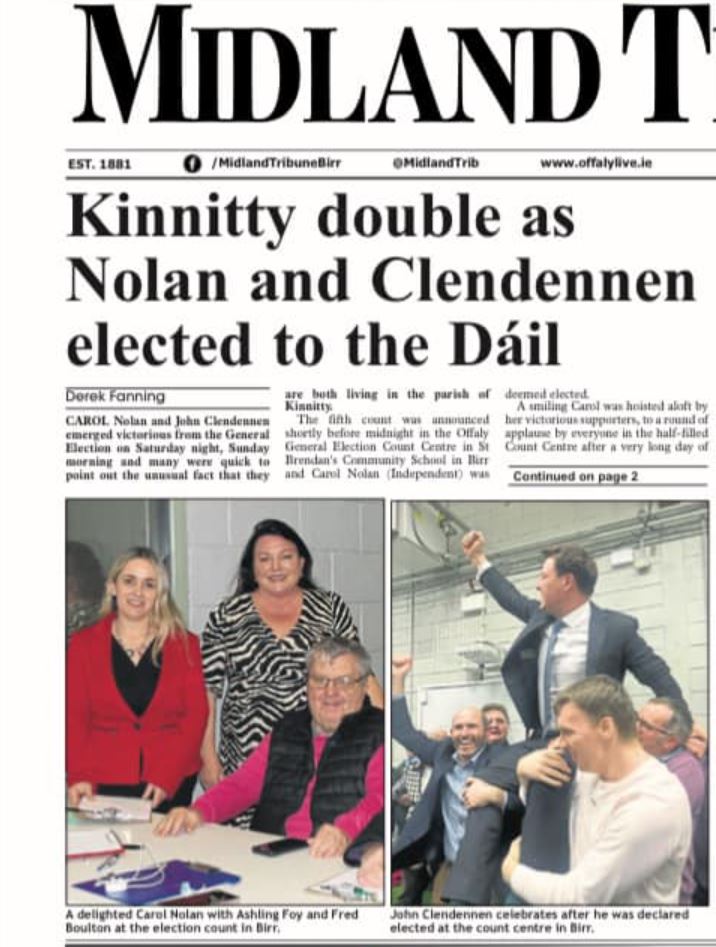
From the Midland Tribune of 5 Dec. 2024 Grace Clendennen writes of Kinnitty in 1901 and 1911
Like the 1901 census, the majority of Kinnitty residents in the 1911 were born in the King’s County. There were 225 people recorded in 49 houses[1]. Roman Catholic was the most common religion stated but a sizable number, 42 out 225, stated their religion to be other than Catholic[2]. Akin to the census of 1901, eight properties were listed as ‘first-class’. Two of the properties were listed as general shops. In 1901 Patrick Egan and his wife were recorded as shopkeepers. A shop assistant, a domestic servant and a yard man lived with the Egan family.
(more…)
 offalyhistoryblog