There was an extraordinary Synod held in Birr in 697AD. This synod was called by Adomnán, abbot of Iona, who arrived in Birr with the princes of church and state and who produced an edict that fundamentally challenged the way warfare was carried out in Ireland and beyond.
St Catherine’s Church, 1815. This is the second article to mark the successful Heritage Week 2023. The new St Catherine’s Church was designed by Francis Johnston and was built in the Gothic style with a Latin cross plan, side-aisles, a tower in the west and a crypt at the east end for the burial place of the Bury family. Its situation on Hophill makes it an impressive landmark in Tullamore. Hophill is a glacial mound which rises steeply to a height of about fifty feet above the land around it. It is not clear how the mound acquired its name or when. The earliest known reference to the hill occurs in a lease of 1748. There is a local story that the spoil for digging out the new lake at Charleville was used to construct the site for the new church. While this is not true perhaps some materials were used which gave credence to this story. Originally more pointed, the hill is a natural one.
Laois Offaly is again to be divided into two three-seat constituencies according to the just announced electoral commission report. ‘This would be the first time that the Offaly constituency would fully align with its county boundary.’ For the 2016 General Election Laois and Offaly were divided and to the Offaly constituency was added 24 electoral divisions from North Tipperary. Laois-Offaly was adopted again for the 2020 general election. Now what was it like in the first Free State election in 1923 just 100 years ago? It was remarkable that the 1923 general election held on Monday 27 August 1923 was in general peaceful. It was only in early July 1923 that Ministers Milroy and Blythe spoke at a Cumann na nGaedheal (CnG) meeting in Tullamore in what was described by the Chronicle as scenes of an unprecedented character in the history of public meetings in Tullamore. The ‘supporters of Mr de Valera’ had posted anti-government posters about the town recalling the executions of Byrne and Geraghty, and also the three young men shot in Birr on a charge of armed robbery. On the office of the state solicitor, James Rogers, in High Street, Tullamore was pasted the words ‘Come inside and see the executioners’. Rogers would have been known both sides in the civil war as someone who defended Sinn Féin prisoners in the 1917–21 period. The newly appointed civic guards kept the peace between Cumann na Gaedheal supporters and supporters of the Republican IRA.[1]
To mark Heritage Week 2023 we have two articles on St Catherine’s Church, Hop Hill, Tullamore. This week the background from the 1700s to the completion of the new church in 1815. When coming to Tullamore by boat or rail the two most prominent sites to greet the visitor are the spire of the Catholic church completed in 1906 and that of St Catherine’s church, built on the mound known as Hop Hill and completed in August 1815.
We take the presence of the Cof I churches of St Catherine’s, Clara, Shinrone, Geashill, Edenderry and St Brendan’s in Birr (to name a few) for granted. The upkeep is great and the contributors few.More will need to be done to structure support for the upkeep of these buildings.
A Francis Johnston plan with the burial crypt of c. 1808-10. Courtesy of the Irish Architectural Archive
Hop Hill site a brave choice
The Hop Hill site was a brave choice as there was work to be done to make it suitable for building and the adjoining ground was soft and prone to flood, especially in the years before the two Brosna drainage schemes of 1850 and 1950. The Tullamore town landlord, Charles William Bury (1764-1835), had reserved the large distillery plot (now the Granary apartments in Market Square) for a church, from about 1800 to 1806. In the latter year then rector, Ponsonby Gouldsbury, and the vestry opted for the Hop Hill site and the new church was largely completed in August 1815. Soon after the old church off Church Street, erected in 1726, was demolished and the site of the church and, possibly an adjoining graveyard, were used for the Shambles or meat market and the remaining land incorporated into the new Market Square or Corn Market. The new Bachelors Walk was worked on from about 1812 as an attractive avenue to the new church from the High Street and from the town’s owner’s new residence, Charleville Castle. The architect for the church was Francis Johnston and for the new avenue, or Bachelors Walk was John Claudius Loudon, the distinguished landscape architect and designer of demesnes.
The young Charles William Bury when aged 28 and just seven years into his estate. He married in 1798 and died in 1835. His best years were up to the completion of the castle. He contributed about £4,000 of the £8,000 it cost to build St Catherine’s.(more…)
The Tullamore and County Offaly Agricultural Show may be described as a unique cross urban/rural community undertaking and a traditional family day out attracting up to 60,000 people to the show. The Tullamore show was rekindled in 1991 by a small group of local people representing urban and rural communities. The Tullamore and Co. Offaly Agricultural Show Society Ltd was founded in 1990 and since its inception the Tullamore Show has grown to become one of Ireland’s largest and finest one day shows with entries from the 32 counties. In the early years of the 1990s the Tullamore Show was held in the grounds of Charleville demesne and castle in the month of August.
A 2018 show launch courtesy of the Show Gallery(more…)
Mag Léna is of interest for two events that occurred in the early historic period. The first event is the pseudo historic Battle of Mag Léna. The second event was the significant Synod of Mag Léna and the Letter of Cummain, part of the Irish church row with Rome over the dating of Easter.
Both incidents caused a split in Ireland!
What’s in a name?
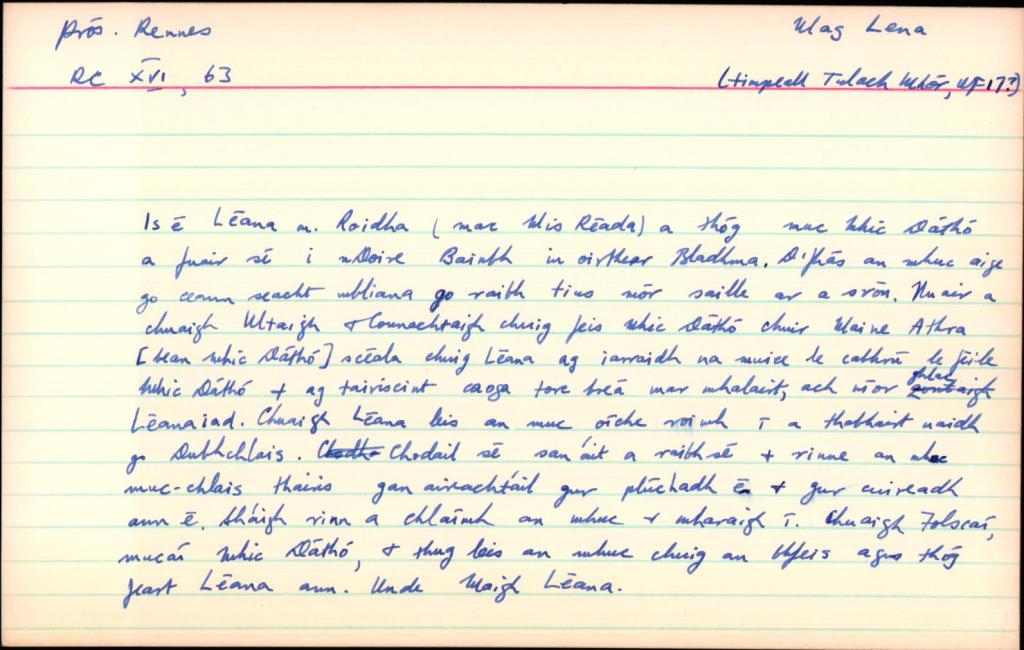
Mag Léna is mentioned in logainm.ie as Moylena and places it in the parish of Kilbride, Co. Offaly. Mag or Magh translates as a plain or open country, there is no information provided on the meaning of the word Léna. Unusually, there are no additional references other than the basic location details, also this older relic from the original card index system below. A 13th century manuscript mentions Cath Mhuighe Léana. Magh Léana is mentioned elsewhere. In his Survey Letters we find O’Donovan used a variety of spellings for the name – Moylena, Moyléna, Moyleana, Moleany and Moy-leana.
Logainm index card for Mag Léna.
As usual there are difficulties with the older Gaelic placenames and how they were recorded over time. Today the only memory of the name is in Tullamore, where the Moylena road joins the Clara Road and eventually joins the Rahan Road through Glendaniel.
The dismantling of the barrack structure of the British military establishment advanced rapidly in the aftermath of the signing of Anglo-Irish Treaty in December 1921. The great exodus in Offaly began in February 1922. The newly issued Offaly Independent (absent since November 1920 due to its destruction by the British military) was now able to report that
11 March 1922 Offaly Independent
, “They are going with a vengeance,” but now it is the army of occupation, not the natives of the country, that is leaving our shores, going while a great sigh of relief goes up, and no pang of regret is felt at the departure of those who held is in bondage for so long. What a change the front of St. Conleth’s School in Daingean now presents from what it did a short time ago. The front gates are now thrown open for the first time in nearly two years, as when the local police barrack was destroyed the splendid group of houses inside the gates of St. Conleth’s School which had been used for the purpose of housing some of the tradesmen employed in the institution were commandeered and used as a barrack for police and Black and Tans until Wednesday of last week when the evacuation took place. From an early hour on that morning the residents of the barracks were astir and it was easy to see that something out of the common was about to take place. Before long it was evident that the long-wished for hour had come and that the Crown forces were about to clear out, bag and baggage. At mid-day lorries arrived from Edenderry carrying the Black and Tans from that district, and all assembled at the Grand Canal Bridge, Daingean for the final parting. Such musical instruments as accordions, mouthorgans, etc., were produced and the disbanded heroes made the welcome ring to the strains of “Come back to Erin” (we hope they won’t). “It’s a long way to Tipperary”, “You’ll Remember Me”, and other items. The townspeople viewed the scene unmoved and the farewells were not returned. On the following day the members of the old R.I.C. force prepared to leave Daingean, and by Friday not a single policeman was to be seen in the place, while a new force guarded the town (OI, 11 2 1922).
The closure in 2012 of Offaly Express, where I served as a staff reporter from 1988 to 2007, marked the end of an era in local journalism.
When I was a schoolboy, living in Tullamore, the dominant local paper was the Offaly Independent, though the Midland Tribune circulated to a degree from Birr. The growth of Tullamore led to a feeling that a specifically local paper was needed, and in 1978, the Tullamore Tribune was launched, under the editorship of the late Geoff Oakley. He remained in that post until he retired in 1994, when he was succeeded by Ger Scully.
The Offaly Express emerged as a sister paper of the Portlaoise-based Leinster Express, which began to circulate around Tullamore in 1984, though it already had a presence in Edenderry and the eastern half of Offaly. Much of the credit for the Offaly edition must lie with the late Kevin Farrell, who would surely have enjoyed the irony of the fact that his death in July 2012 took place the very day on which the Offaly Express ceased publication and that it had to hold on to report the sad news of his passing.
We are drawing to the end of a period of remembrance and reflection on the events that took place during the period 1912–1923 and the emergence of the Irish state as we know it today. These commemorative events have been referred to as the Decade of Centenaries (www.decadeofcentenaries.com)
As we proceeded through the decade of commemoration, it became apparent that little was known or reported about the many women who were active throughout this period, with some notable exceptions such as Constance Markievicz and Mary MacSwiney, but including thousands of other women. Mary McAuliffe has pointed out that there has been a failure to see the women of 1916 and the subsequent years as historical figures. An additional strand has been added to the Decade of Centenaries online resource. ‘Mná 100’ is an online women’s initiative for the final phase of the Decade of Centenaries Programme and continues to work in highlighting the role of women in the revolutionary period (www.mna100.ie). Caitlín Kingston was one such woman.
Caitlín Brugha (nee Kingston)
Caitlín Kingston was born in Birr, Co Offaly, in 1879 to William Kingston and Catherine Roche. The Kingstons were quite prosperous and owned a large store in Main St, Birr dealing in groceries, spirits and delph. They also owned land outside the town. Caitlín had two brothers, John was a Holy Ghost priest in Rockwell College and Charles was Offaly County Secretary during the difficult period of 1900 to 1921, steering the county through the minefield that was local government during the transition from British rule to Irish rule. She had two sisters, Máire who went to live with Caitlín and helped her raise her family after the death of her husband, Cathal Brugha, and Hanoria/Nora who joined the Sacred Heart order of nuns in Roscrea. Caitlín herself was educated in Roscrea. On the death of her father William in 1904, Caitlín helped her mother to run the business. However, they sold that business in 1910 and moved to Dublin.
We are used to hearing of the formal gardens at Birr Castle Demesne and the famous box hedges. The landscape of the demesne has been manicured since the time of Mary, the third Countess of Rosse in the 1840s and 1850s. Later the fifth, sixth and the present seventh earl have devoted much time to demesne improvements. The Illustrated London News in an issue of 1843 was the first periodical with an international circulation to devote space to the demesne (see our earlier blog). In the mid-1960s it was Country Life with the distinguished architectural historian , Mark Girouard, who wrote up three articles on the castle and one on the town of Birr.





 offalyhistoryblog