This is a new 20-minute video recording on the history of the Society, now better known as Offaly History with lots of interesting photos especially recorded for Heritage Week. We want to thank all who have contributed to making it so successful so far with activities across the county, and continuing until Sunday. The lecture on Larkin’s maps and their predecessors we shall post next week, also a video on the Durrow Pattern. Our next lecture is on 5 September on Michael Collins and is important. More information next week.
A PowerPoint presentation narrated by Michael Byrne explores the identities of Castle Street in Birr as part of a project to know and appreciate our distinctive town centres. This Streetscape project is in partnership with Offaly County Council and part funded by the Heritage Council.
An initiative promoted by the Heritage Council as part of its Streetscapes Project
Castle Street about 1857. Courtesy of Birr Castle Archives
The focus of this study is Castle Street in the town of Birr. The street comprises a mix of about thirty commercial and residential properties close to the Camcor river to the south, Main Street and the old parish church to the north, and to the west Birr Castle. On the east at the Market Place or Market Square it opened into Main Street, Bridge Street and from the 1880s into the new Brendan Street.
Castle Street about 1920.
The market house stood from the 1620s where the memorial to the Manchester Martyrs was placed in 1894. Surprisingly, when the market house was taken down in the late 1700s it was not replaced with a new building. Castle Street varied greatly in character from the strong residential houses of two and three-storeys to the robust commercial warehouses close to the boundary of the castle, attracted by the availability of water-power and facilitating in the 1800s the development of distilling, brewing and malting houses. Castle Street was also the principal marketplace in Birr with markets held each week and large fairs three or four times per year. There was a strong base in agri-business in the street and this in turn created businesses such as draperies and boots and shoemaking to cater for the farming clients from the prosperous hinterland. That Castle Street was intimately bound up with the rural economy is clear from the surviving early photographs of the 1900s and one of 1856–7. The early photograph is by Mary Rosse and is of a market day in Castle Street.[1] This would make it the earliest surviving photograph of a busy street in Offaly, as most others are not before 1890 or 1900.
Castle Street about 1970, courtesy Birr Castle Archives
[1] David Davison, Impressions of an Irish Countess: the photographs of Mary countess of Rosse, 1813-1888 (Birr, 1989).
Crotty’s Church, Castle Street
Click on the blue Offaly History Blog to open the video from an email
Exploring Castle Street, Birr: the buildings, business and people.
J. de Jean’ was the nom-de-plume of John Frazer (c. 1804–1852), a Presbyterian of Huguenot extraction, cabinet-maker and a native of Birr. As a young man he started writing poetry, and his first work – a lengthy poem entitled ‘Eva O’Connor’ was published in 1826 (Richard Milliken, Grafton Street, Dublin). During the 1840s individual poems, increasingly expressing radicalised politics, appeared in the newspapers and periodicals of the day, many of which were featured in his collected works `Poems For The People` 1845 and `Poems` 1851.
This online presentation is to promote the first complete edition of his poems, edited by Terry Moylan, Pádraig Turley and Laurel Grube, which will be published in October of this year. The society would like to thank Offaly County Council and Creative Ireland for support for this important publication.
A presentation of the Birr poet John Frazer (J. de Jean)
This weekend sees the start of Heritage Week 2022 and a very welcome return to exploring the county in person with some great material coming on-line too from Offaly History. We are launching six new videos via Offaly History YouTube and Heritage Week 2022. Our thanks to Amanda Pedlow, county heritage officer for all who work in coordinating the programme. She writes:
With over 30 events here is a reminder for Saturday’s events as a starter’…@offalyheritage @HeritageHubIRE Our thanks to Fergal MacCabe for the use of three of his wonderful watercolours of Srah Castle (1588), Ballycowan (1626) and Bury Bridge (1801).
This year’s That Beats Banagher Festival will take place over next weekend Friday to Sunday, 22 to 24 July with a multiplicity of literary, heritage, cultural and sporting events including a food and craft fair in the Bridge Barracks Yard at the West End on Saturday, 12 noon to 4.30 p.m. craft workshops, children’s events, water events, children’s outdoor cinema and other surprise events. We are a day early with the blog to help promote this interesting festival.
Book Launches
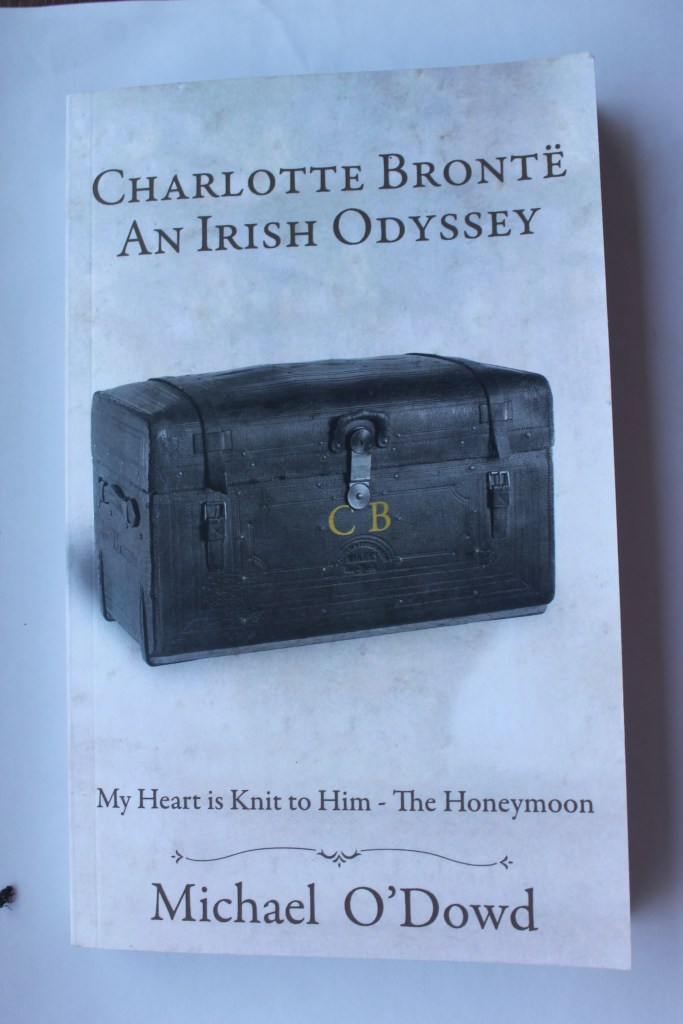
The programme is particularly strong on literary events with the launch of two books on Charlotte Brontë’s honeymoon in Ireland, the first called Arthur & Charlotte, by Pauline Clooney (published by Merdog) and the second, Charlotte Brontë: An Irish Odyssey by Michael O’ Dowd (published by Pardus Media). Pauline & Michael recently spoke with much acclaim at the prestigious Bradford Literary Festival under the title No Net Ensnares Me: Charlotte Brontë Abroad. The event will be held at 6.30 p.m. on Friday 22nd July in the Long Room in The Crank House.
Contributed by Offaly History to mark the Decade of Centenaries
We saw in previous articles in this series the lead up to the civil war notwithstanding the outcome of the general election in June in which the vote was substantially in favour of supporting the acceptance of the Anglo-Irish Treaty of December 1921. In Laois-Offaly all four pro-Treaty candidates were elected with Labour, who preferred to look at the social rather than the Treaty question securing almost fifty percent of the vote. But among the soldiers of the IRA, particularly in Offaly, there was a reluctance to accept the Treaty outcome. Some were of the view that the people would follow where the military led.
The burning of Tullamore courthouse, jail and the former military barracks (in Barrack Street, now Patrick Street) on 20 July 1922 was one of those momentous historic occasions the impact of which had an almost a numbing effect on the people of Tullamore and the county. The completion of these buildings in 1716, 1830 and 1835 were all major steps in the progress of Tullamore. Now all were destroyed in one night for no tangible military benefit by the departing Republican IRA.
Today 14 July 2022 marks one of the most significant centenaries of the year in County Offaly, the burning of Birr Barracks in Crinkill. While the barracks started to go into decline towards the start of the twentieth century, it was still a vital provider of local trade. When the town council requested Lord Roberts station an infantry regiment in the barracks in 1897, local trade from the barracks was valued at £40,000 or around €3.5 million today. While not totally abandoned, troops were stationed in the barracks during the Second Boer War and during the WW1.
On duty at Birr Barracks about 1910
With the signing of the Anglo-Irish Treaty and the evacuation the barracks was handed over to the National Army, Commandant General Michael McCormack taking command of the barracks. The last of the British Army to leave had been a detachment of the Northamptonshire Regiment, which stayed to oversee an auction of government property, which ultimately never took place. The deport staff of the Leinster Regiment, had left several days before, bound for Colchester, which would act as the depot until the regiment was disbanded in June 1922.
Now in the hands of the National Army, the barracks was to act as the headquarters for the 3rd Southern Division. As the rift in the army occurred those in favour of the Anglo-Irish Treaty left the barracks leaving behind the anti-treaty forces, which sealed the faith of the barracks.
The split in the IRA over acceptance of the treaty had been simmering since January 1922. The outcome of the Dáil vote and the June elections (58 seats to pro-treatyites and 36 to anti-treatyites, others 34) did little to dissuade those who believed they had taken an oath to secure a republic and that the stepping stone approach was unacceptable. De Valera and Harry Boland made this abundantly clear in their addresses to the electors in Tullamore in April 1922 (see the earlier blog in this series on 15 June 2022). De Valera had issued an Easter message to the Republic, in which he had asked the young men and women of Ireland to hold steadily on, and that the goal is in sight at last.[1] Tommy Dunne of Ballinagar and a member of the county council told the anti-treaty meeting in Tullamore that:
‘His chief reason for standing by the Republic movement was the construction he put upon his oath under which he felt justified in waging war against the hirelings and agents of the King of England. To recede from that position and take an oath of faithfulness to the country or King he had been waging war against, would be an admission of defeat. We have not been defeated in the fight which we have waged against England in this country for the last two years. . . . Take care that the acceptance of the Dominion Status by Ireland does not have a similar result [division] and that those who are seeking to make Ireland refuse to accept this Treaty do not find themselves opposed by their own country men (cheers).[2]
Those not overly familiar with military history will be still aware of famous battles, probably none more than Waterloo, where Napoleon was defeated by Wellington and his allies in 1815. As today is the 207th anniversary of this decisive battle, we will look at some of the men who were present at this battle who now lie buried in Birr. There are at least four men buried in the town who were present at the battle with many more who fought during the Peninsular Wars, which is a topic for another post. A sad observation is that other than the officers, the other brave men mentioned below are all buried in unmarked graves.
The 16th of June 2022 marks two important anniversaries. The first is the centenary of Ulysses, but the second was the all-important vote on the Treaty held on the same day. The outcome in Ireland of the latter event was eagerly awaited. This election was the first to be held in the new Free State, the first held under the PR electoral system, and the first to be contested by the parties which, in modified forms, were to dominate subsequent Irish politics at least up to 2011. The 1918 election has already been the subject of a blog on Offalyhistoryblog and was a clear win in Offaly and the country for Sinn Féin. This blog is part of our contribution to the #decade of centenaries. We plan more over the summer to include the departure of the British army from Offaly barracks, the lead up to the civil war in Offaly, bank robberies, the burning of the county courthouse, jail and barracks, noted personalities in Offaly in 1922. If you wish to help please email us with your suggestions/contribution. info@offalyhistory.com
The 1922 election was a fight out between the pro-treatyites and the Republicans led by de Valera, but the pact between Collins and de Valera came to grief before election day. Some had looked to the Labour Party to stand aside in 1922, as they had done in 1918, or to vote with the pro-treatyites. Nowhere was the wisdom of Labour going its own way better demonstrated that in the new Laois-Offaly four-seat constituency where William Davin came in as the big winner with more than two quotas. Given its performance in later general elections why did the anti-treatyites not field a candidate? Sean Robbins of Clara had topped the poll in the 1920 county council election and Sinn Féin’s ideologue in Offaly and organiser, T.M. Russell, had come second. Russell, to answer part of the question, had departed the local scene in October 1920 and was in favour of the Treaty. Sean McGuinness, the local IRA battalion commander, was another possible anti-treatyite candidate and he was elected in 1923, but declined to take his seat because of the oath of allegiance. He secured 5,572 votes in 1923.




 offalyhistoryblog