
In these days when there is so much of war and pestilence it is good in looking at the Decade of Centenaries in Ireland to focus on the positive. Things that were done the good of which is still with us. So it is with technical education. Today we look at the early efforts and how positive and innovative were the early pioneers. Our own founder of Offaly History in 1938-9, James Rogers, was one who contributed. So too did those unsung heroes E. J. Delahunty and Willie Robbins. In regard to technical, or what is sometimes referred to as practical education, the earliest attempt in the county to provide such a facility was made at Birr about 1841 when the Parsonstown Mechanics Institute was established in, or to the rear, of the memorial hall at John’s Mall.[1] It was not a success. There were other experiments in agricultural education and model schools, but the first real attempt to provide children and adults with opportunities for technical or practical education came with the passing of the Technical Instruction Act, 1889. A further important stimulus was the passing of the Agricultural and Technical Instruction Act. 1899, which led to the setting up of a new department of agriculture and technical instruction. As a result of the two acts over fifty committees throughout Ireland were working to promote agriculture and technical instruction by early 1900.[2]
(more…)Category: Clara
-
Moorock House, Ballycumber: the first Big House burned in Offaly in the 1919–23 period. By Eamon Larkin, Blog No 372, 9th April 2022
Thomas Armstrong, son of Andrew Armstrong and Lucy Charnock, was born on 22nd August 1702 and when he retired from his position as First Director of his Majesty’s Engineers, Chief Engineer of Minorca and Senior Engineer in the service, purchased the estate of Moorock and built a house there. He died in 1747, unmarried and the estate passed to his brother Warneford Armstrong.
On the 9th October 1793, Warneford Armstrong (1699- 1780) made a lease agreement for three lives and thirty one years of the House, Gardens and Land of Moorock to Richard Holmes, a gentleman of an old King’s County family based in nearby Prospect House. The 390 acres had been leased to James and John Reamsbottom. In 1795 Warnesford Armstrong demised the whole estate of Moorock to Richard Holmes of Prospect House for “lives renewable forever”.
(more…)
-
First Remembrance Day in Offaly for deceased members of the IRA, January 1922.First issue of the revived Offaly Independent. Evacuation of the British military in Offaly begins in February 1922 – Daingean, Clara, Birr and Shannonbridge. Specially contributed, Blog No 356, 12th Feb 2022
We had a blog last April on the 100th anniversary of the death of Matthew Kane. Now we recall the first procession in his memory from Tullamore to his place of burial in Mucklagh in late January 1922. Those early weeks of February 1922 saw the commencement of the removal of the British forces from Offaly in the aftermath of the Anglo-Irish Treaty. The barracks at Daingean, Clara, Shannonbridge and the great Birr barracks were handed over to the IRA. In the first week of February the Offaly Independent was again issued after a break of fifteen months due to the burning by the Crown forces in early November 1920 (see an earlier blog).
(more…)
-
The Public Role of Personal Commemoration. Remarks on the Decade of Centenaries, the Great Flu and the scourge of TB. By Sylvia Turner, Blog No 350, 22nd Jan 2022
On January 7th this year, we raised a glass to commemorate what would have been my mother’s 100th birthday. Born in Kilcoursey Lodge, Clara, she had always said that she was born on a special day, being the day, the Anglo-Irish Treaty was signed in the Dáil. Her explanation to me as a child was that ‘it split Ireland in two and caused a lot of trouble’.
This example of family commemoration running parallel to the national one, relates to one of the aims on The Decade of Centenaries Programme to ‘focus on the everyday experience of ordinary people living in extraordinary times, as well as on the leaders and key actors in these events’
The Decade of Centenaries Programme has led to a great variety of commemorative events and literature, both at a national and local level. The Decade has been commemorated by Offaly History through a variety of media, no longer limited to monuments and the written word, as technology has enabled visual and auditory means to be retained through the use of videos and podcasts.
(more…)
-
Offaly and the Treaty Debate: widespread acceptance. Specially contributed, Blog No 347, 12th Jan 2022
Early 1922 saw just two local organs of public opinion in Offaly – the Midland Tribune and the King’s County Chronicle. The Tribune was owned by the long-term nationalist Mrs Fanning, widow of the late Dr Fanning and herself active in regard to Sinn Féin policy on amalgamation of the workhouses. Her editor was James Pike from Roscore, long-term supporter of Sinn Féin who was now ready to recommend acceptance of the Treaty. So also was Archie Wright, owner of the Protestant and unionist Birr-based Chronicle. The Offaly Independent was more representative of North Offaly, but its printing works had been destroyed by crown forces in November 1920 and did not re-emerge until late spring 1922. During the course of 2022 we plan to bring you articles on the evolving situation in Ireland and Offaly in 1922 and we will be looking into the Offaly Archives, Offaly History Centre and Offaly Libraries to dig deeper for the nuggets.
(more…)
-
The ‘Elite’ of Tullamore skating at Charleville Lake on St Stephen’s Day 1864. By Cosney Molloy. Blog 344, 30 Dec 2021
Skating on Charleville Lake, Tullamore was a popular pastime when I was a young lad. I remember the cold icy winters of 1962, 1982 and 2010. I can recall as a young man the Tullamore people skating on Charleville Lake in 1962. I am a long time now in D 4 but I got down a few weeks before Christmas to the nice butchers in Tullamore – old Tormey’s is still going strong and now you have, Hanlon’s, Crossan’s of Main Street, Ray Dunne and Fergus Dunne, and a few more I would not know. I was sorry to see Grennan’s shop closed for now. I miss Paddy Mac’s, Cleary’s and Joe ‘the Butch’ Kearney and not forgetting Dunne’s butchers off the Square. It was Treacy’s later. Liver we got a lot of and sheep’s hearts in that fine shop. Many old friends gone to the heavenly pastures. I always like to get my turkey in Tullamore and a nice ham even though I am out of the town now for over forty years. What with the bacon factory open until 1989, and now Tullamore Meats, the town has a long tradition in fine food. Come to think of it the bacon factory did a huge business in turkeys back in the 1940s and 1950s when my father was rearing same.
(more…)
-
The internees released from the camps following the Treaty of 6 December 1921. A time of ferment in politics. By Michael Byrne. Blog No 340, 15th Dec 2021
The scene at the railway station [Tullamore] will long be remembered. Long before the hour for arrival of the train, the stream of people to the station premises and surroundings was continuous. There was joy everywhere and the light and hope that the glad tidings brought were seen in the faces of the huge gathering. The railway station premises were thronged while from every point of vantage round about it people awaited the home-coming of the boys whose familiar faces they yearned to see once more.

Ballykinlar autograph courtesy Offaly Archives. For further on this see Offaly History and Decade of Centenaries/ gallery. ‘Autograph books were an important aspect of the material culture of the camps and the internees signed each other’s books with political quotes, inspirational messages, and artwork depicting the camps or political ideals. Although prisoners were released from the camps following the Truce in 1921, anti-treaty republicans were again interned in prison camps such as Tintown in the Curragh during the Civil War.‘ – Offaly Archives Late 1921 was a time of ferment in Offaly. Once the Truce was announced in July 1921 attention turned to matters such as reforms in public health that would see the county infirmary along with the workhouses at Edenderry and Birr closed. The former workhouse at Tullamore was now to serve as county hospital and ‘county home’. It was a major reform pushed through by Sinn Féin who dominated much of local government, save in the urban councils of Birr and Tullamore. As more people were pushed out of the institutions and the economic situation deteriorated the demand for home help grew. Some of the ratepayers were concerned but not the Midland Tribune which was then owned by Mrs Margaret Powell who was one of the few women involved in the Birr local health committees.[1] Her editor from 1912 to late 1940s was James Pike from Roscore, Screggan. Four women sat on the Tullamore Hospitals and Homes Committee chaired by Mrs Wyer. Pike in an editorial on 17 December 1921 was to describe it as a momentous week with the secret debates in the Dáil. Offaly Technical Committee did not wait for the outcome of the Dáil debate and supported the Treaty almost immediately.[2] Supporters included the chairman Fr O’Reilly, Kilcormac, Revd John Humphreys and James Rogers as did Revd R.S. Craig.
(more…)
-
Christmas Reading from Offaly History – twelve new titles of Offaly interest, one for every day of the Festive Season. Another bumper year for local studies. Blog No 337, 4th Dec 2021
All the books here can be purchased from Offaly History (Bury Quay, Tullamore and online) and at Midland Books, Tullamore. You can also view/ borrow at Offaly Libraries and consult at Offaly History Centre.
Rathrobin and the two Irelands: the photographs of Middleton Biddulph, 1900-1920. Michael Byrne (Offaly History, Tullamore, 2021), 330 pages, 280×240, hardcover, €24.99.
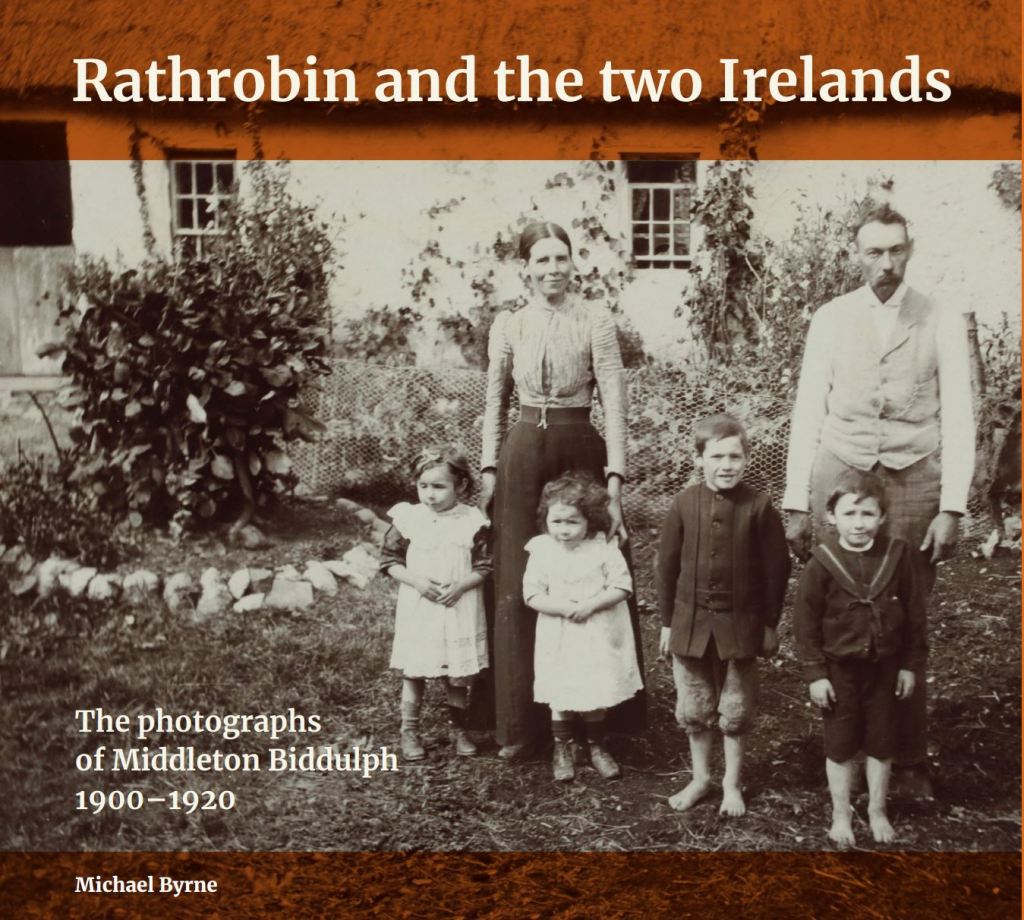
Rathrobin is a book that keeps on giving. Its 250 Biddulph photographs from the 1870s to 1920s, all carefully captioned, depict the two Irelands – unionist and nationalist, Catholic and Protestant, landed and cabbage garden. What is interesting about the pictures of Colonel Biddulph (1849-1926) of Rathrobin near Mountbolus are the nuances. He was of the lesser gentry, was a tenant of the Petty Lansdownes, and was well aware of the Plantations of the 16th and 17th centuries. He appreciated the needs of the farm labourers and was decent to his own tenants, staff and farm workers. His entire estate was not much more than a 1,000 acres. Biddulph’s circle was also the lesser gentry and those who served it such as land agents, bankers and clergy. The Catholic Protestant divide was strong but landed Catholic families did mix in Bidduph’s set, but not merchants or traders (even if very rich). Biddulph had an empathy with his farm workers and their families and sought their advancement. Many local families were photographed, together with the farming activities of his own employees.
Biddulph’s story, and that of his associates and friends, is illustrated by a selection of over 300 pictures in all, of which 250 are from the Biddulph Collection in Offaly Archives, and fifty more to illustrate the introductory essay and provide the all-important context. The essay and the photographs provide a more nuanced understanding of Ireland in the revolutionary period of 1900–23. Biddulph’s wonderful house at Rathrobin that he had so carefully ‘restored’, and all his farm improvements, were lost in the Civil War in 1923. Many other big houses from Ashford, to Ballyfin, Durrow, Brookfield, Screggan Manor and Charleville are also recorded in this volume. Some such as Brockley Park in Laois are now gone thereby making this an important work of record. The photographs by Middleton Biddulph were taken at a crucial moment in Ireland’s history. Their publication now could not come at a better time. Rathrobin is the portrait of one small estate and Killoughy parish in Offaly from the 1650s to the 1920s, but the story is of national interest. T.E. Lawrence spoke of the Arab Revolt, perhaps in Ireland we can talk of the Irish Revolt and not the full circle Revolution. You decide.
Rathrobin was supported by the Decade of Commemorations Unit in the Department of Tourism, Culture, Arts, Gaeltacht, Sport and Media
(more…)
-
Opening of Offaly Archives by Minister Malcolm Noonan, 18 Nov. 2021. Blog No 332, 20 Nov 2021
Offaly History is pleased to announce the opening of Offaly Archives at unit 1F, Cluster Two, Axis Business Park, on Thursday 18 November 2021, by minister of state at the Department of Housing, Local Government and Heritage, Malcolm Noonan.
Offaly History completed the building of its second premises in 2019 to coincide with its 50th anniversary. The new repository is a state-of-the-art archives building managed by a professional archivist, Lisa Shortall, and houses the collections of Offaly History and Offaly County Library. The mix of the voluntary and the public sectors, under professional management, provides a unique blend of enthusiasm, specialist knowledge and continuity that can only enhance Offaly Archives over time.
(more…)
-
Sean Barry: a Volunteer who ‘was in any operation worthwhile in Offaly’, and Three Cheers for Mrs Nurse Barry. By Michael Byrne. Blog No 329, 10th Nov 2021
Some of the more recent contributions to the narrative of the 1912–23 period, such as that of Ferriter and Dolan, have looked at the personal histories of the combatants and less at causation and the course of the military campaign (Hopkinson and Laffan). Others such as Foster (and earlier Thompson) examined the cultural background for what role it played in the mind-set of the young revolutionaries. These approaches can be combined in the context of at least one Tullamore family that of Barry of Earl Street, now O’Moore Street, Tullamore. Here two sons of Richard Barry, Richard jun. and John (Sean) each played a significant role – Richard on the cultural side and Sean as a soldier Volunteer. We will look at Richard’s early years in the cultural movements in Tullamore in a later article.
(more…)
 offalyhistoryblog