A few years back I met up with some members of the Offaly diaspora in the Gresham Hotel, Dublin, for coffee, and we had a reflective chat about the Faithful County. My fellow aficionados were Laura Price and the late Dr. Michael J.S. Egan. Dr. Egan, a truly wonderful Offaly man, raised the idea of marking the termans at Clonmacnoise.
While I had grown up in the area I had never heard the expression. He explained it was the point where funeral corteges paused on the way to the cemetery. I was well aware of the practice, for as a child in the area every funeral paused at what was called the `coffin bush`. I have enquired from local folk and found nobody had used the expression in this context.
Alongside John O’Donovan and Eugene O’Curry the name of George Petrie (1790–1866) will forever be remembered as one of Ireland’s greatest scholars of the first half of the nineteenth century. It was a time when tremendous work was done for Irish archaeology and history. Petrie was a major figure in the historical research section of the Ordnance Survey. Jeanne Sheehy in her The Rediscovery of Ireland’s Past 1830–1930 states that he was the founder of systematic and scientific archaeology in Ireland.
Petrie was involved in the work of the Ordnance Survey from 1833 for ten years. He was very much a polymath and in his late years published a volume of Irish music arising from his efforts to collect and preserve old Irish music.
George Petrie was born in Dublin in 1790 and has a strong King’s/ County Offaly connection through his work at Clonmacnoise, Birr, Banagher, Clonony, Lemanaghan and Rahan. He may have been the most significant topographical artist so far as Offaly is concerned. He was certainly the greatest exponent of the heritage of Clonmacnoise first visiting the site in 1818–22. Dates differ as the visits to Clonmacnoise as was noted in the most attractive publication by Peter Murray and published by the Crawford Gallery in 2004.[1] The other great work on Petrie is that of William Stokes, The life and labours in art and archaeology of George Petrie (Longmans, London, 1868). Also important is Crookshank and Knight of Glin, Irish painters, 1600–1940 (Yale, 2002).
The Dictionary of Irish Biography (DIB) entry by David Cooper records that Petrie, was an artist, antiquary and collector of Irish traditional music, and was born on 1 January 1790 in Dame Street, Dublin, the only child of James Petrie, portrait painter, of Dublin, and Elizabeth Petrie (née Simpson) of Edinburgh, Scotland. James Petrie (d. 1819) was born in Dublin of Scottish parents and studied at the drawing school of the Dublin Society. Afterwards he practised as a miniature painter and a dealer in jewellery, coins, and antique objects at 83 Dame Street. The collecting instinct would stand Irish heritage in good stead with James Petrie’s son George performing an outstanding archival and museum service.
Clonmacnoise and its churches is the subject of a lecture by Con Manning at Offaly History Centre, Bury Quay, Tullamore R35 Y5VO on Monday 14 April 7 30 p.m. Your chance to meet one of the foremost experts on Clonmacnoise – the most important heritage site in County Offaly. So do come all are welcome. Conleth Manning worked for nearly forty years as an archaeologist with the National Monuments Service. During that time he directed excavations at Clonmacnoise as well as at many other monuments around the country. He has a special interest in medieval churches and castles and has published widely on aspects of the medieval and post-medieval periods in Ireland.
The changing face of Offaly towns in the early 1900s: An illustrated history edited by Michael Byrne with contributions from Paul Barber, Stephen Callaghan, Grace Clendennen, Kevin Corrigan, Michael Goodbody, Ger Murphy, John Powell, Laura Price, Ciarán Reilly and Brendan Ryan (Offaly History, Tullamore, 2024, 368 pp). Available from Offaly History Centre and Midland Books Tullamore and online at www.offalyhistory.com. ISBN 978-1-909822-38-2 (hard back), €27.99. The book will be launched at Offaly History Centre, Bury Quay, Tullamore – beside the new Aldi and Old Warehouse. It is already available at the Centre, online at http://www.offalyhistory.com and at Midland Books, Tullamore. If you cannot attend in Tullamore we have a launch at Giltrap’s of Kinnitty on Thursday 21 Nov. at 7. 30 p.m. We will have copies in Bridge Centre for the Christmas Sale 14 to 24 December.
Ted Barrett, one of the pioneers of cruising on the canal, was well aware of its environmental and leisure value. By the late 1960s he was advocating linking the canals with the lakes that might be made from the disused bogs to form a type of Norfolk Broads in Ireland.[1] In this letter of October 1964 he was to show his diplomatic and marketing skills in the course of advocating canal cruising. Barrett was the author of a guide to cruising on the canals.[2] At about the same time as Barrett Harry Egan and Frank Egan of Tullamore had developed a cruiser hire business based at Tullamore Harbour under the name Gay Line Cruisers. Later this was followed by Celtic Canal Cruisers (Mike and Heather Thomas). In fact by mid-1964 things were looking up for the Grand Canal after several years of uncertainty due to the Dublin Corporation proposal to cover over parts of the canal line in Dublin to facilitate sewerage disposal. The IWAI had been formed in 1954 to promote all the waterways but by the 1960s was in the van in protecting the Grand Canal waterway. A branch had been formed in Tullamore with the support of Frank Egan and PV Egan. These men went on to establish Gay Line Cruisers, based in Tullamore, and got involved in boat building. 1964 was also the year in which Brendan Smyth (d. 2021) of Banagher started his Silver Line Cruisers business – now one of the most successful on the Shannon and led by his children Barbara and Morgan. By 1991 up to nine hire cruise firms were offering almost 400 cruisers for self-drive, mostly on the River Shannon.
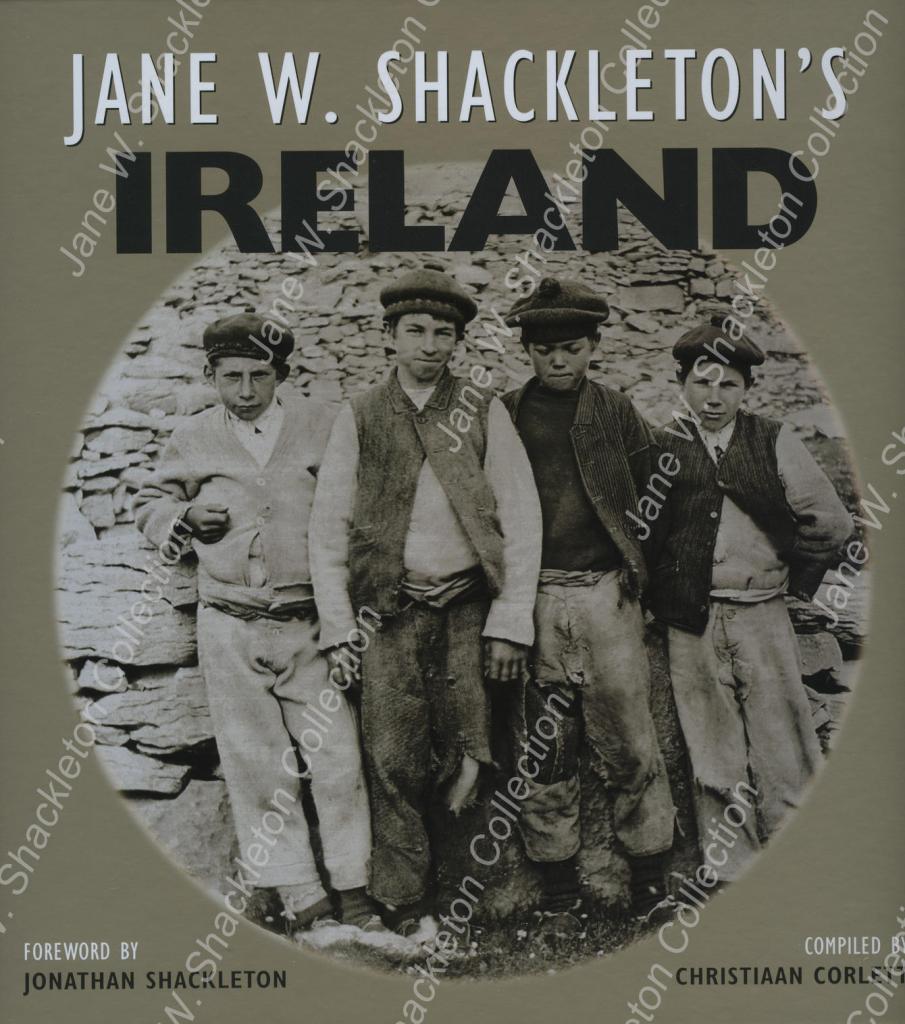
Jane W. Shackleton’s Ireland compiled by Christiaan Corlett (Cork, 2012) is an attractive large format publication was issued by Collins Press and consists of 180 well produced photographs by Jane Shackleton. These pictures are important for the photographic record in County Offaly and mostly date to 1894.
Not surprisingly there are many pictures of mills in this book and there are about ten pictures of Offaly interest. Jane Shackleton started taking pictures in the 1880s and made several tours on the Shannon and along the Grand Canal and Barrow lines. These waterways photographs contribute greatly to the history of the canals and the great mills which were associated with river locations. Many of these were in fact owned by Quaker industrialists. Like other interested women of the period Jane Shackleton was a member of the Royal Society of Antiquaries (RSAI) and took photographs of some of their tours including that of June 1904 around Ireland. Midleton Biddulph, the amateur photographer and retired army officer of Rathrobin near Tullamore was also on this trip and some of his pictures survive and have been published as Rathrobin and the two Irelands; the photographs of Middleton Westenra Biddulph, 1900–1920 (Tullamore, 2021). Corlett informs us that the Shackleton collection consists of 1,000 lantern slides and 44 albums containing several thousand prints, mostly of Irish subjects. This writer had the pleasure of seeing some of the Grand Canal and the turf works at Pollagh back in the early 1970s with Richard Shackleton and Jonathan Shackleton.
The pioneering travel book on the Irish canals was Green and Silver (London, 1949) by L.T.C. Rolt. Tom Rolt made his voyage of discovery by motor cruiser in 1946 along the course of the Grand Canal, the Royal Canal and the Shannon navigation from Boyne to Limerick. The Delanys writing in 1966, considered Rolt’s book to be the most comprehensive dealing with the inland waterways of Ireland. [1] In this extract Banagher gets a severe press very unlike the optimism of the 1890-1914 period and again in the 1960s. Banagher also got a severe jolt post 2008. Things are now improving with sunlit uplands breaking through.
Moving off to Shannon Harbour Rolt got sight of the many arched bridges at Shannon Bridge and passed beneath the swinging span. See last week’s blog by Donal Boland covering the same trip in 2023 as far as Tullamore.
Shannon Harbour with the police barracks and the collector’s/agent’s house.
“Just below, was the Grand Canal depot with a canal boat lying alongside the quay. Opposite, and commanding the bridge was a gloomy fortress backed by a defensive wall of formidable proportions which extended westward like a grey comb along the crest of yet another of the green esker ridges. It was a symbol of the more peaceful times that have now come to the Shannon that, according to the signs displayed, part of the fortress had now become a village shop and bar.”[2]
The pioneering travel book on the Irish canals was Green and Silver (London, 1949) by L.T.C. Rolt (1910–74). Tom Rolt made his voyage of discovery by motor cruiser in 1946 along the course of the Grand Canal, the Royal Canal (fully open from Mullingar to the Shannon, until 1955 and thereafter from 2010), and the Shannon navigation from Boyne to Limerick (happily now navigable up to Lough Erne). The Delanys writing in 1966, considered Rolt’s book to be the most comprehensive dealing with the inland waterways of Ireland.[1]
During the 1940s, and up to the early 1970s the canal candle was flickering but was kept burning by enthusiasts in England and in Ireland. Among these were the late Vincent Delany and Ruth Delany whose book on the Irish Canals in 1966 was a seminal work. As pointed out in the Irish Times in November 1993 Ruth Delany is the most prolific author on the subject of the Irish canals and herself acknowledges that Green and Silver had a profound influence on her. Other writers were Hugh Malet and Colonel Harry Rice – the latter largely founded the Inland Waterways Association. In 1973 Ruth Delany extended the 1966 book with a full-scale study of the Grand Canal which was reissued in 1995 with an update on the previous twenty years.
Tom Rolt was born in Chester in 1910 and after working in engineering and with vintage cars he became a full-time writer in 1939. Some of his many books are shown in the attached illustrations while ‘his biographies of great engineers, such as Isambard Kingdom Brunel (1806-1859), are still highly regarded. As a campaigner, activist and champion of industrial heritage Rolt is best known for his involvement with the Inland Waterways Association, the Talyllyn Railway Preservation Society, the Newcomen Society, and the Association of Industrial Archaeology.’[2] On his marriage in 1939 to Angela Orred, daughter of a retired army major. They went to live on his house boat Cressy and in 1944 published Narrow Boat, a passionate evocation of the British canals and those who worked on them. His wife left him in 1951 to join the Billy Smart circus. Two very focused people.
It was 2003 when the first issue of Offaly Heritage was published. Just twenty years later the twelfth book of essays will be issued by Offaly History on 6 October 2023 at the Offaly History Centre at 6 p.m. and launched by a son of Tullamore, Terry Clavin. Terry is a distinguished historian who works with the Royal Irish Academy and has contributed over 400 biographies to the Academy’s Dictionary of Irish Biography. This is now available online and is a tremendous resource with about 11,000 biographies and eleven published volumes in the main series with a significant number of ancillary publications.
Offaly Heritage 12 is another bumper issue with over 500 pages and very much on a par in quality with the issues since no. 9 was published in 2016. It is a tremendous achievement and, no doubt, benefits from the support of the programme for the Decade of Centenaries and Offaly County Council.
For this issue there was a team of editors – Michael Byrne, Dr Mary Jane Fox, Dr Ciarán McCabe, Dr Ciarán Reilly, Lisa Shortall. Obituaries Editor: Kevin Corrigan.
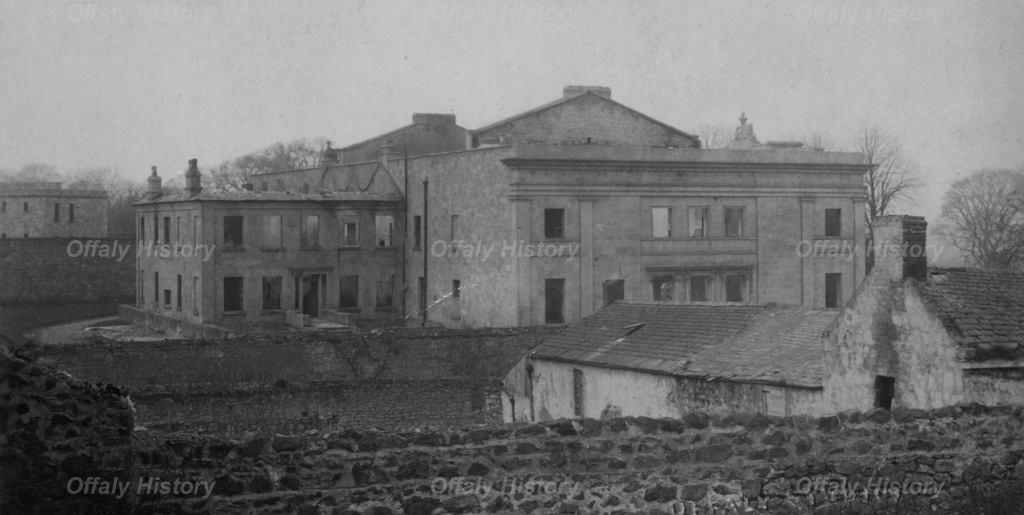
The shell of the county courthouse, July 1922
The essays in section one reflect the ongoing research in Offaly into aspect of life in Ireland 100 years ago as we come to the end of the Decade of Commemoration (1912–1923). The essays reflect the changing nature of society in Offaly at that time, particularly during the years 1920 to 1923 and readers will enjoy contributions as varied as the end of the Wakely family of Rhode; the final years of the Leinster Regiment at Birr; the Protestant minority in Offaly during the revolutionary period; the courts of assize in King’s County in the years 1914–21; the burning of Tullamore courthouse, jail and barracks in 1922; the story of Belgian refugees in Portarlington, and Offaly claimants in 1916.
A series of short lives are presented in this volume, as they were in Offaly 11 and includes entries on individuals as diverse as J.L. Stirling, Averil Deverell, Middleton Biddulph, Robert Goodbody and volunteer Sean Barry.



 offalyhistoryblog