
The changing face of Offaly towns in the early 1900s: An illustrated history edited by Michael Byrne with contributions from Paul Barber, Stephen Callaghan, Grace Clendennen, Kevin Corrigan, Michael Goodbody, Ger Murphy, John Powell, Laura Price, Ciarán Reilly and Brendan Ryan (Offaly History, Tullamore, 2024, 368 pp). Available from Offaly History Centre and Midland Books Tullamore and online at www.offalyhistory.com. ISBN 978-1-909822-38-2 (hard back), €27.99. The book will be launched at Offaly History Centre, Bury Quay, Tullamore – beside the new Aldi and Old Warehouse. It is already available at the Centre, online at http://www.offalyhistory.com and at Midland Books, Tullamore. If you cannot attend in Tullamore we have a launch at Giltrap’s of Kinnitty on Thursday 21 Nov. at 7. 30 p.m. We will have copies in Bridge Centre for the Christmas Sale 14 to 24 December.
(more…)Category: Clonony
-
Memories of Offaly: celebrating the mix of rural and urban life in the 1960s and 1970s by Killina, Rahan man Aidan Grennan. Blog No 667, 6th Nov 2024
Memories of Offaly can best be described as opening a diary into life in Co Offaly, over the last 50 or 60 years. The author of the book is Aidan Grennan, from Killina, Rahan. Aidan is to be congratulated on his second book. Both books are available from Offaly History Centre and online at http://www.offalyhistory.com
‘It is a nostalgic glimpse into the people and events in the county within my own life-time’ said Aidan. He commented: ‘I think it’s important now and then, to take a look-back over the years. I love nostalgia’, though we have to live in the present.
(more…)
-
61 Cruising on Grand Canal sixty years ago: Thanks from E.C. Barrett of Joy Line Cruisers reporting on the year 1964 season. No. 61 in the Grand Canal Offaly series. Blog No 621, 12th June 2024

Ted Barrett, one of the pioneers of cruising on the canal, was well aware of its environmental and leisure value. By the late 1960s he was advocating linking the canals with the lakes that might be made from the disused bogs to form a type of Norfolk Broads in Ireland.[1] In this letter of October 1964 he was to show his diplomatic and marketing skills in the course of advocating canal cruising. Barrett was the author of a guide to cruising on the canals.[2] At about the same time as Barrett Harry Egan and Frank Egan of Tullamore had developed a cruiser hire business based at Tullamore Harbour under the name Gay Line Cruisers. Later this was followed by Celtic Canal Cruisers (Mike and Heather Thomas). In fact by mid-1964 things were looking up for the Grand Canal after several years of uncertainty due to the Dublin Corporation proposal to cover over parts of the canal line in Dublin to facilitate sewerage disposal. The IWAI had been formed in 1954 to promote all the waterways but by the 1960s was in the van in protecting the Grand Canal waterway. A branch had been formed in Tullamore with the support of Frank Egan and PV Egan. These men went on to establish Gay Line Cruisers, based in Tullamore, and got involved in boat building. 1964 was also the year in which Brendan Smyth (d. 2021) of Banagher started his Silver Line Cruisers business – now one of the most successful on the Shannon and led by his children Barbara and Morgan. By 1991 up to nine hire cruise firms were offering almost 400 cruisers for self-drive, mostly on the River Shannon.
To return to Ted Barrett’s letter:
(more…)
-
50-51, Grand Canal Townlands East to West: Derries to Glyn No 50-51 in the Grand Canal Offaly Series. By Philomena Bracken, Offaly History. Blog No 606, 27th April 2024
With the construction of the Grand Canal from the late 1750s, brought with it the expansion of Trade. goods could be carried from East to West along the line, this helped boost the development of the local economy from the late 18th century. The Offaly section of the canal runs approximately 42 miles and is home to a number of species and wild plants, due to the cross over through wet bog land during the development of the canal way[1].
The first townland we come to along this way is Derries. It is situated in the Electoral Division of Ferbane, in the Civil Parish of Wheery or Killagally, in the Barony of Garrycastle, in the County of Offaly. The Irish name for Derries is Na Doirí meaning The Oak Woods.

Derries townland map. Image Source: Townlands.ie / Illustrations Nature on Irish Canals by Paul Francis Wheery or Killagally is a large civil parish and it extends about 7 miles from Pollagh Village.
(more…)
-
6-10 The Grand Extension, Shannon Harbour to Tullamore. A Journey in August 2023. By Donal Boland. Nos 6-10 in the Grand Canal Offaly series. Blog No 564,13th Jan 2024
A singlehanded trip from the River Shannon to the town of Tullamore along the western section of the Grand Canal was conducted by the writer over seven days in August, 2023. The trip was conducted aboard the heritage vessel Bomb Scow a converted thirty-three foot Royal Navy seaplane tender. Our thanks to Donal Boland for this comprehensive overview of the Brosna Line, Shannon Harbour to Tullamore which is better presented as one extensive with its helpful picture coverage. This comprises articles 6 to 10 in the series on Grand Canal Offaly.

Content
- Overview
- Entrance from the River Shannon
- First Lock Number 36
- Lock 36 to 35
- Lock 35 to 34 Shannon harbour
- Lock 34 to 33 Clonony Barracks
- Lock 33 Belmont…
- Belmont to Tullamore
- Memories
Appendix 1: Hull and Spoke Concept
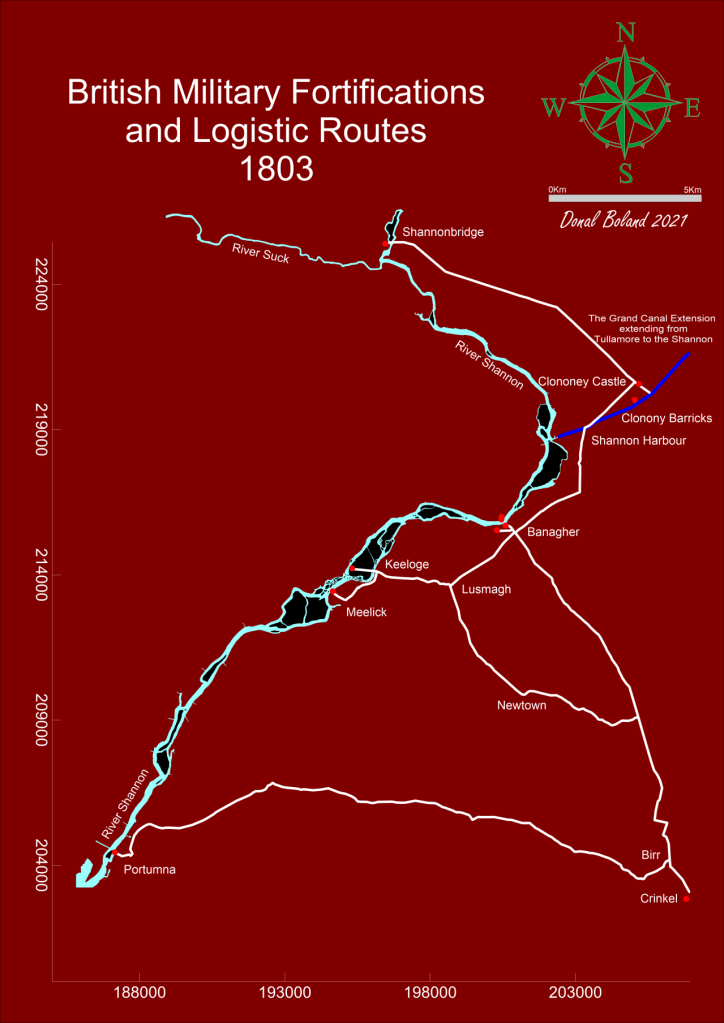
Appendix 2: The Napoleonic Aspect
1. Overview
A singlehanded trip from the River Shannon to the town of Tullamore along the western section of the Grand Canal was conducted by the writer over seven days in August, 2023. The trip was conducted aboard the heritage vessel Bomb Scow a converted thirty-three foot Royal Navy seaplane tender.
The trip, was a fact-finding event to record the on-water experience as part of an initiative to highlight the possibility of attracting more visitors to this section of the canal. Described here as The Grand Extension, previous research had revealed its construction was later than the eastern section of the canal and forming part of the British Militaries Napoleonic defensive network.
The route commenced in the west on the callow fringed landscape of the River Shannon, travelling through boglands on a raised section of the canal and terminating to the east in an Esker dominated upland landscape, encountering the villages of Shannon Harbour, Belmont, Ferbane, Pollagh, Rahan and the town of Tullamore.
The Stllwater Navigation extending for a distance of twenty two miles and rising some ninty feet is comprised historically of the waterway, ten locks, twenty bridges, eighteen aquaducts, four feeders and four spillways. Presently the waterway is managed by four lock keepers or waterway patrollers with overlapping areas of responsibility, who operate the lock systems and control the sections water levels.
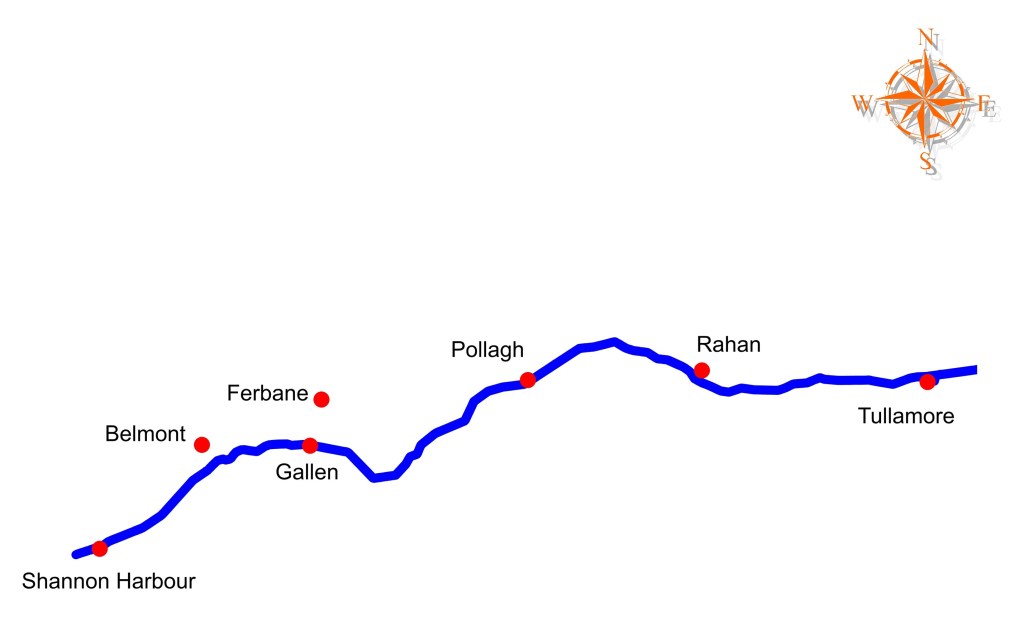

The Grand Extension, Town and Villages The heritage vessel Bomb Scow moored on The Grand Extension 2. Entrance from the River Shannon
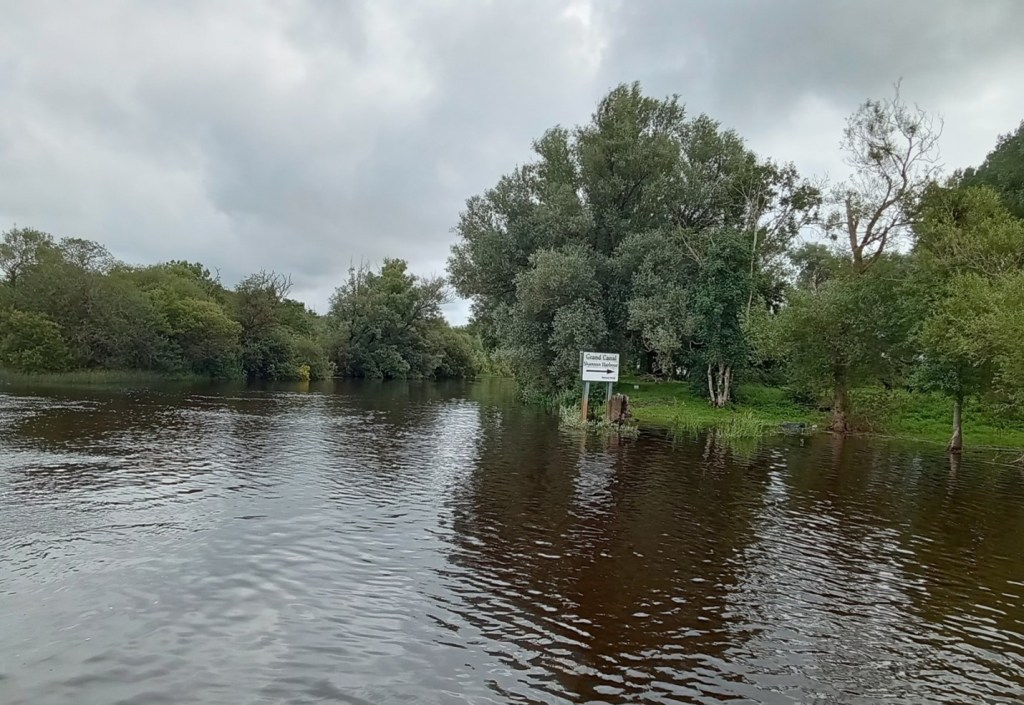
The Stillwater navigation of The Grand Extension is accessed from the River Shannon by way of the Brosna River and its confluence with the Shannon. This entrance is characterised by magnificent over-hanging foliage to the north and earthen banks associated with the canal’s construction to the south. An isolated, derelict bridge-keeper’s cottage that stands on Bullock Island is passed as you enter the River Brosna waterway.
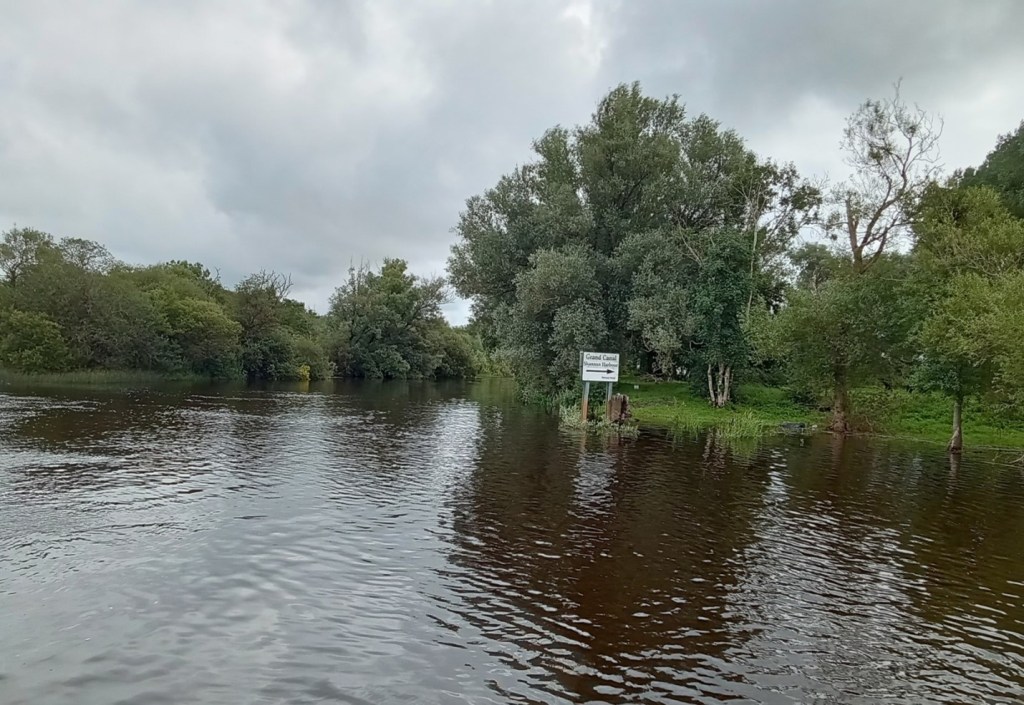
The confluence of the River Brosna waterway with the River Shannon
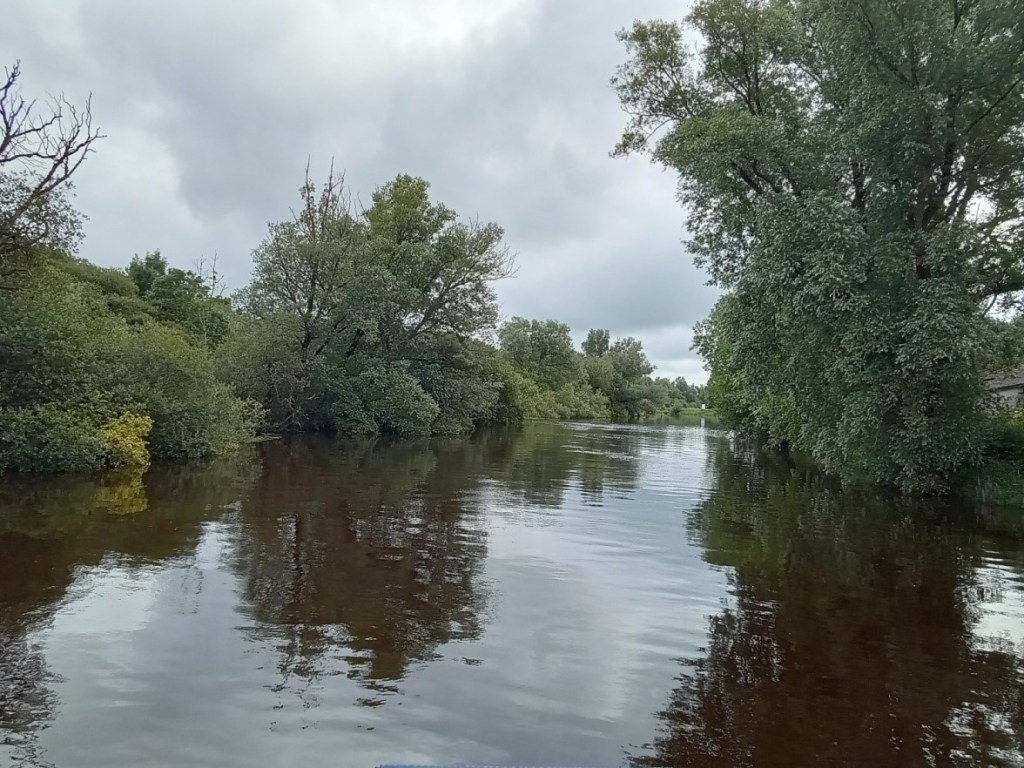
The River Brosna waterway

The confluence of the River Brosna Waterway and The Grand Extension
3. Lock Number 36
Lock 36 is the final, lowest lock on the Grand Canal system and the first lock you meet when arriving from the River Shannon. A long, floating jetty stands on the southern bank immediately below the lock, providing access to land by way of a large sloping ramp. The lock constructed of cut-stone is entered via wooden balanced, hanging gates that incorporate water control sluices, operated by the lock keeper utilising a rack and pinion mechanism mounted on the gates topside. The gates are opened and closed by way of the long balance beam that extends from each gate.
An engraved stone plaque mounted on the north wall of the lock, details the construction and features of the extension.


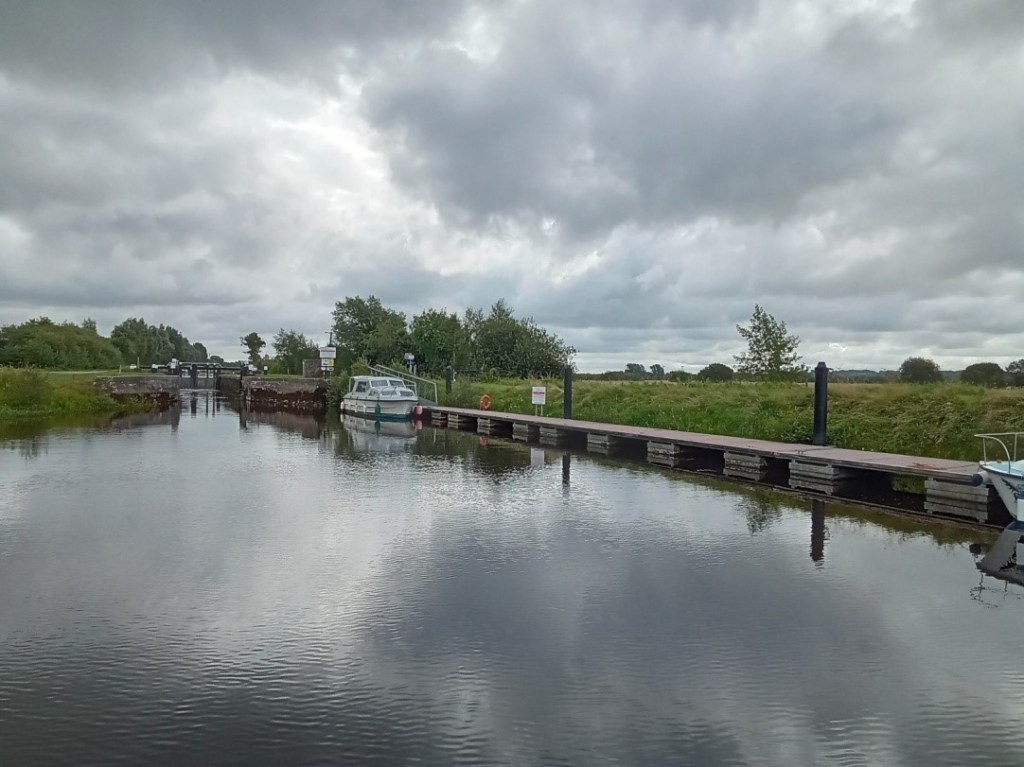
The entrance to Lock 36 and its large waiting jetty 
The empty cut-stone lock chamber and wooden gates

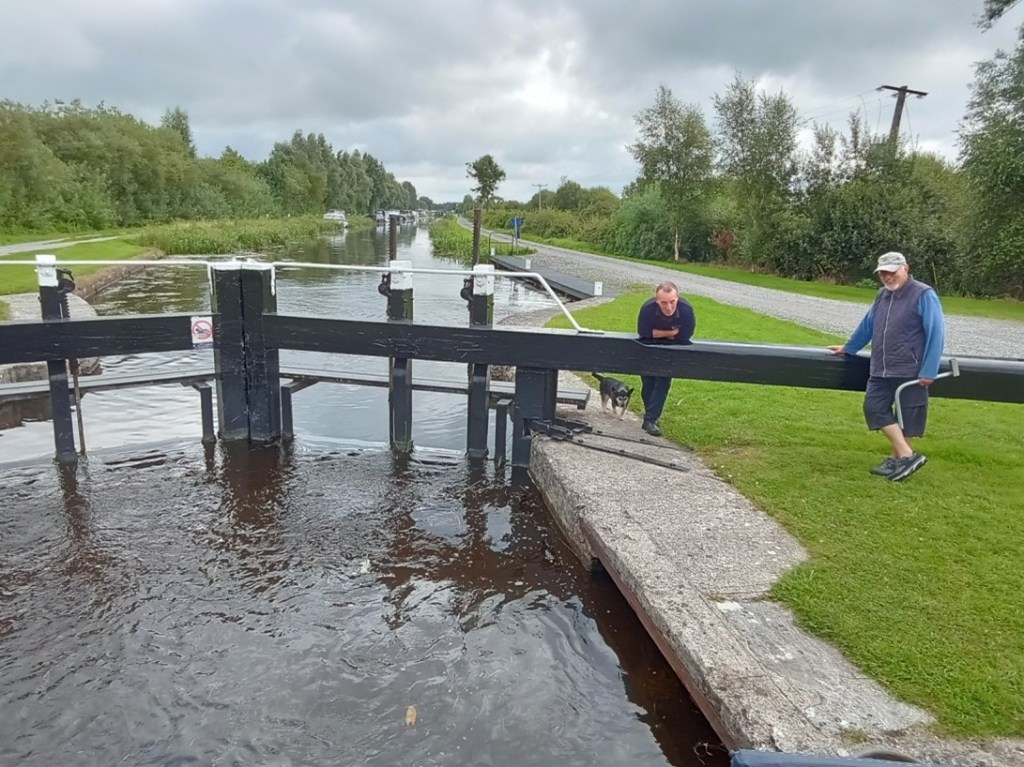
The full lock chamber and upper-gates 
The upper lock gates opened and the ever-attendant lock keeper
4. Lock 36 to 35
This short section of the canal provides an initial experience and understanding of the Stillwater navigation. It is many times narrower than the River Shannon with a defined navigation path bordered by moored vessels to the north and a rich reed-based ecosystem to the south.

Entering the first section of The Grand Extension

The short canal section extending from Lock 36 to Lock 35

Lock 35
5. Lock 35 to 34
The second, Lock 35 on the system, provides access from the first level up to the second level which is comprised of Shannon Harbour, Griffith and Clonony bridges and a section of canal extending to the thirty fourth lock that contains numerous moored vessels for most of its length The waterway beyond the moored vessels starts to provide an understanding of the true characteristics of this Stillwater navigation.
A feature of this canal is the construction of bridges and locks immediately adjacent to one another, this allowed for the transfer of horses (which were originally employed to pull barges along the navigation) from one towpath to the other.

Entering Shannon Harbour
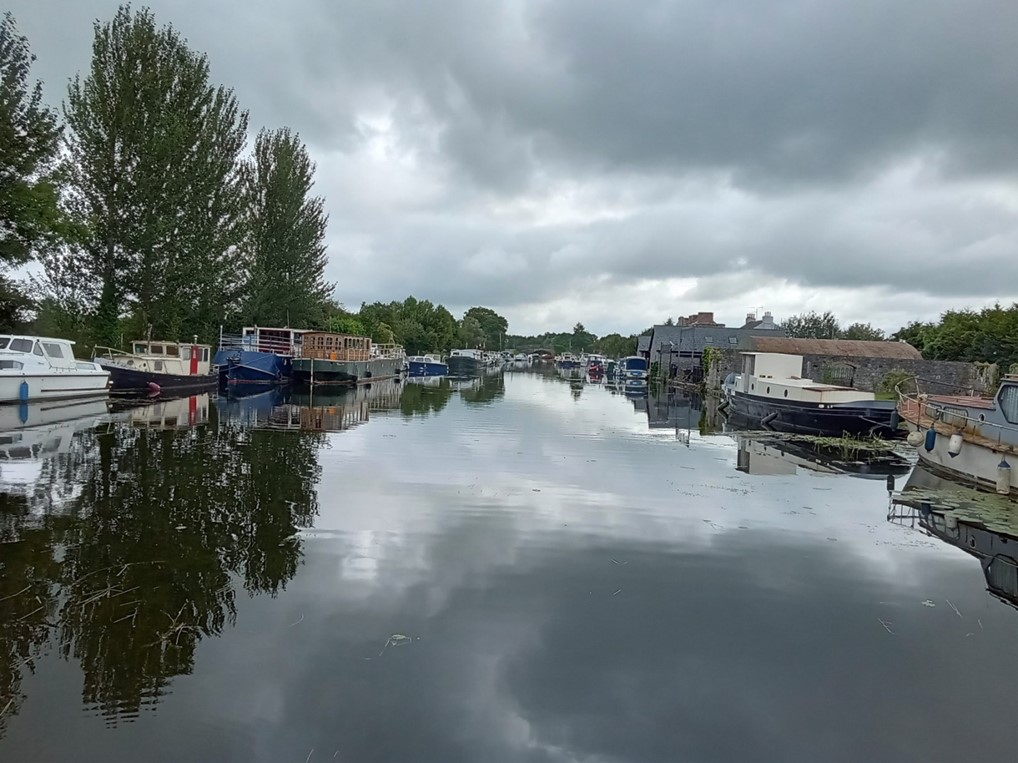
Shannon Harbour
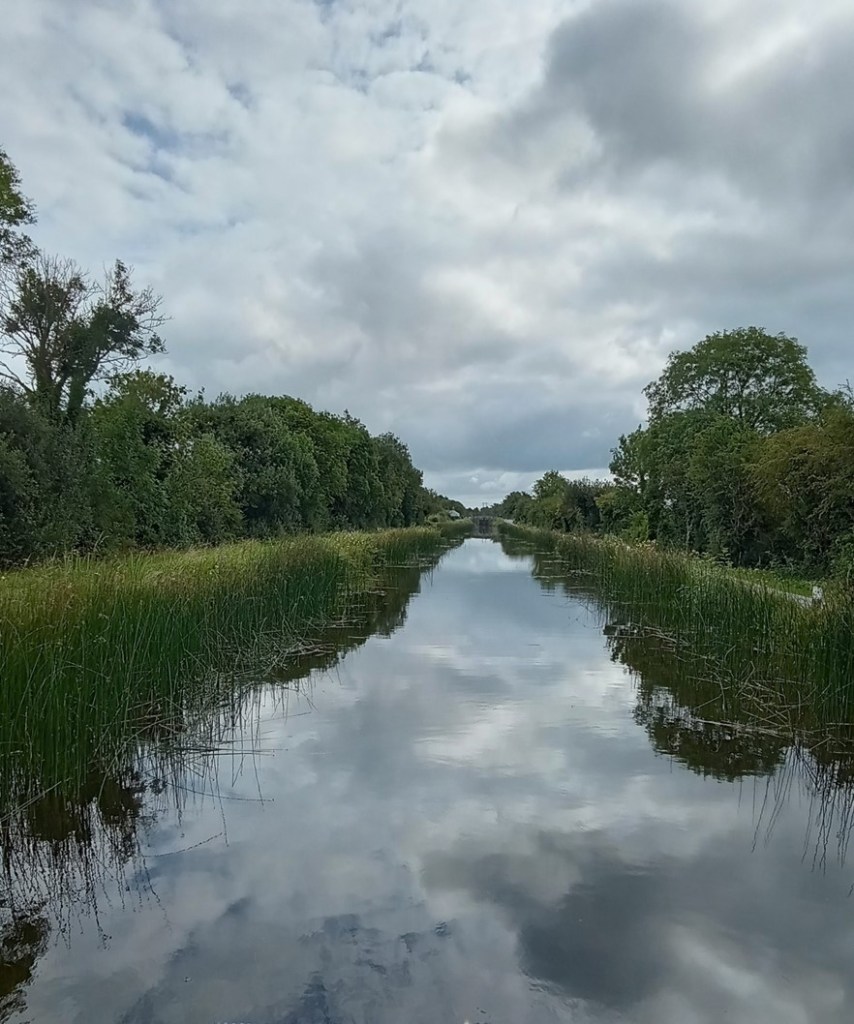
The canal extending to Clonony Bridge and Lock 34
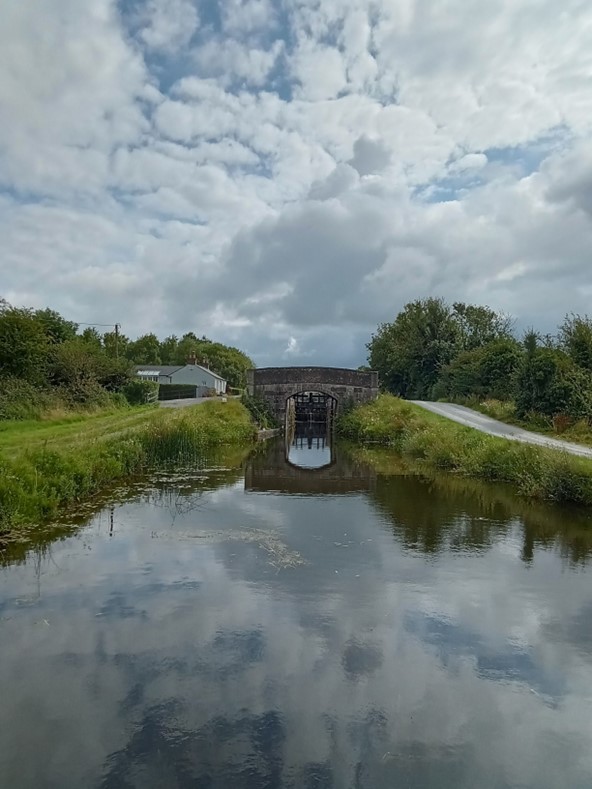
Clonony Bridge and Lock 34
6. Lock 34 to 33The section of canal east of Lock 34 is best described as the military section as along its northern bank lies the remains of Clonony Military Barracks – most likely the military destination of the canal and the reason it was constructed swiftly. The military grounds are defined to the west by a wooden fence and metal gate and to the east by a long roadside timber fence. The towpath within the military grounds is substantially wider encompassing a lay-by or mooring area. Immediately east of the military grounds lies L’Estrange Bridge and Quay which was utilised by the L’Estrange family for commercial purposes possibly associated with the barracks.
The canal beyond L’Estrange Bridge and Quay displays its mature natural character as a tranquil linear still-waterway navigation mostly devoid of habitation and humanity broken only by the arrival of Belmont Mill.


The Eastern and Western boundaries of the Military Lands
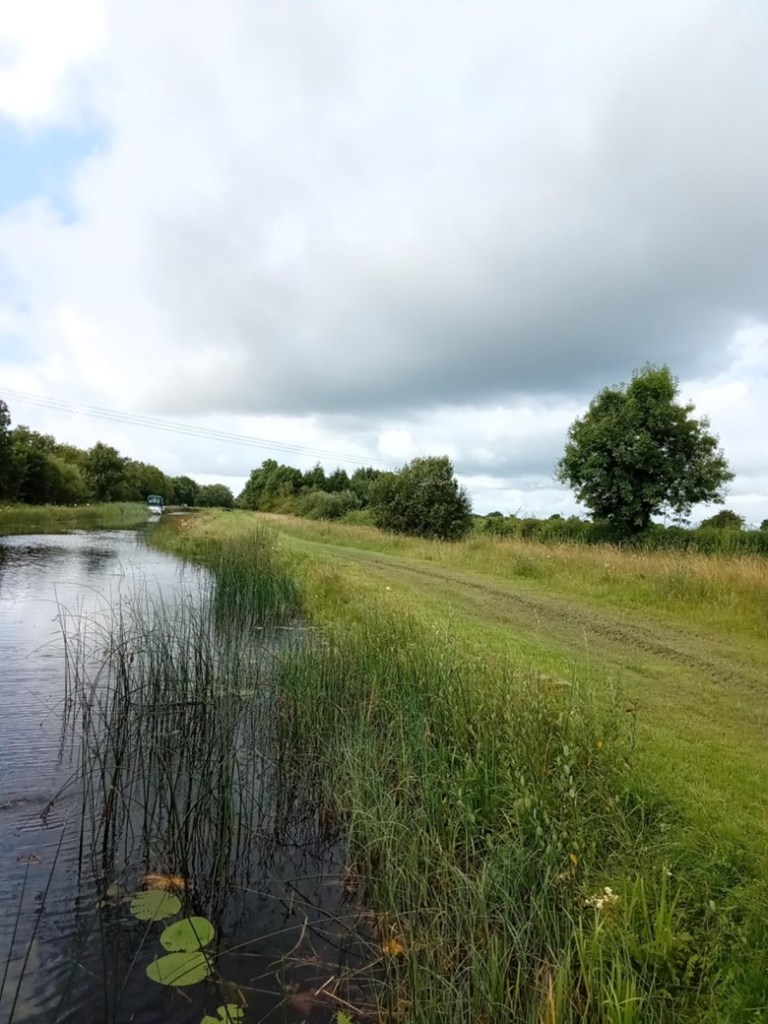
The lay-by and broader towpath within the Military Grounds

L’Estrange Bridge / Quay and Belmont Store
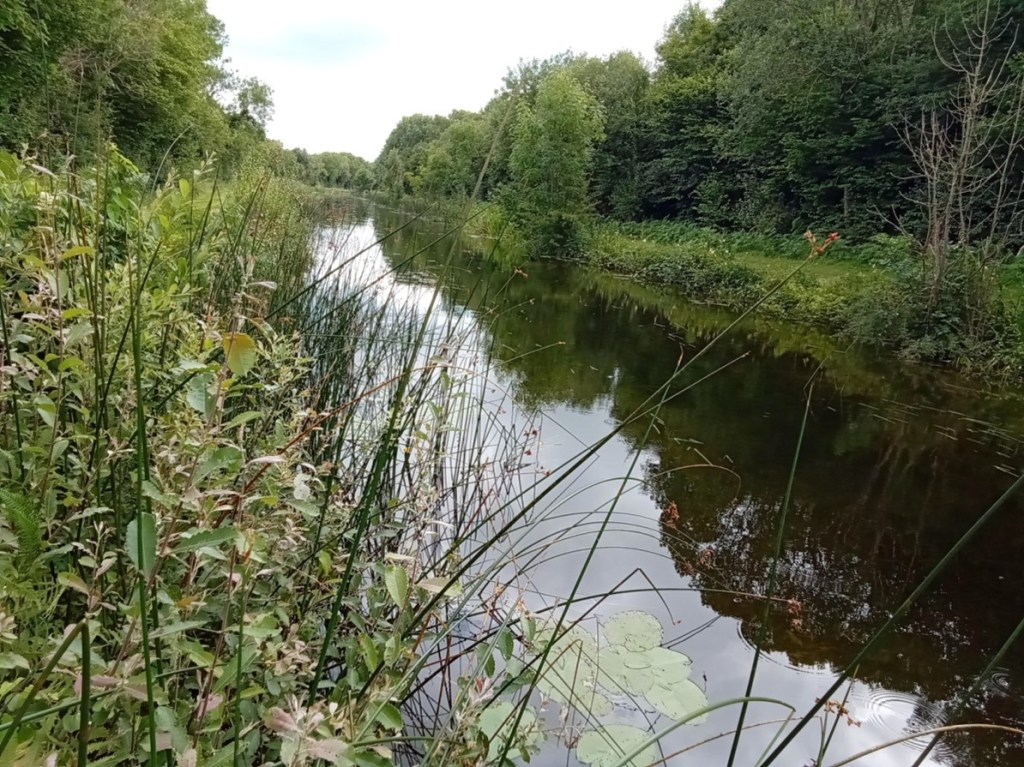
The magnificent natural features of The Grand Extension
7. Lock 33
Lock 33 or Belmont Lock is the only double lock on the Grand Extension. A double lock is constructed when a high lift is required at a location. The standard lift for locks on the canal is circa eight feet while the lift a Belmont Lock is some fifteen feet. Transiting this lock is a delightful experience hard to describe and best experienced.

Belmont Mill and Lock

Lock 33 at Belmont
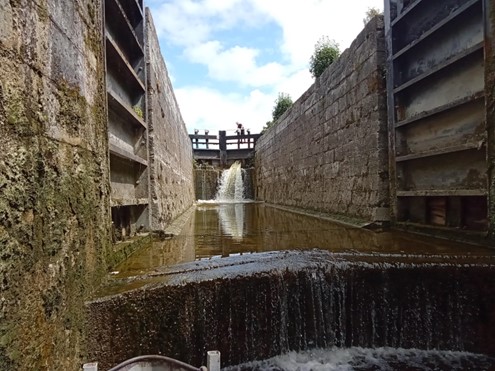
Filling the lower level 
Filling and emerging from the upper level
8. Belmont to TullamoreThe canal extending east from Belmont Lock to Tullamore is best described as isolated continuous delightful for some and a horror for others. The mind may transition into a relaxed static state imbibing the natural landscape and the activities of inhabiting creatures or one may be bored to insanity. The architecture of the locks, bridges and associated buildings coupled with the relatively unchanged landscape propels one back in time to the period of the canal’s construction in the early eighteen hundreds. This relaxation is interspersed by interludes of surprise and delight when a bridge is encountered and frantic activity when locking from one level to another. The villages of Gallen/Ferbane, Pollagh and Rahan when encountered are a connection with present times providing basic mooring facilities. The town of Tullamore provides an opportunity for the replenishment of supplies and the possibility of fresh water. The facilities available to the canal traveller are sparse and presently reflect the industrial era of canal usage.

A simple water tap

The continuous Stillwater Navigation

A canal bridge endowed with generations of growth

Bell’s Bridge and Lock 32

Gallen Village, bridge and rest area
Gallen Village bankside mooring area

Pollagh Village and Canal-Side facilities 
Lock 31
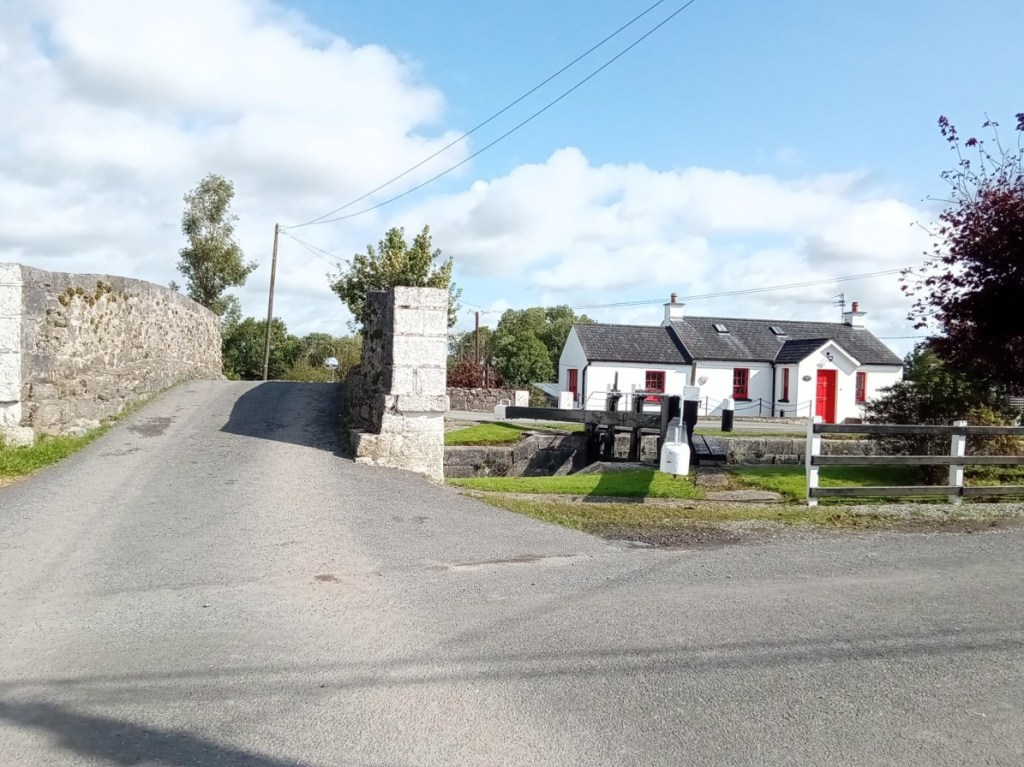
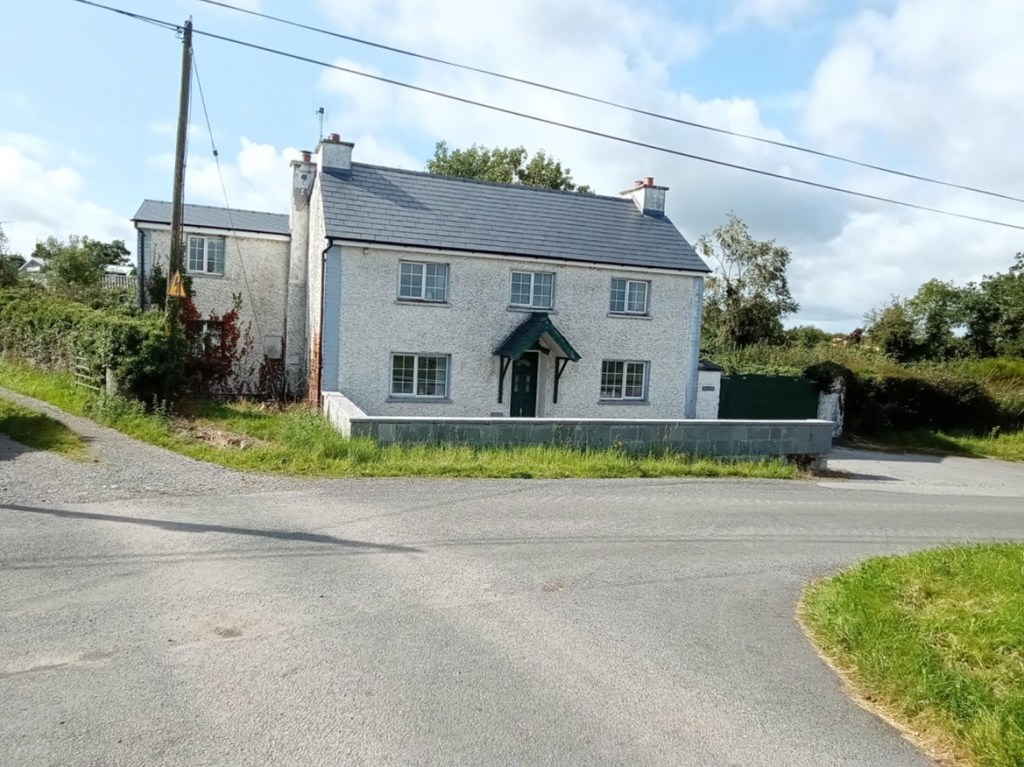
Lock 30 and the canal manager’s house.

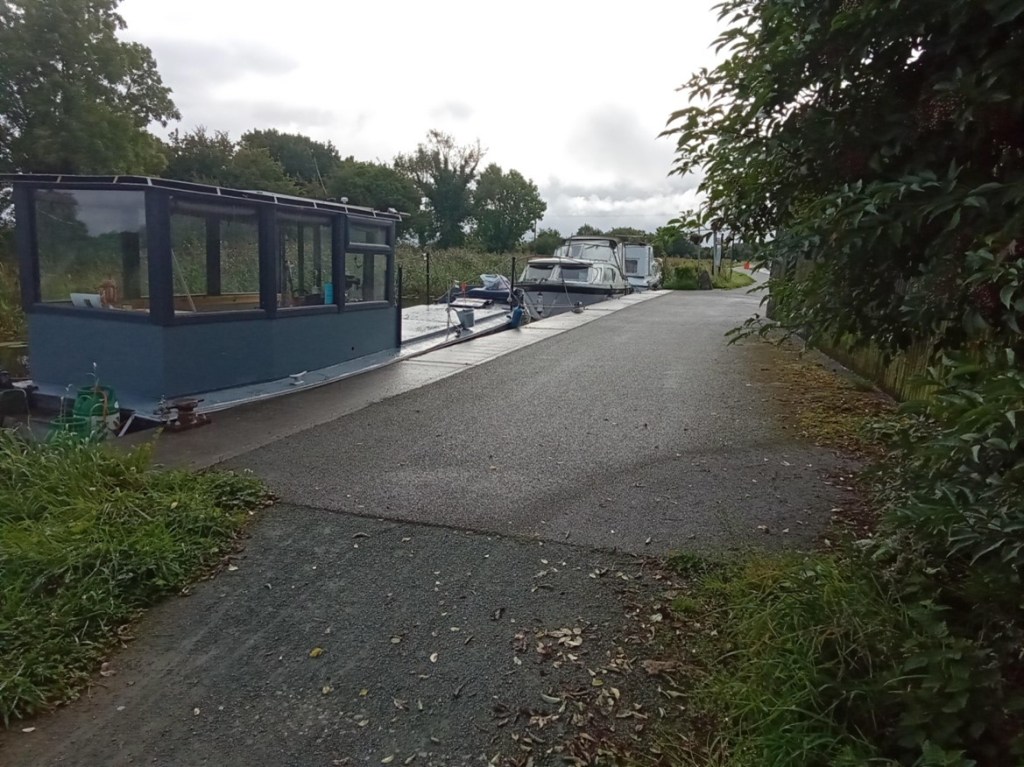
The canal-side facilities at Rahan Village and the Thatch pub – a former Williams branch shop

Ballycowan Castle of 1626 and beside it the Huband aqueduct dated to 1803. Huband was a barrister and a director of the Canal Company from 1777 for most of the years to 1835. 
Srah Castle, Bridge and and the railway bridge
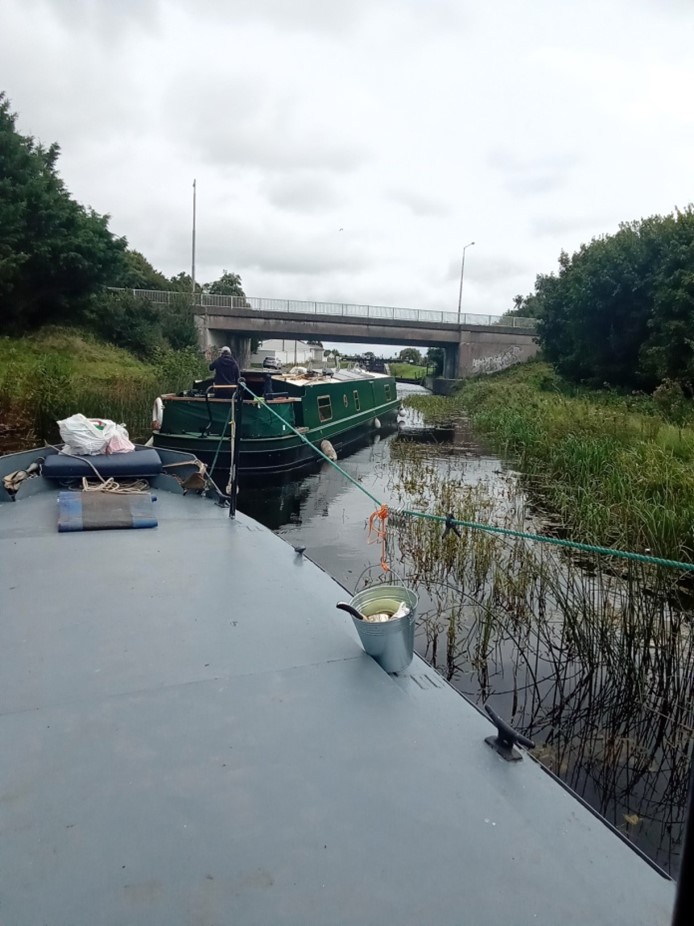
Sragh Bridge and Lock 28
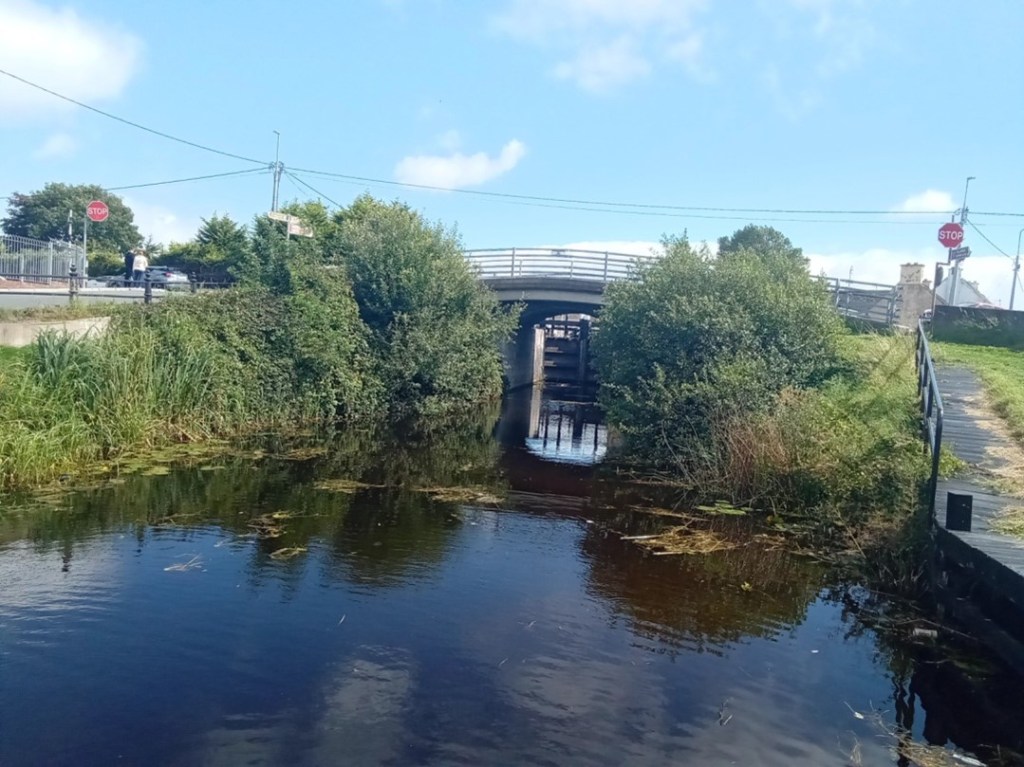
Entering Tullamore at the Clara Road Lock 29
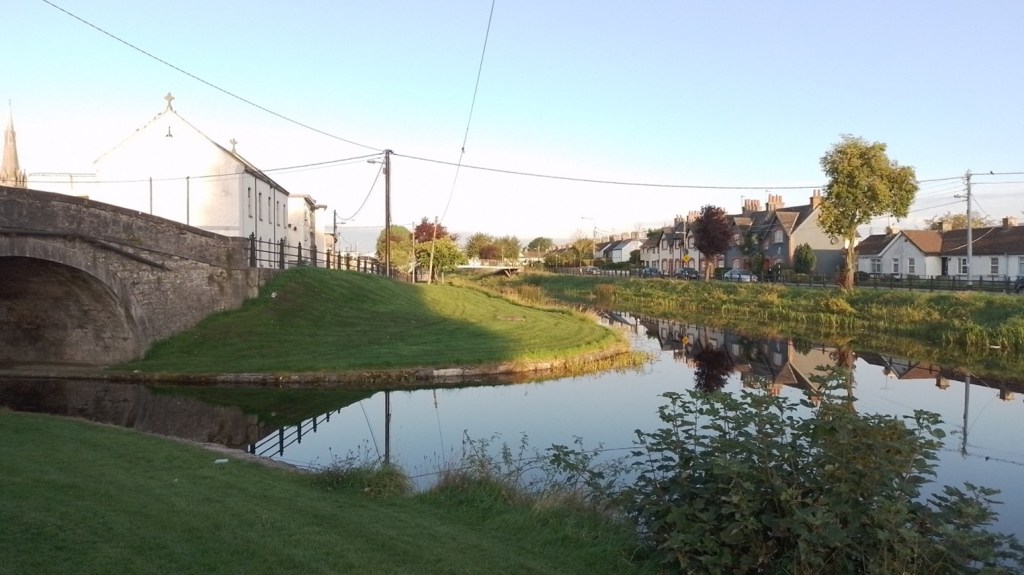
The spur from the canal main line to Tullamore Harbour

The canal side facilities in Tullamore Town
9. Memories
Memories of this trip are especially positive
- The waterway was weed free with a good water level
- The courtesy and efficiency of the water patrollers was first class
- The lock landings were in a good condition
- The lock operating systems all worked well
- The lock surrounds were neat and well maintained
- The lock keeper’s cottages were a joy to behold
- Canal-side moorings and services were adequate and of their time
Appendix 1: The Hull and Spoke Concept

Appendix 2: The Napoleonic Aspect
Donal Boland
The James & Mary Barge
Rodgers Lane, Shannon Road
Portumna, H53 K5C6
-
Hollow House, Tinnycross, Tullamore: from fortified planter’s home to scenic gardens. By Aisling Walsh. Blog No 489, 13th May 2023
The site on which Hollow House can be found on is one that has changed and adapted throughout its time starting in the 17th century. The first sign of life in the area is the bawn wall for the residence that was said to be “built by de Renzi” it can be assumed that there was a castle on the site because of an ordnance survey stating ‘Castle in ruins’. It is certain that they were living incredibly comfortably for the time because of their previous home in Clonony castle for eight years from 1612 to1620 before leaving and eventually buying the land where Hollow House stands today. The bawn and circular towers found in the area were originally built with defence in mind, as time passed their use became more domestic. The towers were repurposed as pigeon towers.
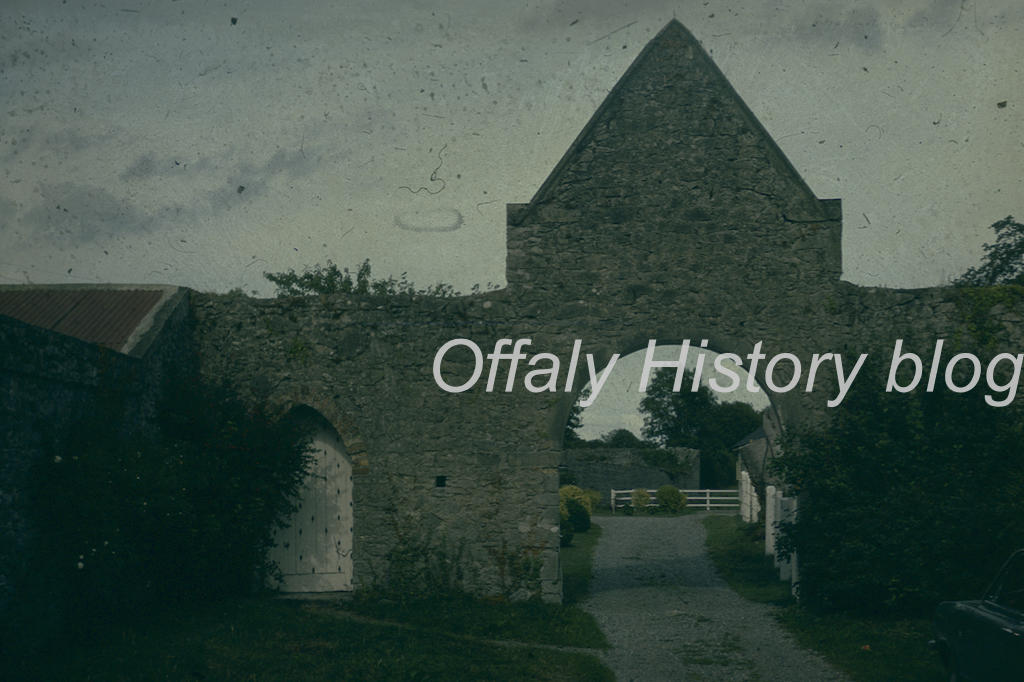
Remaining part of the bawn wall from the outside
The gardens at Hollow House have been described as early-eighteenth century by Maurice Craig and William Garner but the 1838 ordnance survey of Tinnycross seems to confirm no such gardens are depicted. However, the same survey also left out a large lake near Birr castle so it is still possible that the features were simply left out for some reason or another. This same issue presents itself with putting a date on the creation of the decorative pond in the garden as it first appears in a 1910 ordnance survey of Tinnycross, but since the 1838 survey may be unreliable, it is uncertain when the pond was actually built. The farmyard beside the house shows signs of being built in the mid-late 1800s, the largest building has a corner slab with the year 1863 seen on the wall. The pond in the garden includes two stone structures built in three tiers of oddly shaped limestone rocks, the gaps in these stones were more than likely used by water fowl as a shelter. These structures were decorative pieces more than anything, it is unfortunate to note that one of these structures was destroyed by a falling tree in recent years, the stones from the structure remain in the place where it once stood.
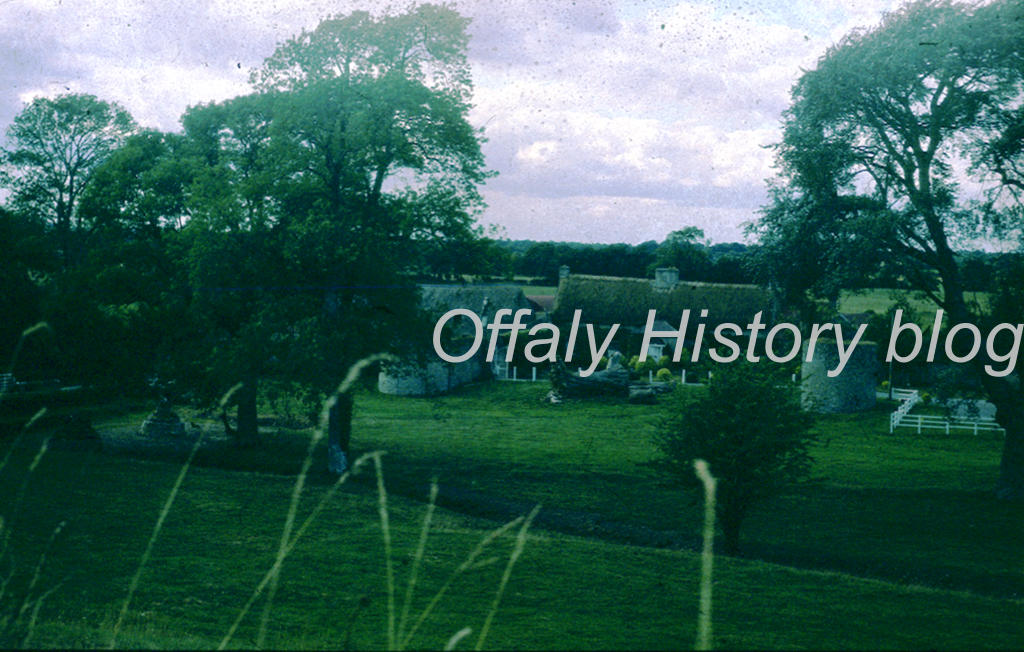
Long shot of the gardens, house, pond and turrets at Hollow House,
Sir Matthew De Renzy (1577-1634) was born in Cologne, Germany. It must be noted that the surname de Renzy has been spelt de Renzi or de Renci and these spellings were used interchangeably on different documents. He became a cloth merchant in Antwerp, one of many merchants who held control over the trade in the city, this fell apart due to a decline in trade in the area which was caused by a conflict between the Dutch United Provinces and the ruling Spanish Hapsburgs which led him to move to London in 1604, he found himself in financial difficulty in early 1606 and when he was unable to recover enough money from merchants who owed him, he was then declared bankrupt. With his creditors were pursuing him so he fled rapidly to Ireland via Scotland arriving in Dublin in August, without a penny to his name.
His main ambition upon arrival was to obtain land and he understood that to achieve this successfully he would need friends in high places. He made many good contacts in Dublin and further afield including Sir Arthur Chichester, then Lord Deputy of Ireland. As a polyglot he was fluent in Latin, Italian, English, German, French and Spanish and set about learning Irish he learned both spoken and colloquial Irish from Conchubhar and Tadhg Mac Daire MacBruaideadh he also learned classical Irish in Sligo from Tadhg Ó hUiginn so that he could read Irish manuscripts and write in the language this new skill aided him in communicating with the Gaelic Lords at the time and gaining the trust and more importantly, their land. He acquired 100 acres in Clonony where he lived in the castle that remains standing to this day. His 100 acres expanded to over 1000 acres in the following years.

Hollow House c. late 1970s. Courtesy Offaly History In around 1620 he sold his land in Clonony and became a government administrator in Dublin, he was knighted in 1627. Not much is known about his marriage but he was first married in 1608 to Mary Adams and his second marriage was to Anne Maypowder. His interest in the Irish language was purely from the perspective of a planter attempting to gain land in a functioning Gaelic Lordship that still remained in Offaly at the time. Despite his affinity in their language the local farmers and families often disrespected his claim to the land he lived on often ploughing on his land and de Renzy had to fight hard to keep his claim on any land in the area both legally and literally, this conflict may have been the reason for the defensive style found at Hollow House. He also had a son Matthew de Renzy, his heir. In 1630 he purchased land near Tinnycross Co. Offaly, in the name of his eldest son. De Renzy died in 1634, his son Matthew Jr. commissioned a memorial for his father in St. Mary’s Church Athlone where it can be seen today.
Matthew Jr. was listed as the owner of the land in Tinnycross in the Down Survey of 1654-6, during his ownership of the land he let it to Francis De Renzy who lived there with his wife Elizabeth Keane. Francis died in 1665 and is commemorated in Durrow church with a carved grave slab. This stone was moved outside to the north face in about 2004. His wife remarried and eventually died in 1686. The land came into the hands of the Cox family of Ferns through another Matthew De Renzy in 1704. Sir William Cox was cited as the owner in Griffith’s Valuation of 1854. He leased it to Edward Kelly who has been noted to live in Tinnycross in a list of landholders in King’s Co. 1824 and Griffith’s valuation 1854. It is also noted in Griffith’s valuation that Edward Kelly was also leasing small amounts of land to several people in the area, Michael Seery, William Freyn, Christopher and Elizabeth Hackett and James Lynham. It can be assumed that the land remained to be leased to different families for residence and farming for the next 50 or so years until eventually coming into the hands of the Walsh family where they would continue to live in the area for most of the 20th century and beyond.
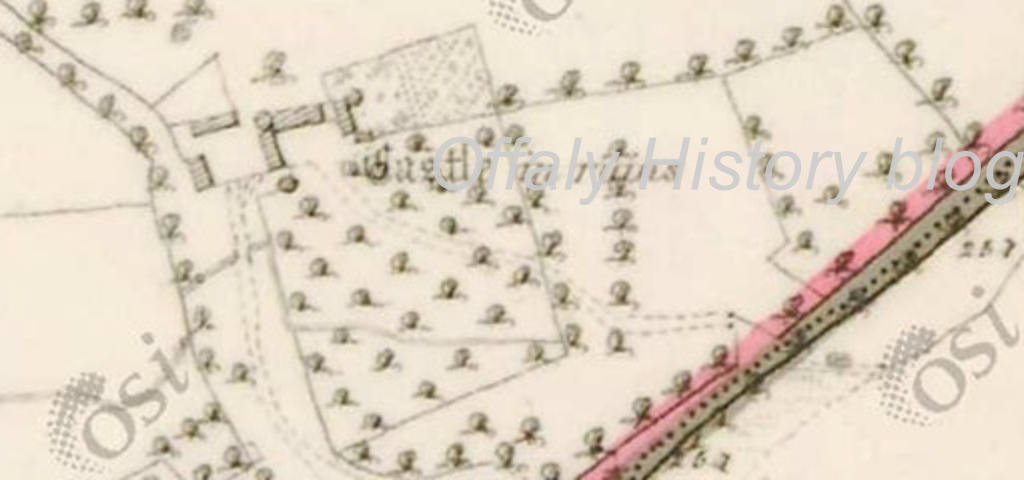
Map of 1838 showing Hollow House with the inscription “Castle in ruins”
The beginning of the 20th century sees Hollow House being inhabited by two young men Patrick Walsh, 18 listed as the Head of the Family and his younger brother Andrew, 17. Looking at the House and Building Return from the 1901 census the landlord listed for their dwelling was Michael Walsh who appears to be their father from his own census record with many children and of perfect age to have had both of the brothers. Another link between them is that Michael is listed as a farmer under his own occupation while the young men put themselves down as farmer’s sons. The evidence suggests that the brothers had started to farm on their own just north of where their father lived and worked with the rest of the rather large family having eight other children at home and a servant to help either on the farm or around the house. By 1911 we can see that Andrew has started a family with his wife, Elizabeth and two young children Michael and Patrick.
Archaeology.ie provides the following:
Townland: BALLYNASRAH OR TINNYCROSS
Description: An early Georgian farmhouse is situated on the site of castle of which nothing remains. The four round corner towers along with bawn wall and round arched gateway with triangular pediment and spiral finials all belong to the late 18th or early 19th-century and were built after the castle was destroyed probably by the occupiers of the now ruinous Georgian farmhouse.
An early Georgian farmhouse is situated on the site of a castle of which only the bawn survives. The four circular angle towers along with part of the bawn wall (OF009-023001-) appear to date from the seventeenth century. The round arched gateway with triangular pediment and spiral finials appear to belong to the late eighteenth or early nineteenth-century and were built after the castle was destroyed probably by the occupants of the ruinous farmhouse. The back wall of this cottage is part of the earlier bawn wall of 17th century date. Probable plantation castle of 17th century date with large rectangular bawn wall with four corner flanking towers. The wall and angle towers are defended with gun loops that provided flanking fire along the outer face of all four walls of the bawn.
The above description is derived from the published ‘Archaeological Inventory of County Offaly’ (Dublin: Stationery Office, 1997). In certain instances the entries have been revised and updated in the light of recent research.
Offaly History members and friends at Hollow House, late 1970s. The picture includes Fr Conor McGreevy, Baron von Ow, Ger Coughlan, Cecil Lumley, Danny Robbins, Joan McGill, John Devereaux, Frank Meehan, Tom Galvin, Owen Wyer, Mrs J. Doyle. Younger members Terese and Noel Scully, Brendan Doyle. Class: Bawn
Townland: BALLYNASRAH OR TINNYCROSS
Scheduled for inclusion in the next revision of the RMP: Yes
Description: An early Georgian farmhouse is situated on the site of a castle of which only the bawn survives. The four circular angle towers along with part of the bawn wall appear to date from the seventeenth century. The round arched gateway with triangular pediment and spiral finials appear to belong to the late eighteenth or early nineteenth-century and were built after the castle was destroyed probably by the occupants of the ruinous farmhouse. The back wall of this cottage is part of the earlier bawn wall of 17th century date. Probable plantation castle (OF009-023—-) of 17th century date with large rectangular bawn wall with four corner flanking towers. The wall and angle towers are defended with gun loops that provided flanking fire along the outer face of all four walls of the bawn.
Compiled by: Caimin O’Brien.
Date of upload: 23 May 2011Sources:
Griffith’s Valuation 1854
A list of landholders names in King’s Co. 1824. Available at RootsIreland
https://www.dib.ie/biography/de-renzy-sir-matthew-a2468
map images found on – https://osi.maps.arcgis.com/apps/webappviewer/index.html?id=bc56a1cf08844a2aa2609aa92e89497e
Offaly History wishes to thank Aisling Walsh for her work for the Society as a transition year student from Sacred Heart, Tullamore. Well done
-
The recent discovery of the earlier name for Banagher, County Offaly and its significance. By Kieran Keenaghan and James Scully. Blog No 484, 26th April 2023
In 1120 Turlough O’Connor, high-king of Ireland, built a ‘principal’ bridge on the River Shannon at a place called Áth Cróich. Recent study has proven that this is an earlier name for Banagher.
SIR MATHEW DE RENZY (1577-1635)
Sir Mathew De Renzy writing in December 1620 about West Offaly with particular reference to roads and passageways made two clear statements regarding a major crossing point on the River Shannon at Banagher and how there was practical and convenient access to the West and Galway from that location.
1. ‘At the Benghar there ought a towne or a good fort to be made, to keep that passage of the Shannon, for that in no other place can come any horsemen near the river to take passage out of Connaught but only here, by reason of the impediments of the bogs and woods; from this passage it is but 30 or 34 miles to Galway all hard and fair ground.
2. At Banagher ‘…to be no more than about 30 miles (from the Shannon at Ahcro or Benghar to) to Galway over the Shannon, all hard and faire ground
Both these references leave no doubt that there was a major crossing point at Banagher in the 1620s. More importantly the second quote equates Banagher with a place called Ahcro (Áth Cróich). This information was crucial to the recent acceptance by the Locus placenames project (Locus) that the two places are synonymous. Consequently, in future editions of their definitive dictionary of Irish placenames, Banagher and Áth Cróich will be recorded as one and the same place. The implication of this decision is that it requires a major revision of Banagher’s early history.
(more…)
-
Ah Here! Ireland’s Liveability Index – Offaly is the most ideally suited county to access all parts of Ireland. By Imelda Higgins with Pics by Paul Moore. Blog No 259, 30th Jan 2021
Now that we are all locked down in our various counties I miss my occasional trips to Offaly to visit old friends. I keep an eye on local news on line and love the Tullamore Tribune and the Offaly Express. I was dismayed the other day to see a report on the Express that Offaly ranked lowest in Ireland on a Liveability Index! What in the name of Heaven is a Liveability Index!! I decided to look into it all a little further. Seemingly a father and son (with obviously too much time on their hands!) decided to rate every county in Ireland on four (4!!) parameters. One criterion was natural amenity which they assessed by developing ‘a unique method of ranking the natural amenity of a particular area using the percentage of each area covered by water and mountains and attributed as urban’ (Leinster Express 16 Jan 2021 Lynda Kiernan). Having spent so many happy years in Offaly I would certainly disagree with the findings and would challenge that duo to explain them fully! The very fact that Offaly is not covered with water and mountain makes it one of the most attractive counties in Ireland. Offaly’s unique landscape is one of peace and tranquility. The wide open stretches of bog covered with the most wonderful heathers and gorse throughout the year make it a joy to behold in any season. A mid 19th century saying that when gorse is out of bloom, kissing is out of season is certainly true of midland scenery!
(more…)
-
Dancing in Ireland since the 1920s: Your recollections needed. Maria Luddy. Blog No 248, 19th Dec 2020
Many readers and their parents will have great recollections of the dancing scene in Ireland. You can help write the history. Share your thoughts and send on the stories needed to build a picture of the dancing scene in Ireland. Many will recall Je t’aime played in the 1960s in St Mary’s Hall, or the Harriers, Tullamore. But what about the County Ballroom and the parish halls in Clara, Birr, Rahan, Killeigh and so many more. Did dancing bring about the ‘ruin of virtue’?
Dancing has always been a source of expression, fun and entertainment in Ireland. People danced at the crossroads, in each other’s houses, at social events, festivals, and in licensed dancehalls all around the country. From the early twentieth century the Catholic hierarchy became particularly concerned with the opportunities that might arise for sexual immorality in dancehalls. In October 1925 the bishops and archbishops of Ireland issued a statement which was to be read at ‘the principal masses, in all churches on the first Sunday of each quarter of the ecclesiastical year.’ The statement referred to the ‘evils of dancing’ and it was ‘a grave and solemn warning to the people with regard to the spiritual dangers associated with dancing’. The statement noted: ‘We know too well the fruit of these [dance] halls all over the country. It is nothing new, alas, to find Irish girls now and then brought to shame, and retiring to the refuge of institutions or the dens of great cities. But dancing halls, more especially, in the general uncontrol of recent years, have deplorably aggravated the ruin of virtue due to ordinary human weakness. They have brought many a good innocent girl into sin, shame and scandal, and set her unwary feet on the road that leads to perdition’. The behaviour of the men did not elicit much comment. From the mid-1920s and throughout the early 1930s there were constant references in the newspapers to the problems of dancehalls and motor cars. In 1931 Cardinal McRory combined the two and saw a growing evil in ‘the parking of cars close to dancehalls in badly lighted village streets or on dark country roads. Cars so placed are used … by young people for sitting out in the intervals between dances’. ‘Joy-riding’ had a very different connotation in the period than it does now. Reporting on a sermon by the bishop of Galway, the Irish Independent noted that ‘joy-riding’ was conducted by ‘Evil men – demons in human form come from outside the parish and outside the city – to indulge in this practice. They lure girls from the town to go for motor drives into the country, and you know what happens… it is not for the benefit of the motor drive. It is for something infinitely worse’.
(more…)
-
The Maynooth Local Studies Series, recent issues, the Offaly volumes and the entire series listed here. Sources for Offaly History and Society, number 10. Blog No 230, 7th Oct 2020
The current issue of Irish Historical Studies (no. 165, May 2020) has a featured review of five issues from the Maynooth Local Studies series published in 2019. That brought the number issued to 144. We attach the list to 144 for your convenience and we bring to your attention the latest batch of four. Raymond Gillespie is the quiet man behind the series and who has acted as general editor since its inception in 1995. The reviewer in IHS, Maura Cronin, reminds of his characterising local history as being ‘primarily about people in places over time’. Place is described as the bedrock of local history, but it must be seen in the context of the actions of people and the pivotal role of historical research is looking for the forces of disruption and of cohesion. What brought people together and what drove them apart.
The four new issues of 2020
Four new volumes have been published in the Maynooth Studies in Local History series (general editor Professor Raymond Gillespie). The volumes by Denis Casey, Emma Lyons, Brendan Scott and Jonathan Wright and can be ordered via Offaly History Centre.
(more…)
 offalyhistoryblog