This is part three of a four-part blog on the 1835 Poor Law Inquiry into the baronies of Philipstown Upper and Lower. The respondents to the questionaries for Philipstown/Daingean were Rev P. Rigney and Roger North. Roger North was a landowner in King’s County. He inherited the Kilduff estate upon the death of his father, Roger North, in 1830. He was involved in estate management, including raising rents, which made him unpopular with local farmers and other landlords.[1] North was shot dead in 1850.
Transcripts of the Poor Law Reports – ContinuedThe questions raised by the Poor Law Commissioners for the local respondents are in the column on the left
This is part two of a three-part blog on the 1835 Poor Law Inquiry into the baronies of Philipstown Upper and Lower. The respondents to the questionnaires for Philipstown were Rev P. Rigney and Roger North. Roger North was a landowner in King’s County. He inherited the Kilduff estate upon the death of his father, Roger North, in 1830. He was involved in estate management, including raising rents, which made him unpopular with local farmers and other landlords.[i] Roger North was shot dead in September 1850.
The Commission of Enquiry into the Poorer Classes in Ireland was the result of the United Kingdom government’s investigation of rapid increases in population living in extreme poverty. From their official reports in the post-Napoleonic period Ireland’s growth-rate had remained high. In the 1831 census Ireland returned a population of 7.8 million up from 6.8 million in 1821. In the year 1831 the population baronies of the Upper and Lower Philipstown was 17,311. The town of Daingean had a population of 1,454.[i] For King’s County in general please see our previous blog.[ii]
In the baronies of Philipstown Upper and Lower two commissioners were appointed: Jonathan Binns and James O’Hea. It should be noted, previous to the dissolution of the Parliament of Ireland in 1800, Philipstown returned two members to that legislature.[iii] In 1835 Tullamore became the county town and with that the assizes were moved there from Philipstown.[iv] As the Poor Law Commissioner Jonathan Binns reflected:
‘Its trade has disappeared – many of its houses are in ruins – its shops are falling into decay – and its population, as these signs sufficiently indicate, are poor and wretched.’[v]
The changing face of Offaly towns in the early 1900s: An illustrated history edited by Michael Byrne with contributions from Paul Barber, Stephen Callaghan, Grace Clendennen, Kevin Corrigan, Michael Goodbody, Ger Murphy, John Powell, Laura Price, Ciarán Reilly and Brendan Ryan (Offaly History, Tullamore, 2024, 368 pp). Available from Offaly History Centre and Midland Books Tullamore and online at www.offalyhistory.com. ISBN 978-1-909822-38-2 (hard back), €27.99. The book will be launched at Offaly History Centre, Bury Quay, Tullamore – beside the new Aldi and Old Warehouse. It is already available at the Centre, online at http://www.offalyhistory.com and at Midland Books, Tullamore. If you cannot attend in Tullamore we have a launch at Giltrap’s of Kinnitty on Thursday 21 Nov. at 7. 30 p.m. We will have copies in Bridge Centre for the Christmas Sale 14 to 24 December.
Ted Barrett, one of the pioneers of cruising on the canal, was well aware of its environmental and leisure value. By the late 1960s he was advocating linking the canals with the lakes that might be made from the disused bogs to form a type of Norfolk Broads in Ireland.[1] In this letter of October 1964 he was to show his diplomatic and marketing skills in the course of advocating canal cruising. Barrett was the author of a guide to cruising on the canals.[2] At about the same time as Barrett Harry Egan and Frank Egan of Tullamore had developed a cruiser hire business based at Tullamore Harbour under the name Gay Line Cruisers. Later this was followed by Celtic Canal Cruisers (Mike and Heather Thomas). In fact by mid-1964 things were looking up for the Grand Canal after several years of uncertainty due to the Dublin Corporation proposal to cover over parts of the canal line in Dublin to facilitate sewerage disposal. The IWAI had been formed in 1954 to promote all the waterways but by the 1960s was in the van in protecting the Grand Canal waterway. A branch had been formed in Tullamore with the support of Frank Egan and PV Egan. These men went on to establish Gay Line Cruisers, based in Tullamore, and got involved in boat building. 1964 was also the year in which Brendan Smyth (d. 2021) of Banagher started his Silver Line Cruisers business – now one of the most successful on the Shannon and led by his children Barbara and Morgan. By 1991 up to nine hire cruise firms were offering almost 400 cruisers for self-drive, mostly on the River Shannon.
The bumper volume of essays (list below) in Offaly and the Great War (Offaly History, 2018) can now be accessed free online at www.offalyhistory.com thanks to the Decade of Centenaries. The book of 28 essays is also available in hardcopy from Offaly History for just €20. In all over 50 articles free to download. Go to the Decade of Centenaries on the offalyhistory.com website.
When the great historian and first ‘telly don’ A.J.P. Taylor published his short history of the First World War just in time for the remembrance days of over fifty years ago he wrote that the war reshaped the political order in Europe. That its memorials stood in every town and village and that the real hero of the war was the Unknown Soldier.
The Civil Parish of Geashill is the largest Parish in Offaly, and contains 74 townlands. As well as fine fields and bog land – dark, shale and lime mudstone, are just some of the materials you will find in its bedrocks.
The Parish is part of the ancient territory of “Ui Failghe of the O’Connor chiefs”. It contains some of the oldest remains of castles and is rich in history. From ancient sites such as Enclosures and Ringforts. Sadly many of them have been lost due to nature elements and neglect. It contains the town land of Cappyroe which borders the Grand Canal line, it is the 293rd largest townland in Co. Offaly and in Irish is Ceapach Aodha Rua, translation meaning Plot of Land[2].
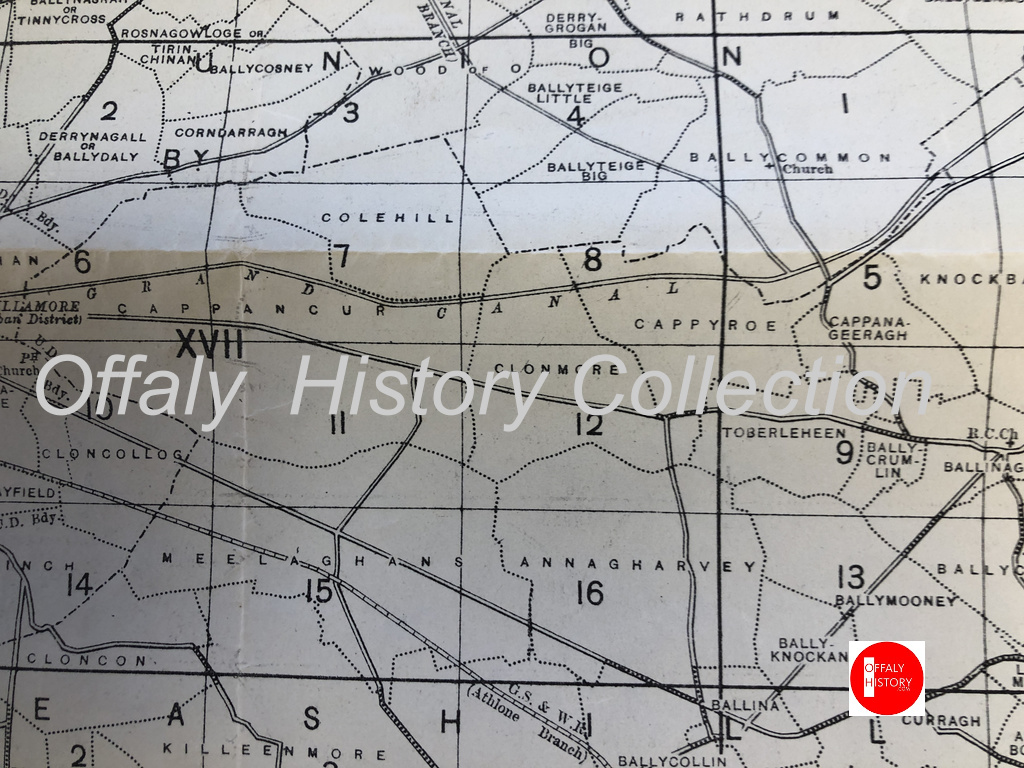
Map of the townlands from Ballycommon to Tullamore. There are over 1,000 townlands in Offaly. See townlands.ie for more.Your walk along the canal from Ballycommon will see you visit Cappyroe, Clonmore and Cappancur
In 1911 Cappyroe had one of the lowest concentration of houses in the area, during this period the household returns and ancillary, shows us that the population decreased from 106 in 1841 to 21 in 1911. There were 6 houses on record, all of all of Private Dwelling, with all inhabited, with classes of houses between 1st and 2nd . Age of occupiers ranging from 1-80. Here are the families that occupied these buildings during this time:
As we make our way along the line, we come to lock 22nd, which was previously mentioned in the last series of “East to West”. The 23rd Lock is followed close behind. A smooth and clear pathway can be found, making it easy to walk or cycle along the way. Coming up we see the 24th Lock. This lock is located near the former Celtic Canal Cruisers. We are preparing an article on this canal attraction, 1974-2004.
(08. Celtic Canal Cruisers / Image Source/ Offaly History). We are preparing a blog on this important cruise line. Can you help with material?
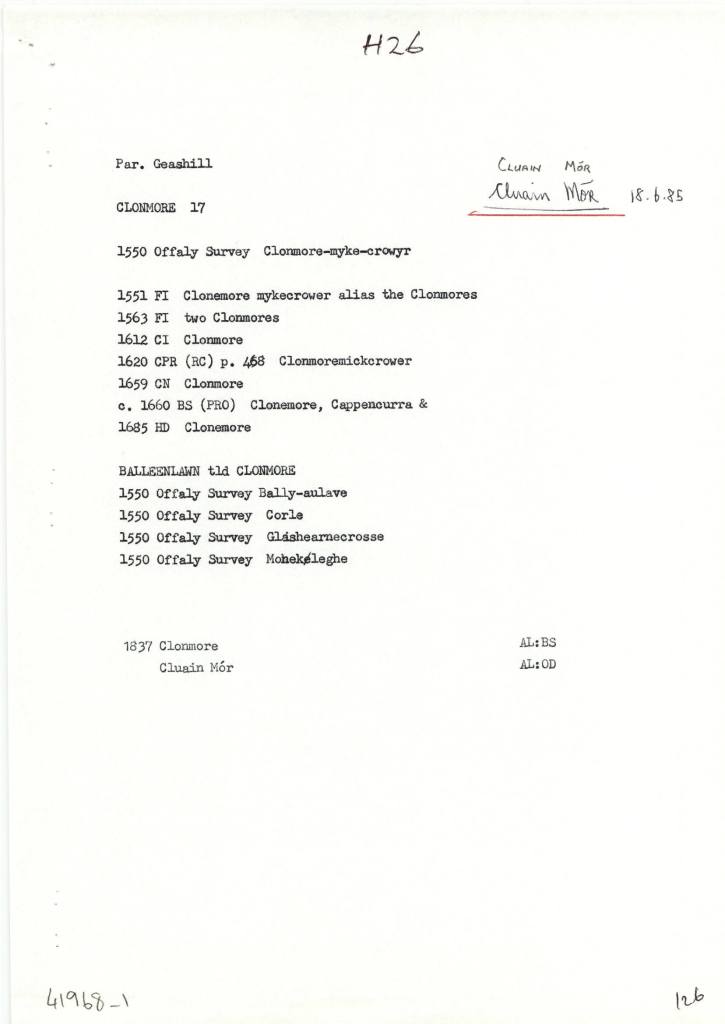
Clonmore (Cappancur), in the Civil Parish of Geashill, in the Barony of Geashill, in the County of Offaly. The Irish name for Clonmore is Cluain Mór meaning Great Field.
Clonmore is the site of a few known churches the Balleenlawn Church that stood until the early 19th century. Its Foundation, was discovered in 1942. It also contained an old graveyard that is still intact today[3].
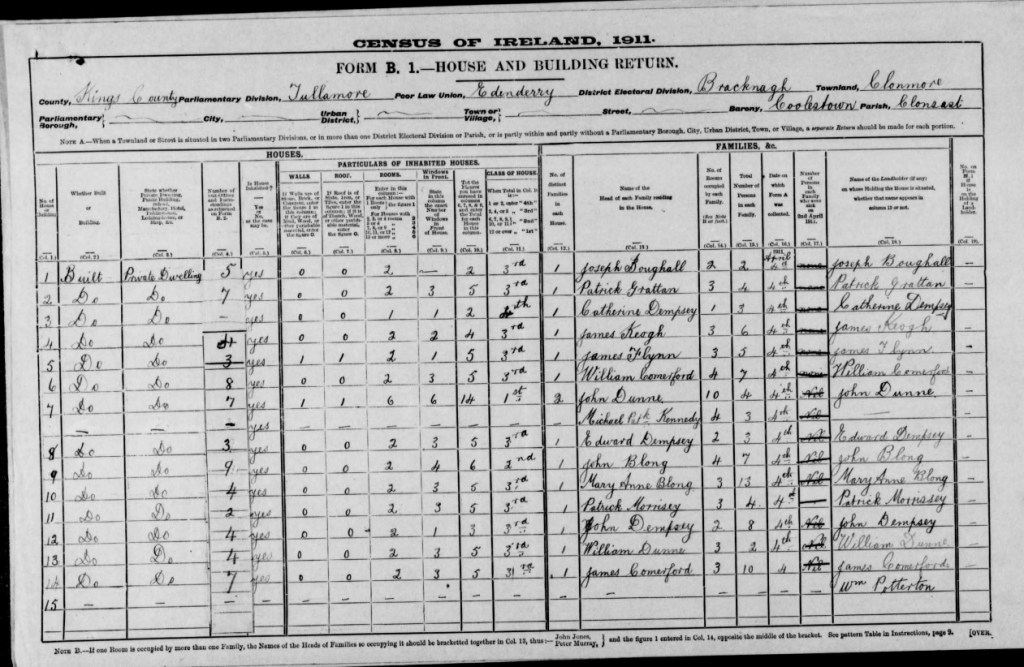
In 1911 Clonmore had 26 houses in the area, during this period the household returns and ancillary, shows us that the population decreased from 220 in 1841 to 101 in 1911. There was 26 houses show on record all of all of Private Dwelling, with all inhabited, with classes of houses between 1st, 2nd and 3rd. Age ranging from 1-80. Here are some of the families that occupied these buildings during this time:
(15.Coachman, source Travel and Transport in Ireland, Edited by Kevin B.Nowlan)
With the construction of the Grand Canal it provided a better connection to reach different townlands around the country. With many place still not connected by waterway, the coach services provided that connect for passengers to reach their final destinations.
As we make our way out of the Geashill Civil Parish, we reach the 25th Lock and Just at Digby Bridge, here we can see just the spire of Tullamore’s Catholic church. Close by is the 26th lock, the barony bridge with its passage under the canal and on to Tullamore. More on Wednesday.
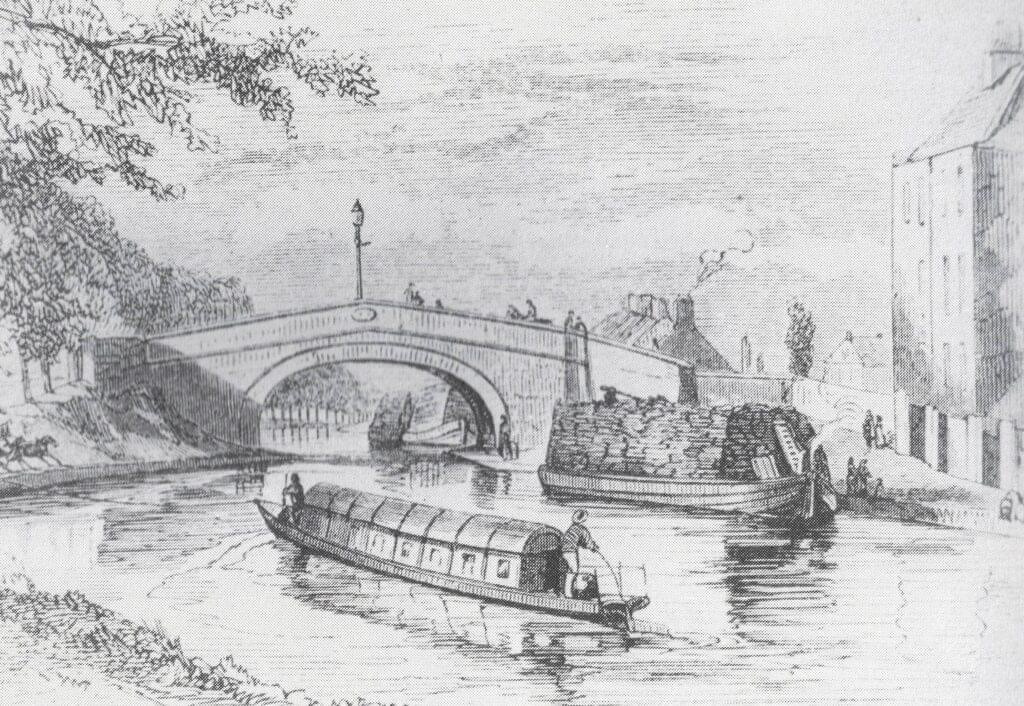
Flyboats on the canal in the 1830s, similar to the later design of the Celtic Cruisers fleet of the 1970s
[1] See “Safe Harbour, The Grand Canal at Edenderry” Mairead Evans & Therese Abbott” Topic Newsppapers Ltd, P22-23
[2] Offaly thought Time & Its Townlands. Thomas Lee. Pub: Ottait Publishing p173
[3] Offaly thought Time & Its Townlands. Thomas Lee. Pub: Ottait Publishing p173
Michael Hoy was born in Daingean county Offaly in the year 1834 to William Hoy and Rosanna Concasey. His father died when he was a young boy. In 1853 he emigrated with his mother, brother William, and two sisters Rosanna and Elizabeth, settling in Brooklyn. His older brothers Joseph and John, along with another sister Mary had gone to America a few years before. Michael Hoy learned the stone cutters trade in Brooklyn. In 1854 the family moved to Cooperstown, New York, which is two hundred miles north of the city. Young Hoy worked in his trade for one more year before returning to Brooklyn. In 1857 he went to Minnesota, settling in the town of Saint Anthony. At this time Saint Anthony had a few scattered houses on the east bank of the Mississippi river. He followed his trade and the same year of his arrival he cut stone for the building of the State University.
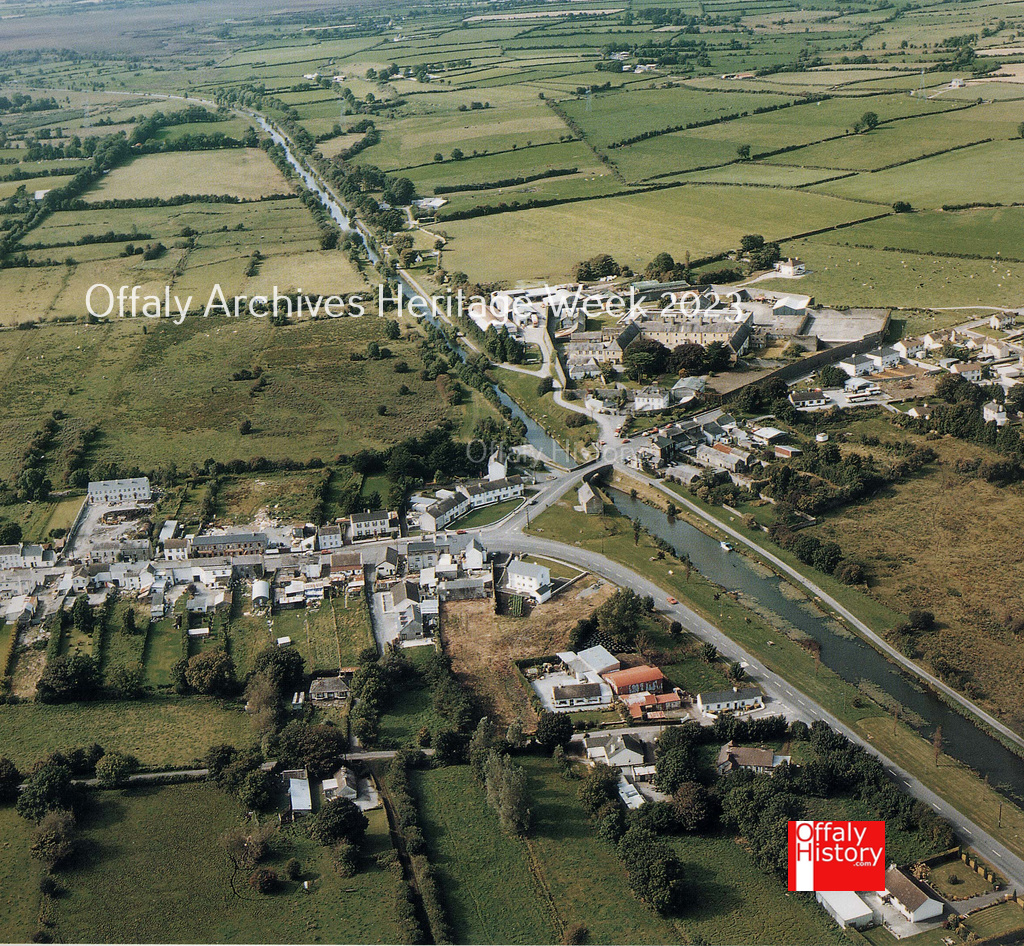
The Grand Canal was constructed as far as Philipstown/ Daingean in 1797 providing the town with an opportunity to import goods at lower transport costs and to export turf and agricultural products to the city of Dublin.
Some immediate benefits came with the canal such as the large house (formerly Scully’s) on the western side of the Molesworth bridge and later the canal warehouse on the eastern side. This was described on the Killaly 1806-7 map as the collector’s house. The trade and stores business moved on to Tullamore exclusively for the six years pending the completion of the access to Shannon Harbour in 1804. The need for a canal hotel was eliminated with the building of the Tullamore hotel in 1801-2 and that at Shannon Harbour in 1806.
The line of the canal ran from Toberdaly to Killaderry parish, the townland of Castlebarnagh Big and into the town of Daingean. From there is passed on to Ballymullen and Ballycommon. As with Tullamore the canal came in on the north side of the town cutting through cabins in its way to the south of the military barracks and gallows hill. In the estate landscape that it was in the 1700s to the 1900s the big houses of Mount Briscoe, Clonearl and Kilduff were to the north and Springfield, Mount Lucas and the lost demesne of River Lyons to the south. The latter was almost devoid of trees unlike the well planted Clonearl and the planted avenue to the house at Mount Briscoe. On the southwest was the old crossing point of Ballinagar heading on to Tullamore.
Killaderry civil parish, is part of the ancient territory of Clann Colgain which was made up of three tuaths. The parish lies in an area which splits Kilclonfert civil parish into two parts and has the town of Daingean at its Centre.
Down is in the Electoral Division of Mountbriscoe, in Civil Parish of Killaderry, in the Barony of Lower Philipstown, in the County of Offaly The Irish name for Down is Domhain meaning Deep.
Down townland has a possible burial mound here and there is also a platform ringfort in the townland which is 26 metres in diameter and enclosed by a slight bank. [1]







 offalyhistoryblog