Today with the canal being a popular walking destination, you can see along the canals places associated with the townlands . Just outside Rhode, on the way to Edenderry, are the ruins of old windmills of the eighteenth century. These once had a wind shaft mounted in the cap (one is preserved at the Guinness brewery and was used by the Roe distillery). The wind turned the millstones in the tower below and were used to help ground grains for flour.
Seven windmills are known to have been constructed during this period in Offaly. By 1830, most of the windmills had gone out of service. The last windmill to be used was dated up to 1880, called the Fahy Windmill[1]. Tullamore had two in the eighteenth century on the hill behind O’Moore Street.
This article looks at the north Offaly towns featured in Major (later general) Vallancey’s report carried out in 1771 and designed to support the construction of the new Grand Canal line to Tullamore and the Shannon. Vallancey was then a young engineer, employed to report to the Commissioners of Inland Navigation and his findings were published in, AReport on the Grand Canal or Southern Line (Dublin 1771).[1] This report is useful as a window on some of the north King’s County (hereafter generally referred to as Offaly) towns and villages.[2]
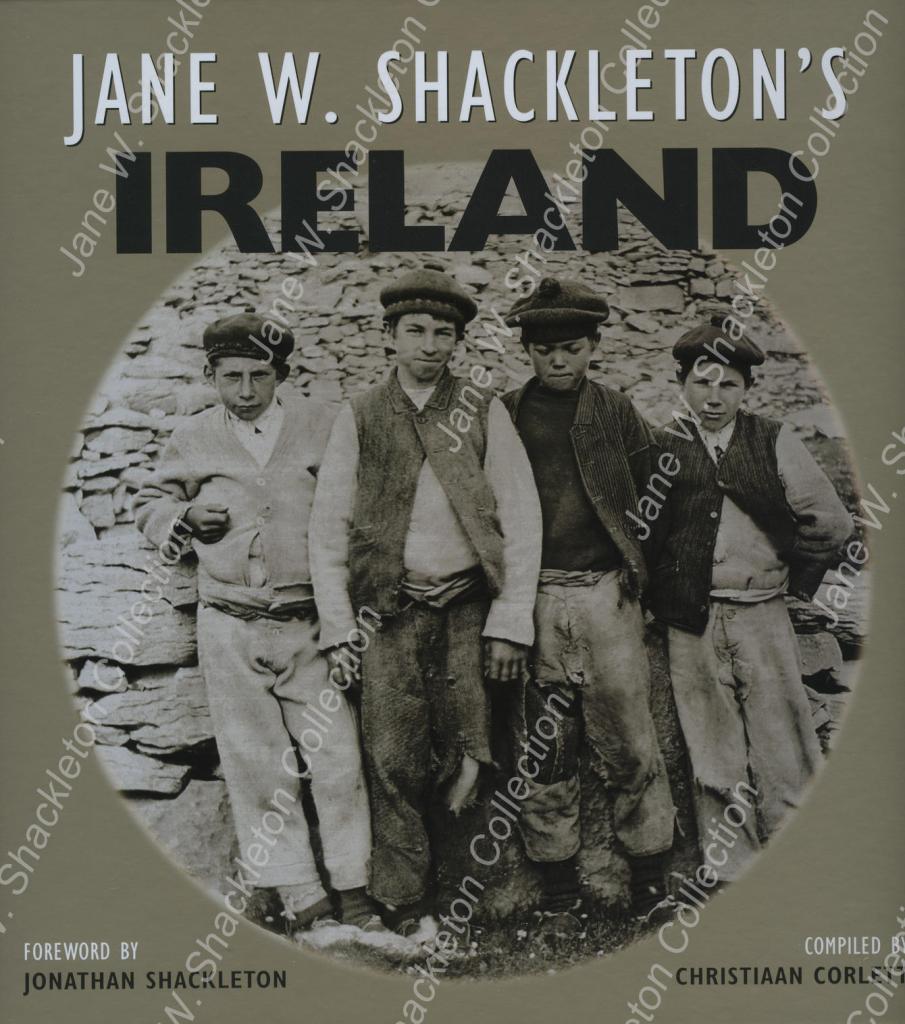
Jane W. Shackleton’s Ireland compiled by Christiaan Corlett (Cork, 2012) is an attractive large format publication was issued by Collins Press and consists of 180 well produced photographs by Jane Shackleton. These pictures are important for the photographic record in County Offaly and mostly date to 1894.
Not surprisingly there are many pictures of mills in this book and there are about ten pictures of Offaly interest. Jane Shackleton started taking pictures in the 1880s and made several tours on the Shannon and along the Grand Canal and Barrow lines. These waterways photographs contribute greatly to the history of the canals and the great mills which were associated with river locations. Many of these were in fact owned by Quaker industrialists. Like other interested women of the period Jane Shackleton was a member of the Royal Society of Antiquaries (RSAI) and took photographs of some of their tours including that of June 1904 around Ireland. Midleton Biddulph, the amateur photographer and retired army officer of Rathrobin near Tullamore was also on this trip and some of his pictures survive and have been published as Rathrobin and the two Irelands; the photographs of Middleton Westenra Biddulph, 1900–1920 (Tullamore, 2021). Corlett informs us that the Shackleton collection consists of 1,000 lantern slides and 44 albums containing several thousand prints, mostly of Irish subjects. This writer had the pleasure of seeing some of the Grand Canal and the turf works at Pollagh back in the early 1970s with Richard Shackleton and Jonathan Shackleton.
Patrick Lynch and John Vaizey in their history of Guinness’s brewery in the Irish economy to 1876 observed that in England the canals followed trade while in Ireland it was hoped that trade would follow the canals. It was a hope that was only partially fulfilled as outside of Dublin the new canals served few areas of commercial or industrial importance.[1] The observation was following in the line of Arthur Young in the 1770s who had advised ‘to have something to carry before you seek the means of carriage’.[2] Yet the record of the carriage of goods on the canal was satisfactory with 500 million ton miles carried in 1800 and double that by the 1830s.[3] The Grand Canal was especially beneficial to north Offaly for the transport of stone, brick, turf, barley, malt and whiskey. All bulky goods suited to water transport. The emerging firm of Guinness also found the inland water transport system helpful to sales and market penetration. The slow movement of Guinness beer by waterway was good for product quality on arrival.
The view is about 1840 and the book 1960. There is a copy at Offaly History Centre Library
Work on the Grand Canal started in 1756 and by 1779 the first stretch of water from James’s Street to Robertstown was completed. Over the next twenty years the canal was extended to Tullamore (1798) and Shannon Harbour (1804). The six-year delay at Tullamore while resolving issues with the direction of the ‘Brosna Line’ at Tullamore facilitated the establishment of a canal hotel, stores and a harbour.
The line from Tullamore to the Shannon is known as the Brosna route. Last week we looked at it from the terminus at Shannon Harbour and followed Donal Boland’s well illustrated trip from the Shannon to Tullamore. The canal had reached Daingean in 1797 and Tullamore in 1798. It was then the terminus for six years with trade opened to Shannon Harbour in 1804 and fully in 1805. During that period the directors of the Grand Canal Company had considered three options for completing the canal to the Shannon:
1. To lock down into the River Brosna and continue as a river navigation.
2. To construct a canal alongside the Brosna.
3. To continue the canal on the same level to the south, with the possibility of an extension to Birr and the lock down steeply into the Shannon at Banagher.
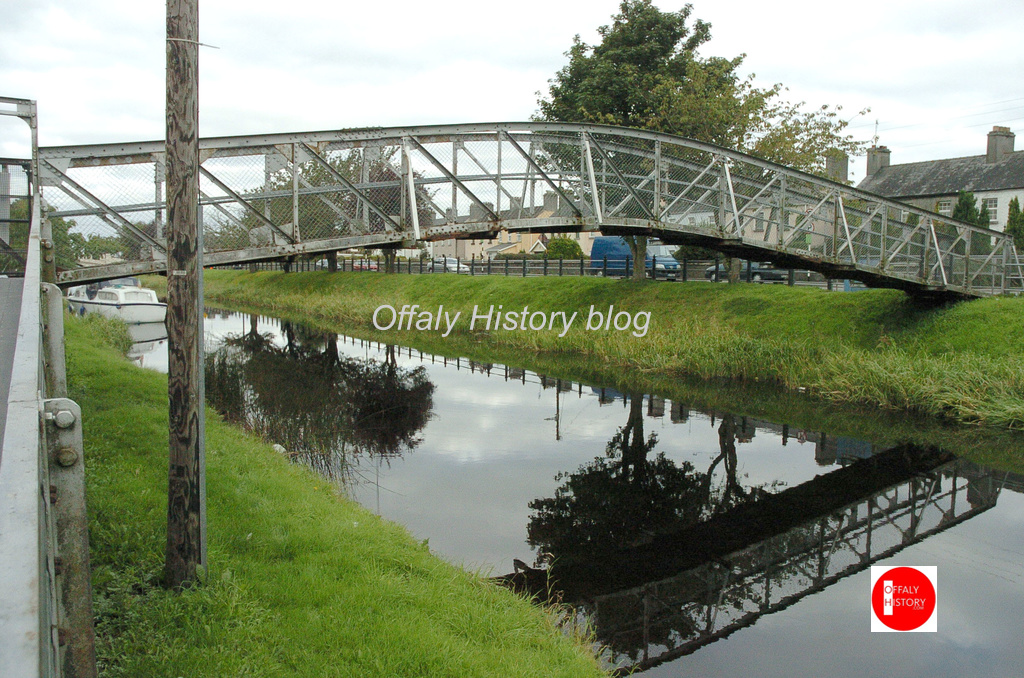
The commencement of the Brosna line at Tullamore was east of the Kilbeggan bridgeand close to the first canal warehouse on Bury Quay close by this footbridge of the 1930s to 2013.(more…)
This week we look at the background to the Vallancey report on the Offaly towns carried out in 1771 to facilitate the construction of the new Grand Canal line from Dublin to the Shannon. Vallancey was then a young engineer, employed to report to the Commissioners of Inland Navigation and his findings were published in a little known and very scarce pamphlet, AReport on the Grand Canal or Southern Line (Dublin 1771).[2] This report is useful as a window on some of the north King’s County (hereafter generally referred to as Offaly) towns and villages and all the more so because of the scarcity of published accounts of the midland towns prior to 1800.[3] The report was published in the same year as that of John Trail who was at the time employed by Dublin Corporation.[4] Vallancey was writing with a mission. He was being paid to spin the story of the benefits that would come from inland navigation and to highlight the difficulties with road transport and its adverse impact on competition and pricing of commodities so as to bolster the arguments in favour of canal construction and satisfy those who were paying his consultancy fees.
Why not contribute to our series of blog articles on the Grand Canal in Offaly – info@offalyhistory.com.
This month we begin a series of articles on the history and heritage of the Grand Canal in County Offaly that will run to upwards of 50 blog articles in 2024 and have its own platform on our website, http://www.offalyhistory.com. Our aim is to document the story of the course of the canal from the county boundary east of Edenderry to Shannon Harbour in the west. Today the Grand Canal is one of the greatest amenities that County Offaly possesses and we want to tell the story, and for readers to contribute by way of information and pictures. All the material will be open to be used on our website and the format will allow for editing to improve and to receive additional information from you the reader, which will be acknowledged. So Buen Camino as we make our journey through a quiet and well-watered land. The year 2024 marks the 120th anniversary of the completion of the Shannon Line at Shannon Harbour and may also see the completion of the canal greenway in this county.
The rugby grounds at Spollanstown have been used for sporting activity in Tullamore for over 140 years. The establishing of the Spollanstown sports field is rooted in the difficult situation in the 1880s when the land war was at its height, the home rule movement was advancing steadily and, increasingly, sporting activities reflected the deep political and religious divide in the country.
Kilbeggan team in 1927-28. Birr was able to affiliate to IRFU in 1887 and Tullamore in 1937(more…)
It was 2003 when the first issue of Offaly Heritage was published. Just twenty years later the twelfth book of essays will be issued by Offaly History on 6 October 2023 at the Offaly History Centre at 6 p.m. and launched by a son of Tullamore, Terry Clavin. Terry is a distinguished historian who works with the Royal Irish Academy and has contributed over 400 biographies to the Academy’s Dictionary of Irish Biography. This is now available online and is a tremendous resource with about 11,000 biographies and eleven published volumes in the main series with a significant number of ancillary publications.
Offaly Heritage 12 is another bumper issue with over 500 pages and very much on a par in quality with the issues since no. 9 was published in 2016. It is a tremendous achievement and, no doubt, benefits from the support of the programme for the Decade of Centenaries and Offaly County Council.
For this issue there was a team of editors – Michael Byrne, Dr Mary Jane Fox, Dr Ciarán McCabe, Dr Ciarán Reilly, Lisa Shortall. Obituaries Editor: Kevin Corrigan.
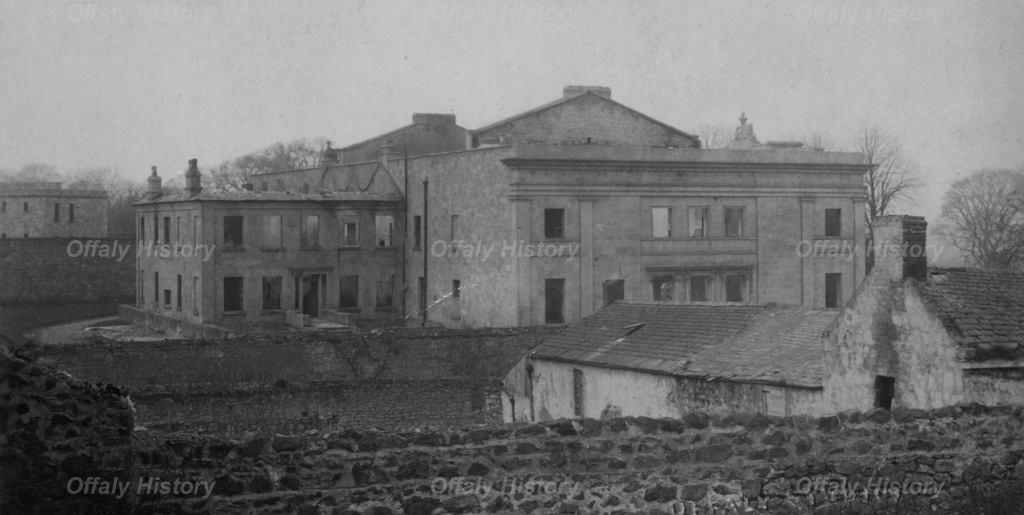
The shell of the county courthouse, July 1922
The essays in section one reflect the ongoing research in Offaly into aspect of life in Ireland 100 years ago as we come to the end of the Decade of Commemoration (1912–1923). The essays reflect the changing nature of society in Offaly at that time, particularly during the years 1920 to 1923 and readers will enjoy contributions as varied as the end of the Wakely family of Rhode; the final years of the Leinster Regiment at Birr; the Protestant minority in Offaly during the revolutionary period; the courts of assize in King’s County in the years 1914–21; the burning of Tullamore courthouse, jail and barracks in 1922; the story of Belgian refugees in Portarlington, and Offaly claimants in 1916.
A series of short lives are presented in this volume, as they were in Offaly 11 and includes entries on individuals as diverse as J.L. Stirling, Averil Deverell, Middleton Biddulph, Robert Goodbody and volunteer Sean Barry.
Laois Offaly is again to be divided into two three-seat constituencies according to the just announced electoral commission report. ‘This would be the first time that the Offaly constituency would fully align with its county boundary.’ For the 2016 General Election Laois and Offaly were divided and to the Offaly constituency was added 24 electoral divisions from North Tipperary. Laois-Offaly was adopted again for the 2020 general election. Now what was it like in the first Free State election in 1923 just 100 years ago? It was remarkable that the 1923 general election held on Monday 27 August 1923 was in general peaceful. It was only in early July 1923 that Ministers Milroy and Blythe spoke at a Cumann na nGaedheal (CnG) meeting in Tullamore in what was described by the Chronicle as scenes of an unprecedented character in the history of public meetings in Tullamore. The ‘supporters of Mr de Valera’ had posted anti-government posters about the town recalling the executions of Byrne and Geraghty, and also the three young men shot in Birr on a charge of armed robbery. On the office of the state solicitor, James Rogers, in High Street, Tullamore was pasted the words ‘Come inside and see the executioners’. Rogers would have been known both sides in the civil war as someone who defended Sinn Féin prisoners in the 1917–21 period. The newly appointed civic guards kept the peace between Cumann na Gaedheal supporters and supporters of the Republican IRA.[1]




 offalyhistoryblog