When renowned Offaly archaeologist Caimin O’Brien, cited Sir Edmund Spenser’s inclusion of a verse on Croghan Hill in his most famous poem, The Faerie Queene, in Stories from a Sacred Landscape: from Croghan Hill to Clonmacnoise; the curiosity bells began to ring. This was an amazing revelation and posed questions as to how Spenser was familiar with Croghan Hill and its religious history? Had he visited the area? When did he visit? What were the circumstances pertaining to his visit? And latterly, the question arose as to whether it was possible that this visit influenced him in some distinctive way? And furthermore, whether that influence was positive or negative?
(more…)Category: Daingean
-
The origins of the Leix-Offaly Plantation. By Dr Diarmuid Wheeler. Blog 270, 13th march 2021
We welcome this week Dr Diarmuid Wheeler on an important subject for Ireland and for the midlands, being the colonial experiment known as the Leix-Offaly Plantation. For those interested in the Decade of the Centenaries, the resurgence of interest in the Irish language, 1916 and the War of Independence, knowing the roots of the conflict is essential. The fort of Philipstown would soon be adopted as the county town for the new King’s County of the 1550s. The courts of assize to display the might and power of English law continued to be held in King’s County until 1921 while the name of the county was changed only in 1920 to Offaly. The Civil War of 1922–3 would witness the burning of houses such as Ballyburly, owned by the Wakely family, who had come to Ireland as soldier settlers in the time of Elizabeth.
Dr Wheeler will give his lecture on the Leix-Offaly Plantation to Offaly History from his home in the United States on Monday night 22 March at 7.30 p.m. Email us at info@offalyhistory.com with the subject heading ‘Zoom Wheeler’ for the access code [Ed.]
The beginnings of the midlands colonial project can be traced back to the early sixteenth century when the Tudor government, who firmly believed that Ireland rightfully belonged to the English crown and that the country’s keeping was essential to England’s overall safety, sought to restore the island to its twelfth century “conquered” state from which the crown hoped to profit. Brendan Bradshaw argues that the Tudors and the Old English of Ireland were heavily influenced by Renaissance humanism that encouraged them to bring reform to Ireland. But the administration lacked significant knowledge and experience of the country, particularly during Henry VIII’s reign and quickly realised that reforming the island would take significantly more military and financial resources than they had anticipated. By the final years of the 1530s, it was apparent that a certain degree of coercion and military force would be necessary to bring about wide scale reform. Yet the Tudors were also aware that they could not employ outright force to achieve their objectives, lacking the necessary resources to do so. Instead, the Tudor administration recognised that they would need to accommodate the natives of Ireland, at least somewhat, in order to make their aspiration a reality.
(more…)
-
The Tullamore Grand Canal Hotel, 1801–1974. By Michael Byrne. Blog No 252, 6th Jan 2021
The first hotel constructed in Tullamore in 1786 cost £200. The second in 1801 about £4,5,00. Even by multiplying by 200 for the cost of living today, this expenditure was light in the context of the three new hotels in Tullamore in 1997- 2008 which may possibly represent a total expenditure of €25 million for 270 beds. And yet the canal hotel of 1801 was a major investment and may have never made a return to the Grand Canal Company. The need for it disappeared within five years of its construction. By contrast the deprecated Bury Arms (Hayes/Phoenix Arms) in the centre of town was in business for over 200 years.

The Bury Arms (later Hayes Hotel) erected in 1786, demolished 2000. From the Hanly Collection Offaly History. This view in the late 1950s. The first hotel (that we know of) to be constructed in Tullamore was the Bury Arms Hotel (later the Phoenix Arms, demolished 2000, now Boots Pharmacy), erected in 1786 as an inn for Tullamore at a cost to the landlord, Charles William Bury, of £200. We know that in 1798 it had 13 beds for letting. The hotel was first leased to John Tydd at a yearly rent of £20. John Tydd and his son Benjamin were both dead by 1798 at which point the innkeeper was one Mr Doherty. Captain William Evans, who had been a director of the Grand Canal Company until c.1796, but remained with the Company providing engineering advice until 1805, was critical of the Bury Hotel on his visit there in 1798. His departure from the company in 1805, possibly following soon after the completion of the works to Shannon Harbour in 1804. Notwithstanding Evans’ criticism of the Bury Arms hotel Sir Richard Colt Hore who stayed at the hotel in 1806 wrote: ‘At Tullamore I found a good inn and accommodation at Doherty’s (the Bury, later Charleville Arms) near the Bridge’ (Tour, p. 32). The hotel had changed its name in line with that of the ennobling of the town’s landlord who became Lord Tullamore in 1797, Viscount Charleville in 1800 and earl of Charleville in 1806. It should be mentioned that there was at least one earlier inn in Tullamore, that of Hugh Clough in the 1760s and other smaller hotels post 1800.
(more…)
-
The Maynooth Local Studies Series, recent issues, the Offaly volumes and the entire series listed here. Sources for Offaly History and Society, number 10. Blog No 230, 7th Oct 2020
The current issue of Irish Historical Studies (no. 165, May 2020) has a featured review of five issues from the Maynooth Local Studies series published in 2019. That brought the number issued to 144. We attach the list to 144 for your convenience and we bring to your attention the latest batch of four. Raymond Gillespie is the quiet man behind the series and who has acted as general editor since its inception in 1995. The reviewer in IHS, Maura Cronin, reminds of his characterising local history as being ‘primarily about people in places over time’. Place is described as the bedrock of local history, but it must be seen in the context of the actions of people and the pivotal role of historical research is looking for the forces of disruption and of cohesion. What brought people together and what drove them apart.
The four new issues of 2020
Four new volumes have been published in the Maynooth Studies in Local History series (general editor Professor Raymond Gillespie). The volumes by Denis Casey, Emma Lyons, Brendan Scott and Jonathan Wright and can be ordered via Offaly History Centre.
(more…)
-
Offaly GAA blessed with some great club history publications: sources for Offaly History and Society, no. 7. By Kevin Corrigan. Blog No 222, 2nd Sept 2020
Offaly GAA blessed with some great club history publications: sources for Offaly history and society, no. 7. GAA is very fortunate to have a number of fabulous club history publications at its disposal. Clubs such as Clara, Daingean, Edenderry, Kilcormac/Killoughey, Seir Kieran and Tullamore have produced particularly comprehensive and detailed club histories and their value to members is immense.
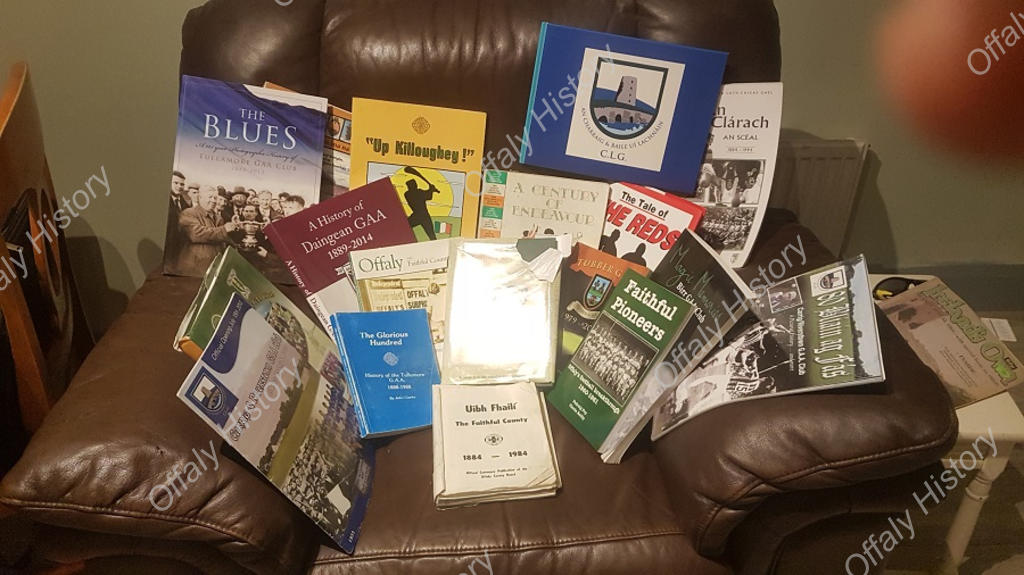
I have started research earlier this year on my latest project, a comprehensive, detailed history of Offaly GAA. It is a very big undertaking with a huge volume of research required before you even consider putting pen to paper. It will be a three year plus project and trying to get a picture of all eras and factors in the growth of the GAA in Offaly is quite daunting.
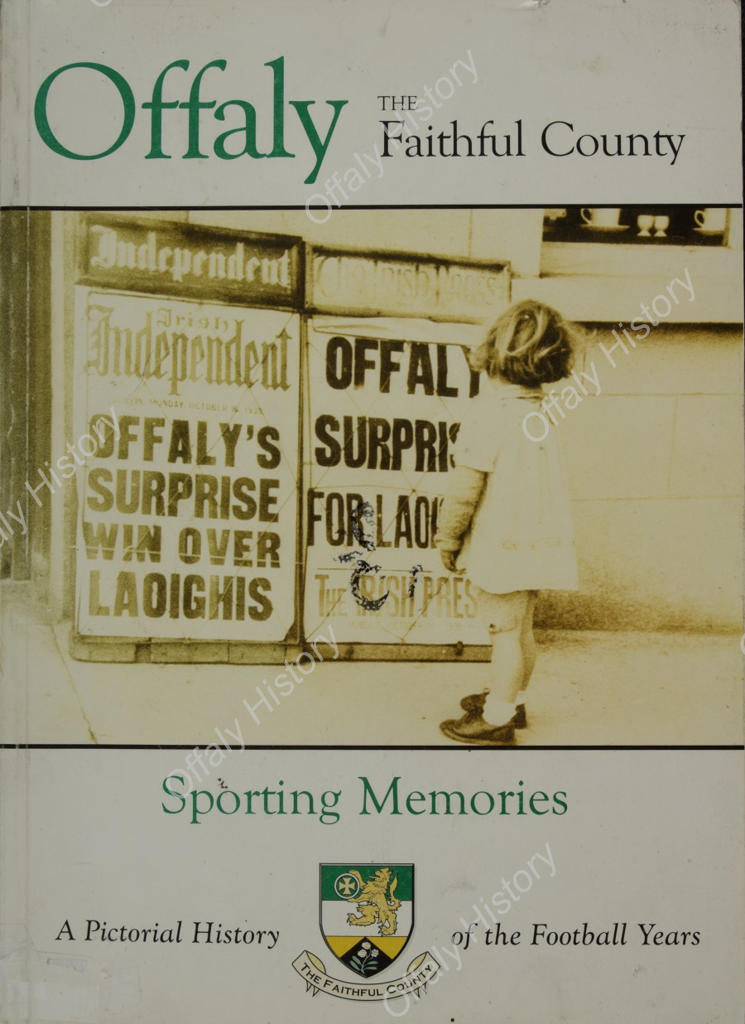
My aim is to do a proper history of Offaly GAA, one that transcends its mere sporting contribution to the county. To a very large degree, the GAA successes from the 1960s through to the 2000s contributed greatly to the well-being of Offaly as a county and provided its own distinct unique identity. Whether you have any interest in sport, GAA doesn’t float your boat or you prefer other sporting codes, the importance and contribution of the national games to Offaly simply can’t be understated.
(more…)
-
The rediscovery of Bloomville, County Offaly. Christopher Fettes. Blog No 221, 29th August 2020

Bloomville, Cloneygowan, County Offaly On June 15th 1991, I climbed a locked gate marked Bloomville, just as the rain stopped and the sun came out. There were some lovely beeches, but no sign of a house. I then spotted two ancient chestnuts, and it was only then that I could see the house in the distance.
It was a case of love at first sight, with everything sparkling in the sunshine, and I wondered why the agent’s advertisement had not included a photograph. Only when I approached the house could I understand the reason. The traditional roses (still flourishing 29 years later) looked pretty, but, close up, the house looked very neglected.
(more…)
-
No 2, Sources for Offaly History & Society: some of the older printed books – Sir Charles Coote, General view of the agriculture and manufactures of the King’s County with observations on the means of their improvement. Dublin, 1801. Blog 212, 29th July 2020
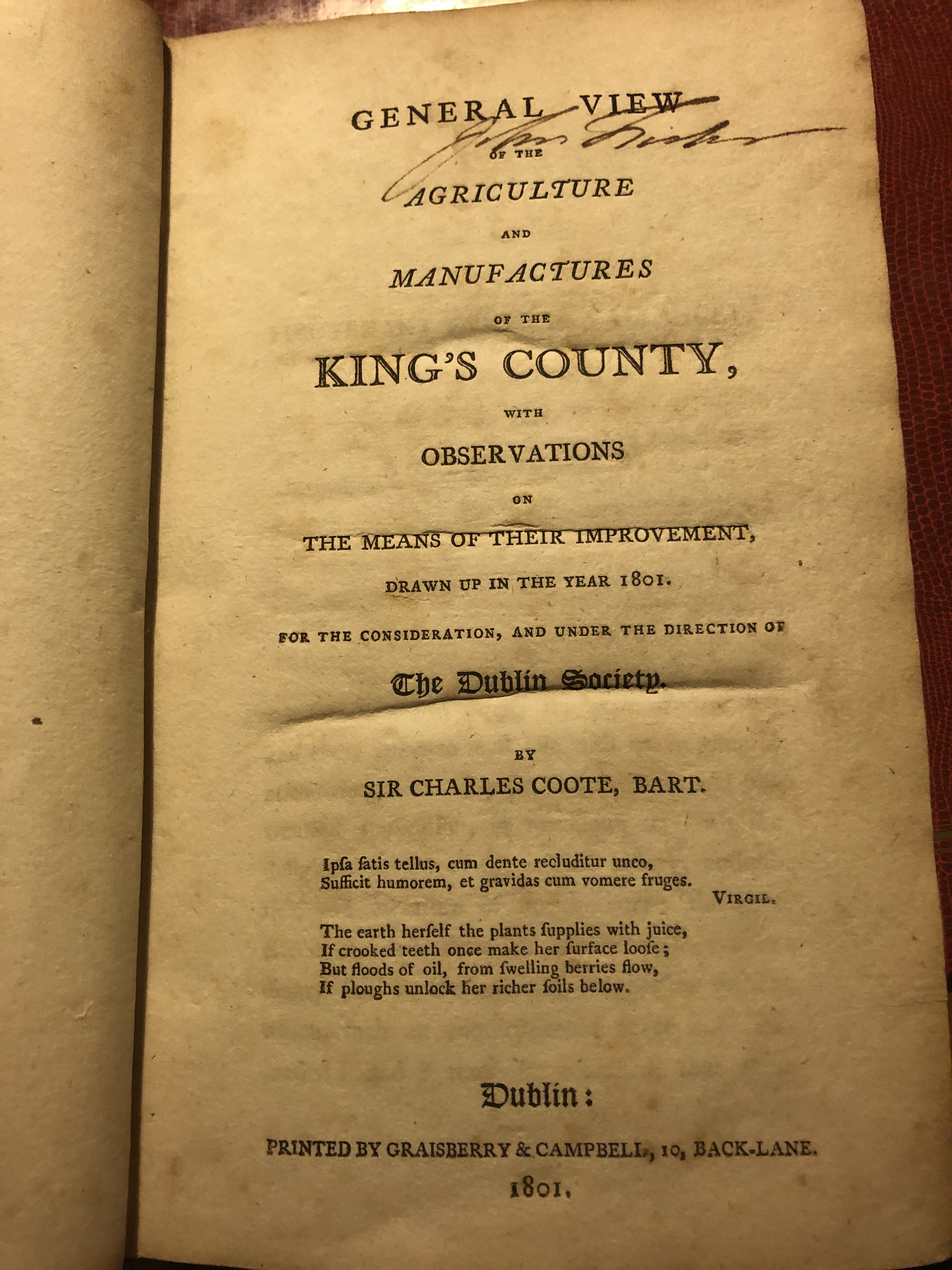
John Foster’s copy of Coote’s, King’s County Survey. Offaly Archives is collecting all the rare books on the county for the county collection. Foster was the last Speaker in the old Irish Parliament and strongly opposed the Union. He was a vice-president of the [Royal] Dublin Society until the 1820s and was ennobled as Lord Oriel. He and his father were great improvers even when it was not economic for them to do, or prudent. Foster was a great bibliophile which may have been a comfort to him in his cash-straitened latter years. This week as a substitute for our cancelled lectures during Covid we list some of the older books on Offaly History and some of which are still of use and must be consulted. The list is by no means complete and does not cover archaeology or geology. By older we mean studies mostly published before 1920 and many being diocesan histories. One book that is essential to look at is the Dublin Society survey of the county in 1801. This is the first book published about County Offaly/King’s County and deserves a read before moving on. John O’Donovan when preparing the ordnance survey memoirs in the 1830s had occasion to use Coote, among other books, and considered Coote a blockhead and worse. Yet, there are some nuggets for those who are patient. Coote was trying to promote for the Dublin Society (later Royal Dublin Society) agricultural education. The farming societies were not started until the 1840s and wilted in the Famine years. It was the 1900s before countrywide education in agricultural methods began with Horace Plunkett, agricultural cooperation and the Department of Agricultural and Technical Instruction.
-
Interesting Graves and Graveyards of Offaly. By Stephen Callaghan. Blog No 193, 29th April 2020
Back in 2014 I was an intern in the Heritage Office in Offaly County Council. I compiled a database of all known post 1700 burial grounds in the county. Compiling the database required thorough desk and field based research. During fieldwork I visited 170 of the 187 burial grounds I recorded. While visiting these places I noted many interesting and unusual features, some of which are the basis for this blog post. The list is of course subjective. There are certainly more interesting and unique features waiting to be discovered in Offaly burial grounds. (more…)
-
Researching the story of your house: Brady’s shop, Daingean, Offaly and some of Daingean’s old families. By Claire Gogarty. Blog No 176, 22nd Feb 2020
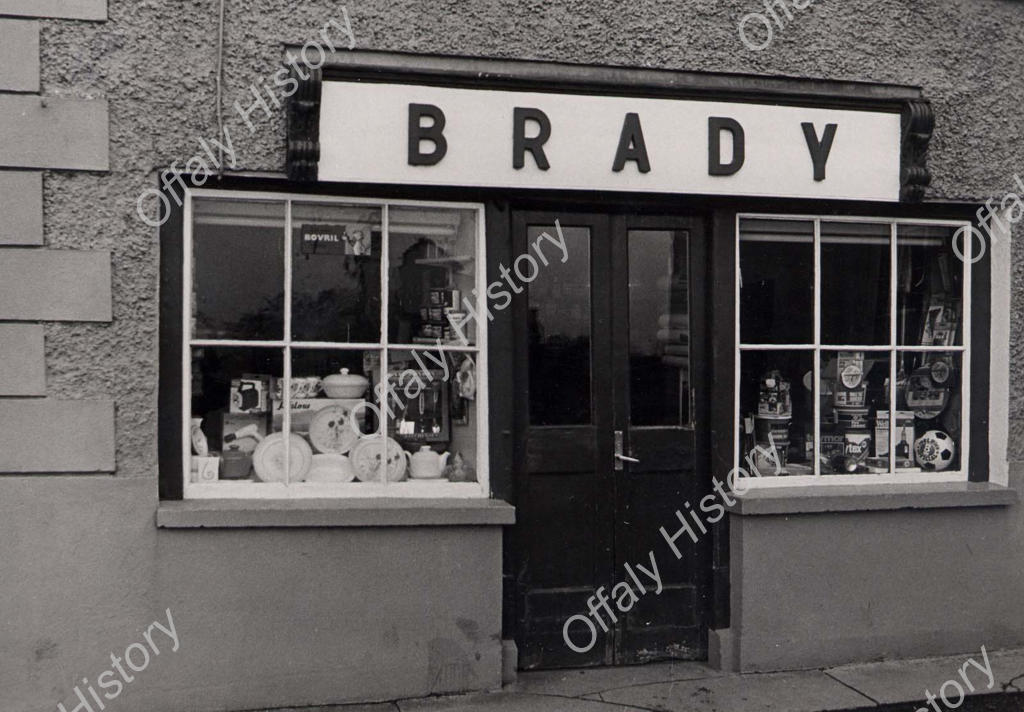
Brady’s shop, Daingean in the 1980s I was asked by John Brady to research his house, which has long functioned as a shop in Daingean, Co. Offaly. John Kearney’s book From the Quiet Annals of Daingean contains a picture of the old post office, with the name Z. Collins above it, and a large ivy-covered wall beside it, taken some time at the beginning of the 20th century. This is the same building, so it was going to be very interesting to find out all about it.
 offalyhistoryblog