Nineteenth-century Edenderry experienced a prolonged building programme, spearheaded by successive members of the Hill family, marquess’ of Downshire. Chief amongst these was the building of a branch line of the Grand Canal to Edenderry in 1802, furthering the line which had passed within two kilometres of the town in 1796. This line brought extensive investment to the area and was the catalyst for the building of stone and slated houses which replaced cottages and cabins.
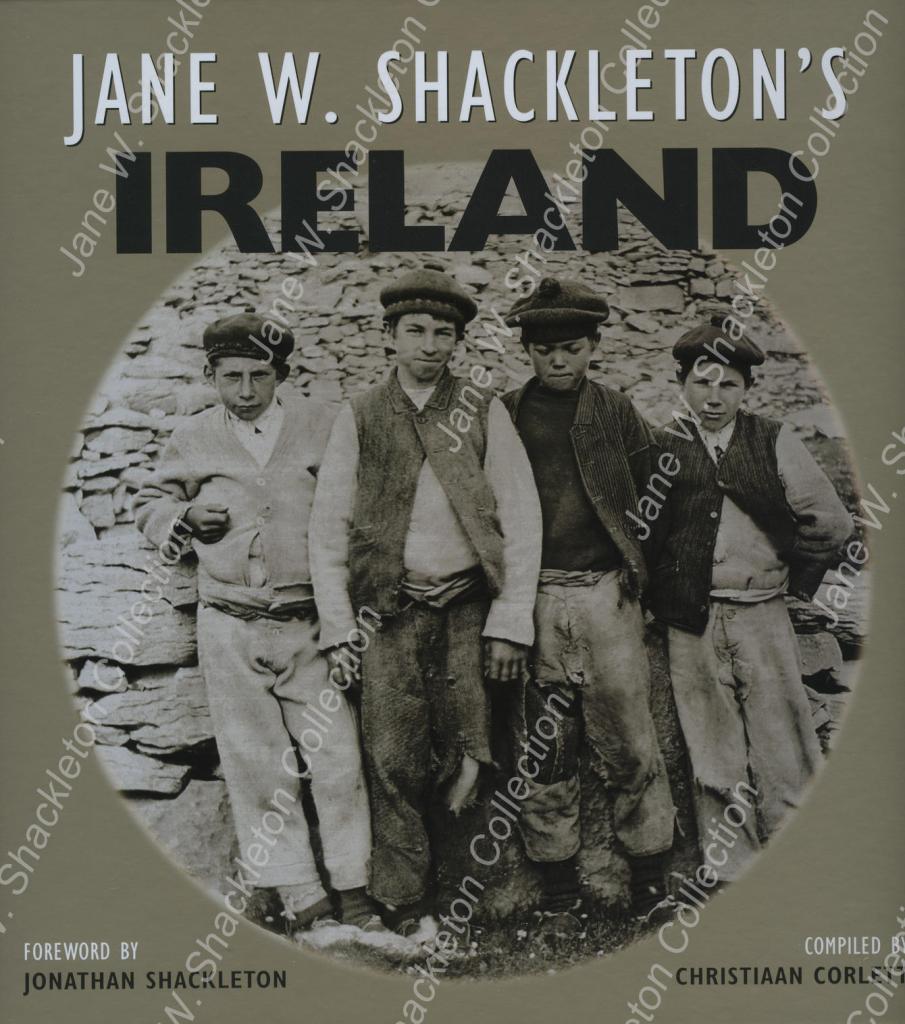
Jane W. Shackleton’s Ireland compiled by Christiaan Corlett (Cork, 2012) is an attractive large format publication was issued by Collins Press and consists of 180 well produced photographs by Jane Shackleton. These pictures are important for the photographic record in County Offaly and mostly date to 1894.
Not surprisingly there are many pictures of mills in this book and there are about ten pictures of Offaly interest. Jane Shackleton started taking pictures in the 1880s and made several tours on the Shannon and along the Grand Canal and Barrow lines. These waterways photographs contribute greatly to the history of the canals and the great mills which were associated with river locations. Many of these were in fact owned by Quaker industrialists. Like other interested women of the period Jane Shackleton was a member of the Royal Society of Antiquaries (RSAI) and took photographs of some of their tours including that of June 1904 around Ireland. Midleton Biddulph, the amateur photographer and retired army officer of Rathrobin near Tullamore was also on this trip and some of his pictures survive and have been published as Rathrobin and the two Irelands; the photographs of Middleton Westenra Biddulph, 1900–1920 (Tullamore, 2021). Corlett informs us that the Shackleton collection consists of 1,000 lantern slides and 44 albums containing several thousand prints, mostly of Irish subjects. This writer had the pleasure of seeing some of the Grand Canal and the turf works at Pollagh back in the early 1970s with Richard Shackleton and Jonathan Shackleton.
Along our Grand Canal Journey from Edenderry to Shannon Harbour we come to Rathmore, a small townlands, on the south side of the canal. Rathmore is in the Electoral Division of Edenderry Rural, in Civil Parish of Monasteroris, in the Barony of Coolestown, in the County of Offaly.
The Irish name for Rathmore is An Ráth Mór meaning great, big ring-fort.
Here we can find the site of a possible Enclosure, it can be seen in outline from aerial photos. Enclosures are one of the most common sites found in Co. Offaly, with over hundred found all over the county. They are often similar to other types of enclosures defined either by a bank or a fosse, such as the Ringforts.
They are identified from other enclosures by being either very large or small and without an entrance. Many are only known as cropmarks, visible only from aerial view, they have no original dates but some may be from the Iron Age.
At the opening of the nineteenth century Edenderry was said by one observer to soon ‘be a heap of ruins.’[i] The new Grand Canal was expected to bring relief to Edenderry and the surrounding hinterland. In the aftermath of the 1760s economic downturn in the woollen industry Edenderry suffered greatly having once employed 1,000 workers in the trade.[ii] The Downshire estate in the town and surrounding hinterland consisted of 14,000 statute acres of land.[iii]
The linking of Edenderry to the canal was of economic necessity in the last decade of the eighteenth century. As Ciarán Reilly explains:
‘Without the Grand Canal, Edenderry in the nineteenth century would have not as prospered as it did, the canal providing a much needed communication network and transportation for goods such as peat, corn and flour to Dublin.’[iv]
Charles Vallancey believed ‘the peasantry are starving and nothing will contribute so much to their relief as the Inland Navigation.’ John Hatch, as Edenderry agent for the Blundell estate was aware of the potential for economic progress of the Grand Canal for the town. (5 W. A. Maguire, ‘Missing persons: Edenderry under the Blundells and the Downshires, 1707-1922’ in William Nolan and Timothy P. O’Neill (eds), Offaly: History & Society (Dublin, 1998), pp 515-542 at p. 524.)
In June 1787 Hatch alerted the Blundells that it was confirmed the canal would pass near Edenderry:
‘… by this resolution of the company everything will rise again and higher than ever and I have not now the smallest doubt of our going on with the canal to or near Edenderry.’[vi]
A case can be made for declaring that the Grand Canal in Offaly is the county’s greatest building. No other structure has contributed so much to the economic development of so many of its towns and villages over the last 230 years. In addition, it has supported the recreational wellbeing of local citizens for a hundred years or more and seems set to do so exponentially in the decades ahead. It also preserves a relatively undisturbed wildlife corridor for many of our threatened flora and fauna species. The canal has its own rich cultural identity, much celebrated in literature and music. Its components, listed below, still combine to create an architectural entity that is almost fully operational although in a fashion undreamt of when it was first conceived in 1715, well over 300 years ago.
Combining the Shannon or Main Line (1793–1804) and the Kilbeggan Branch (1830–35), the stretches of the canal in Offaly and Westmeath took just over fifteen years to build. As it flows forty-four miles from Cloncannon, south-east of Edenderry, to Bunbrosna and Minus, downstream of Shannon Harbour, and eight miles along the Kilbeggan Line, its architectural components present a staggering list: it tumbles through sixteen locks; crosses five large aqueducts; supports and reflects forty or so ancient and modern bridges; funnels into its own channel an array of supplies or feeders, kept in control by a strategically placed system of overflows or overspills; conducts scores of unwanted streams, syphoned and otherwise, through scores of tunnels or culverts, under its non-porous bed to nearby rivers and gently glides along between a hundred miles of well-staunched towpaths and embankments to a seamless confluence with the brimming Brosna and the Lordly Shannon.
The death of Ger Connolly at Droimnin Nursing Home, Stradbally on 25th January 2024 marks the end of an era in the political life of County Offaly.
Aged 86 Gerard C (Ger) Connolly was a former Fianna Fáil councillor, TD and Minister of State who might best be described as the great survivor of Offaly politics, with an unbroken record as TD from 1969 until his retirement in 1997. He was witness to and an important figure in some of the most turbulent times in Irish politics, as a devoted supporter of Charles J Haughey during the Eighties.
His entry onto the national stage and his electoral record mark him out as one of the most significant figures in a five seat constituency with no shortage of political titans including a former Taoiseach and three former cabinet ministers.
Colourful, engaging and often provocative in political debates Ger Connolly was hugely popular throughout the constituency, securing first preference across traditional party boundaries, especially in North Offaly. He loved the cut and thrust of politics and his one liners and bot mots, delivered with theatrical flair, often enlivened debates in Offaly County Council and Dáil Eireann.
He was also a diligent constituency worker and as Minister of State made a significant contribution to the implementation of new policies on urban renewal and inner city development.
Strongly supportive of the construction industry and a firm believer in encouraging private sector development he relished his role as Minister of State at the Department of the Environment. He had a reputation as a decisive Minister of State and enjoyed good relations with civil servants, often surprising those who might have initially mistaken his mischievous smile and faux distain for detail.
This week we look at the background to the Vallancey report on the Offaly towns carried out in 1771 to facilitate the construction of the new Grand Canal line from Dublin to the Shannon. Vallancey was then a young engineer, employed to report to the Commissioners of Inland Navigation and his findings were published in a little known and very scarce pamphlet, AReport on the Grand Canal or Southern Line (Dublin 1771).[2] This report is useful as a window on some of the north King’s County (hereafter generally referred to as Offaly) towns and villages and all the more so because of the scarcity of published accounts of the midland towns prior to 1800.[3] The report was published in the same year as that of John Trail who was at the time employed by Dublin Corporation.[4] Vallancey was writing with a mission. He was being paid to spin the story of the benefits that would come from inland navigation and to highlight the difficulties with road transport and its adverse impact on competition and pricing of commodities so as to bolster the arguments in favour of canal construction and satisfy those who were paying his consultancy fees.
Why not contribute to our series of blog articles on the Grand Canal in Offaly – info@offalyhistory.com.
This month we begin a series of articles on the history and heritage of the Grand Canal in County Offaly that will run to upwards of 50 blog articles in 2024 and have its own platform on our website, http://www.offalyhistory.com. Our aim is to document the story of the course of the canal from the county boundary east of Edenderry to Shannon Harbour in the west. Today the Grand Canal is one of the greatest amenities that County Offaly possesses and we want to tell the story, and for readers to contribute by way of information and pictures. All the material will be open to be used on our website and the format will allow for editing to improve and to receive additional information from you the reader, which will be acknowledged. So Buen Camino as we make our journey through a quiet and well-watered land. The year 2024 marks the 120th anniversary of the completion of the Shannon Line at Shannon Harbour and may also see the completion of the canal greenway in this county.
It was 2003 when the first issue of Offaly Heritage was published. Just twenty years later the twelfth book of essays will be issued by Offaly History on 6 October 2023 at the Offaly History Centre at 6 p.m. and launched by a son of Tullamore, Terry Clavin. Terry is a distinguished historian who works with the Royal Irish Academy and has contributed over 400 biographies to the Academy’s Dictionary of Irish Biography. This is now available online and is a tremendous resource with about 11,000 biographies and eleven published volumes in the main series with a significant number of ancillary publications.
Offaly Heritage 12 is another bumper issue with over 500 pages and very much on a par in quality with the issues since no. 9 was published in 2016. It is a tremendous achievement and, no doubt, benefits from the support of the programme for the Decade of Centenaries and Offaly County Council.
For this issue there was a team of editors – Michael Byrne, Dr Mary Jane Fox, Dr Ciarán McCabe, Dr Ciarán Reilly, Lisa Shortall. Obituaries Editor: Kevin Corrigan.
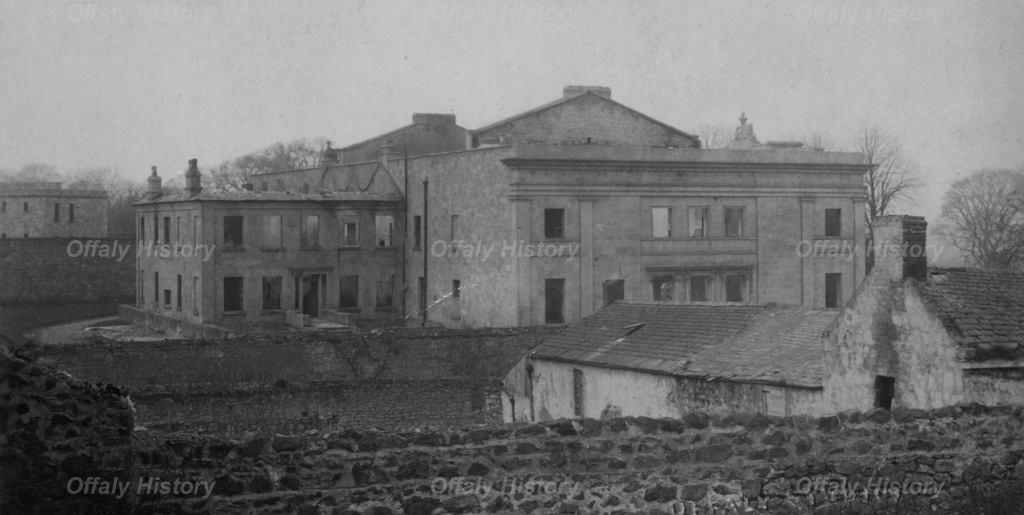
The shell of the county courthouse, July 1922
The essays in section one reflect the ongoing research in Offaly into aspect of life in Ireland 100 years ago as we come to the end of the Decade of Commemoration (1912–1923). The essays reflect the changing nature of society in Offaly at that time, particularly during the years 1920 to 1923 and readers will enjoy contributions as varied as the end of the Wakely family of Rhode; the final years of the Leinster Regiment at Birr; the Protestant minority in Offaly during the revolutionary period; the courts of assize in King’s County in the years 1914–21; the burning of Tullamore courthouse, jail and barracks in 1922; the story of Belgian refugees in Portarlington, and Offaly claimants in 1916.
A series of short lives are presented in this volume, as they were in Offaly 11 and includes entries on individuals as diverse as J.L. Stirling, Averil Deverell, Middleton Biddulph, Robert Goodbody and volunteer Sean Barry.
Laois Offaly is again to be divided into two three-seat constituencies according to the just announced electoral commission report. ‘This would be the first time that the Offaly constituency would fully align with its county boundary.’ For the 2016 General Election Laois and Offaly were divided and to the Offaly constituency was added 24 electoral divisions from North Tipperary. Laois-Offaly was adopted again for the 2020 general election. Now what was it like in the first Free State election in 1923 just 100 years ago? It was remarkable that the 1923 general election held on Monday 27 August 1923 was in general peaceful. It was only in early July 1923 that Ministers Milroy and Blythe spoke at a Cumann na nGaedheal (CnG) meeting in Tullamore in what was described by the Chronicle as scenes of an unprecedented character in the history of public meetings in Tullamore. The ‘supporters of Mr de Valera’ had posted anti-government posters about the town recalling the executions of Byrne and Geraghty, and also the three young men shot in Birr on a charge of armed robbery. On the office of the state solicitor, James Rogers, in High Street, Tullamore was pasted the words ‘Come inside and see the executioners’. Rogers would have been known both sides in the civil war as someone who defended Sinn Féin prisoners in the 1917–21 period. The newly appointed civic guards kept the peace between Cumann na Gaedheal supporters and supporters of the Republican IRA.[1]



 offalyhistoryblog