This month we begin a series of articles on the history and heritage of the Grand Canal in County Offaly that will run to upwards of 50 blog articles in 2024 and have its own platform on our website, http://www.offalyhistory.com. Our aim is to document the story of the course of the canal from the county boundary east of Edenderry to Shannon Harbour in the west. Today the Grand Canal is one of the greatest amenities that County Offaly possesses and we want to tell the story, and for readers to contribute by way of information and pictures. All the material will be open to be used on our website and the format will allow for editing to improve and to receive additional information from you the reader, which will be acknowledged. So Buen Camino as we make our journey through a quiet and well-watered land. The year 2024 marks the 120th anniversary of the completion of the Shannon Line at Shannon Harbour and may also see the completion of the canal greenway in this county.
We need wind energy, but are we to give up on saving the bogs and destroying natural and community amenity in the process? This article looks at the works at Clongawney bog and the real threat to Lemanaghan and the natural heritage of County Offaly. More transparency is needed and more care about what outcomes we intend to have in Offaly in regards to our landscape. Will the area of Lemanaghan be now destroyed? We in Offaly need to revisit this and ensure care is taken and proposed works assessed by independent experts . The works proposed for Lemanaghan need to be scrapped or scaled back to protect what should be a special conservation area. Communities need to know what is happening to their local landscape. What has happened so far at Clongawney?
Clongawney works
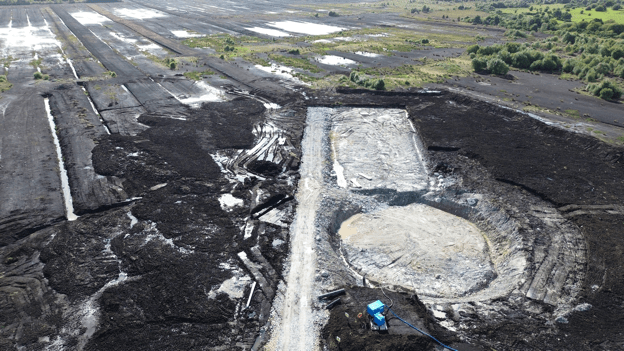
It is difficult not to be disturbed and distressed by the images below which shows excavation in progress for a wind turbine base in Clongawney bog. There is an enormous amount of destruction and disruption for a relatively small base. And what makes the situation much worse and even more disturbing is that the turbine is clearly located in bog wetlands. In a few years this area will be covered in vegetation and will be home to a variety of wildlife. And right in the middle will stand a massive turbine with massive blades. The bogs are special places. They have suffered so much over the last 70 years. Ignorance and necessity may be the explanation for what happened. However there is no excuse now. This is permanent destruction of our bogs. How can this be allowed to happen ?
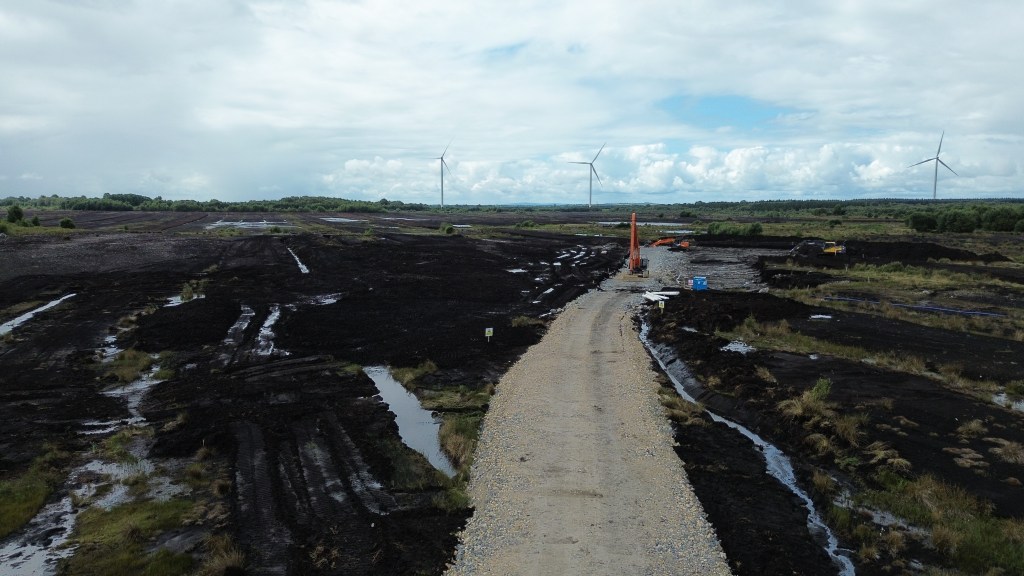
Below are photographs of the works at Clongawney Bog near Banagher and the works which must conflict will all our plans to protect the natural environment.
CLONGAWNEY IS LOST. DERRINLOUGH IS LOST. LEMANAGHAN IS NEXT.
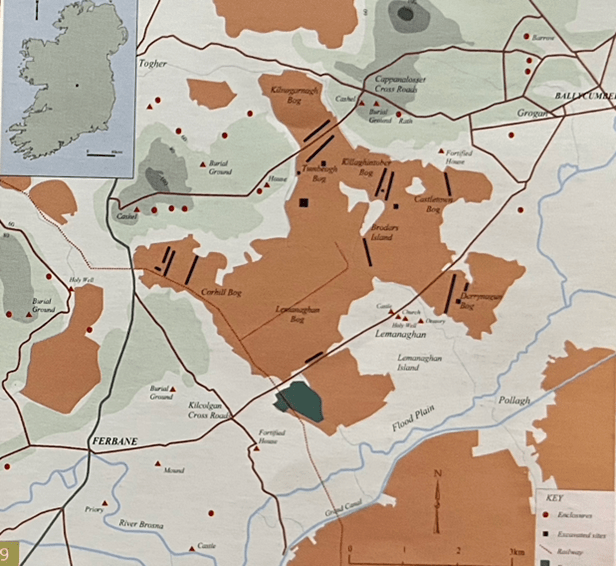
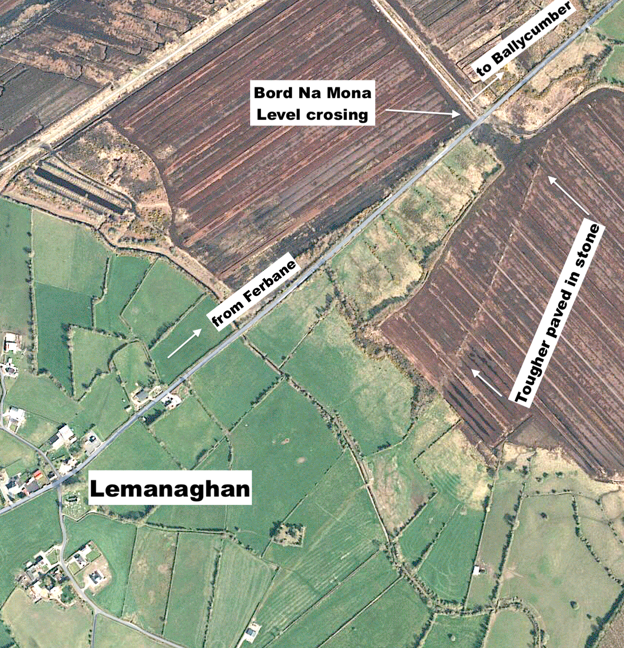
There can be few places in Ireland of more historic importance than Lemanaghan. The image above shows the location of several toghers which have been found on Lemanaghan Bog. Amazingly the largest togher on Lemanaghan can be seen clearly from space! Click on the Google Earth link and be astonished.As can be clearly seen from the map above the bog is criss-crossed with ancient toghers and holds an array of archaeological sites. It would be unthinkable to put wind turbines on the callows or the eskers or the bogs that surround
Links in higher resolution to some of the pictures below.
This is a dramatic way to show this fabulous togher Lemanaghan Togher
The massive dumper which can be seen on this image helps size this extraordinary motorway type junction on Clongawny Bog. This motorway/roadway will only be used once to transport the components for a turbine and then….? To comprehend the scale of what is happening you need to visit to Clongawny.This find took place a few weeks ago on Clongawny Bog, just a mile or so from Banagher. Note wind turbine construction activity in the background. It is piece of timber with at least two square holes worked by human hand, possibly two thousand years ago. The piece is located on the side of a drain about half metre below the bog surface. No doubt there are many more precious archaeological artefacts and sites awaiting discovery in Clongawny and Lemanaghan and in other bogs.This image shows an extensive deposit of bog iron ore also on Clongawny Bog. In the background are tens of thousands of stone are being poured onto the bog surface.
Bord Na Mona Bogs in 2023 A Brief Summary
Peat harvesting ended in 2020 but finished on many bogs more than 20 years earlier. There is at least 1 metre of bog remaining on all bogs and more than 2 metres in most places.
Return to nature
A wide variety of vegetation has become established on many bogs with little interference from anyone with the possible exception of the blocking main drains. Drinagh is now a beautiful area of perhaps 1000 acres with wide expanses of vegetation interspersed with water and inhabited by a variety of wild life.
Rewetting
Extensive ‘rewetting’ has been carried out on a few bogs. This mainly involves the construction of ‘berms’ about 3/4 metres high and up to 7 metres wide thereby dividing the bog into fields a few acres in size. The berms prevent water runoff and hopefully in time will lead to growth of sphagnum moss. This system is totally dependent on rainfall and long dry spells will be a significant test as well as fire risk when berms dry out. Derrinboy bog is a good example and is easily accessed from the Kilcormac- Kinnitty road.
Wind turbines
Wind turbines were erected on Mount Lucas bog a few years ago and are now in progress on Clongawney and Derrinlough bogs. Because of the heavy and sizeable components a grid of motorway type roads have to be constructed on the bogs. These are supported on mats of very heavy duty plastic as bogs are not capable of taking weight. On completion access is secured and controlled by BNM. If Mount Lucas is taken as an example wind turbine farms will not be an attractive place to visit unless cycling or walking on 7 metre wide ‘straights’ can be considered exciting. There is a real fear that at some point in the not too distant future BNM wind farms will be packaged and sold off to international investor funds.
Tracks and Trails
Substantial state funding is now available to help make the 10s of 1000s of acres of post peat harvesting bogs interesting and attractive places to visit for locals and visitors. The management of this fund seems to rest entirely with BNM. There are hundreds of kilometres of bog rail track which can be easily made into walking and cycle ways. All of the bogs have raised headlands where no harvesting took place and these are ideal and save places for cycling or walking. It is important that those playing a role in the design of this project have a familiarity with and sensitivity to the bogs and to the locality.
It was 2003 when the first issue of Offaly Heritage was published. Just twenty years later the twelfth book of essays will be issued by Offaly History on 6 October 2023 at the Offaly History Centre at 6 p.m. and launched by a son of Tullamore, Terry Clavin. Terry is a distinguished historian who works with the Royal Irish Academy and has contributed over 400 biographies to the Academy’s Dictionary of Irish Biography. This is now available online and is a tremendous resource with about 11,000 biographies and eleven published volumes in the main series with a significant number of ancillary publications.
Offaly Heritage 12 is another bumper issue with over 500 pages and very much on a par in quality with the issues since no. 9 was published in 2016. It is a tremendous achievement and, no doubt, benefits from the support of the programme for the Decade of Centenaries and Offaly County Council.
For this issue there was a team of editors – Michael Byrne, Dr Mary Jane Fox, Dr Ciarán McCabe, Dr Ciarán Reilly, Lisa Shortall. Obituaries Editor: Kevin Corrigan.
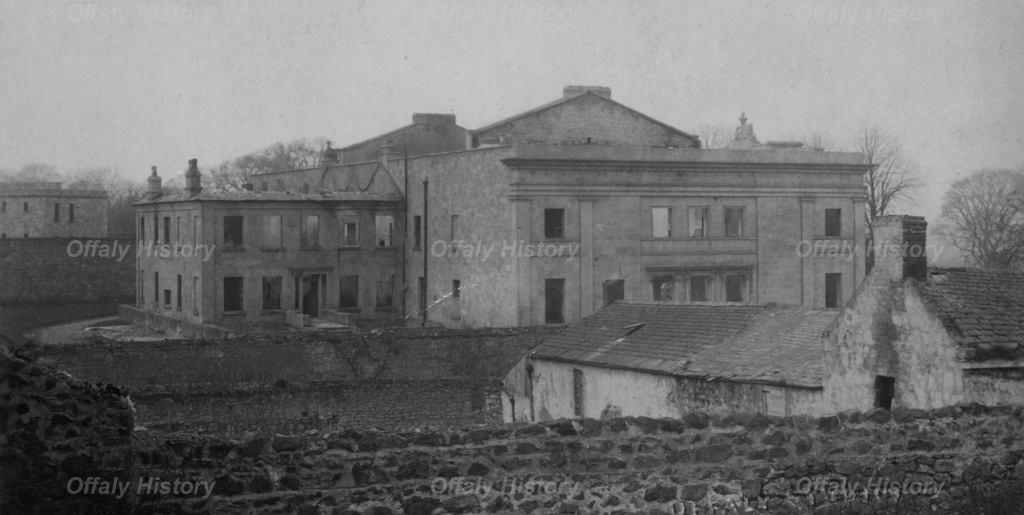
The shell of the county courthouse, July 1922
The essays in section one reflect the ongoing research in Offaly into aspect of life in Ireland 100 years ago as we come to the end of the Decade of Commemoration (1912–1923). The essays reflect the changing nature of society in Offaly at that time, particularly during the years 1920 to 1923 and readers will enjoy contributions as varied as the end of the Wakely family of Rhode; the final years of the Leinster Regiment at Birr; the Protestant minority in Offaly during the revolutionary period; the courts of assize in King’s County in the years 1914–21; the burning of Tullamore courthouse, jail and barracks in 1922; the story of Belgian refugees in Portarlington, and Offaly claimants in 1916.
A series of short lives are presented in this volume, as they were in Offaly 11 and includes entries on individuals as diverse as J.L. Stirling, Averil Deverell, Middleton Biddulph, Robert Goodbody and volunteer Sean Barry.
The founding of Tullamore Credit Union in April 1963 was one of the best things that ever happened in Tullamore. The same can be said of the credit union movement founded in Ireland in the late 1950s. How did it come about? How was it sustained? Who were the leaders, managers and staff at the front line? The success of a community-based, people-centred and voluntary effort is all the more relevant today when people often have only machines to turn to in the provision of services and some feel disenfranchised both at local and central government level. ‘We ourselves’ was heard a lot in this ‘Decade of Centenaries’. It was also the cry of the credit union founders in the Lemass-led early 1960s when practical steps were taken to stem the flow of emigration and provide employment opportunities at home through the provision of credit where it could be useful.
A contribution to marking the Decade of Centenaries in Offaly and recalling the past generations and the towns and villages on the eve of the War of Independence
In marking the years from 1912 to 1923 we may think that the years around 1916, the War of Independence and the Civil War were times of unmitigated strife. Not so. Normal life continued, if punctuated by violent acts, such as the shooting of policemen in Kinnitty, Kilbeggan or Tullamore. The finding of bodies of spies, ‘the disappeared’, in Mountbolus or Puttaghaun. The holding of brief gunbattles in Ballycommon or Charleville Road. Worst of all the organised state violence condoned by Churchill and Lloyd George in the form of the Black and Tans racing through towns and villages in the dead of night and taking shots at anything that moved. Yet normal life continued and no better illustrated than by the issue, almost every week, (Offaly Independent excepted as the printing works was destroyed by British forces ) of the three or four local papers in Offaly and from time to time trade supplements or special publications such as trade directories that very much illustrate local business in most of the Offaly towns. Recently Offaly History acquired the 1919 MacDonald’s Trade Directory for Ireland to add to its collection at Bury Quay, Tullamore.
It was a quiet afternoon on Monday 3 July 1922 when Thomas Mitchell, the manager of the Ulster Bank in High Street, Tullamore was shot dead by the IRA in the course of a robbery carried out by the Republican IRA (often then called the Irregulars to distinguish them from the Free State’s National Army). Sometimes these events are called ‘daring raids but in this case and for three months previously there were no RIC policemen and the town of Tullamore was in July under the control of the Republican IRA. The Four Courts had been evacuated on 30 June and the battle for Dublin would soon be determined in favour of the Free State army. By 20 July Tullamore would be under the control of the Free State, but with pockets of Republican forces still in the countryside including in some of the bigger houses such as Rathrobin, near Mountbolus. A report of the Mitchell shooting by way of the inquest was published on 8 July by the Offaly Independent which was based in what was by then Free State territory. The issue of the Midland Tribune for 8 July is not available and both it and the Offaly Chronicle were published in Birr in the heart of Republican army territory. Both papers were censored and afraid to offend.
The Offaly Chronicle 20 July 1922
The Offaly Independent issues of early July were burned by the Republicans in Tullamore. The Independent had been a fearless supporter of Sinn Féin from 1916 to its destruction by the British military in November 1920. It reappeared in February 1922, but its owner Thomas Chapman was unwell and died in April 1922. It was now staunchly Free State whereas the Midland Tribune sought to have unity under its editor James Pike, also a staunch Sinn Féin supporter. The Chronicle after the death of John Wright in 1915 lost any unionist gusto it had and would have been afraid to be outspoken from the time of the Truce and the departure of the British in March 1922. July 1922 was a time when wise counsel was to remain silent. The Christian Brothers used to say it was a trait ingrained in Offaly people!
The old Ulster Bank house in High Street. To the right is Adams, Bank of Ireland, Ulster and J.A. Kilroy hardware.(more…)
My grandmother was Margaret Lambe from Greatwood, Killoughy. Her sister married Thomas Lawless of the pub at the Blue Ball. Margaret married Timothy Conroy of Cloonagh. My mother Bridget(1904-87 , was her eldest child. She was the eldest of nine sisters and one brother, the youngest of the family who died in his infancy, and she was reared by her grandmother in Greatwood from a very young age. Margaret, my grandmother, died in 1916 after childbirth from postpartum bleeding. My mother was sent as a boarder to the convent in Ferbane run by “The French nuns” as they were known [The French missionary order of the Sisters of St Joseph of Cluny who came to Ferbane in 1896.] In my mother’s time some of the nuns in residence were born in France and still spoke French to each other. The records of her time there survive and she was an outstanding student. In November 1918, Stanislaus Murphy, Secretary to the Commissioners of Education in Ireland wrote to her, “Miss Bridget M. Conroy, The French Nuns Convent, Ferbane”, informing her that she had won, what was known as, the Banagher prize. The money paid her fees for that year in the school in Ferbane. The full title of the prize was the Diocesan Schools and Banagher Royal School Endowments.[1] My mother was very proud of her Banagher prize and she retained the letter from the Department as a prized reminder. In her old age she did put the laconic comment; “She must have had brains once!” on the back of the letter telling her of the award.
In these days when there is so much of war and pestilence it is good in looking at the Decade of Centenaries in Ireland to focus on the positive. Things that were done the good of which is still with us. So it is with technical education. Today we look at the early efforts and how positive and innovative were the early pioneers. Our own founder of Offaly History in 1938-9, James Rogers, was one who contributed. So too did those unsung heroes E. J. Delahunty and Willie Robbins. In regard to technical, or what is sometimes referred to as practical education, the earliest attempt in the county to provide such a facility was made at Birr about 1841 when the Parsonstown Mechanics Institute was established in, or to the rear, of the memorial hall at John’s Mall.[1] It was not a success. There were other experiments in agricultural education and model schools, but the first real attempt to provide children and adults with opportunities for technical or practical education came with the passing of the Technical Instruction Act, 1889. A further important stimulus was the passing of the Agricultural and Technical Instruction Act. 1899, which led to the setting up of a new department of agriculture and technical instruction. As a result of the two acts over fifty committees throughout Ireland were working to promote agriculture and technical instruction by early 1900.[2]
This week we welcome Ronan Healy, a new contributor to our series of articleson Offaly History. We are pleased to have his contribution and invite our readers to put the hand to the churn and write for the series.
In the townland of Strawberry Hill lies a cross-slab with a history that has generated a number of different theories but no definitive answer. This cross-slab is indistinct in the landscape. You would easily drive or walk past it without even noticing it. However this simple piece of stone has a history, folklore and decoration that suggests it is much more than a simple stone on the side of the road. This blog post will look at the history of the cross-slab, previous research on the slab and some suggestions for the future preservation of the cross-slab.
The scene at the railway station [Tullamore] will long be remembered. Long before the hour for arrival of the train, the stream of people to the station premises and surroundings was continuous. There was joy everywhere and the light and hope that the glad tidings brought were seen in the faces of the huge gathering. The railway station premises were thronged while from every point of vantage round about it people awaited the home-coming of the boys whose familiar faces they yearned to see once more.
Ballykinlar autograph courtesy Offaly Archives. For further on this see Offaly History and Decade of Centenaries/ gallery. ‘Autograph books were an important aspect of the material culture of the camps and the internees signed each other’s books with political quotes, inspirational messages, and artwork depicting the camps or political ideals. Although prisoners were released from the camps following the Truce in 1921, anti-treaty republicans were again interned in prison camps such as Tintown in the Curragh during the Civil War.‘ – Offaly Archives
Late 1921 was a time of ferment in Offaly. Once the Truce was announced in July 1921 attention turned to matters such as reforms in public health that would see the county infirmary along with the workhouses at Edenderry and Birr closed. The former workhouse at Tullamore was now to serve as county hospital and ‘county home’. It was a major reform pushed through by Sinn Féin who dominated much of local government, save in the urban councils of Birr and Tullamore. As more people were pushed out of the institutions and the economic situation deteriorated the demand for home help grew. Some of the ratepayers were concerned but not the Midland Tribune which was then owned by Mrs Margaret Powell who was one of the few women involved in the Birr local health committees.[1] Her editor from 1912 to late 1940s was James Pike from Roscore, Screggan. Four women sat on the Tullamore Hospitals and Homes Committee chaired by Mrs Wyer. Pike in an editorial on 17 December 1921 was to describe it as a momentous week with the secret debates in the Dáil. Offaly Technical Committee did not wait for the outcome of the Dáil debate and supported the Treaty almost immediately.[2] Supporters included the chairman Fr O’Reilly, Kilcormac, Revd John Humphreys and James Rogers as did Revd R.S. Craig.









 offalyhistoryblog