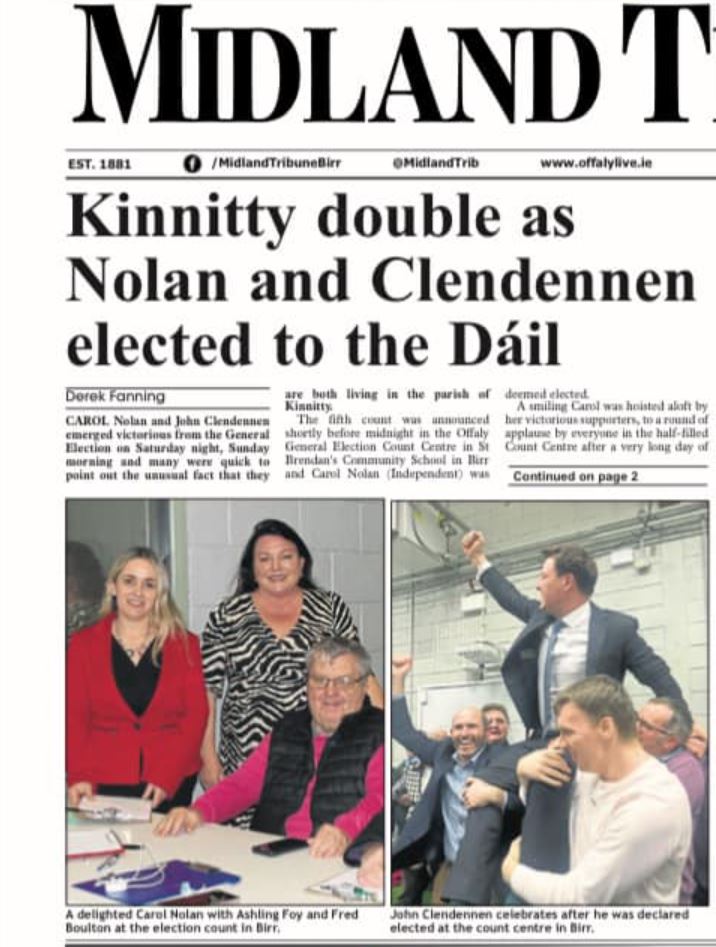
Kinnitty Parish can now celebrate having two TDs, not to mention so many of of its young men on the first Offaly team to win an All Ireland back in 1924. All part of recent celebrations. What was the village like a generation earlier in the 1890s and earlier 1900s? To find out more come to the launch of The Changing Face of Offaly towns in the early 1900s published by Offaly History and for which local woman Grace Clendennen contributed an essay. Please note the launch time of 8 30 p.m. (ed.)
From the Midland Tribune of 5 Dec. 2024
Grace Clendennen writes of Kinnitty in 1901 and 1911
Like the 1901 census, the majority of Kinnitty residents in the 1911 were born in the King’s County. There were 225 people recorded in 49 houses[1]. Roman Catholic was the most common religion stated but a sizable number, 42 out 225, stated their religion to be other than Catholic[2]. Akin to the census of 1901, eight properties were listed as ‘first-class’. Two of the properties were listed as general shops. In 1901 Patrick Egan and his wife were recorded as shopkeepers. A shop assistant, a domestic servant and a yard man lived with the Egan family.
On the morning of Sunday October 12th 1924, two excursion trains from Birr and Tullamore bringing approximately 1000 Offaly supporters left the county for Croke Park in Dublin. As the Birr train pulled into Ballybrophy, a large train full of Cork supporters was seen in waiting. However, as the Offaly train was placed in front of its Cork counterpart for departure, one excited Faithful supporter prophetically exclaimed, ‘Gosh we’re ahead of Cork, we’ll be that way all day’. His enthusiasm was greeted with the response ‘we hope so’, as the Midland Tribune (MT) reporter who witnessed the event noted the contrast in the Cork supporters who seemed unable for a moment to countenance ‘the idea of defeat’, while the Offaly supporters were travelling more ‘in hope’ of victory but with the knowledge that their team which had come through a long campaign ‘were determined to fight in every ounce of their strength’ to land the county’s first national title.
The changing face of Offaly towns in the early 1900s: An illustrated history edited by Michael Byrne with contributions from Paul Barber, Stephen Callaghan, Grace Clendennen, Kevin Corrigan, Michael Goodbody, Ger Murphy, John Powell, Laura Price, Ciarán Reilly and Brendan Ryan (Offaly History, Tullamore, 2024, 368 pp). Available from Offaly History Centre and Midland Books Tullamore and online at www.offalyhistory.com. ISBN 978-1-909822-38-2 (hard back), €27.99. The book will be launched at Offaly History Centre, Bury Quay, Tullamore – beside the new Aldi and Old Warehouse. It is already available at the Centre, online at http://www.offalyhistory.com and at Midland Books, Tullamore. If you cannot attend in Tullamore we have a launch at Giltrap’s of Kinnitty on Thursday 21 Nov. at 7. 30 p.m. We will have copies in Bridge Centre for the Christmas Sale 14 to 24 December.
Violet Magan (aged 48), a sister of Shaen Magan, was acting as land agent to Colonel Biddulph of Rathrobin, Mountbolus, Tullamore and had continued to run the estate business of after the burning of Rathrobin House in April 1923. She was born in 1876 and was well known in the midlands as a volunteer worker with the Irish Agricultural Organisation Society ((I.A.O.S.) and went everywhere on her bicycle. Colonel Biddulph departed Ireland in a hurry in June 1921. It was soon after the killing of two RIC men in an ambush at Kinnitty. At the end of June there took place the killing of two brothers at Coolacrease near Cadamstown over land or over obstruction of the IRA or being alleged informers. The jury is out on this, but it can be said that many of the big house burnings were in the interest of securing for distribution the remaining demesne and home farmlands of the once big landlords. The Biddulph brothers of Kinnitty and Mountbolus had up to 2000 acres most of which they farmed themselves. Colonel Biddulph had about 700 acres and gave good employment in the area and was popular with his workers and tenants. His brother Assheton of Kinnitty had died in 1916 and the lands were in course of being sold in 1921-22. Shaen Magan was the husband of Kathleen Biddulph, the favourite niece of Col. Biddulph was was childless.
It was 2003 when the first issue of Offaly Heritage was published. Just twenty years later the twelfth book of essays will be issued by Offaly History on 6 October 2023 at the Offaly History Centre at 6 p.m. and launched by a son of Tullamore, Terry Clavin. Terry is a distinguished historian who works with the Royal Irish Academy and has contributed over 400 biographies to the Academy’s Dictionary of Irish Biography. This is now available online and is a tremendous resource with about 11,000 biographies and eleven published volumes in the main series with a significant number of ancillary publications.
Offaly Heritage 12 is another bumper issue with over 500 pages and very much on a par in quality with the issues since no. 9 was published in 2016. It is a tremendous achievement and, no doubt, benefits from the support of the programme for the Decade of Centenaries and Offaly County Council.
For this issue there was a team of editors – Michael Byrne, Dr Mary Jane Fox, Dr Ciarán McCabe, Dr Ciarán Reilly, Lisa Shortall. Obituaries Editor: Kevin Corrigan.
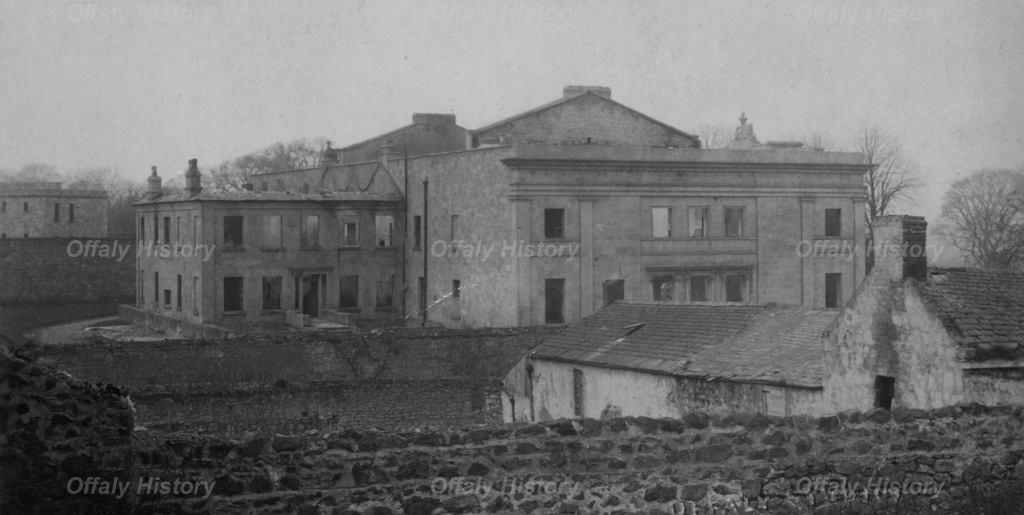
The shell of the county courthouse, July 1922
The essays in section one reflect the ongoing research in Offaly into aspect of life in Ireland 100 years ago as we come to the end of the Decade of Commemoration (1912–1923). The essays reflect the changing nature of society in Offaly at that time, particularly during the years 1920 to 1923 and readers will enjoy contributions as varied as the end of the Wakely family of Rhode; the final years of the Leinster Regiment at Birr; the Protestant minority in Offaly during the revolutionary period; the courts of assize in King’s County in the years 1914–21; the burning of Tullamore courthouse, jail and barracks in 1922; the story of Belgian refugees in Portarlington, and Offaly claimants in 1916.
A series of short lives are presented in this volume, as they were in Offaly 11 and includes entries on individuals as diverse as J.L. Stirling, Averil Deverell, Middleton Biddulph, Robert Goodbody and volunteer Sean Barry.
James Weale was appointed to the position of clerk in charge of Irish land revenue in the Commissioners of Woods, Forests and Land Revenue in 1827. The Commissioners managed the English kings’ estates. His actual position was that of the tenth clerk in the London Office but that did not describe his role in Ireland. Prior to his appointment these lands had been managed by officials in the Treasurer’s Office in Dublin Castle but following the Union of 1800 many Dublin offices were amalgamated with their counterparts in Whitehall. The Woods Commissioners were aware that the lands had been poorly managed in Dublin and were determined to introduce a better administrative structure. Weale continued to live in London but spent some months in Ireland from his first visit in 1826 till he died in Dublin in 1838. Weale had been secretary to Lord Sheffield prior to his appointment as an administrative clerk in the Woods Office in 1810. From 1827 he supervised the sales of many of the Crown’s remaining Irish estates. Further, he was the principal organizer in the few attempts to reform and regenerate life on ailing estates like Kinnitty, King’s County and Kingwilliamstown (now renamed Ballydesmond) in northwest Cork. In his management of these estates, he ran afoul of many of Ireland’s most powerful and influential landowners and encountered opposition from some of the personnel in Dublin Castle who resented the new management from London. Weale’s role in Ireland has been largely misunderstood but mainly ignored.
Kinnitty is very much on the tourist trail in Offaly and is arguably the finest planned village in the county. In this the second extract first published in 2011 in Paddy Lowry’s Kinnitty my home in the Slieve Bloom (2011) Paddy Lowry looks back to almost 100 years ago. Courtesy of Kilcormac Historical Society. Offaly History has some copies of this now scarce title for sale.
The launch of Kinnitty in 2011 with Amanda Pedlow, Paddy Lowry and Paddy Heaney. The two Paddys are now part of our heritage and we fondly remember them both.
Some of the locals in Kinnitty were fond of making up rhymes to annoy and tease each other and I remember when we were young the following would often be heard.
I first began to take notice of things in the village when I started school in 1926. Kinnitty was very different then to what it is now and indeed even twenty years after I started school there were already many changes taking place. It was a very busy and prosperous place in those times and it had a great array of businesses and personnel.
Welcome to this our 48th blog for the Decade of Centenaries. All of them will soon be posted to the Decade of Centenaries site hosted on www.offalyhistory and with thanks to all our contributors and partners and especially Offaly County Council, Offaly Libraries, the heritage office and Offaly Archives. We have now posted 302 blogs since 2016 and reached 304,000 views. Our contributors grow in number and so does this body of knowledge, free to use and enjoy across the globe. We welcome new contributors via info@offalyhistory.com.
The coming into force of the Truce in the war with England on 11 July 1921 marked the end of an era in that the struggle with our powerful neighbour was to cease. The editor of the Midland Tribune, James Pike, of Roscore, Tullamore, saw it as grounds for optimism. The Offaly Independent was burned out by the British security forces the previous November. The Chapman family paid a heavy price for their advocacy of Sinn Féin. The Birr King’s County Chronicle, as a staunchly loyalist newspaper, cannot have been much pleased with the outcome but it was accepted.
Change is always about but perhaps more so since ‘Nine Eleven’ 2001 and March 2020 than we care to appreciate. Changes in eating out in Tullamore’s streets in recent days would have come as a shock to our predecessors of 1914. We are not Spain as Brewery Tap owner, Paul Bell, recently remarked but the fine weather and the adoption of coffee over tea are all helping. In the interior things are changing too. The love of banking halls is gone and now it is all doors and screens as new ways of working come in. The new county offices inTullamore (2002), and in many other buildings, may yet have to be reconfigured, and as for nightclubs what are we to do. On top of that some Tullamore municipal councillors are talking of revisiting our list of Protected Structures to remove those buildings that cannot be sold and are falling down.
All this talk of change, inside and out, suggests that we look again at what we had in the way of streetscapes before that period of great turbulence when Ireland was on the verge of Home Rule and Partition was unmentionable. It was ‘The Sunday before the War’ time. Thanks to the work of photographer Robert French (1841–1917) and the Lawrence Studio (1865–1942) we can look back, not in anger or nostalgia, but in awe at what was achieved in our towns over the period from the 1740s to 1914, but more especially in the years of growth and prosperity from 1891 to the First World War.
The Lawrence Collection of some 40,000 photographs are well known. Perhaps less so that the online catalogue from the National Library (nli.ie) is in large format, high resolution, for the Offaly towns, allowing us to dig down/zoom in to see the detail that escapes one looking at the ubiquitous printed photograph in the pub or the tablemat. There are almost 200 Lawrence photographs for the Offaly towns and villages. For Tullamore there are at least 17, for Birr over 70, Banagher 3, Clara 20, Edenderry over 16, Portarlington 18, Kilcormac 12 including four placed in County Cavan, Clonmacnoise at least 33, Kinnitty 3, Mountbolus 1, and perhaps more to be identified. These figures are estimates and likely to change such as one of the earliest for Tullamore (late 1890s perhaps) that became available in recent years, or at least better known and the subject of this blog.
A very fine book from Kieran Hickey and Allen Lane (1973)(more…)



 offalyhistoryblog