Sometimes researching history is like trying to make a jigsaw that’s missing too many pieces. Sometimes, someone throws a few pieces from a different jigsaw in, just to complicate matters even more. This one such story.
New Arrivals in the neat little town
In May 1896 the Midland Tribune reported…
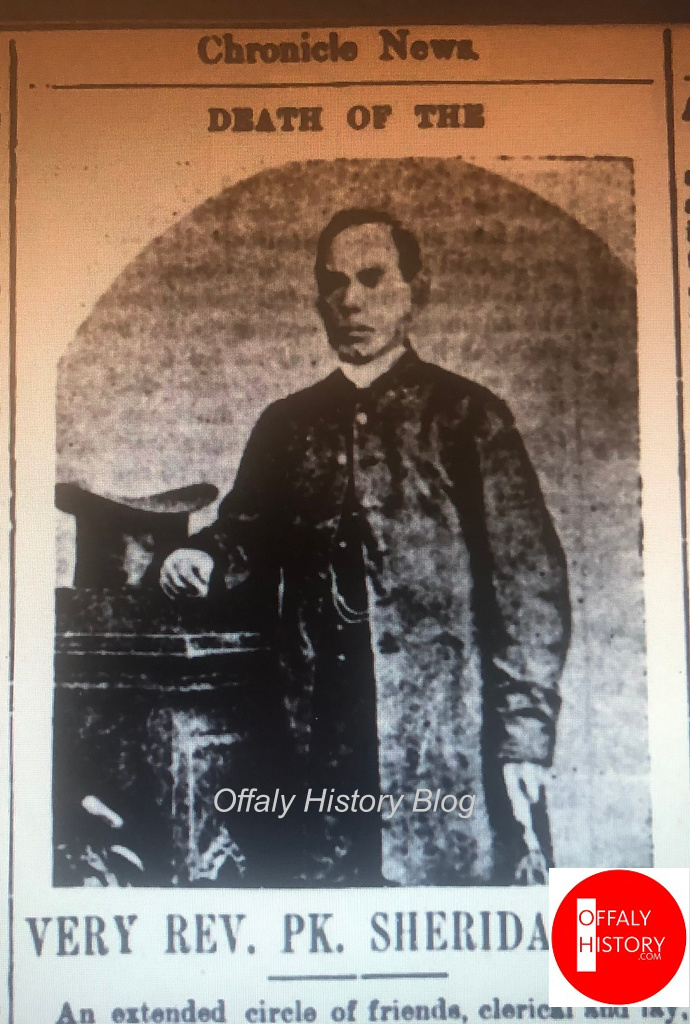
‘Tuesday last was celebrated by great festivity and rejoicing at Ferbane, the occasion being the arrival of four Sisters of the Order of St. Joseph to found a Convent in the neat little town. The nuns came at the invitation of the esteemed Parish Priest, Very Rev. Canon Sheridan who had prepared for their accommodation in the large vacant building beside the Brusna Bridge’
A Priest and his Parish
Canon Patrick Sherdian was a man who got things done, but he liked things done his way. Ordained in 1855 and stationed at Ferbane from 1875 until his death in 1899, the Canon interested himself in every aspect of his parishioners’ lives. His time in Ferbane was occasioned by conflict, be it with some members of the local home rule organisation, the Board of Guardians or his own curates. Nevertheless, his achievements were substantial. In 1894, he led the successful campaign to save the Clara to Banagher Railway branch line. Having built a national school in High Street, he set out to construct the Church of the Immaculate Conception at Ferbane. Work progressed quickly and the Canon set to work on raising the estimated £7,000 required to complete the job. To accomplish this, he organised a massive raffle and a Grand Bazaar to be held on the last week of May in 1897.
The 1824 Survey of Irish schools and the reason it was carried out must be put in context. That context probably can be traced back to the Gavelkind Act, enacted in the Protestant Irish Parliament 120 years earlier in 1704. This act brought into force what became known infamously as the Penal Laws.
The Penal Laws were intended to protect the interests of the Protestant Ascendency from any future threat from the Catholic majority. Amongst these laws was one stating that “No Catholic may attend a university, keep a school, or send his children to be educated abroad. £10 reward is offered for the discovery of a Roman catholic teacher.”
These laws were severe, but as time went by, were more observed in the breach. Teachers, many of whom lived an itinerant lifestyle for fear of discovery and arrest, moved around the country, being sheltered by families in the areas where they would provide lessons for local children, often in outdoor, secluded areas, protected from view by hedges and the alert observations of a well-positioned look-out. This led to the use of the term ‘hedge school’, the convenor of which was known as the ‘Hedge School Master’.
The changing face of Offaly towns in the early 1900s: An illustrated history edited by Michael Byrne with contributions from Paul Barber, Stephen Callaghan, Grace Clendennen, Kevin Corrigan, Michael Goodbody, Ger Murphy, John Powell, Laura Price, Ciarán Reilly and Brendan Ryan (Offaly History, Tullamore, 2024, 368 pp). Available from Offaly History Centre and Midland Books Tullamore and online at www.offalyhistory.com. ISBN 978-1-909822-38-2 (hard back), €27.99. The book will be launched at Offaly History Centre, Bury Quay, Tullamore – beside the new Aldi and Old Warehouse. It is already available at the Centre, online at http://www.offalyhistory.com and at Midland Books, Tullamore. If you cannot attend in Tullamore we have a launch at Giltrap’s of Kinnitty on Thursday 21 Nov. at 7. 30 p.m. We will have copies in Bridge Centre for the Christmas Sale 14 to 24 December.
Violet Magan (aged 48), a sister of Shaen Magan, was acting as land agent to Colonel Biddulph of Rathrobin, Mountbolus, Tullamore and had continued to run the estate business of after the burning of Rathrobin House in April 1923. She was born in 1876 and was well known in the midlands as a volunteer worker with the Irish Agricultural Organisation Society ((I.A.O.S.) and went everywhere on her bicycle. Colonel Biddulph departed Ireland in a hurry in June 1921. It was soon after the killing of two RIC men in an ambush at Kinnitty. At the end of June there took place the killing of two brothers at Coolacrease near Cadamstown over land or over obstruction of the IRA or being alleged informers. The jury is out on this, but it can be said that many of the big house burnings were in the interest of securing for distribution the remaining demesne and home farmlands of the once big landlords. The Biddulph brothers of Kinnitty and Mountbolus had up to 2000 acres most of which they farmed themselves. Colonel Biddulph had about 700 acres and gave good employment in the area and was popular with his workers and tenants. His brother Assheton of Kinnitty had died in 1916 and the lands were in course of being sold in 1921-22. Shaen Magan was the husband of Kathleen Biddulph, the favourite niece of Col. Biddulph was was childless.
This week we look at the background to the Vallancey report on the Offaly towns carried out in 1771 to facilitate the construction of the new Grand Canal line from Dublin to the Shannon. Vallancey was then a young engineer, employed to report to the Commissioners of Inland Navigation and his findings were published in a little known and very scarce pamphlet, AReport on the Grand Canal or Southern Line (Dublin 1771).[2] This report is useful as a window on some of the north King’s County (hereafter generally referred to as Offaly) towns and villages and all the more so because of the scarcity of published accounts of the midland towns prior to 1800.[3] The report was published in the same year as that of John Trail who was at the time employed by Dublin Corporation.[4] Vallancey was writing with a mission. He was being paid to spin the story of the benefits that would come from inland navigation and to highlight the difficulties with road transport and its adverse impact on competition and pricing of commodities so as to bolster the arguments in favour of canal construction and satisfy those who were paying his consultancy fees.
Why not contribute to our series of blog articles on the Grand Canal in Offaly – info@offalyhistory.com.
The Tullamore and County Offaly Agricultural Show may be described as a unique cross urban/rural community undertaking and a traditional family day out attracting up to 60,000 people to the show. The Tullamore show was rekindled in 1991 by a small group of local people representing urban and rural communities. The Tullamore and Co. Offaly Agricultural Show Society Ltd was founded in 1990 and since its inception the Tullamore Show has grown to become one of Ireland’s largest and finest one day shows with entries from the 32 counties. In the early years of the 1990s the Tullamore Show was held in the grounds of Charleville demesne and castle in the month of August.
A 2018 show launch courtesy of the Show Gallery(more…)
When Christians arrived in Ireland and started to write about the country they found an island of Gaelic kingdoms, perhaps up to 150, that was dynastic and the political organisation was based on the tuath. The tuath was the bedrock of the Gaelic political system and is described as a small kingdom. Most of what we know now has been gleaned from the Irish Law Tracts, commonly known as the Brehon Laws. Other written sources include the Hero and Saga Tales.
Rathrobin House, Mountbolus was the most modern and one of the finest of the ‘Big Houses’ burnt by the anti-Treaty IRA during the Civil War of 1922-3. Its loss was a tragedy for the district and for its owner and builder Lt Col Middleton Biddulph. Today the house is a ruin and the intended tomb of the old colonel in Blacklion churchyard remains empty. Biddulph was a generous man of independent means and was not dependent on exacting high rents from his tenants and employees with whom he was on the best of terms. Much has been written of the trauma experienced by participants in the Civil War, of the needless killings and the executions (81). It was a shocking time for the two sides and many innocent people suffered also. Perhaps some of the post-Civil War trauma and the silence can be attributed to the consideration that the war may have been an unfortunate and costly mistake. It may have seemed so to some of the participants following the success of the Free State and Fianna Fáil governments in rolling back on the oath, dominion status and the ports in the 1930–38 period. Thus confirming the ‘stepping stone’ thesis. As with the Spanish Civil War (much more violent) there is, even now, a kind of Pact of Forgetting (Pacto del Olvido) with people wanting to move on and forget about something that should not have happened. Yet, it is important to record the events of that period and what brought about the shocking atrocities especially in Kerry. County Offaly had its share in these tragedies.
Nestled in the foothills of the majestic Slieve Bloom Mountains, Ballyboy or Baile Buí, meaning the town of the Yellow Ford, is a picturesque village of rich historical significance. Like many villages in Ireland, the modest present-day facade of Ballyboy belies a history that has seen the rise and subsequent fall of an early Christian monastery, a site visited by many historical figures in the early years, including Hugh O’Neill, the Normans and even Oliver Cromwell.
St. Brigid’s Convent & St. Mary’s Church
St. Brigid founded a convent in our village in or around the year 500 A.D. The people of the village maintain that it was the very first convent she built in Ireland. The Convent was situated on the mound still known as Abbey Rath (later becoming the site of the Norman Motte and Bailey) The convent continued until 1539. Around the same time as St. Brigid built her convent, it is said that the first church in the village, St. Mary’s Church was also built. Mass would have been celebrated in Saint Brigid’s Convent or at St Mary’s church.
From 1650, when Cromwell’s army marched to the village from Cadamstown and destroyed St. Mary’s Church, until 1704, there was no church in the parish. The old church had a round tower that came almost to the centre of the present-day road. There was also a tunnel from the church to the fort at Abbey Rath. The tunnel was 400 metres long.
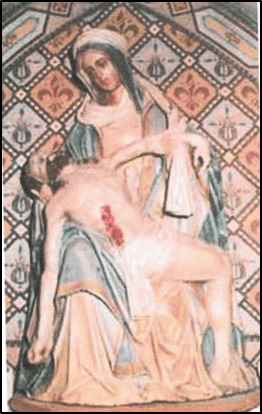
During Cromwell’s attack, the precious Pieta was bravely hidden by two McRedmond women from Knockhill. When they saw Cromwell and his men approaching from Cadamstown, they rushed to the church, took the Pieta from its place just inside the door and hid it outside in a heap of rubbish. Everybody fled to the woods and caves before Cromwell and his men reached the village, in case they would be killed. In the dead of night, for Cromwell’s army was still in Ballyboy, a party of men took the statue and carried it a short way across the Silver River and over the fields to Ballybracken, also known as Ridgemount. Here they buried it 6 feet deep in the bog below Derryhoy, where it lay hidden for over 60 years. Ridgemount is the area where the Faithful Fields are now situated. These men promised not to tell anyone where the Pieta was buried. Just before the last of the men died, he told people where it was located. When it was found, the Pieta was brought to the Church of the Nativity BVM in Kilcormac, where it still remains today.
The Pieta as it presently stands inthe Church of the Blessed Virgin Mary, Kilcormac.
During Penal Times Catholics were forbidden to practise their religion and resorted to celebrating mass in secluded places. There is still a corner field in Ballinacarrig called ‘The Mass Pit’. According to Rev. A Cogan’s “The Diocese of Meath, Ancient and Modern”, a priest was arrested in his vestments for saying mass near the Motte in Ballyboy.
St. Mary’s Church Ballyboy
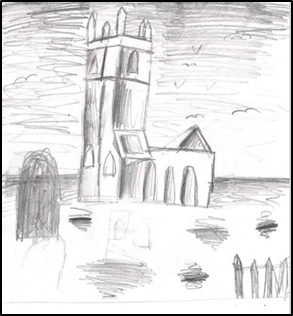
St Mary’s Church, Ballyboy by Aran Kelly
St. Mary’s Church Ballyboy
Saint Mary’s Catholic Church was taken over by the Church of Ireland between the dates 1709 and 1715 when there was renewed persecution of Catholics. The present church was built in 1815 with a loan of £900. Several years later, it was repaired with a grant of £279. In 1874, a very bad thunderstorm hit Ballyboy and the tower of the church was struck by lightning. It is said that the flash ripped a body that had been buried a few days before out of its grave. Two years after Griffith’s Valuation, the women of Ballyboy got together and subscribed a sum of money to purchase a chalice for the Church. This chalice is still in use in Kilcormac and on its base is inscribed ‘Pray for the Matrons of Ballyboy, 1856’.
Written by
Seán Lambe, Aran Kelly, Andrea Feighery, Kyle Jennings, Harry Bracken, Rory Grennan
The Normans in Ballyboy
In 1175, the Normans arrived in Ballyboy and built a Motte and Bailey in the village on Abbey Rath, on the banks of the Silver River. The Castle was initially built as a secure garrison for the Anglo-Norman army as they advanced through this region using the routeways in Fir Cheall. Once the region of Fir Cheall had been secured by the Anglo-Normans, the castle acted as a focus for settlement which grew up around and under the protection of the earth and timber castle. At the base of the mound are the remains of old walls, said by some to be the ruins of St. Brigid’s Convent.
Towards the end of the 14th century, the O’Malley’s took possession of the Anglo-Norman castle. The lands and castle of Ballyboy remained in the hands of the O’Malley’s until the Irish War of 1641-53. After this war the lands and castle of Ballyboy were confiscated by the Commonwealth government and granted to Sir William Petty. During the Williamite Wars in Ireland of 1688-91, the village and castle of Ballyboy became a garrison for Williamite soldiers. In 1690 the Jacobite forces attacked and burnt the town and the Williamite forces took refuge in the castle located on the ‘Mount’ in the centre of the village.
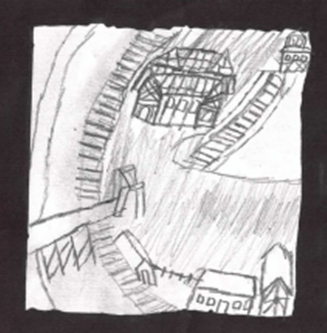
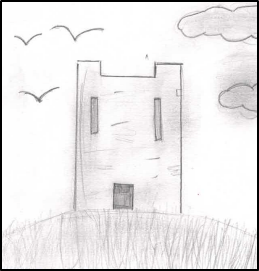
The earth and timber Norman Castle in Ballyboy by Grace Guinan
The Bailey part of the Motte and Bailey By Luke Guinan
The Norman Castle in Ballyboy by Anna Doolan
The archaeological remains of the earth and timber castle consist of a large D-shaped bailey that lies to the southwest of the low motte and survives today as a well-defined curving field boundary. The poorly preserved remains of a wall belonging to a stone structure can be seen standing on the summit of the motte. This wall may belong to the stone castle depicted standing on the summit of the motte on the 1654 Down Survey map.
In the post-medieval period, the castle was in ruins and the stone from it was probably reused in the construction of the present houses in the village. During this time, a stone wall was constructed along the base of the motte on the southern side. The church and castle with its associated settlement can be seen depicted on the 1654 Down Survey map of Ballyboy Barony. The Church of Ireland ruins are located on the site of the medieval church.
This photograph shows the motte or mound of the Anglo-Norman earth and timber castle. A later post-medieval wall cuts across the base of the motte which is visible on the left side of the photo. The footings of the stone structure can be seen on the top of the motte.
Written by
Grace Guinan, Luke Guinan, Anna Doolan, Aaron Coady
Scoil Bhríde Ballyboy
Our school, Scoil Bhríde Ballyboy is named after St. Brigid.The site of our present-day school was originally a hat and glove factory. During Penal Times, it was against the law for Catholic children to be educated, so a hedge school was set up to secretly educate local children. For a short period during the early 1700’s, the ruins of the old church in Ballyboy was used as a hedge school also.
The site of the Hedge School in Ballyboy
When Penal Laws ended in 1782 it was no longer illegal to have hedge schools so there was a school built in the village. There is little known about the school other than it had a thatched roof.
In 1820 a new school with a thatched roof was built by Lord Lansdowne’s wife. It is said that the school was also aided by an annual donation of £6 from the Marquess of Lansdowne. This school had a Protestant Schoolmaster and provided Catholic and Protestant children with an education. In 1832, the school was taken over by the Board of Education. The roof was slated and a Catholic Schoolmaster appointed. Griffith’s Valuation tells us that there was a dwelling house where the master would have lived. There was no piped water and the ditch was used as a toilet.
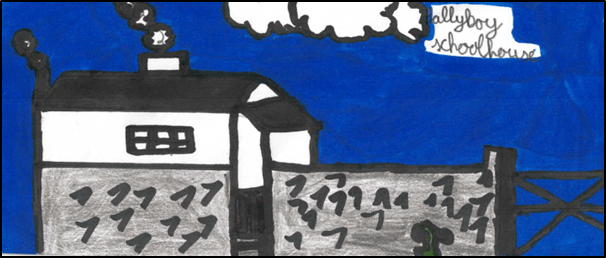
The Schoolhouse in Ballyboy, built by Lord Lansdowne’s wife
Ballyboy Schoolhouse 1820-1962 by MJ Hynes
The school was originally very close to the road but in 1960 it was knocked and a new one, seen below, built further back. This new school design was typical of the time being a large one storey building with tall windows. All the children were taught in two rooms. There was a small solid fuel stove in each classroom for heat, and the children would fetch turf from the shed which is now our boiler house.
Ballyboy School in the late 1960’s with the central chimney used to heat both classrooms. This central chimney is no longer present in our current school.
The school has been extended twice since it was built, in 1996 and in 2004. We now have a big playing pitch outside where we can play. We have a safe environment, and we are building a set down area so our parents can drop us off safely to school. For a such a small village we have a lot of history.
The First extension in 1996
Scoil Bhríde Ballyboy September 2022
Back in Time….the steps in our school wall that once led to the Hatter’s Factory
The old water pump outside our school. This pump would have been used as a source of water on the night of the fire in the hall.
Written by
Daniel Lambe, MJ Hynes, Theo Kilmartin, Sean Russell, Bryan Feighery, Aaron Grimes McDermott
Dan and Molly’s
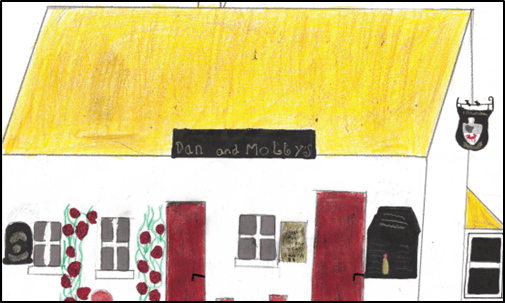
Dan and Molly’s pub was built in the 1800’s. It has been a pub for over 150 years. Originally the Redmond’s owned the pub, then the Molloy’s, the Petits, the Lynch’s and then the Ryan’s. The Ryan’s moved into the building in 1863 and Jack Ryan passed it down to his daughter Molly, who married Dan Boland. The pub then became known as Dan and Molly’s. Dan and Molly’s daughter Catriona now runs the pub alongside her husband Fergal. Dan and Molly’s still has the thatched roof because there was a preservation order put on the building in the 1970’s which does not allow it to be removed. Dan and Molly’s is the only straw thatched pub left in Offaly. The pub is used for music sessions, set dancing, card games, music lessons and general community events. The lessons are run by Ballyboy CCÉ. The family have a keen interest in the arts as the music has been passed down through four generations – namely Jack Ryan, his daughter Molly, grand-daughters Catriona and Stella and now the great grand-children John, Anna, Daniel, Séan and Katie. On April 12th, 2011, the pub went on fire, when a spark from the chimney ignited the straw on the thatched roof. This was a devastating evening for the family and for the community. It took many units of the fire brigade to bring the fire under control. Luckily the roof was restored to its original condition soon after.
Dan & Molly’s Ballyboy by Anna McDonald
Written by
Anna McDonald, Fiadhna Leamy, AJ Bracken, Daniel Heffernan, Cára Guinan, Mark Dolan
Ballyboy Hall
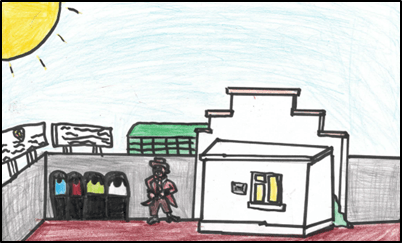
Ballyboy Hall was built in 1954 by the Young Farmers Association. It was built by voluntary labour mostly in the evenings, after the work of the day was done. In 1690, more than 250 years before this, King William of Orange had spent a night in the hotel which had stood on this very site. (The new hall was built on the site of the old hotel.) In 1967, there was a fire in the hall during a Whist Drive. The calamity happened because an oil heater caught fire. Local people who were there, said that it was an awful tragedy and many people got very badly burnt. On the night, water was pumped from the village pump, located outside the school to treat the injured. Luckily nobody died in the fire. The hall has remained derelict for many years until recently, when several locals came together and formed a group called Ballyboy Community Development Group. The group are fundraising to build a new community hall on the same site as the old one. They plan to develop a green space and recreational area in the village including landscaped area with seating, lighting and amenity car parking area.
Ballyboy Hall by Cian Brunswick
Written by
Cian Brunswick, Adam Coady, Lochlann Fletcher, Alice Molloy, Sophie McGarry, Michael Clavin
Great work from the children of 5th and 6th class at Ballyboy School. This is our first blog from a school. Many of our blogs are used by schools and we look forward to more contributions from your area. Congratulations to Ballyboy, all the children who wrote and illustrated. A special thanks to the staff and in particular to their teacher Ms Michelle Egan, and also to Ms G. Clendennen.
Offaly History welcomes contributions by way of articles on all aspects of the history of County Offaly
The Dunne family has inhabited parts of County Laois since time immemorial. They descended from Cathair Mór, second century Monarch of Éire and Brittas House, near Clonaslee, became their family seat (after their main residence in Tinnahinch was blown to bits in 1653). Family land holdings hovered around 10,000 acres throughout what was then known as the Queen’s County.










 offalyhistoryblog