Along our Grand Canal Journey from Edenderry to Shannon Harbour we come to Rathmore, a small townlands, on the south side of the canal. Rathmore is in the Electoral Division of Edenderry Rural, in Civil Parish of Monasteroris, in the Barony of Coolestown, in the County of Offaly.
The Irish name for Rathmore is An Ráth Mór meaning great, big ring-fort.
Here we can find the site of a possible Enclosure, it can be seen in outline from aerial photos. Enclosures are one of the most common sites found in Co. Offaly, with over hundred found all over the county. They are often similar to other types of enclosures defined either by a bank or a fosse, such as the Ringforts.
They are identified from other enclosures by being either very large or small and without an entrance. Many are only known as cropmarks, visible only from aerial view, they have no original dates but some may be from the Iron Age.
At the opening of the nineteenth century Edenderry was said by one observer to soon ‘be a heap of ruins.’[i] The new Grand Canal was expected to bring relief to Edenderry and the surrounding hinterland. In the aftermath of the 1760s economic downturn in the woollen industry Edenderry suffered greatly having once employed 1,000 workers in the trade.[ii] The Downshire estate in the town and surrounding hinterland consisted of 14,000 statute acres of land.[iii]
The linking of Edenderry to the canal was of economic necessity in the last decade of the eighteenth century. As Ciarán Reilly explains:
‘Without the Grand Canal, Edenderry in the nineteenth century would have not as prospered as it did, the canal providing a much needed communication network and transportation for goods such as peat, corn and flour to Dublin.’[iv]
Charles Vallancey believed ‘the peasantry are starving and nothing will contribute so much to their relief as the Inland Navigation.’ John Hatch, as Edenderry agent for the Blundell estate was aware of the potential for economic progress of the Grand Canal for the town. (5 W. A. Maguire, ‘Missing persons: Edenderry under the Blundells and the Downshires, 1707-1922’ in William Nolan and Timothy P. O’Neill (eds), Offaly: History & Society (Dublin, 1998), pp 515-542 at p. 524.)
In June 1787 Hatch alerted the Blundells that it was confirmed the canal would pass near Edenderry:
‘… by this resolution of the company everything will rise again and higher than ever and I have not now the smallest doubt of our going on with the canal to or near Edenderry.’[vi]
Richard Biggs was born in Devizes, Wiltshire, England into a Presbyterian family of educated and educators. Religious faith was prevalent in the paternal side of his family. Richards’s great grandfather James Biggs became a Presbyterian Minister, his grandfather Richard Biggs became a Senior Deacon and alongside Richard’s father Richard W. Biggs ran a highly acclaimed private boarding school for boys in Devizes Wiltshire between 1822 and 1865.
Richard Biggs’ (b.1847) maternal side were the Purser family of Rathmines Castle. His mother Sarah Purser was the youngest daughter of John Purser’s first marriage to Sarah Smith. The Pursers were also educated, and educators. Richards’s uncles and cousins were Civil Engineers, Chief Engineers, Barristers, Millers and Grain Merchants, Physicians, Artist, Secretaries, Teachers, including Professors of Mathematics, some of the Purser family worked and owned shares in the firm of Guinness Brewers Dublin. It is said that John Purser who died in Cork in 1781 was the first to brew porter In Ireland[i]
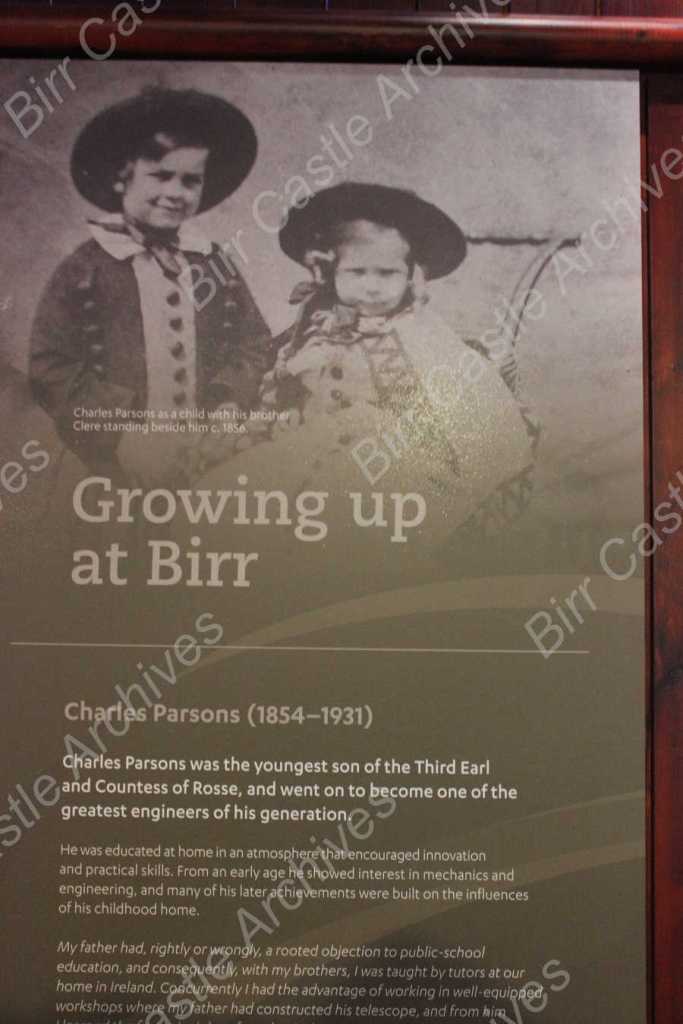
Richard Biggs’ (1847) early education began in the Biggs boarding school in Devizes alongside his cousin John Purser (b.1835). Some members of the Geoghegan family also attended the school (www.devizesheritage online). John Purser received numerous prizes and awards for his mathematical skills. He became tutor to the four sons of William Parsons earl of Rosse Birr, in 1857, including Charles Algernon Rosse who is known for inventing the steam turbine. Another first cousin, Sarah Henrietta Purser (b.1848) a well-known artist and stain glass worker who launched An Tur Gloine (The Tower of Glass), was the first female member of the Royal Hibernian Academy 1923. Sarah painted amongst others, William Butler Yeats, Maude Gonne and Countess Markievicz, some of her stained glass work is in St Patrick’s Cathedral, Dublin. A further first cousin, Alfred Purser (1847), a School Inspector, married Ellen Hilderbrand. Their daughter Olive Constance Purser born in Parsonstown (1886) was one of the first women to be admitted to Trinity College Dublin in 1904. Both Richard Biggs (b.1847) and son Henry Biggs (1882) are named in The Atlas of Irish Mathematics Fermanagh 2022 (online).
Birr 1869–1874, the death of Mary Ward and the new school founded
Mary Ward, died Birr, 1869.
On the 28 July 1869 Richard Biggs, BA, Scholar of Trinity College Dublin, under the immediate patronage of the Earl of Rosse advertised in the Kings County Chronicle that he intended opening a school for young gentlemen in Parsonstown (Birr). The following advertisement reads under the headline Education: ‘Mr Richard Biggs BA, Scholar of Trinity College Dublin, and Honourman in the University of London announces that he intends early in September to open a SCHOOL FOR DAY PUPILS in his premises recently occupied for that purpose at 15, Oxmantown Mall, Parsonstown, and that he is also making arrangements for the reception of boarders [This house was later that of Mrs Burbage ]. In seeking to establish a first-rate school in this neighbourhood, Mr Biggs is honoured and encouraged by the immediate patronage of the Right Hon. the Earl of Rosse. Full particulars of the terms, the course of study etc. will be given on application. Birr Castle, Parsonstown’ (KCC 04 August 1869).
Oxmantown Mall c. 1900. The first school at no 15 was on the lower left. The Ward accident took place on the right corner below the trees.
On the 31st of August 1869 Richard was driving a steam engine when an unfortunate accident occurred, Mary Ward a scientist, astronomer, microscopist, and author was thrown from the vehicle. Mary’s death is known as the world’s first recorded motor vehicle accident. The following day, Richard Biggs gave evidence at the inquest as follows: ‘I was guiding the engine, at the corner of Cumberland Street and Oxmantown Mall on yesterday, at about half past 8 o’clock, we had just turned into Cumberland Street when I felt a slight jolt and saw Mrs Ward fall, I jumped off immediately, I cannot give any reason for the jolt’. The jury returned a verdict that ‘Mary Ward’s death was caused by an accidental fall from a steam engine on which she had been riding in the town of Parsonstown the previous day. The jury expressed their sympathy towards the Hon. Capt. Ward, they also stated there was no blame attaching to any person in connection with the occurrence.’ [ii]
The Rosse boys were educated at home. Charles Parsons did exceptionally well.
A year after the fatal death of Mary Ward Richard Biggs married Sarah Francis Geoghegan (c.1848) daughter of Thomas Geoghegan MD and Anne Purser, eldest daughter of John Purser’s first marriage to Sarah Smith in Dublin on the 12 January 1870. Sarah Geoghegan’s brothers Thomas Grace Purser (c1841) and William Purser (1843) were in 1870 leading brewers in the Guinness brewery, another brother Samuel (1848) followed as a leading brewer later becoming chief engineer to the firm. [iii] A daughter was born to Richard and Sarah at the Parsonstown School in August 1872.
Various articles in the King’s County Chronicle between 1872 and 1874 report:
Mr Biggs threw open the Chesterfield school grounds for the Sunday school of Birr Church to hold their annual fete (July 1872). Mr Biggs also threw the school grounds open to the respectable public so they could witness ‘this species of development of muscular Christianity’ at the Chesterfield Sports Day. (December 1873). Chesterfield school pupil Mr L’Estrange broke his left arm whilst enjoying a game of football in the recreation grounds, Mrs Biggs immediately placed him under the care of Dr Myles (February 1874). The Leinster Reporter mentions Dr Biggs Chesterfield Grammar School is now one of the best regulated and patronised private colleges in the country has consulted with builder Mr M. Moran in relation to building a new wing to accommodate the increasing number of boarders (LR 15 October 1874) An advertisement requesting ladies and gentlemen to join the choir of which Richard Biggs. L.L.D. was the Hon Sec. of Parsonstown’s Choral Society. (December 1874).
Chesterfield, Parsonstown [Birr] School
The following article of 1874 describes Birr’s/Parsonstown’s Chesterfield School run by Richard Biggs under the headline:
Probably Parsonstown stands first among provincial towns, as far as the facilities for obtaining a first-class education are concerned. To be sure in Armagh, Dungannon, Enniskillen and some other towns, there were endowed grammar schools; but thanks to Richard Biggs, Esq., M.A. Parsonstown, unendowed as it is, has all the advantages and privileges of the Royal School districts. Besides laying out a considerable sum in putting the fabric of Chesterfield School and the surrounding ground into a condition such as Eton might be proud of, and besides devoting his own time in the class room with a constancy which is downright amazing, considering Mr Biggs is a gentleman of independent private means, this philanthropic scholar has given other proofs without number of his resolution to make Chesterfield School second to none in the country. And it is gratifying to know that his exertions are receiving extending encouragement, as the number of the pupils attest to the value of his endeavours. Within the past ten weeks four additional masters, teachers of the various classic and modern continental languages, have been appointed by Biggs. The various details belonging to a first-class school, are not wanting and in the local appointments, Mr Biggs is to be congratulated. The Department Instructor, in the person of Mr Arundel being as efficient a drill-sergeant as could be chosen, and the other arrangements are in nice harmony. The natural salubrity of the elevation on which the school stands, could not be surpassed, while the sanitary arrangements – so far as art can go– are perfect to which happy combination is due the almost total immunity from sickness among the scholars, rendering the office of medical adviser and attendant, which Dr Stoney is so well qualified to discharge virtually a sinecure. The townspeople owe no little gratitude to Mr Biggs for the benefits which he has conferred, and is conferring in so many ways; and we are sure if the opportunity ever presents itself for their giving expression to the sentiment of good will that prevails for him among every class in the community, they will accord an ovation as warm as it will be genuine’ [sic] (KCC 26 February 1874).
Chesterfield school possibly about 1880-1900. It was on the Banagher Road, Birr. Offaly History will publish a further article on the school soon.
Galway 1875-1894
Richard Biggs and Sarah Francis Geoghegan had seven further children, Richard Thomas (1878-1883). Grace Elizabeth (1879). Henry Francis (1882). John (1884). James Richard (1886). Maurice William (1888). Edward (1891-1891). All the children’s place of birth is noted as College Road Galway and their father’s rank/profession is noted as Head/School Master or Gentleman.
Richard Biggs began his post as headmaster of Galway Grammer School in 1875, a newspaper advertisement reads under the headline, Education: ‘Galway Grammar School. On the foundation of Erasmus Smith. This school will after the summer holidays, be carried on by Richard Biggs, MA, L.L.D. Information can be had on application, to him at Parsonstown School. Boarders cannot be received for some months to come, but the work of the day school will be resumed by Howse, ex Scholar QCG, and the classes will be at once assimilated to those at Parsonstown School under the direction of the headmaster, Richard Biggs, MA, LL. D, Parsonstown’ (IT June 1875).
Despite unfavourable conditions Richard Biggs continued to build a reputable school. In 1876 he wrote to the Board of Harbour Commissioners requesting that an alteration of the strict rules would allow his boarders to bathe at the end of the jetty before seven o’clock in the morning. A Trinity College Dublin entrance examination placed a pupil of Galway Grammar School sixth out of eighty-five candidates, Mr F. Sheppard, son of Frank Sheppard, Esq was solely prepared by Dr Biggs headmaster of Galway Grammar School. 1885 saw Galway Grammar school rugby team join five other fledging rugby clubs to become Connacht Rugby, Richard Biggs became the first president of the Connacht branch of the IRFU.[iv]
An extract of a report given by inspector Professor Mahaffy employed by the Erasmus Trust reads, ‘Galway flourished under a new Headmaster Dr Biggs who was appointed in 1875 from Parsonstown School. Within 15 years numbers had increased to almost 90. This occurred in spite of conditions which Mahaffy described as unfavourable to a boarding school:
‘No advantage is offered by Galway except good bathing. The town is full of decay and pauperism. Idle boys trespass on the school grounds, and molest the school, because it is respectable.’
Nevertheless, Mahaffy was impressed by the school, although both the schoolroom and the boys ‘wanted brushing and cleaning.’ The Headmaster was ‘a very able man and thoughtful man, full of new ideas and very attentive to his school’ and his staff were also praised.[v]
In May of 1878, the Irish Times reported that Mr and Mrs Richard Biggs paid a short visit to Chesterfield school, and that a fete given by Mr and Mrs Rev. W. Ewing in honour of the late principal’s visit.
Portora, 1894-1904
In November 1894, an announcement in The Northern Whig named Richard Biggs as successor to the Rev. W.B. Lindesay headmaster of Portora Royal School, Enniskillen. Over the following years further advertisements at the beginning of each school term naming the assistant Masters, along with some of the pupils’ scholarships, first honours, prizes and various exam achievements were placed in newspapers.
In early 1899 the Intermediate Commissioner conducted an inquiry into the workings of the Intermediate Education Act. Mrs Biggs headmaster of Portora School amongst others gave his opinions and beliefs. Biggs believed it was highly desirable and practicable to have separate papers for pass and honour students, he also thought the middle grade be abolished, at that time there were one hundred pupils of which eighty-six were boarders in Portora School. (Daily Express, 09 February 1899).
In Portora (Enniskillen Rural, Fermanagh) the address on the Biggs family’s 1901 census, named the residence as, Richard Biggs Headmaster Royal School aged fifty-four, born in England, his wife Sarah F. Biggs, no occupation aged fifty-two born in Dublin, three of his children: Grace E. Biggs, no occupation aged twenty-one born in Galway; Henry F. Biggs, Scholar aged eighteen born in Galway; Maurice W. Biggs, Scholar aged twelve born in Galway; Nephew Richard Thomas, Scholar aged thirteen born in India; Margaret Bell Matron of school aged forty-seven born in England, and eight servants.[vi]
Richard Biggs, aged fifty-seven, drowned in Lough Erne on the 23rd of June 1904. A solicitor, Mr James Pringle, when arriving at his own boat house noticed Mr Biggs canoe floating on the lake. ‘The Sad Death of Dr Biggs’ headlines the inquest for Richard Biggs Headmaster of Portora Royal School, whose body was found close to Portora boat house about five yards from the shore in Lough Erne after his canoe was seen floating upside down. The jury found ‘that the deceased came to his death by drowning and added that they agreed with Dr Kidd’s evidence that from the appearance of the body it was not incompatible with heart seizure or a fit of apoplexy as a factor in the cause of death’ the jury expressed heartfelt sympathy with Mrs. Biggs and family. (Weekly Irish Times, 02 July 1904). Richard Biggs was buried in Rossery COI cemetery, Fermanagh on the 27th of June 1904. His effects in the sum of £21,970 13s 9d was granted to his wife Sarah Francis Biggs. Richard Biggs was the second member of his family whose death occurred accidently at Portora School, his cousin Robert Mallet (1843-1859) Purser, son of Benjamin Purser the brother to Richard’s mother, died in an accident on the 22nd March 1859 aged sixteen at Portora School Enniskillen.
Trinity College Dublin Entrance Awards Biggs Memorial Prize.
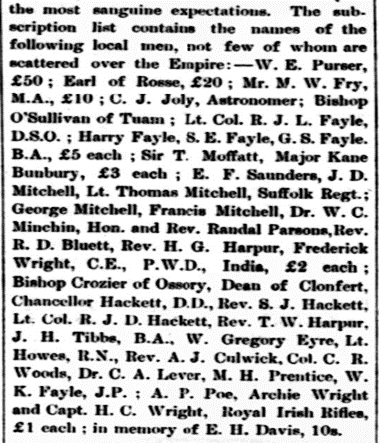
The Old Boys of Parsonstown and two other school where the late Dr Biggs was Principal and other friends supported by subscription a memorial which is to take the shape of a Trinity College Annual Prize. Subscriptions varied from £50 to 10s.
19041217 The Leinster Reporter Entrance award. This prize was founded in 1905 by subscription in memory of Richard Biggs. It is awarded annually on the basis of public examination results as defined in section 1, to the person who achieves the best results of those who have been pupils for at least one year at Chesterfield School, Birr (or such other school at Birr as may take its place), or at Portora Royal. The list includes (among others) Archie Wright of the Chronicle, Birr, an old boy of the school.
[i] Ronald Cox. Dublin Port Chief Engineers (Dublin 2023) p. 70.
[ii] King’s County Chronicle (Offaly 18690901), p. 3.
[iii] Patrick Lynch & John Vaizey. Guinness’s Brewery in the Irish Economy 1759-1876 (Cambridge 1960), p. 236.
Part two of this presentation looks at the Charleville and Macartney aqueducts west of Tullamore and the Silver River aqueduct halfway between Ballycommon and Kilbeggan.
THE CHARLEVILLE AQUEDUCT
The Clodiagh River rises in Knockachoora Mountain in Sliabh Bloom and flows swiftly through Clonaslee and on under Gorteen, Clonad and Mucklagh bridges into Charleville Demesne before passing under the Charleville Aqueduct, just before its confluence with the Tullamore River at Kilgortin in Rahan. Less than half a mile upstream on the canal stands the Huband Aqueduct overlooked by the imposing Ballycowan Castle.
The Charleville Aqueduct is called after Charles William Bury who had become Viscount Charleville in December 1800 and it was as such, he was recorded in the lists of attendees of the Court of Directors of the Grand Canal Company during the years the canal was being constructed from Tullamore to Shannon Harbour, 1801-04.
Image 1.excerpt from the minutes
An excerpt from the minutes of a meeting of the canal company held 24th February 1801 where Lord Charleville’s request for the use of one of the company’s boats for the purpose of conveying Lady Charleville to town was accommodated. The memo further states that his wife was in a precarious state of health, most likely an allusion to her being in the advanced stages of pregnancy as her son Charles William Bury was born nine weeks later, on 29th April 1801. (Courtesy of National Archives of Ireland, Dublin)
Image 2. Charles William Bury, 2nd earl
Charles William Bury, 2nd Earl of Charleville, born late April 1801, seated in red cloak before a curtain, portrait by Henry Pierce Bone, 1835.
C. J. Woods’s entry for the first earl of Charleville, (1764-1835), in Dictionary of Irish Biography, R. I. A., (2009), gives a concise résumé of his adult life:
Bury was MP for Kilmallock in 1789–90 and 1791–7, becoming Baron Tullamore on 26 November 1797, Viscount Charleville on 29 December 1800, and 1st earl of Charleville (of the second creation) on 16 February 1806. He was an Irish representative peer from 1801 until his death. With Johnston he designed and built a Gothic castle on his demesne, Charleville Forest, 3 km south-west of Tullamore. Begun by November 1800, it was completed in 1808, to which a terrace, lawns, artificial lake, grotto, and 1,500 acres of woodland were added. Elected a fellow of the Royal Society in 1803 and a fellow of the Society of Arts in 1814, Charleville had ‘wide intellectual interests which never came to fruition’. The earl of Charleville died 31 October 1835 in his lodgings at Dover and was buried at Charleville.
Fred Hammond’s great survey of the bridges in Offaly (2005) gives the following description of the building:
Triple-span masonry bridge carries Grand Canal over Clodiagh River. Abutments, piers and cutwaters are of dressed limestone blocks, regularly laid. The cutwaters are of triangular profile and rise to arch spring level at both ends of the piers. The arches are of segmental profile and each spans 3.07m; their voussoirs are of finely dressed stone. The soffits are very slightly dipped towards their centres to accommodate the bed of the canal. Dressed string course over arch crowns. Parapets are of random rubble, coped with dressed masonry blocks. The parapets are spaced at 10.08m and terminate in out-projecting dressed stone piers. The east end of the south parapet has been rebuilt. The canal narrows to 4.50m, with tow paths either side. The sides are stone lined at this point and there are timber stop slots at the east end of the aqueduct.
Hammond considered the edifice worthy of regional heritage importance.
THE MACARTNEY AQUEDUCT
Image 3.Detail of William Ashford’s painting
Detail of William Ashford’s painting of the crowded scenes at the opening of the Ringsend Docks, Dublin, 23 April 1796, showing Lord Camden, the Lord Lieutenant of Ireland, conferring a knighthood on Mr. John Macartney with the Westmoreland, Buckingham and Camden Locks in the background. Macartney can be seen in a genuflected position on the right-hand quay wall beneath a billowing British naval flag. (Courtesy of the National Gallery of Ireland)
This is the western-most aqueduct in Offaly straddling the townlands of Falsk and Derrycarney, south of Ferbane. The structure is named after Sir John Macartney, one of the more influential directors of the Grand Canal Company. As alluded to above he was knighted by the Lord Lieutenant at the opening of the Grand Canal Docks in 1796, “in consequence of his energetic exertions in the promotion of the inland navigation of Ireland.” Like Huband’s Aqueduct at Ballycowan, it has two commemorative plaques dating it to 1803.
Image 4. Commemorative plaque dated 1803
Commemorative plaque dated 1803 on the south parapet wall of the Macartney Aqueduct.
Fred Hammond’s appraisal of the building says it all:
This is the largest aqueduct on the Grand Canal in Co. Offaly and second only to the Leinster Aqueduct (Co. Kildare) in size on this canal. It is of high-quality construction and has been sympathetically refurbished. It is of historical interest due to attested date and link with Grand Canal Co. Also, a substantial landscape feature hereabouts. Of national heritage significance, meriting inclusion in Record of Protected Structures.
Image 5. A delightful drawing by Israel Rhodes
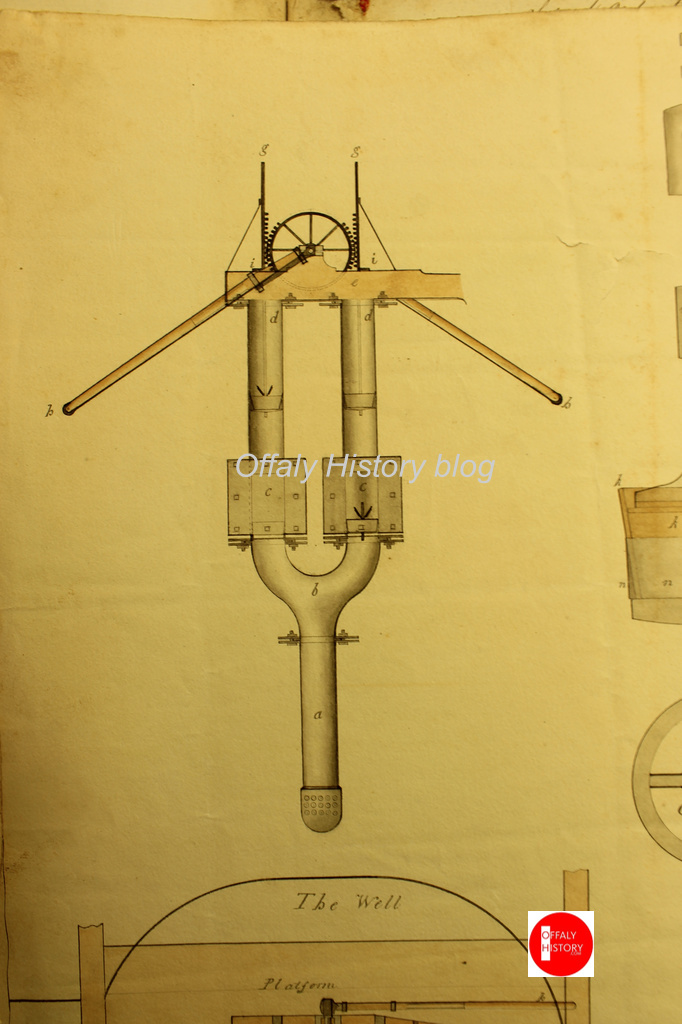
A delightful drawing by Israel Rhodes, dated to March 1802, showing details of the steam-powered pump that was used during the construction of the Macartney Aqueduct over the Silver River. This is from the minute books of the Grand Canal Company where such visual representations are very rare. The depiction is signed by Rhodes as engineer and by Arthur Chichester Macartney, then an influential director of the canal company. (Courtesy of National Archives of Ireland, Dublin)
The aqueduct crosses the fast-flowing Silver River after it has meandered over twenty-miles from the slopes of Wolftrap Mountain high up in Sliabh Bloom The river’s course takes it through Cadamstown, Ballyboy, Kilcormac and Lumcloon before joining with the Brosna half a mile downstream of the aqueduct.
Image 6. Map by John Longfield c.1810
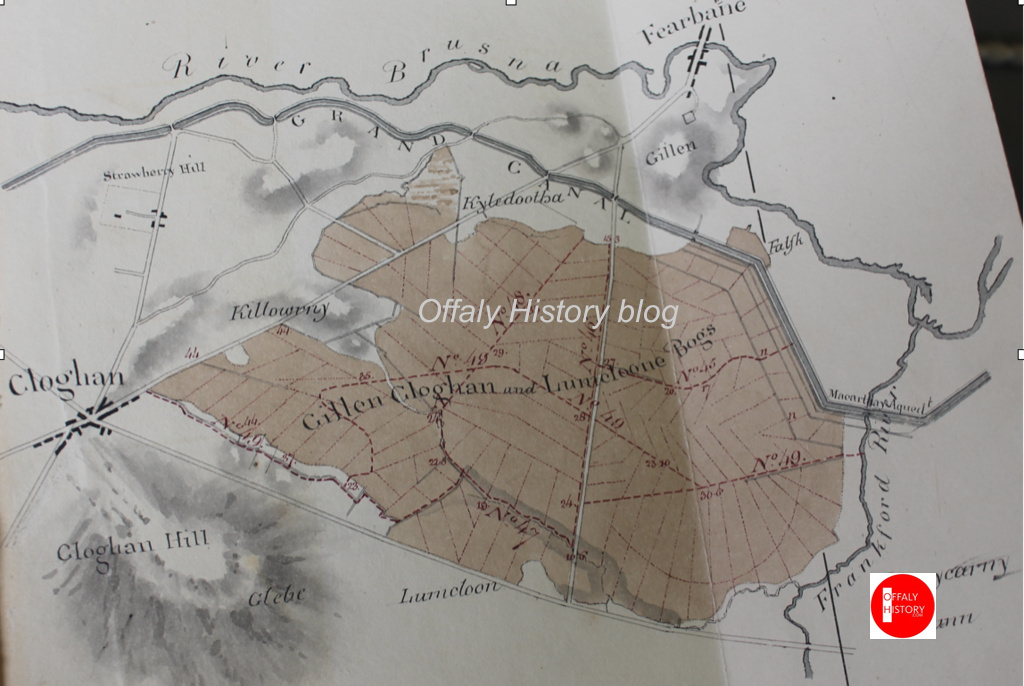
Map by John Longfield c.1810 showing the Grand Canal turning sharply to the north-west just downstream of the Macartney Aqueduct and thus avoiding the Gallen, Cloghan and Lumcloon complex of bogs before meandering (almost) from Gallen to Belmont, always in close proximity to the River Brosna. The Silver River is depicted as the Frankford River in deference to the old name for Kilcormac, the last town it passes through before its confluence with the Brosna. (Courtesy of The National Library of Ireland)
SILVER RIVER AQUEDUCT ON THE KILBEGGAN BRANCH
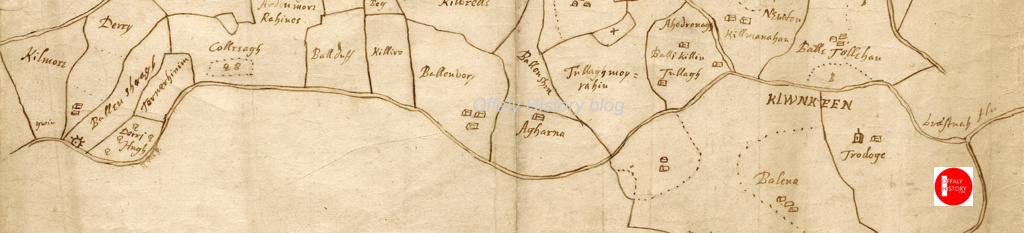
To avoid confusion with the other Silver River crossed by the Macartney Aqueduct, this aqueduct straddles the Silver River which separates the counties of Offaly and Westmeath between the townlands of Bracklin Little and Lowertown. The river rises upstream of New Mill Bridge, in Rahugh, in Westmeath. In Offaly it flows via Derrygolan, Acantha, Gormagh, Ballyduff, Aharney, Coleraine, Coolnahely and Aghananagh before joining the Clodiagh at Aghadonagh, in Rahan. The 1838 six-inch map shows five mills on this relatively short river. The earliest of these mills is probably that at Ballynasrah or Tinnycross as it is shown on John Gwin’s map of the Barony of Ballycowan which was drawn c.1625, almost four hundred years ago.
Image 7. Detail of John Gwin’s map showing Silver River
Detail of John Gwin’s map of the barony of Ballycowan which shows the Silver River flowing from Ballynasrah in the bottom left-hand corner to its confluence the Clodiagh at Aghadonagh on the right- hand side, passing Ballyduff, Aharney and Tullymorerahan. The mill is indicated by a mill-wheel symbol. The map is part of a set of twenty-eight important maps of various parts of Offaly drawn four hundred years ago in the Mathew De Renzy papers in the National Archives in London.
KILBEGGAN BRANCH
As early as 1806 the Grand Canal Company’s engineer John Killaly had prepared a detailed map for a proposed branch from Ballycommon on the main canal to Kilbeggan. This line was closely adhered to when work finally begun twenty-four years later in 1830. An application for funding was made in 1825 and despite strenuous objections from the Royal Canal Company a loan was approved in 1828. In March 1829 Killaly had completed the plans and specifications for the line. A month later William Dargan’s proposal to build the line for £12,850 was accepted.
Image 8 William Dargan
William Dargan, (1799-1867)
From the outset work was slow due to continuous wrangling between the contactor and the company. Dargan had taken his own levels, but the canal company insisted he use those of Killaly. Even when progress was made recurring problems with staunching the huge embankments at Bracklin Little and Lowertown delayed construction. Allied to this was the major distraction of Dargan’s involvement with the building of Ireland’s first railway line.
Image 9. Bracklin Little and Lowertown townlands on the1912
Bracklin Little and Lowertown townlands on the1912 Ordnance Survey six-inch map, showing the meandering Silver River and the dense hachuring between Lowertown and Murphy’s bridges. This represents the steep slopes of the embankments which carry the aqueduct high above the surrounding landscape. Note the overflow at south end of the aqueduct. This was to prevent the level of the canal rising to a height where it would overflow the banks and lead to a major breach. Just like at the Blundell Aqueduct there were twenty-six miles of canal without a lock which would have poured out at this point if a burst occurred, leading to much destruction and a long-term closure of the navigation.
Dargan’s chief biographer Fergus Mulligan describes this episode in Dargan’s life in the Royal Irish Academy’s Dictionary of Irish Biography:
Ireland’s first railway line, the Dublin & Kingstown, opened in 1834 and Dargan was fortunate to win the contract to build it against six competitors. Working under another Telford pupil, Charles Vignoles (qv), as engineer, Dargan began work near Salthill in April 1833, and although he was six months late finishing the line (which opened on 17 December 1834) the penalty clauses in his detailed contract were not enforced. The successful completion of this line gave Dargan a springboard to winning a substantial share of Irish railway construction contracts on offer in the 1840s and 1850s.
Again, we are greatly indebted to Fred Hammond’s monumental survey of all 407 bridges in Offaly in 2005 for a detailed description of this aqueduct:
A tall arched masonry bridge carries the disused Kilbeggan Branch of the Grand Canal over the Silver River at the county boundary. The abutments are of dressed limestone blocks, regularly laid and with finely dressed quoins. The arch is of semi-circular profile, with finely dressed radial voussoirs and dressed stone soffit blocks; it spans 3.59m. The arch is embellished with finely dressed string courses around the tops of the quoins and across the crown. Over the top of the upper string course are four regular courses of dressed stone blocks. They are surmounted by a slightly inset random rubble parapet. The sloping wing walls are detailed as the abutments and are coped with stone flags.
Patrick Lynch and John Vaizey in their history of Guinness’s brewery in the Irish economy to 1876 observed that in England the canals followed trade while in Ireland it was hoped that trade would follow the canals. It was a hope that was only partially fulfilled as outside of Dublin the new canals served few areas of commercial or industrial importance.[1] The observation was following in the line of Arthur Young in the 1770s who had advised ‘to have something to carry before you seek the means of carriage’.[2] Yet the record of the carriage of goods on the canal was satisfactory with 500 million ton miles carried in 1800 and double that by the 1830s.[3] The Grand Canal was especially beneficial to north Offaly for the transport of stone, brick, turf, barley, malt and whiskey. All bulky goods suited to water transport. The emerging firm of Guinness also found the inland water transport system helpful to sales and market penetration. The slow movement of Guinness beer by waterway was good for product quality on arrival.
The view is about 1840 and the book 1960. There is a copy at Offaly History Centre Library
Work on the Grand Canal started in 1756 and by 1779 the first stretch of water from James’s Street to Robertstown was completed. Over the next twenty years the canal was extended to Tullamore (1798) and Shannon Harbour (1804). The six-year delay at Tullamore while resolving issues with the direction of the ‘Brosna Line’ at Tullamore facilitated the establishment of a canal hotel, stores and a harbour.
This evocative piece of writing, describing childhood in Shannon Harbour in the 1950s by Gerry Devery, Cuba Avenue, Banagher won for him the prestigious 1st prize, Autobiographical section in the Writers’ Week, Listowel, Co. Kerry in May 1991. It is one of my many interesting articles over the years in the Banagher Review.[1]Our thanks to Gerry Devery for permission to publish this stylish pieceon the terminus of the Grand Canal in County Offaly
Where the murky, still waters of the Grand Canal join the majestic River Shannon in the heart of the midlands, lies a small village; Shannon Harbour. Here I was born. This once vibrant and prosperous little place, is now quiet and silent with only a few inhabitants and its ghostly ruins to betray its past.
I spent the first fifteen years of my life, in an enormous old house, right by the edge of the canal. My memories of those times, when all life revolved around the village and the canal are very fond ones, it was the beginning of the fifties then and although life was pretty hard for my parents, neither I nor my three brothers and sisters realised this until much later in life. Looking back now I can understand what a difficult job it was to rear seven children within a few feet of the canal bank.
The death of Ger Connolly at Droimnin Nursing Home, Stradbally on 25th January 2024 marks the end of an era in the political life of County Offaly.
Aged 86 Gerard C (Ger) Connolly was a former Fianna Fáil councillor, TD and Minister of State who might best be described as the great survivor of Offaly politics, with an unbroken record as TD from 1969 until his retirement in 1997. He was witness to and an important figure in some of the most turbulent times in Irish politics, as a devoted supporter of Charles J Haughey during the Eighties.
His entry onto the national stage and his electoral record mark him out as one of the most significant figures in a five seat constituency with no shortage of political titans including a former Taoiseach and three former cabinet ministers.
Colourful, engaging and often provocative in political debates Ger Connolly was hugely popular throughout the constituency, securing first preference across traditional party boundaries, especially in North Offaly. He loved the cut and thrust of politics and his one liners and bot mots, delivered with theatrical flair, often enlivened debates in Offaly County Council and Dáil Eireann.
He was also a diligent constituency worker and as Minister of State made a significant contribution to the implementation of new policies on urban renewal and inner city development.
Strongly supportive of the construction industry and a firm believer in encouraging private sector development he relished his role as Minister of State at the Department of the Environment. He had a reputation as a decisive Minister of State and enjoyed good relations with civil servants, often surprising those who might have initially mistaken his mischievous smile and faux distain for detail.
We looked a few days ago at Charles Lever’s description of Shannon Harbour through the eyes of Jack Hinton (1843) and which he commenced writing in the winter of 1841. Another visitor to Banagher was the celebrated novelist, Anthony Trollope. Material has already been published on Offaly History blog on Trollope’s connection with Banagher where he arrived in September 1841 to take up employment with the Post Office. In his Kellys and the O’Kellys (London, 1848), Trollope sends Martin Kelly from Portobello, Dublin to Ballinasloe. His description of the journey is as derogatory as Lever’s and may well be autobiographical as Trollope travelled on the canal as a young man to take up that first post at Banagher.
Charles Lever in his novel Jack Hinton sends his hero on a passage boat from Portobello (Rathmines, Dublin) to Shannon Harbour where he attempts to find accommodation at the hotel, then already in decay. Charles Lever began his Jack Hinton in the winter of 1841.
He had one chapter dedicated to ‘The Canal Boat’ and another to ‘Shannon Harbour’. He must have known the Grand Canal system well as John Lever, his brother, was rector of Tullamore from 1830 to 1843 and from 1843 to his death in 1862 at Ardnurcher (Horseleap). James Lever, their father, died at St. Catherine’s Rectory, Tullamore and was buried 1st April 1833. Charles Lever worked as a dispensary doctor at Kilrush and Portstewart and later in Brussels. He was back in Ireland as editor of the Dublin University Magazine (1842-45). His novels were attacked as stage-Irishry but his later novels have more sympathetic portrayals. It was during the early 1840s while resident in Dublin that Lever tried to ‘recreate the lifestyle of earlier generations of feckless Anglo-Irish gentry, becoming a semi-accomplished rider, hosting all-night card parties, and holding court in a Jacobean mansion in Templeogue, where he was visited by Thackeray, who dedicated his Irish sketch-book to Lever in 1843.’ (DIB online, entry by Jason King).
M0016715 Portrait of John Charles W. Lever
Credit: Wellcome Library, London. Wellcome Images
images@wellcome.ac.ukhttp://wellcomeimages.org
Portrait of John Charles Weaver Lever; from a proof impression of an engraving in the Royal College of Surgeons, signed C.B. Black, 392
Strand, London, 1854.
Published: –
Copyrighted work available under Creative Commons Attribution only licence CC BY 4.0 http://creativecommons.org/licenses/by/4.0/(more…)
The pioneering travel book on the Irish canals was Green and Silver (London, 1949) by L.T.C. Rolt. Tom Rolt made his voyage of discovery by motor cruiser in 1946 along the course of the Grand Canal, the Royal Canal and the Shannon navigation from Boyne to Limerick. The Delanys writing in 1966, considered Rolt’s book to be the most comprehensive dealing with the inland waterways of Ireland. [1] In this extract Banagher gets a severe press very unlike the optimism of the 1890-1914 period and again in the 1960s. Banagher also got a severe jolt post 2008. Things are now improving with sunlit uplands breaking through.
Moving off to Shannon Harbour Rolt got sight of the many arched bridges at Shannon Bridge and passed beneath the swinging span. See last week’s blog by Donal Boland covering the same trip in 2023 as far as Tullamore.
Shannon Harbour with the police barracks and the collector’s/agent’s house.
“Just below, was the Grand Canal depot with a canal boat lying alongside the quay. Opposite, and commanding the bridge was a gloomy fortress backed by a defensive wall of formidable proportions which extended westward like a grey comb along the crest of yet another of the green esker ridges. It was a symbol of the more peaceful times that have now come to the Shannon that, according to the signs displayed, part of the fortress had now become a village shop and bar.”[2]








 offalyhistoryblog