For about forty years Tullamore was home to the production, bottling and marketing of a world-class product, Irish Mist liqueur. The background to the project to establish a whiskey-based liqueur came from English contacts of the Williams distillery company, B. Daly, and arose out of the scarcity of whiskey in England as the war came to an end in 1945. By late 1947 production of the liqueur compound – a mixture of honey, sugar and whiskey – commenced in Tullamore. Sales were good initially, but with the return of competitors to the market, such as Drambuie, and difficulties with the English shareholders progress slowed.
The good news is that with the support of Creative Ireland and Offaly County Council we are on an excursion to find out what made Irish Mist a product distributed worldwide and using the best designs for packaging. It was all started in Tullamore in 1947 so you can help fill in the gaps. We want to hear from people with memories. We want to record it in book form while there are people who can give first-hand accounts.You have a story to tell and you may have pictures.Please contact John Flanagan, Ardan Heights, Brian Jaffray or Michael Byrne. Why not email us info@offalyhistory.com or call to Offaly History Centre, Bury Quay, Tullamore.The work on the project has now started so get in earlywith your contribution of a memory or a picture.
Desmond Williams, a grandson of the founder of the firm was with the product from the start. He concentrated his sales skills on the wealthy Irish in America and by 1953 had established a small market there. It was his famous father-in-law, Oliver St. John Gogarty, who introduced Irish Mist to the U.S. when he personally conveyed four miniatures to a trade agent there in late September 1949, by way of samples of the new product.[1] Later, it was Irish connections such as that with Jim Costello (formerly of Ferbane, Offaly) and owner of a unique bar and restaurant in New York with an avant-garde clientele who gave an order for two cases and was willing to take another eight of a small shipment in 1950.[2
Oliver Mulpeter was heard to say he ‘would not miss it for the world’ and carrying the national flag which he proudly bore as the nephew of one of the wounded soldiers, he was among the first to arrive.
The commemoration was to honour soldiers of the National Army who were wounded in a Civil War ambush, two of whom died some weeks later. Relatives of all four casualties gathered for a roadside ceremony on a bitterly cold January day with traffic thundering past inches away on that busy road between Raheen and Geashill in North Offaly.
An honour guard of soldiers of The Irish Defence Forces Veterans group was present led by Declan Sheridan. They came to attention and gave the salute as the ceremony progressed – a poignant mark of respect to their comrades-in-arms of a century ago, their presence there an important and vital element of the event.
It was one hundred years to the day that the ambush took place at that spot, within sight of old Raheen chapel, on a bend of the road overlooked by rising ground. The ambush party opened fire with rifles and a Lewis gun from both sides of the road on a platoon of fourteen soldiers marching from their Geashill garrison to Sunday mass. Luckily the Lewis gun jammed, otherwise casualties would have been much higher.
So we are soon reaching the day when the new Esker Arts Centre building will open in Tullamore. Is it the first public building since 2013 and the new bridges on the canal. Before that we had the town library (2011), the regional hospital, the town park, bypass, courthouse and the swimming pool. When Revd Dean Craig performed the opening ceremony for the newly built courthouse in June 1927 (after its burning in 1922) he could not remember when such an opening had taken place of a public building and that stretched back to his father’s coming to Tullamore in 1869. So these openings are important and give rise to a good deal of pleasure, pride in our place and hope for the future.
The arts in Tullamore was never a strong point when compared with towns like Birr and Athlone. That is in the past and we now look forward to a programme of events for 2023 and beyond. The arts centre project in Tullamore has gone through vicissitudes since it was first planned in the 2000s and dropped as late as 2014 when the budget was too high but less than it is today. . Now the new building is in the former Kilroy’s store in High Street and not in Kilbride Park as was once intended. Before that the library district was considered in a €20 million plan that was dropped after 2007. In its style, as to the exterior, the new arts center bears more resemblance to the Wexford opera house (2010). Unlike the great local public buildings, such as the courthouse (1835-1922-1927-2007) or the jail of 1830 (destroyed in 1922 by the retreating Republicans during a disastrous civil war) the new arts centre is built on the site of a shopping precinct since the 1880s and earlier.
The pavements were not great but the buildings were so fine. Bank of Ireland front of 1870 (now Hoey & Denning) and Ulster Bank (1890s). The Kilroy front was c. 1880.
The now arts building occupied three generations of the Kilroy family in the years 1908-2007. It was a great hardware store and early made a reputation that was consolidated under the young Dermot Kilroy whose coming into full management of the business coincided with the start-up of RTE Television. He and his father, James A. and son Derry Kilroy were all master marketeers – something that will not be lost on the news arts administration whose job it will be to make the new Esker Arts Centre a viable and attractive proposition. And no doubt it can be.
The new arts centre is in Tullamore central with a strong location in the High Street where so much business was done in the past and good parking in public and private carparks nearby. No doubt it will have coffee and liquor facilities. It would make sense to secure the adjoining Ulster Bank building if the bank would be disposed to sell at a reasonable price in recognition of its contribution to Tullamore since 1893. We say this because the bank and Kilroy’s (now the arts centre) were part of one property from the 1800s and had a common landlord in the Crofton family, long associated with Tullamore. Their main home was at Merryfield – a lost demesne on the site of what is now Charleville Lake (1809-12), but they also had 29 High Street (from the 1930s the Roberts garage).
The old shop front was considered the finest in Tullamore in the 1880s. This picture possibly about 1957 with J.A. Kilroy at the shop entrance. The Carragher pharmacy appears to be under renovation.(more…)
Offaly History have a vacancy for a qualified archivist at Offaly Archives (see our blog of 6 Jan. 2023 in regard to the post). Arriving for interview by air balloon would strike a chord. Speaking of which the balloon fire of 10 May 1785 is perhaps the best-known event in the history of Tullamore and yet there are few surviving accounts.
First there were almost no local newspapers serving the midlands at the time. Neither have diaries or letters survived of any of the townspeople of that period save one letter of 12 May 1785 published by way of reportage in the Hibernian Magazine of the fire that occurred on the fair day. This would have been on Tuesday 10 May 1785. The letter from the Tullamore correspondent is clearly the most useful and more informed than similar reports in Finn’s Leinster Journal and Faulkner’s Dublin Journal. Some of these reports put the loss at 130 houses and not 100 as advised to us by the letter writer. One other short note was penned by Molly Burgess (née Pennington) of the Methodist Community who lost their church (dated to 1760) in Swaddling Lane off Barrack/Patrick Street. This lane was also known as Ruddock’s Lane and post 1905 as Bride’s Lane. After the fire the Methodists build a new chapel or preaching house on the site of the present-day church. The current church was build 101 years after the first
Fr Colm Gaynor was a Catholic curate in Birr in the years 1922–37. Originally from Tyone, Nenagh his valuable memoir was published in 2003 and included with that of Sean Gaynor and Eamonn Gaynor. The book was published by Geography Publications as Memoirs of a Tipperary family: the Gaynors of Tyone, 1887–2000. It is available from Offaly History Centre to buy or to read at Bury Quay, Tullamore.
The three young Tullamore men were William Conroy (20), Patrick Cunningham (22) and Colm Kelly (18) and they were executed by the Free State military in the grounds of Birr Castle on 26 January 1923. They were from poor families in the town and had no one of influence to speak for them. It is said that a fourth young man was allowed to go free.
Writing later to the Military Service Pensions Board about the execution of three men, Sean McGuinness, brigade O/C and on the Republican side said :
The three had been expelled from their IRA active service unit for some minor misdemeanours. McGuinness wrote that the men returned to Tullamore, where they “remained unemployed and I presume penniless and without a smoke”. He claimed they were executed by the Free State for a “few minor robberies”, though the court records show they were summarily executed for armed robbery. McGuinness suggested that “their crime was nothing compared with that of the great betrayal of the Republic by the authority responsible for the killing of these three youths”.
Such was the legacy of bitterness understandably arising from the Civil War.[1]
@offalyarchives @offalyheritage @courthouses @offalycountycouncil. See our blog of 6 January in regard to a vacancy at Offaly Archives for an archivist.
Reports vary as to how much destruction of the Offaly County Council’s papers took place. A report of 22 July 1922 was upbeat as to how much material was saved. This optimism appeared to be ill-founded:
It is feared that valuable books and papers have been burned. Later, it appears one of the staff of the Co Council was knocked up at his lodgings a short time before the burning of the courthouse, and when he visited the place saw it filled with armed men and the smell of petrol everywhere. They gave him a few minutes to remove some books, documents, etc, to a place of safety. Most of the books, including the rate books, and documents were found undamaged in the strong rooms after the fire. A good deal of documents, including correspondence, was, of course, burned, but at the time of writing it is impossible to make any accurate estimate of missing property. It is stated that the records of the Clerk of the Crown and Peace Office escaped burning in the strong room. . . Thursday Evening, Mr Costello, Co Surveyor’s clerk, Mr Barney Coughlan, Co Council staff, were called before the fire started and with the help of the courthouse caretaker’s daughters (Misses Mooney) and some others, removed before the fire started, large numbers of books and papers. The work had to be done speedily as very little time was allowed for it, but as a result of the efforts made, and the fact that the strong rooms saved most other documents, very little is missing belonging to the Co Council. Cart loads of stuff are being taken to the Urban Council and Technical building, [offices in what is now Banon’s yard in O’Moore Street]
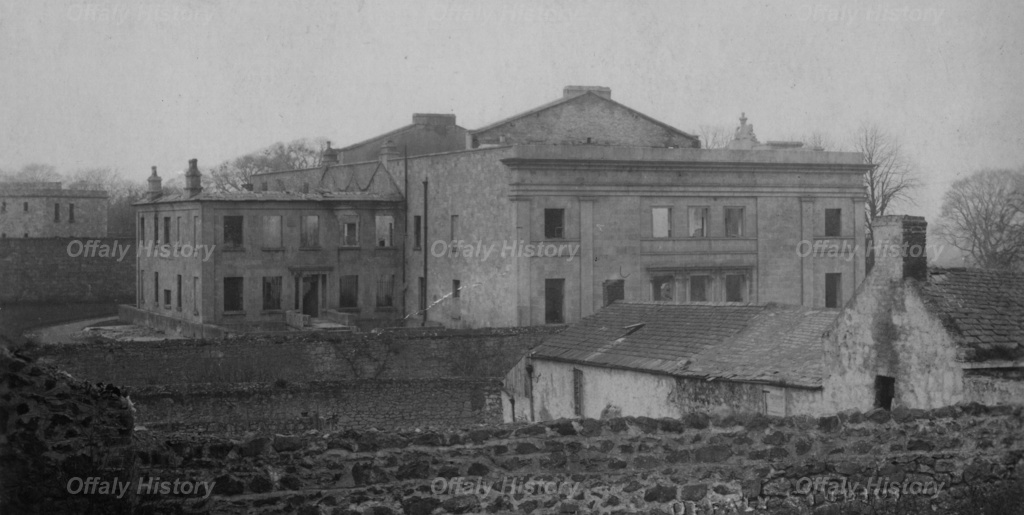
part of the Tullamore jail in the mid-1930s. After the burning there was general plunder of the fittings
where it is intended to re-establish the Co. Council offices. The Co. Council staff are returning to the same offices as they occupied while the British military were in possession of the Courthouse [Jan. 1921–Jan. 1922] Large crowds spent the day viewing the burning remains of the buildings and visiting the interior of the prison. Very few heard anything unusual last night and it was only about 6 or 7 a.m. this Thursday morning the destructive ravages of the fire became generally known.[1]
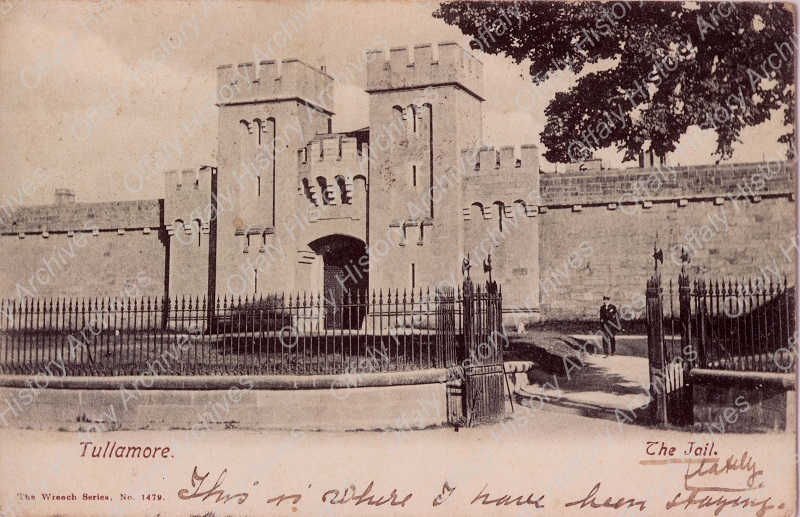
The original Tullamore courthouse of 1835 was destroyed by the Republican IRA on 19-20 July 1922 with the barracks and the jail. It was rebuilt in 1927 for £10,000, and again in 2007 for €10 million.
Things must have been appallingly chaotic for the council staff trying to sort the mess and later having to move back to very confined office, not being much more than ‘a stuffy little office in High Street’.[2] The council staff was now headed by John Mahon who had been the county accountant and was now also acting county secretary following the dismissal/forced retirement in January 1921 of Charles P. Kingston by the new Sinn Féin dominated council on the alleged grounds of neglect of duty.[3] Kingston had been the council’s chief administrative officer since 1900 and would have worked with the old parliamentary party councillors who dominated the scene until the local elections in June 1920. When the results were coming in that June Kingston commented that the ‘election was remarkable and even more revolutionary than the elections of 1898 when only three members of the old grand jury were returned’. Probably Kingston had anticipated the change, did not like it, and was preparing for his departure. He had clashed with the Sinn Féin county organiser and ideologue, T. M. Russell, who had been on the council since early in 1917 and was much too clever for Kingston’s liking. Kingston was enterprising and had erected ‘two fine blocks of double villas’ at Clonminch Road, Tullamore in 1909.[4] He had sold his own house in this development to John Williams (son of D. E. Williams) in late 1918 and perhaps moved to Dublin at this time as he was involved in the Kingston Drapery business from the 1920s. In any case the Kingston removal put considerable pressure on the remaining officials in the councils. All this emerged with the investigation into the council’s affairs and its dissolution in 1924.
The Tullamore jail was partially destroyed on 19-20 July 1922. ‘This is where I have been staying lately.’
The council’s own Finance Committee minute book recorded on 3 August 1922 that:
A meeting of the finance Committee was held in the Urban Council Hall, Tullamore, on the 3rd day of August 1922.
Mr John O’Meara presiding.
The other Members present were: – Messrs Luke Scally and James O’Connor
Payments to the amount of £1,377. 11s.3d. on foot of Works in charge of the County Surveyor, salaries, & c. were made.
The secretary reported, for the purpose of the record on the Minutes, that the County Courthouse and all the contents of same were burned and totally destroyed on the 19th July, and that the Safe, which was in the County Council Office, and which contained Ledgers and Abstracts, Vouchers, Paying Orders, Cheques, Bonds, Bank Pass Books, &c., had fallen to the bottom of the Courthouse, and when it was opened, all the contents were found to have been totally destroyed, being burned into ashes. Certain other books, such as the Minute Books, Rate Collectors’ Books, &c., were stored in the Strong Room in the Crown and Peace Office, by the courtesy of the Assistant Clerk of the Peace, [Mr Holohan] and were found to be safe.
The Secretary also reported that Messrs Healy, Coghlan and Costello had saved all the Rate Books, Expenditure Books, some documents, &c., and County Surveyor’s Books that they possibly could from the fire, and that they had worked hard at great personal risk, and he (Secretary) recommended them to the consideration of the Committee. The County Surveyor also supported this recommendation, and the Committee granted the three persons concerned a sum of £7 each, subject to the approval of the Local Government Department.[5]
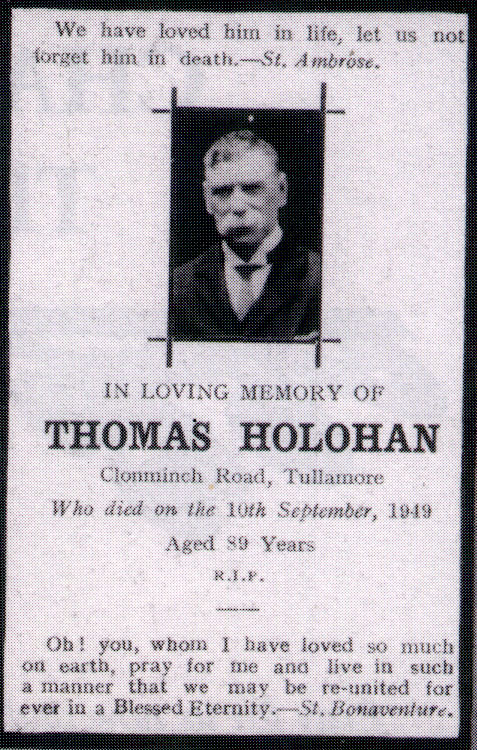
Thomas Holohan is obliged to sue the council for the balance of £2 due
In October 1922 the council agreed to pay Mrs Mooney, the former caretaker of the courthouse a sum of £7 for her work in saving a considerable amount of furniture from the fire in the courthouse.[6] The council was less liberal with Thomas Holohan, the deputy clerk of the peace working in what would later be the county registrar’s office.[7] He had requested the council to pay him the balance of £2 due to him of the total sum of £5 he had paid to a carter to assist in moving the court documents and some ratepayer material from the brick-lined safe. This included some 5,000 items relating to land registration. It took three days to remove the material at the expense of £5 paid by Mr Holohan, who also had had the assistance of his own family in the removal for which he had not charged anything. The council had let the matter go to quarter sessions rather than refund Holohan the balance of €2 of his out-of-pocket expenses for the transport of the documents. Judge Fleming awarded the amount claimed. Ironically, some of the documents saved may well have been included in the planned destruction about 2010 of old land folios in all the county registrars’ offices across the country showing previous transactions on the title. This was done as part of the moving online of the land registry folios but at the loss of much useful historical material.
Thomas Holohan (1860-1949) was a member of the rising middle classes of Tullamore. He became Assistant Clerk of the Peace in 1892 and retired as Senior Clerk in the Circuit Court Office in 1942. In 1909 he moved his family from their rented house in Store Street into ‘Innisfree’ (now ‘Loughmore Lodge’) one of the four substantial semi-detached villas on Clonminch Road built as a speculative development by the County Secretary, Charlie Kingston.
The county council was dissolved on 4 September 1924 and a commissioner appointed. This followed on from a report in May 1924 by the Ministry of Local Government’s chief engineering inspector on the state of the county’s roads and that the results of expenditure on road maintenance were about as bad as could obtain.[8] The situation was aggravated by the difficulty in collecting rates since June of 1920 and the repudiation of the Local Government Board. Furthermore, the accounts books had been seized by both the IRA and the RIC from June 1920. The council staff had been evicted from their courthouse offices in January 1921 and only allowed return in March 1922. Their stay only lasted four months. These reasons and the lack of a trained accountant following on from the promotion of John Mahon to county secretaryship were advanced by Mahon as the reasons for the shortcomings in the council’s management of local affairs. Mahon resigned from the county secretaryship in April 1925 due to chronic illness.[9]
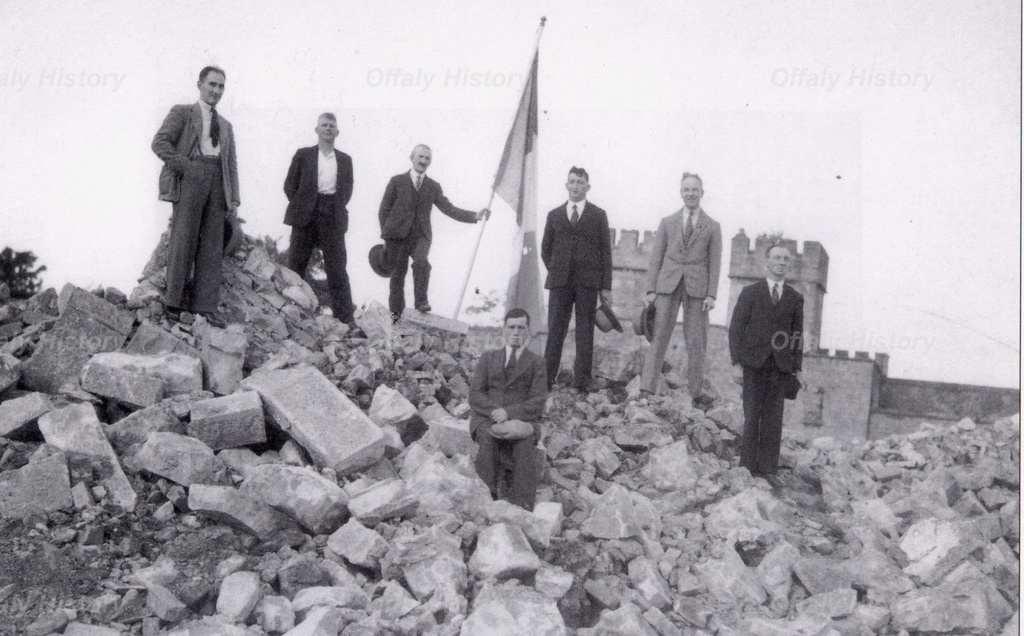
Republican IRA marking the destruction of the jail during the building works for Salts factory in 1937. Included in the picture are Messrs Digan, Clarke and Brennan.
The records of the council’s predecessor – the King’s County Grand Jury
In the several references in the press to the surviving records of the council and the clerk of the crown and peace nothing at all was said as to the fate of the grand jury records (see previous blogs). These would have included the presentment books and perhaps an old county map of the 1750s or perhaps that of 1809. John Wright had drawn on what appears to be a surviving series of presentment books from 1817 for his guide to Offaly published in 1890.[10] These were probably printed in Birr by Thomas Legge who was the only printer in Birr from that time until his death in 1826.[11] Wright did have access to what may have been a list of the sheriffs from 1787 and a summary of the judicial business, but not until 1817 the presentments or ‘Jobs’ books. He was able to list the full list of grand jurors from 1803 and presentment business (as was of interest to him) from 1820.[12] The fact that so much was destroyed in 1922 makes Wright’s book valuable today. The Offaly Archives catalogue provides listings of what survived. In the case of the council from 1912 and for the grand jury generally from 1830. But there may be more out there from 1817 because a collection was sold at Purcell’s for the very high price of £4,000. The rumour was that the National Library bought them but that may not be the case. A buyer from Offaly History went to £1500 but dropped out at that point to great disappointment.
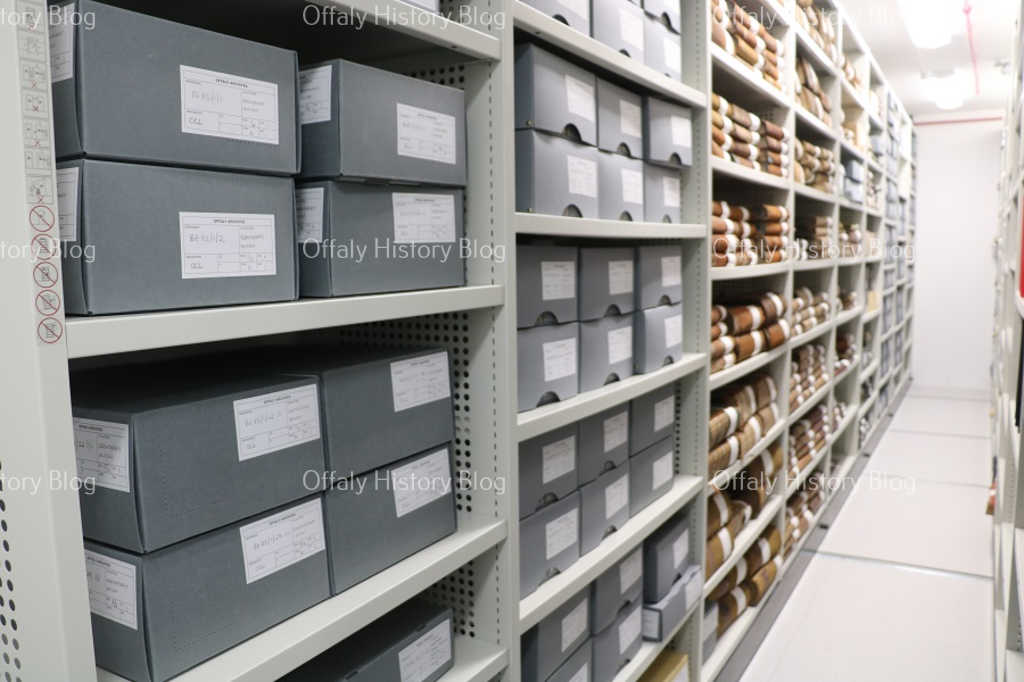
The good news is that our county records are now housed in Offaly Archives.
[1]Midland Tribune, 22 July 1922; Offaly Chronicle, 27 July 1922.
[2] Ibid., 29 July 1922; Tullamore and King’s County Independent, 4 Sept. 1915.
[3] This saga can be followed in Michael Murphy, Anne Coughlan and Grainne Doran, Grainne, Grand jury rooms to Aras an Chontae: local government in Offaly (Tullamore, 2003) pp 143–5.
[7] Holohan (1860-1949) was a member of the rising middle classes of Tullamore. He became Assistant Clerk of the Peace in 1892 and retired as Senior Clerk in the Circuit Court Office in 1942. In 1909 he moved his family from their rented house in Store Street into ‘Innisfree’ (now ‘Loughmore Lodge’) one of the four substantial semi-detached villas on Clonminch Road built as a speculative development by the County Secretary, Charlie Kingston. A noted figure on the Offaly legal scene, to the end of his days, Holohan still dressed in the senior civil servant’s uniform of sponge bag trousers, winged collar, a short ‘Parliamentary’ jacket and a bowler hat. He was dismayed by the actions in the Civil War of the Anti-Treaty forces, whom he always referred to in later life as ‘The Irregulars’. Information from Fergal MacCabe.
[8] Offaly Archives: minute book of Offaly County Council.
[9] Murphy, Michael, Coughlan, Anne and Doran, Grainne, Grand jury rooms to Aras an Chontae: local government in Offaly (Tullamore, 2003), pp 145-6.
[10] [John Wright (ed.).] The King’s County directory, 1890, including a short history together with coloured map, almanac and calendar. Parsonstown: King’s County Chronicle, 1890. Reprinted as Offaly one Hundred years ago with a new introduction by Michael Byrne (Naas, 1989).
[11] Michael Byrne, Printing and bookselling in Offaly in the nineteenth century (Tullamore, 2020), pp 52–3.
[12] John Wright (ed.). The King’s County directory, 1890, pp 253–62.
The end of the eighteenth and beginning of the nineteenth centuries witnessed in Ireland and Britain an acute shortage of physical currency from the royal mint. Silver coin output was limited to the small coins of penny, twopence, threepence and fourpence. There were no shillings between 1787 and 1816. Gold was issued, but copper coins had not been issued for Ireland since 1782. There were two consequences to this: a large output of light weight counterfeit copper coins, known as ‘raps’ in Ireland; and a private enterprise output of token coins during the 1790s to the 1810s, which could be redeemed for official coin by the token issuer.
It was a casual comment at the recent excellent Heritage Day event at Seir Kieran, Discovering Seir Kieran Monastic Site, a local mentioned that there had been a visit in recent months from a group from Cornwall, visiting the birth place of St. Piran/St. Ciarán. Cornwall had been mentioned as a place associated with St. Ciarán by one of the speakers on the day. It was time again to have a look at this St. Piran. Piran is by far the most famous of all the saints to have gone to Cornwall from Ireland.
St. Ciarán was one of the Twelve Apostles of Ireland along with Brendan of Birr. Charles Plummer’s translation of the Life of Ciarán has him arriving to Ireland before St. Patrick. He also had the title of the ‘first born of the Saints of Ireland’. He is supposed to have been born at Cape Clear in Cork where there is a church, a beach and a standing stone as memorials to him.
The finding of the De Burgo-O’Malley Chalice in a house in High Street, Tullamore in 1896 was a significant event and the chalice now features in A History of Ireland in 100 Objects.[1] Other artifacts in the 100 series include the Clonmacnoise Crozier, Old Croghan Man and the Ballinderry Brooch. Surprising omissions from the 100-book were The Shrine of St Manchan, The Book of Durrow and MacRegol’s Gospel. Never mind, these manuscripts were included in the British Library exhibition in 2018–19, and the wonderful new book The Shrine of St Manchan will make the locally held shrine known to a much wider public.[2]
Irish Sporting Lives (Royal Irish Academy, 2022) brings to life sixty figures who in their individual ways illustrate the drama and diversity of Irish sporting history.
This collection of biographical essays draws from the Dictionary of Irish Biography (DIB) and spans 200 years from the early nineteenth century. It is edited by DIB researchers Terry Clavin and Turlough O’Riordan, with an introductory essay by former Tullamore GAA clubman and Offaly Gaelic football coach, Ireland’s foremost sports historian, Professor Paul Rouse.
The biographies in Irish Sporting Lives encompass serial winners and glorious losers, heroes and villains, role models and rogues, enduring legends and forgotten or overlooked greats. Trailblazing women feature prominently, and their stories highlight the adversity they had to overcome in pursuing their sporting dreams. Aside from household names such as George Best, Jack Kyle, Christy Ring, Lady Heath, Alex Higgins and Jack Charlton, the volume will also inform readers about less well-known but equally fascinating figures. These include Vere Goold, the only Wimbledon tennis finalist ever convicted of murder; Dave Gallaher, New Zealand’s most revered rugby captain; and Martin Sheridan, the winner of nine Olympic medals for the USA.




 offalyhistoryblog