‘Girls do not play the same kind of games as boys’ was the opinion of Florence McCollum at Drumfad National School, County Donegal, in 1937. Florence was one of thousands of children who participated in the Irish Folklore Commission scheme known as the Schools’ Folklore Collection (Bailiúchán na Scol). Over fifty thousand schoolchildren in their final year of primary school, from five thousand schools in the twenty-six counties of Ireland (Northern Ireland was excluded), were invited to collect local folklore. Seán Ó Súilleabháin, archivist for the Commission, developed a booklet containing guidelines entitled ‘Irish Folklore and Tradition’, which was distributed to all schools. The folktales were recorded first in the children’s homework copybooks, then corrected by teachers and re-written into official notebooks which, when combined, became the manuscript collection. The children wrote down folklore and folk practices gleaned from older people in their families or local community. In the manuscripts, however, we can also find the voices of the children themselves, as they wrote about their own personal experiences with games, toys, and pastimes under headings such as ‘Games I Play’ or ‘Games We Play’. This blog considers the evidence from Donegal and Offaly and looks at how gender and play interacted.
It has been a good year for new publications contributing to the history of County Offaly and helping us to get to know ourselves and our place better. When the annual report of the Tullamore Credit Union is dropped in the door you know Christmas is close. Seeing the cover and that the credit union is now sixty years old set us thinking of phases in our history. The year 1923 marked the end of the civil war. After a period of growth from 1891 to 1918 things got difficult. You could write off 1923–63 in terms of the economic engine. It was mostly switched off with exceptions in Tullamore Yarns, the Bacon Factory, Tullamore and the Williams and Egan businesses serving the midlands. The emerging Bord na Mona and ESB were providing jobs in west Offaly from the 1950s and east Offaly later, but it was the 1960s before a general ‘all boats’ lift up occurred. Equally you could say that since September 2001 (and the mobile phone) we have been living with anxiety which seems to grow every year especially since Brexit 2016 and now the war and climate change. Not to mention all the things we have to do online to comply with the requirements of banks and government. These books are all available from Offaly History, Bury Quay (and online http://www.offalyhistory) and our friends in Midland Books, Tullamore.
This question has popped up recently arising from the launch last week in Birr by Offaly History of a book containing the complete poems of John De Jean Frazer. The Tullamore launch is Thursday 24 Nov. at Offaly History Centre at 5 p.m. so the editors may get to meet you there. You are welcome to attend.
John De Jean Frazer was a poet and cabinet-maker, the son of a Presbyterian Church minister from Birr, then known as Parsonstown. He was also a quite accomplished artist.
While his exact date of birth is not known, it is pretty certain he was born in 1804 and died a young man in 1852.
He was believed to from Huguenot stock, this belief coming from the use of `De Jean` in his name. We are not sure of this, and certainly a recent DNA test by one of his descendants cast doubt on this, as it showed no French DNA but rather Scottish. Frazer is certainly a Scottish name and is quite common in Ulster. His being from a Presbyterian family tends to make me believe that a Scottish ancestry is more likely to be correct. The `De Jean` in his name could be explained by possible sympathy with the ideals of the French revolution.
First established under the 1881 Land Act, the Irish Land Commission began as a regulator of fair rents, but soon evolved into the great facilitator of land transfer. However, over emphasis on these aspects of its work can sometimes camouflage its equal significance as the main instigator and architect of rural reform. There is no doubt that for most of its existence from 1881 to 1992 the Land Commission was the most important state body operating out of rural Ireland where its long tentacles spread into every nook and cranny. [Come to Professor Dooley’s lecture on Monday in Tullamore – see details below.
Two serious fires took place at Birr Castle within the hundred years from 1832 to 1919. Thankfully there has been nothing like it since and the castle was fortunate to survive the burnings of country houses in the county in the period from June 1922 to April 1923. Birr Castle is the only large house in the county to have survived in the same family since the 1620s. Its Gothic exemplar Charleville Castle, Tullamore also survived the destruction of the Civil War period. Both houses were occupied by the Free State Army from late July 1922.
The fire of 1832, ninety years earlier, was perhaps the most destructive and in its aftermath Laurence Parsons, the second earl of Rosse took the opportunity to add a third storey to the great house that had been substantially rebuilt in 1801–03. Its comrade in Tullamore is dated 1800 to 1812, or 1809 the grand opening – if not quite finished.
The B.B.C.’s centenary celebrations and John Bowman’s recent feature on RTÉ’s Sunday morning broadcast which included a recording of my late father, Llewellyn Marcus Goodbody, bring to mind the important part that Clara played in the development of radio, the scientific discovery which transformed communications and is now part of everyday life. Without the backing of Irish capital it is possible that Guglielmo Marconi’s invention would never have got off the ground.
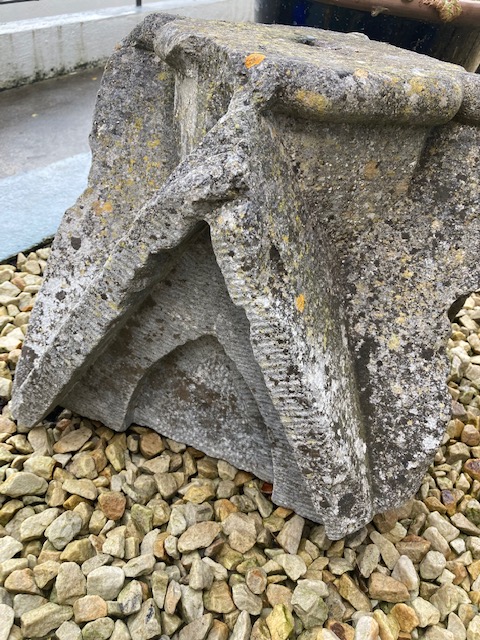
The first post-reformation Catholic Church in Tullamore parish was completed in 1775. Recently an architectural fragment from that church was presented to the Society. Ballyduff chapel was a small T-shaped building the remains of which are still standing and used to be glimpsed from the roadway between the former Wrafter’s farmhouse and the Carroll Meats factory. It is now in the grounds of Axis Business Park and easy to access.
The architectural fragment from Ballyduff first RC post-Reformation church of 1775 presented to Offaly History by John Wrafter.(more…)
Huge Crowd Gather in Bracknagh Community Hall for viewing of Film
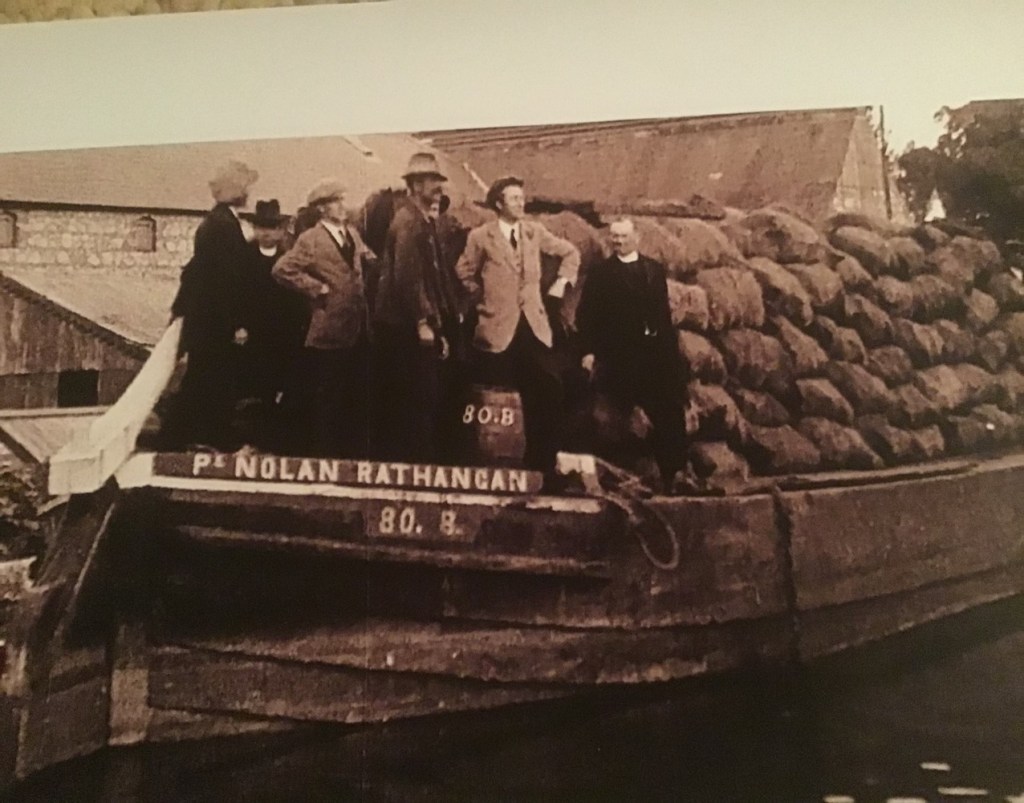
Bracknagh Community Hall was full to capacity on Thursday last for the viewing of a film on the Ballynowlart Martyrs and the Turf Co Operative 101. The event was organised and hosted by the newly formed Bracknagh Heritage Group (A sub group of the Bracknagh Community Association). The guest speaker was Larry Fullam, local historian and researcher from Rathangan. Tony Donnelly extended a warm welcome to the large gathering. Mary Delaney, on behalf of the heritage group introduced and welcomed both Larry Fullam and Amanda Pedlow (Offaly Heritage Officer). Amanda addressed the audience on the supports provided by the Heritage Council for viable local projects.
Larry spoke on how in 1917 a local priest Fr Kennedy with the help of Fr O’ Leary from Portarlington had the remains of the victims of a fire at Ballynowlart church in 1643 exhumed and reburied in the grounds of the St. Broughan’s church. The story of Ballynowlart attributes the setting alight of the church on Christmas Day in 1643 to Cromwell’s forces. A congregation of 108 people, who were attending Christmas Mass all died, with the exception of two, who were said to have escaped. The film produced by Pathe showed Fr Kennedy handling the exhumed skulls of the victims and preparing them for reinternment in Bracknagh in 1917. The second part of the film centered on how in 1921 (one hundred and one years ago), as part of the Government’s selling of bonds and fundraising, the Bracknagh Turf Co Operative exported sacks of turf to New York to raise money to fund the then, newly formed, Dail Eireann. Larry donated a number of photographs of the stills from the film to the Bracknagh Heritage Group.
The last time a film on Ballynowlart was shown was in 1964 in the cinema in Portarlington. This event was organised by the late Harry Milner of Walsh Island and was attended by a huge crowd from the Bracknagh area, many of whom are still part of the community of Bracknagh today. The Bracknagh Heritage group are very grateful to Larry for his in-depth research and knowledge and for providing us with a great insight into Bracknagh’s past.
The members also expressed their appreciation to all those who attended Thursday evening’s event and are delighted to see the interest and enthusiasm for local history in the area.
The group intend to pursue the following projects in the near future. The real story of the Ballynowlart Martyrs. The monastic site of Saint Broughan at Clonsast. The Impact of Bord na Mona in the area. The Story of John Joly and the extended Joly family.
Lord Ashtown and his role in evicting tenants from the Bracknagh area in the mid 19th century, and how some Bracknagh emigrants were banished to places like Oneido in New York.. The RIC Barracks in Ballynowlart and The Mill at Millgrove. It was highlighted at the conclusion of the meeting how the Catholic Church, built at the peak of the Irish Famine celebrates 175 years this year. The group extend;’/ thanks to Lisa Quinn, Chairperson of the BCA for facilitating the event.
Mary Delaney
(on behalf of the Bracknagh Heritage Group, which include. Francis Cunningham, Mary Crotty, Mary Briody, Barry Cunningham, Tony Donnelly & Aidan Briody).
People from Bracknagh gather outside Portarlington Cinema 1964 after watching a film on the Ballynowlart Martyrs (Photo courtesy of Larry Fullam) Bag of Turf from the Bracknagh Turf Co-Operative destined for New York 1921
Contributed by Offaly History to mark the occasion
The new book, St Manchan’s Shrine, by Griffin Murray and Kevin O’Dwyer was launched to great acclaim by the CEO of the Heritage Council Virginia Teehan on Friday 21 October 2022 at Offaly History Centre, Tullamore before a large and distinguished audience. Proceedings began at 5 30 p.m. with Amanda Pedlow ably acting as chair and introducing the four speakers. First was the author of the text Griffin Murray, followed by silversmith and photographer Kevin O’Dwyer. The County Offaly CE Anna Marie Delaney skillfully chartered the progress being made in regard to the county’s heritage while CEO Virginia Teehan paid tribute to the county for its wide-ranging involvement in heritage projects and availing of the funding available. The new Offaly Archives was a leading case but one among many successful projects undertaken. Another is that of the funding received to create the post of a biodiversity officer. Offaly has demonstrated its ability to secure funding for projects and that was a reflection of the work being done in the county. Ms Teehan congratulated the authors, Griffin Murray and Kevin O’Dwyer, on a job well done. Yet another exemplar.
In this article John Gibbons talks about the value of oral history and the importance of making the recording. John started recording in Offaly in conjunction with the Offaly History in December 2014. Since then over forty people have volunteered to be recorded. You do have a story so why not contact John or we can put you in touch via Offaly History. John has contributed material to Offaly Archives which will prove very useful in years to come. A story worth telling is a story worth saving.



 offalyhistoryblog