Collecting books on your favourite topics is an ever present challenge that can give great satisfaction and broaden as well deepen one’s knowledge of a subject. On 8 October 2022 Offaly History Centre is hosting a book fair, such as not seen in the town for three or four years. Many dealers are coming so why not call and talk books from 10 a.m. to 5 p.m., but don’t get caught in the callows! Bring money and enthusiasm.
Book fair day 8 Oct. The Society has over 50,000 books of which 25,000 are for sale comprising about 3,000 titles. The Society’s 13,000 titles in its library can be viewed on http://www.offalyhistory.com as to the titles. Call if you want to read something including many of the latest Irish history publications.(more…)
The Dunne family has inhabited parts of County Laois since time immemorial. They descended from Cathair Mór, second century Monarch of Éire and Brittas House, near Clonaslee, became their family seat (after their main residence in Tinnahinch was blown to bits in 1653). Family land holdings hovered around 10,000 acres throughout what was then known as the Queen’s County.
Township could be said to have begun in Tullamore in 1622. On 30 September the anniversary will be marked with an outdoor exhibition of drawings by Fergal MacCabe and a Timeline of Events showing the story of the town since the earliest times. We have covered many stories of Tullamore in over 420 blogs published in this series. All can be accessed on www.offalyhistory.com. For a quick link to all these resources see @offalyhistory
Historical Notes by a contributor writing in 1912, edited by Offaly History
This contribution to local studies was made in 1912 and was based on the writer’s access to a copy of the Tullamore entry in Slater’s Trade Directory published in 1846. At the time there was no public library in Offaly and private reading rooms were few. Neither was there photocopying or digitized copies. Books were expensive and access confined to only a few. There is unlikely to have been any bookshop in Offaly in 1912. By that time Sheppard’s in Birr, the only decent bookshop in Offaly in the mid nineteenth-century, was concentrating on stationery.
The only original comment from our contributor of the 1912 article was in reference to the coming Home Rule and the appointment of Catholics to public office. The War of 1914–18, 1916, The War of Independence and the Civil War were yet to come. The writer remarked:
Judging by the names of those filling public positions in Tullamore sixty odd years ago [in 1846], Catholics and Nationalists had very little influence in the administration of public funds. But times are changed, and even in the comparatively brief period which has elapsed since the above described state of things existed, one cannot but marvel at the immense strides made in science, mechanical engineering, and the arts generally, while the rapid development of National political ideas and aim points to the rapid approach of a golden era for our country.
What a pity the writer did not say more about 1912. That is the gap we have been trying to fill with our blogs on the Decade of Centenaries and our new Decade platform on www.offalyhistory.com. We are now working on a book to bring all these article and photographs together and to be published in late 2023. In the meantime we share this article on Tullamore in 1846. In 1912 the article was probably written out by hand from the rare book and then typeset with hot metal type for publication in the local press. To think that in those days people depended entirely on the printed newspaper for news of things past and pressing matters then current. The new telephone was first tested in Clara in 1898 and the motor car locally in the same year. It was only ten years later in 1908 that telephone services began to develop in the county and likewise with the motor vehicle. To quote the article of 1912:
Slater’s Directory compiled so far back as the year 1846 – [over 175 years ago] – contains some interesting particulars at this distance of times regarding the towns, villages and parishes with which it deals. One frequently hears this period in our history referred to as “the good old coaching days,” though famine and pestilence wasted our land, and the exodus of our kith and kin may be said, as a consequence, to have been inaugurated amid the distressful scenes of “Black Forty – Six and Forty – Seven.” Railways had not then intersected the country, nor had the electric telegraph spreads its message-bearing network round the world. “Wireless” was unknown, and the telephone lay hatching in the cradle of its inception. Business moved in a slow and happy manner, with neither rush nor worry, such as crush the life out of our present-day business men, Heavily-laden carriers carts moving lazily along with their burdens of merchandise from town to town, were a frequent and picturesque sight along the high roads, while the sounding horn of the “Royal Mail” coach awoke the echoes in vale and mountain, as does the shrill steam-blast of its successor at the present time. Carriers’ inns were a feature of our towns, and around the fires in winter, or about the doors in the summer’s eve, many jokes were cracked, and stories told of “life on the road”
Of deeds of valour done ‘gainst robber bold.
Or encounter with a ghostly visitant.
A Bianconi coach in Clonmel, probably 1830s by John Harris, after Michael Angelo Hayes. In 1836, Hayes produced what was to prove one of his most popular pieces of work. It was a series of four illustrations entitled “Car Driving in the South of Ireland” and featured the famous Bianconi coaches, one of the main forms of public transport in Ireland at the time. They were engraved by John Harris and published by Ackermann in 1836. Concerning them, Crookshank and Glin remarked: “They were extremely popular, were often reprinted and clearly made his name.”
The hotel from which the Royal mail coach took its departure upon its daily or nightly journey was regarded as a place of importance in the community, and was generally the scene of much animation as the coach was being prepared for the road. Ostlers bustled around their well-groomed horses, getting them into position, with loud-voiced orders to their dumb friends as to good behaviour, while the scrutinising eye of the driver beamed upon them, sometimes in anger, but more often with a look of happy approval. In a by no means softly modulated voice he gave his directions as to traces, bits, reins, swing bars etc., while porters buzzed about like a flock of bees, getting passengers’ luggage into the “boot” of the coach under the driver’s seat, paying scant need to its owner’s inquiries as to possible safety. Highwaymen were not unknown in those days. Passengers took leave of their friends and become seated inside or scrambled to the top of the coach by means of steps conveniently ‘placed for the purpose, and the “Guard, “splendidly robed in brightest of scarlet, bearing the Royal insignia on each shoulder, strutted, peacock-like, up and down the pavement, frequently consulting his watch as the hour for departure approached. At least he become seated, and a huge blunderbuss on each side of him, warned all and sundry that something unpleasant awaited those who, ventured to exhibit an impertinent curiosity as to the content of Her Majesty’s mails. A loud blast of the guard’s horn, and the driver whipped up his horses – they were off.—
Off on their journey for good or for ill,
Down thro’ the valley, up over the hill;
Some to return – some future to roam—
While fond hearts are grieving behind them at home.
TULLAMORE
The authority from which we quote says, that according to the Census of 1841 the parish of Tullamore contained 9,608 inhabitants, and the town 6,343 of that number. The post office was situated in William Street; and the post-master was John Alexander Bradley. There was a delivery of letters daily; those from Dublin and the North arriving every morning at half-past five o’clock, and those from Parsonstown, Mountmellick, and the South and West every evening at seven. Letters from Dublin and the North were dispatched every evening at half-past seven, those from Parsonstown , etc., at six o’clock every morning. A one-day delivery of letters would hardly meet present-day business requirements.
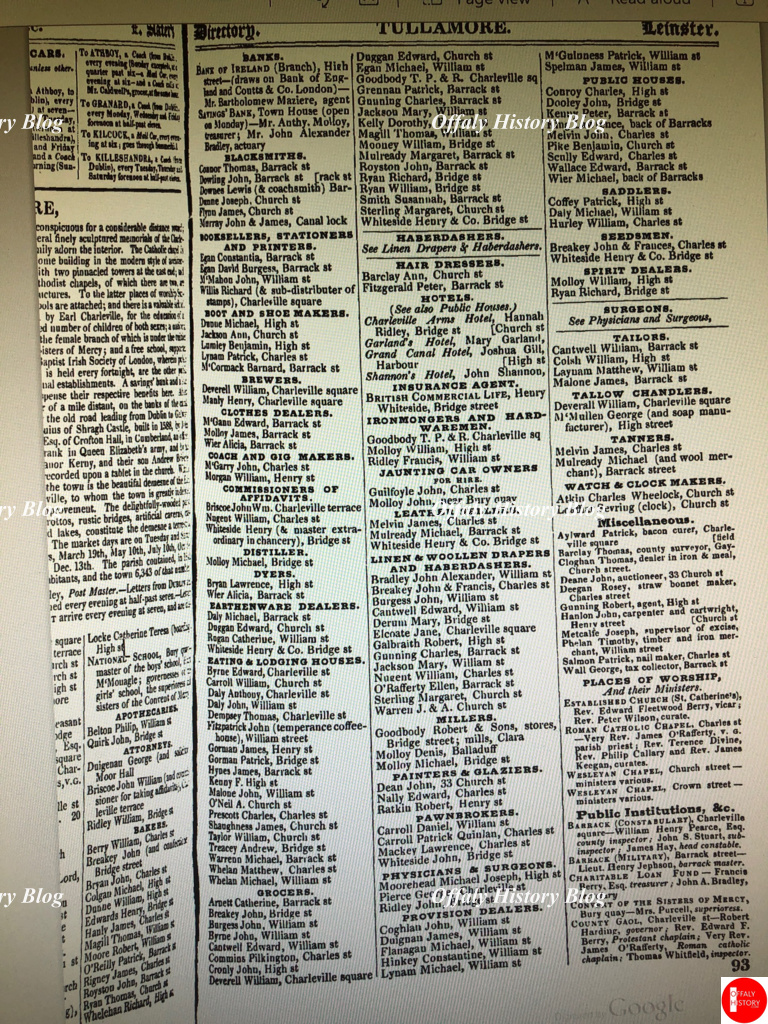
The entry for Tullamore from Slater 1846. Note the number of bakers
In the historical sketch the “Directory” says: – “Tullamore, or Tullamoore, the latter appellation said to be derived from the moor on which it stands [in fact the surname of the Moore family] is the county and Assize town of the King’s County, and a parish, in the barony of Ballycowan, 57 miles W. by S. from Dublin, 25 S.E by E from Athlone,12½ N.E. from Ballyboy, 10 west from Philipstown, and six south from Kilbeggan The Grand Canal passes the end of the town, affording water communication with Dublin and Shannon Harbour ; and the small river Clodagh (a branch of the Brosna) runs through, and is crossed by a neat bridge. The town is arranged in the form of cross and the houses being white, and the streets wide, it is in appearance airy and cleanly. The surrounding country is level, and the bogs are numerous, causing turf to be cheap and giving employment to great numbers of persons in producing and bringing it to market. The public structures, besides the places of worship and schools are a noble and admirably constructed gaol, with a graceful courthouse, market house, barracks, and a convent. The Assizes, having been removed from Philipstown, are now held here, and petty sessions every Saturday. The municipal government is vested in a Seneschal, and the local magistrates. The headquarters of the constabulary force is in this town, which is the residence of the county inspector. The principal business establishments are two breweries, the same number of tanneries, a distillery, a branch of the Bank of Ireland, and four hotels.
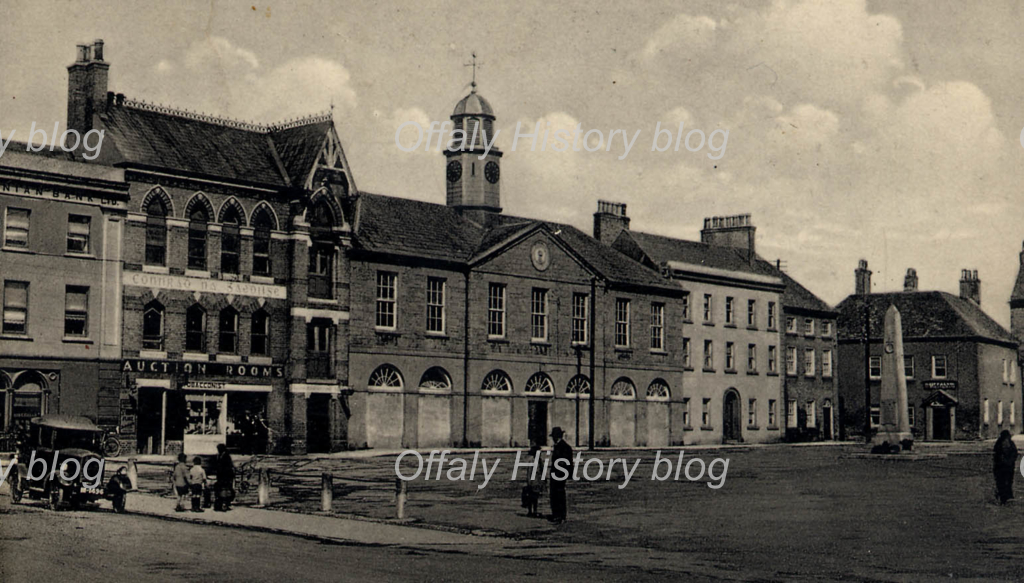
The savings bank was located in the former market house (centre)as was the Tullamore Charitable Loan Fund
The parish church of St. Catherine, which stands about a quarter of mile from the town, upon a lofty, sandy hill, is a new building, with a handsome pinnacled tower, conspicuous for a considerable distance round; and several finely sculptured memorials of the Charleville family adorn the interior. The Catholic chapel is a handsome building in the modern style of architecture, with two pinnacled towers at the east end: and the Methodist chapels, of which there are two, are neat structures. To the latter places of worship Sunday school are attached, and there is a valuable school, founded by the Earl of Charleville, for the education of an unlimited number of children of both sexes: a National School, the female branch of which is under the tuition of the Sisters of Mercy, and a free School, supported by their Baptist Irish Society of London, wherein public worship is held every fortnight are the other public educational establishments. A Savings Bank and a Loan Found dispenses their respective benefits here. About quarter of a mile distance, on the banks of the Canal, and near the old road leading from Dublin to Galway, art the ruins of Shragh Castle, built in 1588 by John [Bris]scoe, Esq., of Crofton Hall, in Cumberland, an officer of high rank in Queen Elizabeth’s army, and by his wife, Eleanor Kerny, and their son, Andrew Briscoe, Esq., as recorded on a tablet in the church. Within a mile of the town is the beautiful demesne of the Earl of Charleville, to whom the town is greatly indebted for its improvement. The delightfully-wooded park, with its grottos, rustic bridges, artificial caverns, cascades and lakes, constitute the demesne a terrestrial paradise. The market days are on Tuesday and Saturday. Fairs, March 19th, May 10th, July 10th, October 21st, and December 13th.
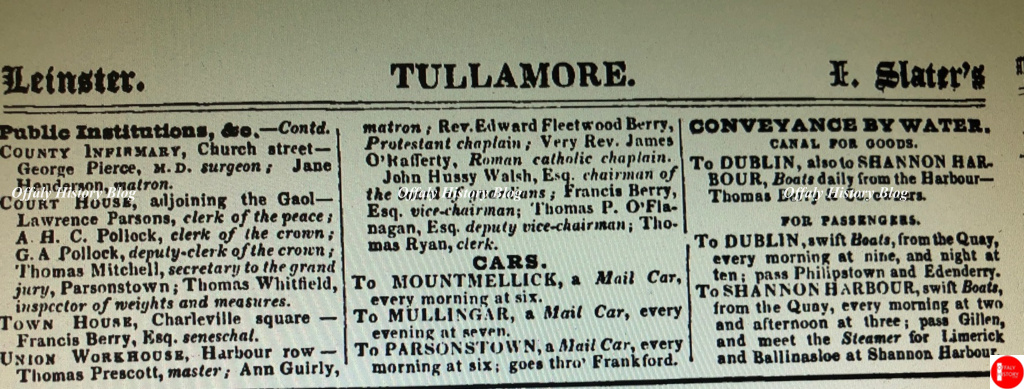
Slater 1846 on transport from Tullamore
A mail car ran to Mountmellick every morning at six; to Mullingar every evening at seven, and to Parsonstwon every morning at six, passing through Frankford. Conveyance by water canal for goods to Dublin and Shannon Harbour was available by boats running daily-. Thomas Berry and Co., owners; and for passengers by same route, “swift boats,” started from the Quay [near Bury or Whitehall Bridge] for Dublin every morning at nine, and night at ten, passing Philipstown and Edenderry. To Shannon Harbour, swift boats left the Quay every morning at two, and afternoon at three, passing Gillen, and meeting the steamer for Limerick and Ballinasloe to Shannon Harbour. The Very Rev. James O’Rafferty, V G, was P. P. of Tullamore at this time, the curates were Rev Terence Devine, Rev Philip Callary, and Rev James Keegan. The Protestant congregation of St. Catharine’s were ministered to by Rev Edward Fleetwood Berry (Vicar), and Rev Peter Wilson, curate. Mrs Purcell was superiors of the Convent of Mercy, Bury Quay. The other religious denominations do not seem to have had any fixed pastor attached to their congregations.
The public institutions were officered as follows: ____
Constabulary Barrack, Charleville Square ____ William Henry Pearce, County Inspector ; John S. Stuart, Sub-Inspector ; James Hay, Head-Constable.
Miliary Barrack, Barrack street – Lieut. Henry Jepson, Barrack Master.
Charitable Loan Fund – Francis Berry Esq., Treasurer; John A Bradley, secretary.
County Gaol – Robert Harding, Governor; Very Rev James O’Rafferty, Catholic chaplain; Rev Edward F. Berry, Protestant chaplain; Thomas Whitfield Inspector.
County Infirmary, Church street – George Pierce, M.D., Surgeon ; Jane Henderson, Matron.
Courthouse adjoining the Goal – Laurence Parsons, Clerk of the Peace ; A.H.C. Pollock, Clerk of the Crown; Thomas Mitchell, Secretary to the Grand Jury, Parsonstown ; Thomas Whitfield, Inspector of Weights and Measure.
Town House, Charleville Square – Francis Berry, Esq., Seneschal.
Union Workhouse Harbour Row – Thomas Prescott, Master; Ann Guirly, matron. Very Rev. James O’Rafferty, Catholic chaplain; Rev. C. F. Berry, Protestant chaplain; John Hussy Walsh, Esq., Chairman of the Board of Guardians; Francis Berry, Esq., Vice-Chairman ; Thomas P. O’Flanagan, Esq., Deputy Vice –Chairman.
There were four hotels – The Charleville Arms, Hannah Ridley, Bridge street; Garland’s Hotel, Mary Garland, Church street ; Grand Canal Hotel, Joshua Gill, Harbour; and the Shannon Hotel, John Shannon.
The medical practitioners comprised – Michael Joseph Moorhead, High Street; George Pierce, Charleville Square; John Ridley, Bridge street; and amongst the hardware and ironmongers the firm of Messrs T. P. and R. Goodbody is mentioned. Agent for the Bank of Ireland Branch, Mr. Bartholomew Maziere.
Savings Bank, Town House (open on Mondays) – Mr Anthony Molloy, treasurer; Mr. John Alexander Bradley, actuary.
Apothecaries – Philip Belton, William Street; John Quirk, Bridge street.
Attorneys – George Duigenan, John William Briscoe, Charleville Terrace; William Ridley, Bridge Street.
In addition to the four hotels mentioned above , the names of nine publicans and two spirit dealers, four pawnbrokers, three saddlers, two tallow chandlers, four tailors, two tanners, three millers, two dyers, two brewers, one distiller, while eating and lodging house keepers musters a total of nineteen. Grocers and provision dealers number thirty- one; blacksmiths, six; boot and shoe- makers, five, etc.
Note the number of hotels and eating and lodging houses
All the south midland towns declined during the fifty-year period after the Famine with the exception of Clara where the Goodbody jute factory provided employment for 700 workers in the 1880s. The towns of Birr and Banagher were most severely hit. The decline of Birr was exacerbated by the final closure of the large military barracks in Birr in 1922. The previous year the Birr workhouse was closed and amalgamated with Tullamore. At a time of depression and scarce employment opportunities it was not surprising that the county capital, Tullamore, should seek to draw to itself whatever job opportunities existed in the public service sector, but it was to cause a good deal of resentment in Birr up to the 1950s.
The growth of middle-class housing after 1900 may be said to have begun with the building of four ‘villas’ at Clonminch in 1909 by Charles P. Kingston, the then county secretary to King’s County Council. It was preceded earlier by the substantial house of Daniel E. Williams completed at Dew Park in 1900. Were it not for the war and the scarcity of materials we might have seen more housing in the 1916–23 period. However, there was a further scarcity of building materials and high prices in the early 1920s and it was not until about 1930 that middle-class housing began to grow again and almost entirely on Charleville Road and Clonminch the period prior to the Second World War. After a slow start in the late 1920s council housing was constructed in earnest from 1933–4 and up to 1940, resuming again in the late 1940s (see my earlier blog).
Several of my ancestral families came from Ireland in the early to mid 1800s. They came from Counties Dublin, Armagh, Tyrone, Westmeath and King’s (now Offaly) and surrounding midlands counties. The one common factor was that they all migrated to Quebec, settling in several small communities in the area just southeast of Quebec City across the St. Lawrence River.
After a generation, many of those families moved to western Canada or the United States, often settling together. Many went to Wisconsin and Michigan where they worked in the logging industry and farmed. In the next generation, some married into other Irish families, so studying one’s family gradually evolved into studying several. My families were among those settling in Jacksonport, Door County, Wisconsin.
I had always wondered how and when these Church of England/Ireland families got to Ireland from England and Scotland, then migrated to the same places in North America. What did they have in common? There are no relevant ship manifest lists for British Isles migrants going to Canada since it is a part of the British Commonwealth, and it was not like going from one country to another.
I have an old family Bible with some information, but for the most part all I had to go on was Canadian census records or church records which gave a child’s birthplace and age, indicating approximately when the families left Ireland, and if I was lucky, a more specific birthplace. Usually, specific meant only a county. Family lore told of one or two Bagley children being born in Clara, Kings County. Other names of the Quebec families appeared in the Irish Midlands, so I concentrated my research there.
A contribution to marking the Decade of Centenaries in Offaly and recalling the past generations and the towns and villages on the eve of the War of Independence
In marking the years from 1912 to 1923 we may think that the years around 1916, the War of Independence and the Civil War were times of unmitigated strife. Not so. Normal life continued, if punctuated by violent acts, such as the shooting of policemen in Kinnitty, Kilbeggan or Tullamore. The finding of bodies of spies, ‘the disappeared’, in Mountbolus or Puttaghaun. The holding of brief gunbattles in Ballycommon or Charleville Road. Worst of all the organised state violence condoned by Churchill and Lloyd George in the form of the Black and Tans racing through towns and villages in the dead of night and taking shots at anything that moved. Yet normal life continued and no better illustrated than by the issue, almost every week, (Offaly Independent excepted as the printing works was destroyed by British forces ) of the three or four local papers in Offaly and from time to time trade supplements or special publications such as trade directories that very much illustrate local business in most of the Offaly towns. Recently Offaly History acquired the 1919 MacDonald’s Trade Directory for Ireland to add to its collection at Bury Quay, Tullamore.
To conclude our Heritage Week series of talks online we want to tell you the illustrated talk New light on Irish county map-making in the early 19th century – tracings from William Larkin’s map of King’s County/ Offaly, c. 1808 has now been uploaded. You get a 30-minute introduction from the leading expert on the early maps of Offaly. This is followed by minute comparisons of the Larkin tracings for west Offaly with the published Larkin atlas of 1809. Dr Arnold Horner has prepared an in-depth lecture on map-making in King’s County in the early nineteenth century where he analyses the significance of the new map tracings attributed to William Larkin which were donated to Offaly Archives last year, and conserved by Liz D’arcy through Heritage Council funding. He particularly looks at features in the landscape around Birr, Banagher, and Ferbane.
With thanks to Offaly Archives last Tueday’s lecture (16 Aug. 2022) by Dr Arnold Horner is now online as are the maps which are recently conserved.



 offalyhistoryblog