The Summer of 1921was heralded as having some of the best Irish weather days in ten years.1 Many people used the opportunity to cycle their bicycles along the countryside roads and lanes, whilst keenly observing the fields of green and gold ripening barley. The slight breeze gently blowing the ears of grain with the browny blue hues of the Slieve Bloom mountains to the southwest as background. The farmers were looking forward to a decent crop that year, and to attract good prices when selling to the local malt houses, brewers, and distillers. They would be able to take on additional seasonal labour to get the harvest in on time. After yet another long Winter, much needed outdoor activity and laughter was a recipe for relief from the underlying and not too far off reality of political turmoil, criminality, and civil strife. ‘The Truce that came into effect on 11 July 1921 officially ended what is now most often referred to as the War of Independence and came as the culmination of the most violent six months of the war.’2 ‘Relieved civilians celebrated the arrival of peace and Volunteers returned home to bask in newfound freedom, safety, and adulation.’3 But sadly, it was to be a summer that would be remembered not for the good weather alone.
Change is always about but perhaps more so since ‘Nine Eleven’ 2001 and March 2020 than we care to appreciate. Changes in eating out in Tullamore’s streets in recent days would have come as a shock to our predecessors of 1914. We are not Spain as Brewery Tap owner, Paul Bell, recently remarked but the fine weather and the adoption of coffee over tea are all helping. In the interior things are changing too. The love of banking halls is gone and now it is all doors and screens as new ways of working come in. The new county offices inTullamore (2002), and in many other buildings, may yet have to be reconfigured, and as for nightclubs what are we to do. On top of that some Tullamore municipal councillors are talking of revisiting our list of Protected Structures to remove those buildings that cannot be sold and are falling down.
All this talk of change, inside and out, suggests that we look again at what we had in the way of streetscapes before that period of great turbulence when Ireland was on the verge of Home Rule and Partition was unmentionable. It was ‘The Sunday before the War’ time. Thanks to the work of photographer Robert French (1841–1917) and the Lawrence Studio (1865–1942) we can look back, not in anger or nostalgia, but in awe at what was achieved in our towns over the period from the 1740s to 1914, but more especially in the years of growth and prosperity from 1891 to the First World War.
The Lawrence Collection of some 40,000 photographs are well known. Perhaps less so that the online catalogue from the National Library (nli.ie) is in large format, high resolution, for the Offaly towns, allowing us to dig down/zoom in to see the detail that escapes one looking at the ubiquitous printed photograph in the pub or the tablemat. There are almost 200 Lawrence photographs for the Offaly towns and villages. For Tullamore there are at least 17, for Birr over 70, Banagher 3, Clara 20, Edenderry over 16, Portarlington 18, Kilcormac 12 including four placed in County Cavan, Clonmacnoise at least 33, Kinnitty 3, Mountbolus 1, and perhaps more to be identified. These figures are estimates and likely to change such as one of the earliest for Tullamore (late 1890s perhaps) that became available in recent years, or at least better known and the subject of this blog.
A very fine book from Kieran Hickey and Allen Lane (1973)(more…)
There are many people of note from Clara, but two particularly can be seen as associated with the period of Partition; David Beers Quinn and Vivian Mercier. Despite the ongoing War of Independence, the British government passed the Government of Ireland Act in December 1920, providing for the setting up of two parliaments in Ireland. The 3rd May 1921 marked the formation of the United Kingdom of Great Britain and Northern Ireland, so partitioning the island of Ireland. Vivian Mercier and David Beers Quinn had just reached their 2nd and 12th birthdays respectively. Although born a decade apart, in terms of Protestant identity, they represent different socio-economic backgrounds, illuminating what it was to be Protestant and Irish in the South of Ireland.
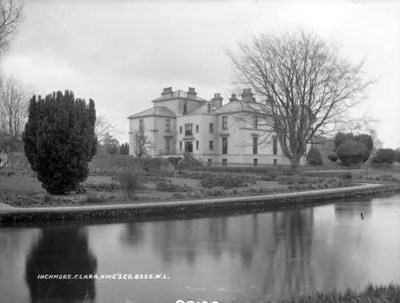
Inchmore where David Quinn worked as a gardener.
David Beers Quinn’s father, also named David, was a member of the Church of Ireland from Tyrone, He was employed as a gardener at the Goodbody house, Inchmore. His mother, Albertina Devine was also a member of the Church of Ireland from Cork with English parentage. Mercier’s father was from a Methodist family of Huguenot origin and his mother from a Church of Ireland clerical background from Monaghan. They lived in Cork Hill, Clara. The Mercier family, like the Goodbody family, were millers. Mercier’s father was born in Durrow, near Abbeyleix, Laois and was employed as a commercial clerk in jute manufacture at the Goodbody mills.
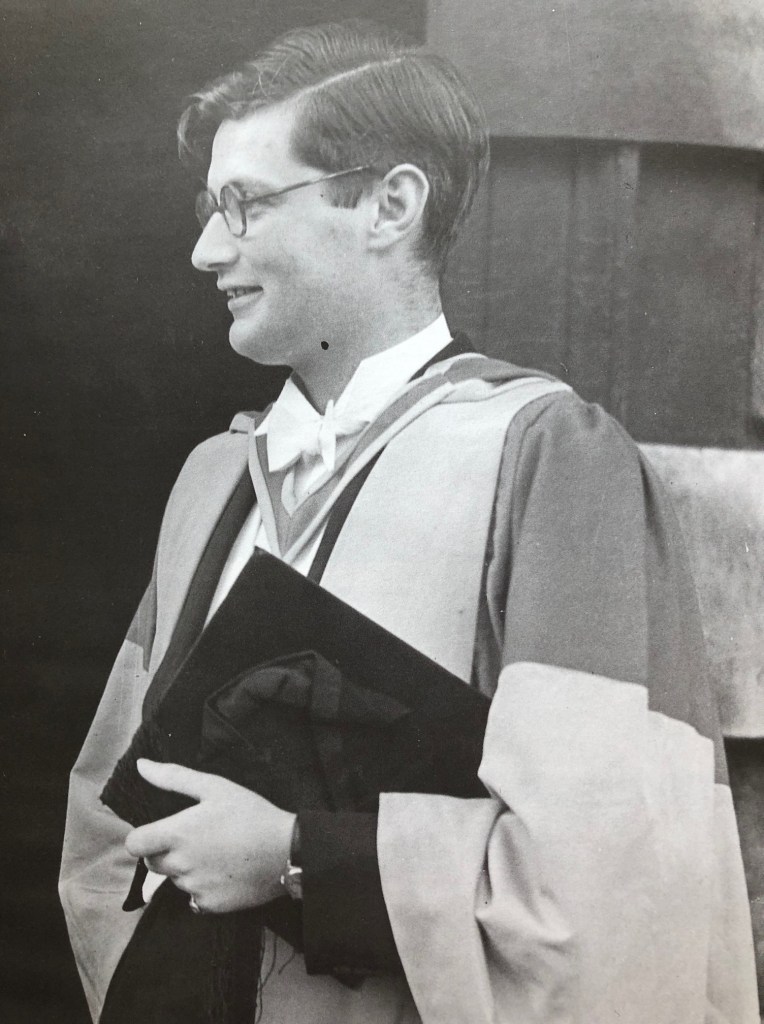
Vivian Mercier
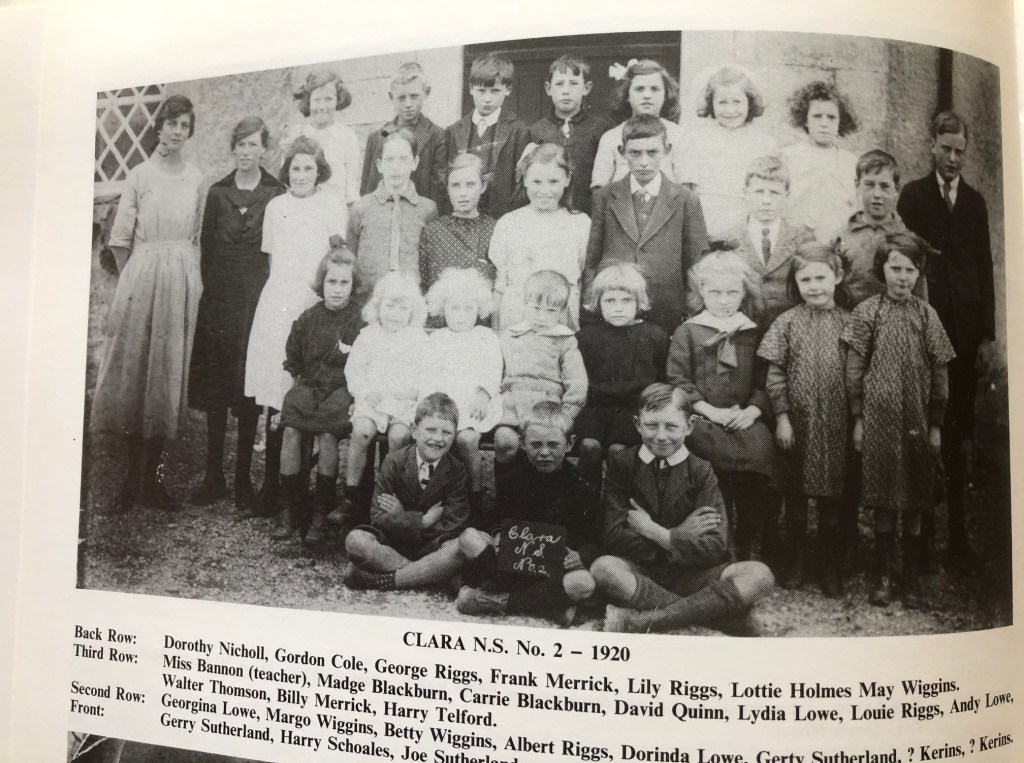
The partition of Ireland affected the education of Quinn and later Mercier. Quinn and Mercier attended Protestant National Schools, Quinn attending Clara No 2 Protestant school and Mercier, Abbeyleix South National School. Why Mercier attended school in Abbeyleix is unknown as the Clara National School was still under the tutelage of Miss Bannon who taught Quinn. However, it is known that Mercier corresponded regularly with Mrs Thompson, a later teacher at the school in Clara. Possibly the Mercier family had moved out of Clara due to unrest to the comparative safety of his father’s family home in Abbeyleix, approximately 60km south.
David Beers Quinn taking a look at one of his editions of Drake’s Voyages for the Hakluyt Society.
Quinn’s parents came to realise that their son was gifted. Finding good Protestant Irish education for a child from a working-class family was almost impossible if they stayed in rural Southern Ireland. The family moved to Belfast in 1922 where his father gained employment and in 1923 Quinn was able to attend the prestigious Royal Belfast Academical Institution. He continued his studies as an undergraduate at Queen’s University, Belfast between 1927 and 1931.
Mercier similarly left the South for Northern Ireland for his secondary education, attending the Portora Royal School in Enniskillen, one of the Public Schools founded by Royal Charter in 1608 by James I. Samuel Beckett (1906 –1989) was a former pupil. Critique of Beckett’s writing, particularly ‘Waiting for Godot’ was to shape much of Mercier’s career. Mercier and Beckett shared an affluent background and Huguenot descent in common.
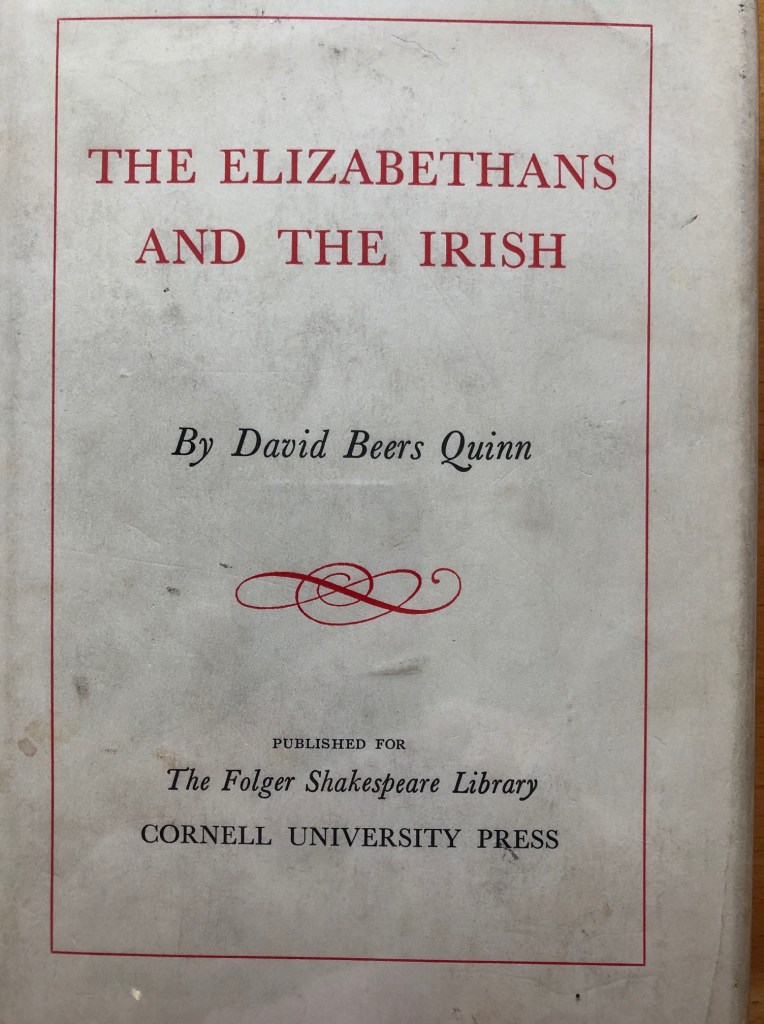
Quinn attended Queen’s College, Belfast (QCB) from 1927 to 1931 and then went to London University for his Masters’ Degree which he was awarded in 1934. There followed an academic career starting at Southampton (1934–9) and QUB (1939–44). After wartime secondment to the BBC European Service in 1943, Quinn moved to University College, Swansea the following year where he remained until 1957 when he moved to Liverpool university until 1976. Between 1976-1978 and 1980-1982 he was Senior Visiting Professor at St Mary’s College of Maryland. Alongside his academic teaching career, he wrote extensively on the voyages of discovery and colonisation of America. Many of his publications appeared as volumes of the Hakluyt Society. However, he continued to engage with Irish history writing The Elizabethans and the Irish (1966). Quinn also contributed substantially to both the second and third volumes of the New History of Ireland series (1987, 1976). However, his enduring influence on Irish history has been to link England’s involvement in Ireland with concurrent adventures in the Atlantic. Quinn married Alison Robertson whom he met whilst at Southampton in 1937. They were both politically active in radical politics. Alison worked with him particularly after their children grew up. She moved beyond indexing his work to becoming co-author and co-editor of several of his later publications.
One of Quinn’s first books. Still well thought of and now rare.
Mercier attended Trinity College, Dublin between 1936 and 1939. In 1940 he married American, Lucy Glazebrook. Whilst studying for his PhD, he worked as a journalist for the Church of Ireland Gazette and contributed to the Bell, a magazine of literature and taught at Rosse College. Mercier pursued an academic career at Bennington College, Vermont City (1947–8) before moving to City College, New York, where he taught English 1948–65. He married Gina di Fonzi in 1950. He became known as an academic who enjoyed teaching. He co-edited, the anthology A thousand years of Irish prose (1952), which became a standard teaching resource. He also compiled Great Irish short stories (1964). During regular visits to Dublin in the 1950s, Mercier studied Irish with Trinity and UCD academics. These studies gave rise to The Irish comic tradition (1962), dedicated to Gina, which broke new ground by combining Irish-language and Anglo-Irish material in support of its central thesis that comedy preceded tragedy in Irish literature and that it was possible to trace a degree of continuity between work in both languages, paying particular attention to Swift and Beckett. Although initially receiving a hostile response, the book is now generally regarded as a key text in the development of Irish studies. In 1965, due to Gina’s declining health, Mercier moved to the University of Colorado as professor of English and comparative literature. Gina died in 1971. In 1972 Mercier was visiting lecturer at the commemoration by the American University of Beirut of the fiftieth anniversary of the publication of Ulysses. Mercier married the Irish author, Eilis Dillon in 1974 and took up his last academic position as professor of English at the University of California, Santa Barbara. During these years Mercier and Dillon moved between California, Italy, and Dublin. Mercier retired in 1987 and he and Dillon moved permanently to Ireland. Here he reviewed books, contributed to literary journals and was a popular speaker at summer schools. He was writing a summative two-volume study of Modern Irish Literature when he died and his wife edited it and had it published in 1994.
Vivian Mercier
Quinn’s obituary in the Irish Times at the time of his death in April 2002 suggests his initial interest in the history of colonisation may have derived from his childhood years. He came from a Church of Ireland ‘colony’ within a ‘colony’ of the Quaker Goodbody family set inside a predominantly Catholic town. In 1998 Quinn wrote an affectionate account of his childhood years growing up there, explaining the relationships between different sectors of the community.
Mercier similarly was influenced by growing up in Clara, believing his experience of going to school ‘under the curious gaze of Catholic contemporaries whose world differed so widely from his own’ as separating him from the Protestant populations around Dublin who were confident in their own identity.
David Quinn at School through the Fields, Clara 1920with Miss Bannon (teacher) and a former OH member May Wiggins. The roll books are now in Offaly Archives.
David Quinn died 19 March 2002, predeceased by his wife Alison who died in 1993. He was survived by his three children. Mercier died whilst on a visit to London on 3 November 1989. He was buried with his parents in Clara after an ecumenical funeral service at St Patrick’s cathedral, Dublin. He was survived by his wife and three children. Quinn and Mercier had diverse careers but it would seem that growing up as Protestants in Clara at a time of when religious communities were divided, influenced the work of them both. Their legacy to Irish scholarship is significant.
Sylvia Turner, May 2021 with thanks to James Gibbons for additional material
Bibliography
N. Canny and K. O. Kupperman, ‘The scholarship and legacy of David Beers Quinn, 1909–2002’, The William and Mary Quarterly, lx (2003), 843–60; ODNB
In the Pigot directory of 1824 Birr was described ‘as far the most considerable of any of the towns in the King’s County. It is situated on the river Birr [Camcor], and adorned with a fine castle, built by the family of the Parsons, the residence of the second earl of Rosse, the proprietor of the town. This town it was said has since been rebuilt by the present earl’. Birr was the leading town in the county from the 1620s until the 1840s but began to loose out because of the lack of an easy and direct link with Dublin, and it being that bit more distant from the capital and less central for local administration. The decline would accelerate after 1900 with the loss of political and administrative influence. By the 1820s Birr had new Protestant and Catholic churches (the latter nearing completion at the time of the census and the publishing of the Pigot directory), two Methodist chapels and a Quakers’ meeting house. The charitable institutions of Birr, were a fever hospital and dispensary, supported by county grants and annual subscriptions; a Sunday school for children of all denominations; a free school for boys, and another for girls. Birr had a gaol and a courthouse (from c. 1803), where the sessions were held four times a year. The prisoners were sent to Philipstown, which was the county town until 1835 for trial for serious crimes. From 1830 when the new gaol was built in Tullamore Birr prison was more a holding centre only. The ruins of the old church near the castle wall are still visible. One mile from the town were the barracks, ‘a large and elegant building, capable of holding three regiments of soldiers’. Birr has two large distilleries and two breweries, which, it was said, gave employment to the poor of the town.
When the well-known musical historian Terry Moylan drew my attention to the Offaly poet John de Jean Frazer, I was forced to confess I had never heard of him, much to my shame. I made enquiries about him and surprisingly few had knowledge of him. Shannonbridge native, James Killeen, currently resident in Illinois, was able to tell me that Master John Lane, who taught in Shannonbridge National School, was aware of him and mentioned him. He always referred to him as Frazer, finding the de Jean a bit much. James also told that Francis Reddy, the son of Michael Reddy M.P. used to enthuse about the Nationalistic poetry of Frazer.
The object of this Blog is to rescue from the mists of time the name and career of this significant Birr poet. Writing in the first half of the 19th century John de Jean Frazer, has left a considerable body of work. His work is hard to source outside the major libraries and college archives.
This is a shame, as his poetry has not been published in a sole collection for a long time. It would be wonderful if this Blog were to give an impetus to someone to undertake such a project, as I feel his writings should be more readily available.
The questions I shall try to answer are, who was he, where did he hail from, what are his most notable works, what were his politics, his religion and his family details.
He is said to have been born and reared in Parsonstown, now Birr, King`s County, however like a lot of things about him there is a degree of uncertainty. On the 100th anniversary of his passing in 1952 The Westmeath Independent did a piece where it said tradition claimed he was from Moystown, near Clonony Castle. There is also a suggesting that he may have been from near Ferbane, guess his poem `Brosna`s Bank` lend a bit of credit to all these claims.
There is some conjecture as to the exact year he was born. We know his date of death was 23rd March 1852, at which time he is recorded as being 48 years old, suggesting he was born in 1804. The current Birr Tourism Brochure gives his year of birth as 1804. However ` A Compendium of Irish Biography 1878` by Alfred Webb gives his date of birth as 1809. Webb also gives his year of death as 1849 which we know is incorrect, so it seems Webb may have needed a better editor. I am inclined to accept the 1804 figure, especially as I discovered his wife was born in 1800.
He is believed to come from a Presbyterian family, but unfortunately records of Presbyterian births/baptisms for Birr only commence in 1854. His family were said to be from Huguenot stock. I have been unable to unearth details of his parents.
‘A rich and dazzling Celtic bewilderment, a perpetual challenge to the eyes and a perpetual delight.’ T.D. Kendrick (Archaeologia 86, 1936)
Saint Manchan’s shrine is one of the most remarkable survivals from Ireland’s medieval past, having been safely kept and venerated in the same locality since its creation in the early twelfth century. This masterpiece of medieval art is now proudly and reverently displayed in the rural parish church of Boher in County Offaly, not far from its original home at the ancient church site of Lemanaghan. St Manchan’s shrine is a gabled-reliquary, taking the shape of steeply pitched roof or tent, and is fitted with carrying rings, which enabled it to be carried in procession by two bearers using poles. It is not only the largest reliquary surviving from medieval Ireland but is also the only remaining example of its type. It enshrines what are believed to be the bones of its eponymous saint, St Manchan, whose death is recorded in AD 664.
An Englishman, Wilfrid Ewart (1892-1922), walked from Cork through the Irish midlands to Belfast during the War of Independence in April-May 1921. His book A Journey in Ireland 1921 (London, April 1922) was his account of that dangerous journey through the Irish heartland. Ewart commenced his journey on 18 April 1921 and finished it on 10 May. How did he escape abduction or shooting as an English spy? He might have come close to meeting death near the Blue Ball. Ewart was born in 1892 and died in 1922 – the year of the publication of his book, killed by a stray bullet in Mexico city on New Year’s Eve 1922. So Ewart lived dangerously as is clear from his passage through County Offaly the year before his death. His account is one of the best we have of feelings in Birr during the height of the War of Independence and on the eve of the killings at Kinnitty and Coolacrease, not to mention so called spys.
The jacket of the first edition of 1922
Ewart was possibly near death at the Blue Ball and surprisingly escaped that fate. He must have had great connections and credentials from both sides in the War of Independence to escape a violent death. He was surprised at how normal life was in Birr and contrasted the scene with the situation in Tullamore, where curfew had lately been imposed. Shots had been fired at the RIC and Black and Tans in the town of Tullamore in early April and one volunteer killed. In making the trip Ewart was out to discover for himself just what justification there was (if any) for British actions in Ireland.
In Birr Ewart met Archdeacon John Ryan who succeeded in 1917 on the death of Dean Scanlan in December 1916 and was parish priest there for 31 years until his death at the age of 96 in 1948. Ewart in his 1921 interview with Ryan described him as:
One of the most picturesque personalities I came across in this part of Ireland was Archdeacon Ryan, of Birr. Indeed, there was not a little in common between this fragile-looking, shy-mannered and unworldly priest and the steel-fibred leaders of Sinn Fein whom I had talked with in Cork. There was the same – how shall one say? – delicate adjustment of mind, softness of voice and manner, strain of poetry, faint perfume of idealism which mollifies, or appears to, the rigid nationalism.
Ewart went on to note that Archdeacon Ryan considered the IRA to be motivated by pure patriotism. Ewart in his interview with John Dooly did focus on the immediate cause of Dooly’s removal from the chair of the King’s County Council in June 1918, but perhaps ought to have got a lot more. The change in public mood in the county did not affect Dooly’s standing in Birr and he continued to be elected as chair of the Birr Urban District Council up to his death in 1924, a record of twenty-four years. Ewart met three other people perhaps including the agent to the Rosse estate. What was emphasised was how law abiding the town was. The county was at that time outside of the martial law area and the markets were functioning. In neither Birr (nor Tullamore, though described as hotter that Birr politically) did Sinn Féin have an outright victory in the urban elections.
For many the habit of reading started with the local library and has never left us. Recollections of the several libraries we have had in Tullamore remind us that so far as reading and comfort goes we have never had it so good. This is the time to recall the first public library in Tullamore started in May 1921, just 100 years ago. For that we have to thank an unsung hero E. J. Delahunty, a native of Clonmel, who was in charge of technical education in the county from 1904 to 1930 and died in 1931. He organized the first ‘students’ union’ in Tullamore and a superb lecture series on the great issues of the day in the 1916–21 period, and with mostly well-known speakers with a national reputation. The Midland Tribune gave the opening of the library an editorial and regretted that the lecture series had to be abandoned that year. Delahunty was shrewd and had the Tribune editor, Seamus Pike, on side. Another unsung hero of the revolutionary decade was Revd John Humphreys, a Tullamore-based Presbyterian minister, and great advocate for technical education. These are three people who need to be included in the Offaly Dictionary of Biography.
Long, long ago, a rocky outcrop on the bed of the river allowed local farmers to herd their livestock across to graze on the small hill on its southern bank. Over time, longer distance routes began to converge on the ford and a small village grew up to cater for travellers, an inn to change horses perhaps, a blacksmith possibly, but this is all conjectural as no traces or records remain.
In 1609 the soldier/settler John Moore bought a half share in the nearby but now long vanished castle and watermill of the Molloys and began to hold an annual fair. By the late 17th. century, ‘Tullymore’ as the old maps called it, was most likely a rural scene of some thatched cottages, an unpaved track and maybe one or two substantial houses (illus.).
A conjectural view of Tullamore in the 1620s when it was said to have a castle watermill and ten cabins. The castle was in ruins by the 1630s but the town then had two watermills on the river.
In time the ford was replaced by a bridge. This gave the small village a certain strategic importance, so in 1716, a military outpost was established to guard it. The security this brought and the provisioning needs of its garrison, attracted new settlers whose residences and businesses were facilitated by the ability of the river to receive household and commercial waste and provide a source of raw material and power. Soon, several flour mills, tanneries, breweries, distilleries and a linen industry had been established. Downstream of the bridge, the river channel was diverted into a large semi-circle, creating a mill stream to power even more industries.
We posted this blog on 21 April 2021 and reproduce it today to mark the passing of John Flanagan, the well-known builder and advocate for Tullamore and County Offaly. Up to that time we seldom wrote a blog on a living person but we made an exception for John Flanagan, the modest man from the Meelaghans, Puttaghan and New Road, Tullamore who has invested his whole life (so far) in making Tullamore a better place for people to live, work, bank and even pray in. We in Offaly History occupy offices at Bury Quay rebuilt for us in 1991-2 by the John Flanagan firm and now we also occupy Offaly Archives, another Flanagan development located at Axis Business Park, Tullamore. Perhaps his greatest achievement was the building of Tullamore Court Hotel. Great in that it was against the odds and had been talked about in Tullamore for thirty years but nothing was done.
As long ago as 1977 the Midland Tribune in a review of Tanyard Industrial Estate commented that John Flanagan was a man whose vision and initiative has given the Tanyard its new lease of industrial life. John Flanagan had by then been 24 years a-building so successfully that John Flanagan and Sons Ltd. was one of the best known contracting firms in the Midlands.
He purchased the Tanyard from Messrs. P. and H. Egan in the late 1960s, established his own offices there (modest of course with no frills) and almost immediately set about using some of the six-acre site to provide facilities for other local people to set up business and projects of various kinds. Some of the buildings on the property were suitable for conversion to new usage but John Flanagan also embarked on his own programme of factory construction. He subsequently purchased other premises in the same area from Messrs Tarleton. With about eleven firms thriving in the Tanyard already, about 3³/8 acres remain available for further development and Mr. Flanagan will be ready to respond to demand as it arises. The whole area was redeveloped in the 1990s and is now emerging as a retail sector in Tullamore, well adapted to the changing economy.
John Flanagan extreme right and beside him is loyal foreman, the late Jim Larkin – in late 1984 after the fire of 31 10 1983 at Tullamore Church.
While his industrial estate has been steadily expanding, so too had his own business as a contractor. In the 1970s his major undertaking included construction of R.T.E transmitting Station at Ballycommon; Tullamore Vocational School; the Post Office in Portlaoise; Farm Centres in Edenderry and Portlaoise; Housing Carlow (a scheme of 57 houses); factories for Messrs Paul and Vincent; in Tullamore and Irish Cables, Athlone.
The old Tanyard Lane c 1996 with the first block of apartments on the right completed and a new carpark under construction
Jobs in hands in the late 1970s included a scheme of 40 houses in Clara for Offaly County Council; the Bank of Ireland premises at Bridge St. O’Connor Sq., a Welfare Home in Edenderry; reconstruction work at St. Loman’s Hospital, Mullingar.
‘Mr Flanagan – who incidentally is Chairman of Banagher Concrete was actively in recent formation of a Chamber of Commerce in Tullamore and is the inaugural President of a body which is expected to make a very significant impact on the industrial and commercial life of the town and district.’





 offalyhistoryblog