
A new book detailing the history of Birr Military Cemetery has been published by Offaly County Council. Researched, written and designed by Stephen Callaghan the book gives an authoritative history of the cemetery and all those identified as buried there. While the cemetery only contains 52 inscribed memorials, the book gives biographical details of a further 230 people buried there. The memorials which survive are also examined and described in detail, including information about type, symbols and details about the materials used and the stonecutters who made them. The cemetery is one of the few surviving features of Birr Barracks and is an important link to the past. The people buried there are a mix of soldiers, soldiers’ wives and children, the latter make up most of the burials.
(more…)Category: Offaly
-
Hunstanton Norfolk to Hunston Offaly and the L’Estrange family. By Sylvia Turner. Blog No 231, 10th Oct 2020
Hunston is the name of a townland in the west of Offaly, close to where the Brosna and Shannon rivers meet. It is unlike many place names in Ireland which relate to an anglicised geographical description. It originates from a planter family who came to Ireland from England in the 16th century during the first plantation of Ireland.
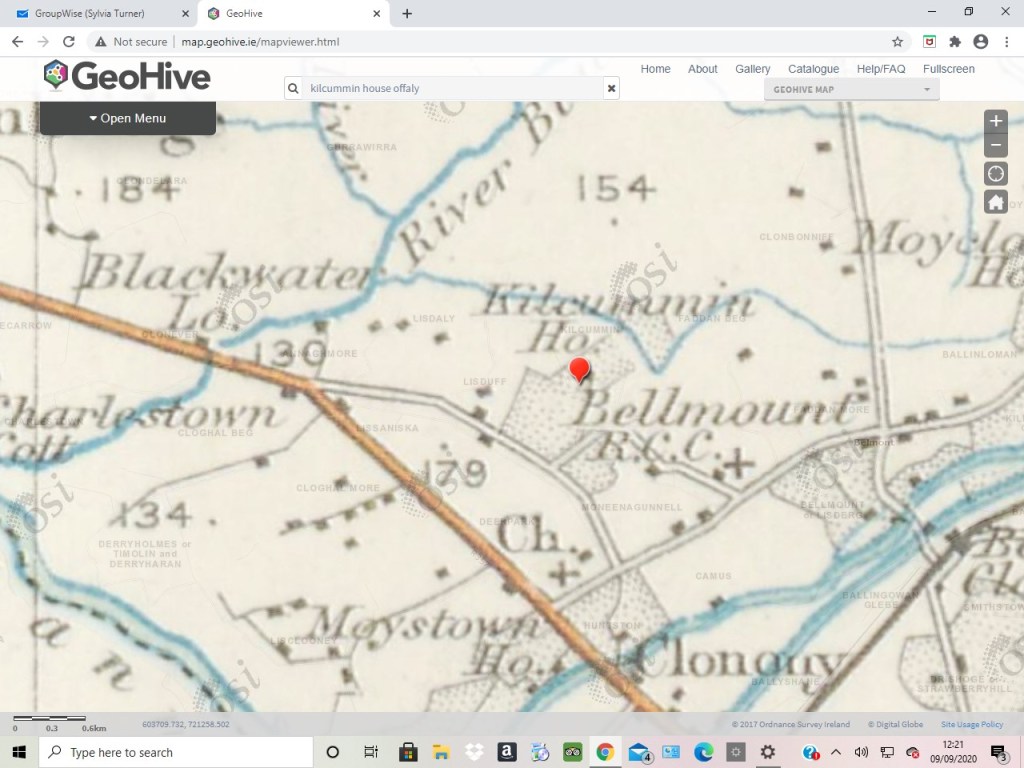
Following Henry VIII claimed of kingship over all of Ireland in 1541, the English wished to extend their control further than the area called the Pale around Dublin to the whole of Ireland. One way was to drive the Irish landowners off their land and replace them with English or Scottish settlers, called ‘planters’. The first plantation took place in the region now known as Offaly and Laois in 1556. It was from this area that the O’Connor and O’Moore clans had invaded the Pale. The Government divided the land into Counties. Present day Laois was named Queen’s County, after Queen Mary, daughter of Henry VIII and present-day Offaly was named King’s County after Mary’s husband King Philip of Spain. Forts were built at Maryborough (Portlaoise) and Philipstown (Daingean).
(more…)
-
The Maynooth Local Studies Series, recent issues, the Offaly volumes and the entire series listed here. Sources for Offaly History and Society, number 10. Blog No 230, 7th Oct 2020
The current issue of Irish Historical Studies (no. 165, May 2020) has a featured review of five issues from the Maynooth Local Studies series published in 2019. That brought the number issued to 144. We attach the list to 144 for your convenience and we bring to your attention the latest batch of four. Raymond Gillespie is the quiet man behind the series and who has acted as general editor since its inception in 1995. The reviewer in IHS, Maura Cronin, reminds of his characterising local history as being ‘primarily about people in places over time’. Place is described as the bedrock of local history, but it must be seen in the context of the actions of people and the pivotal role of historical research is looking for the forces of disruption and of cohesion. What brought people together and what drove them apart.
The four new issues of 2020
Four new volumes have been published in the Maynooth Studies in Local History series (general editor Professor Raymond Gillespie). The volumes by Denis Casey, Emma Lyons, Brendan Scott and Jonathan Wright and can be ordered via Offaly History Centre.
(more…)
-
Fr Michael Kelly, of O’Connor Square, Tullamore and a citizen of Zambia. From the Sources of Offaly History Series, No. 9, oral history from the Diaspora, or the scattered Offalians around the world. Blog No 228, 30th Sept 2020
How many Offaly people have emigrated? They have stories we would like to hear and to archive for Offaly History Centre. This is some of Michael Kelly’s story. You have one too, whether living at home or abroad. So sit down and start writing. The words will flow. Thanks to Michael Kelly SJ for this report. He appears on a postage stamp and is an honorary citizen of Zambia and of Tullamore. We will add this latest report to the almost 250 stories we hold from Offaly people who wrote it down or talked to us. Like our offalyhistoryblog to receive it free every week and sometimes twice a week. Almost 70,000 views so far this year

ON MONDAY, August 22, 1955, a young Irish Jesuit stepped off a plane at the City Airport (which is now a Zambia Airforce base in Longacres). It was his first visit to Africa, and he fell in love with it. He talks about the cheerfulness, generosity and openness of the Zambian people, as well as their suffering. A mathematics genius, he dedicated his life to educating young Zambians, and later to the fight against HIV and AIDS. Sixty-five years later, Father Michael Kelly says he is now looking forward to going home. And by “home”, he is not referring to his native country – Ireland – but to Heaven.
(more…)
-
Offaly and the River Shannon. By Paul Clements. Blog No 227, 26th Sept 2020
For his new travel book on Ireland, Paul Clements has been on a meandering journey along the River Shannon, following in the footsteps of the writer and singer Richard Hayward. His book looks back at Ireland in the 1930s but also considers the present-day Shannon which he believes is now undergoing a renaissance. [
The Ireland of the 1930s was an austere place in which barefoot children played in the street in a young country where the Catholic Church was all-powerful. Electrification of farms and rural houses was still some way off and some areas suffered badly from tuberculosis as well as mass emigration. Life was shaped by the rhythms of the agricultural year and farming was the mainstay of the economy. Despite the poverty, there was another more carefree side to life which respected the arts and cultural history. People gathered at the crossroads for ceilidhs and made the most of what they had. This was the Ireland that fascinated the writer, singer and actor Richard Hayward (1892-1964), who, although born in Lancashire, grew up on the Antrim coast and became a lover of Ireland.
(more…)
-
Researching Offaly History and using the DIB – No 8 in the Sources for Offaly History and Society Series. By Terry Clavin. Blog No 226, 23rd Sept 2020
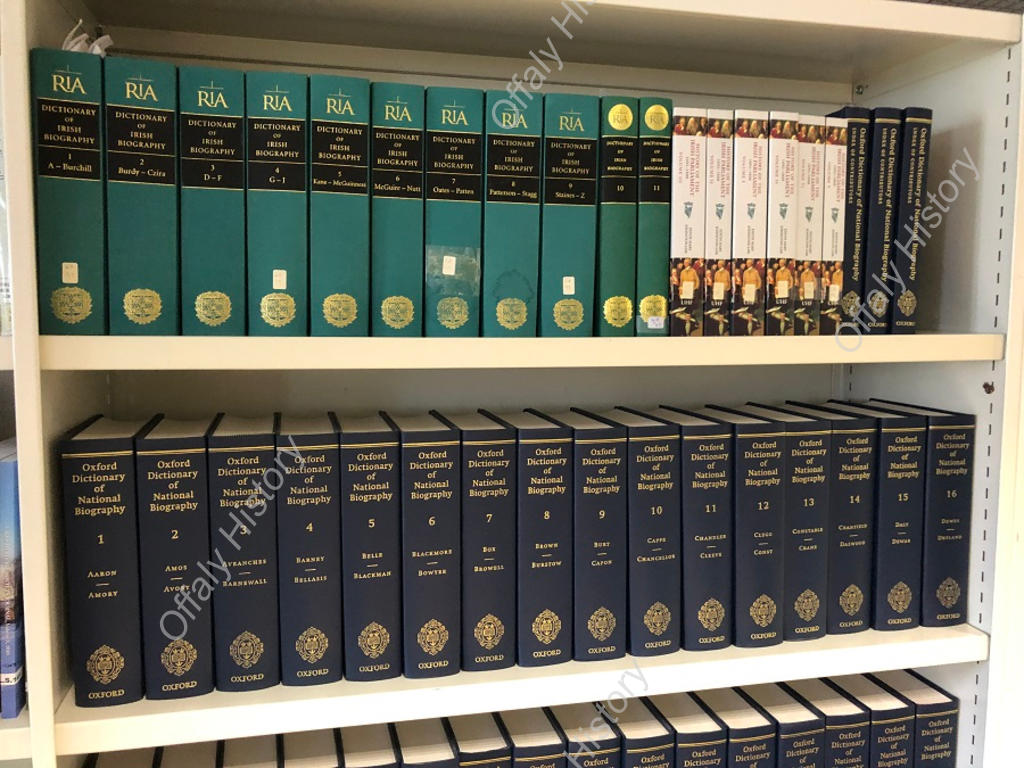
The Dictionary of Irish Biography and the Oxford Dictionary of National Biography at Offaly History Centre This article was written by Terry Clavin in 2014 for the Lions Tullamore Annual and we thank him for permission to use it. The Dictionary of Irish Biography has proved invaluable since it was first issued in nine hard cover volumes in 2009. Now it runs to eleven volumes and much more online. It is at present free to consult and we hope will remain free to consult when Covid ends. From this wicked pestilence some good may come! Since Terry’s article we have a recent book on the Egans of Moate and Tullamore, the third earl of Rosse and last week the second volume of Jeff Kildea’s biography of Hugh Mahon. So keep in touch by consulting the online version of the DIB, our weekly blog and our website. See also our online library catalogue to keep in touch. We add new history books every week to our library at Bury Quay, Tullamore. We congratulate Tullamore man Terry Clavin on his research work for the dictionary and the entries he has written up and also edited.
The Dictionary of Irish Biography (DIB) is the most comprehensive and authoritative biographical dictionary yet published in Ireland. It contains over 9,000 biographical articles ranging in length from 200 words to 15,000 words, which describe and assess the careers of subjects in all fields of endeavour. The subjects eligible for inclusion are those who were born in Ireland with careers inside or outside Ireland and those born outside Ireland with careers in Ireland.
(more…)
-
The Story of Bog Butter. By John Dolan. Blog No 224, 13th Sept 2020
Bog butters are large white or yellow waxy deposits regularly discovered within the peat bogs of Ireland and Scotland. They represent an extraordinary survival of prehistoric and later agricultural products, comprising the largest deposits of fat found anywhere in nature. Often found in wooden containers or wrapped in animal bladders, they are considered to have been buried intentionally by past farming communities. While previous analysis has determined that Irish bog butters derive from dairy fat, their precise characterisation could not be achieved due to chemical compositional alterations during burial in subsequent years. They generally produce a distinctive, pungent and offensive smell.
The largest Irish example weighed 23kg (50lbs) from a find in the Galtee Mountains in 1826. Bog Butter is primarily held in the National Museum with some held by local museums.
(more…)
-
Offaly GAA blessed with some great club history publications: sources for Offaly History and Society, no. 7. By Kevin Corrigan. Blog No 222, 2nd Sept 2020
Offaly GAA blessed with some great club history publications: sources for Offaly history and society, no. 7. GAA is very fortunate to have a number of fabulous club history publications at its disposal. Clubs such as Clara, Daingean, Edenderry, Kilcormac/Killoughey, Seir Kieran and Tullamore have produced particularly comprehensive and detailed club histories and their value to members is immense.
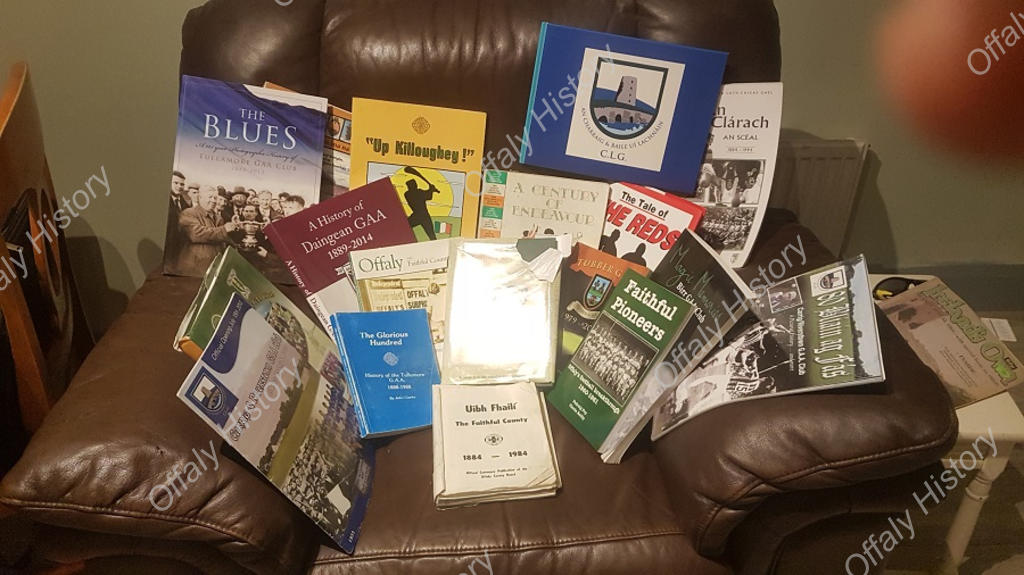
I have started research earlier this year on my latest project, a comprehensive, detailed history of Offaly GAA. It is a very big undertaking with a huge volume of research required before you even consider putting pen to paper. It will be a three year plus project and trying to get a picture of all eras and factors in the growth of the GAA in Offaly is quite daunting.
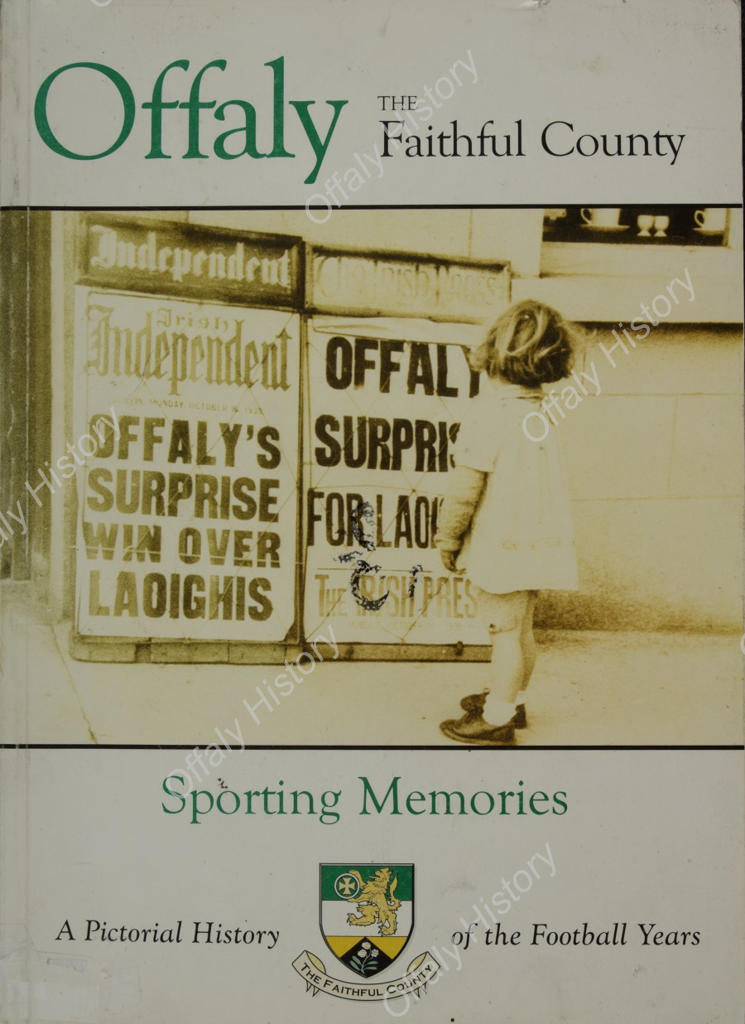
My aim is to do a proper history of Offaly GAA, one that transcends its mere sporting contribution to the county. To a very large degree, the GAA successes from the 1960s through to the 2000s contributed greatly to the well-being of Offaly as a county and provided its own distinct unique identity. Whether you have any interest in sport, GAA doesn’t float your boat or you prefer other sporting codes, the importance and contribution of the national games to Offaly simply can’t be understated.
(more…)
-
The rediscovery of Bloomville, County Offaly. Christopher Fettes. Blog No 221, 29th August 2020

Bloomville, Cloneygowan, County Offaly On June 15th 1991, I climbed a locked gate marked Bloomville, just as the rain stopped and the sun came out. There were some lovely beeches, but no sign of a house. I then spotted two ancient chestnuts, and it was only then that I could see the house in the distance.
It was a case of love at first sight, with everything sparkling in the sunshine, and I wondered why the agent’s advertisement had not included a photograph. Only when I approached the house could I understand the reason. The traditional roses (still flourishing 29 years later) looked pretty, but, close up, the house looked very neglected.
(more…)
-
6 Sources for Offaly History and Society. ‘Offaly one hundred Years Ago’: A compendium by John Wright and published in 1890 as ‘The King’s County Directory’ was reprinted in 1989 as ‘Offaly one hundred years ago’. Blog No 220, 26th August 2020
Written and compiled by John Wright- owner/editor of the King’s County Chronicle, Birr, from 1872 until his death in 1915 – the book was published early in 1890 as ‘The King’s County Directory’. His son Archie succeeded and died in 1954. Increasingly, over the intervening years, it has been treasured as an invaluable source of reference for local historians but it has long been out of print and only a few copies remain extant. It was reprinted in 1989 now in hard back form, in a facsimile edition which reproduces its 368 pages – including 24 pages of advertisements and a number of drawings of noteworthy buildings. Since then it has also been made available on CD.
(more…)
 offalyhistoryblog