Researching Irish family history can be challenging due to the lack of written records. Owing to variation in the legislative union of Ireland, Scotland and Wales with England, registration of births, deaths and marriages was different in each country and comparatively late in Ireland. In Ireland, state registration of non-Catholic marriages began in 1845, but the registration of all births, marriages and deaths did not begin until 1864. Additionally, Church records are often incomplete and those that exist are rarely found before 1800, particularly in rural areas.
In December 1968 Thomas [Tommy] Dunne received the tribute of a soldier’s burial from surviving I.R.A comrades in Offaly and the army in Annaharvey graveyard, near Tullamore.
Thomas Dunne grew up in Ballinagar (between Daingean and Tullamore) along with his siblings Mary, Richard, Margaret and James in the late 1800s. Their father was Tommy and their mother was Anne Brien from nearby Clonmore. Tommy was in his time a leading member of the local Fenian movement and came to Ballinagar from Rathfeston during the time Trench was the land agent for Lord Digby. The family tradition was that Tommy was about 27 at the time and by all accounts was a fine strapping young man. A family of Dunne’s owned the farm at the time, they were relatives of Tommy’s, but because they were all females and because of the impossible situation of that time, they were about to throw up the farm. Trench had someone in mind for the farm but Tommy took it over. One day Trench arrived on the farm and spent a while staring and trying to unsettle the young Dunne. Then Trench spoke “I see you have come Dunne.” “Yes” was the firm reply. Trench then said “On account your family has been here for so long I will let you stay, but instead of the rent being 7 shillings and sixpence an acre it will now be 30 shillings an acre.” This left it nearly impossible to farm but he managed. This incident took place shortly after the infamous evictions on the Geashill estate, where it was reported that the evicted tenants of Geashill filled the streets of Tullamore. A lot of these tenants went on a ship called Erin go bragh to Australia which was charted by a Fr Dunne from Daingean who raised funds for this purpose. He was possibly a relation of the Ballinagar Dunnes.
John Foster’s copy of Coote’s, King’s County Survey. Offaly Archives is collecting all the rare books on the county for the county collection. Foster was the last Speaker in the old Irish Parliament and strongly opposed the Union. He was a vice-president of the [Royal] Dublin Society until the 1820s and was ennobled as Lord Oriel. He and his father were great improvers even when it was not economic for them to do, or prudent. Foster was a great bibliophile which may have been a comfort to him in his cash-straitened latter years.
This week as a substitute for our cancelled lectures during Covid we list some of the older books on Offaly History and some of which are still of use and must be consulted. The list is by no means complete and does not cover archaeology or geology. By older we mean studies mostly published before 1920 and many being diocesan histories. One book that is essential to look at is the Dublin Society survey of the county in 1801. This is the first book published about County Offaly/King’s County and deserves a read before moving on. John O’Donovan when preparing the ordnance survey memoirs in the 1830s had occasion to use Coote, among other books, and considered Coote a blockhead and worse. Yet, there are some nuggets for those who are patient. Coote was trying to promote for the Dublin Society (later Royal Dublin Society) agricultural education. The farming societies were not started until the 1840s and wilted in the Famine years. It was the 1900s before countrywide education in agricultural methods began with Horace Plunkett, agricultural cooperation and the Department of Agricultural and Technical Instruction.
War of Independence Memorial Tullamore, unveiled in 1953
Everywhere in the world today, the role and validity of public art, particularly statues of historical figures, is under scrutiny. At the same time it is the policy of our new Government to place an increased emphasis on urban quality-which presumes the installation of even more public art. This could be a recipe for conflict but much can be learnt from an examination of the history and experience of the provision of sculpture in County Offaly, and its errors and successes.
Manchester Martyrs Memorial Birr 1894
The Three Tests
I suggest that three criteria, all of which are of course totally subjective, apply to any reconsideration of the role of public art. The first is the continuing historical acceptability of the person or event which is commemorated. In Offaly, it is beyond doubt that the Manchester Martyrs Memorial in Birr or the War of Independence Memorial at the Courthouse in Tullamore would pass that test. The second is the intrinsic artistic quality of the work and ‘Saints and Scholars’ by Maurice Harron on the Tullamore bypass is generally agreed to be both striking and imaginative. Finally, there is the work’s contribution to a planned urban ensemble and in this respect both the Downshire Memorial in Edenderry and the Barnes-McCormack Memorial in Banagher which close vistas or reflect their settings, would qualify. It gets a lot trickier however when a work satisfies some of the criteria but not all.
Maurice Harron’s Saints and Scholars Tullamore 2009
For example, in our capital city the statue of Daniel O’Connell, the ‘Liberator’, marks the entrance to the fine boulevard which bears his name and having been designed and executed by the greatest Irish sculptor of his day John Henry Foley, it clearly fulfils all three criteria of artistic worth, civic design contribution and an historically enhanced reputation.
However, further along the same street the statue of Horatio Nelson failed the public acceptability test and along with its beautiful and blameless Doric pillar, was blown up in 1967.
Foley’s Third earl unveiled in 1876
Interestingly, Birr provides a precisely similar scenario. The image of the third Earl of Rosse in John’s Mall is also a fine example of Foley’s skill, and the reputation of ‘The Astronomer Earl’ has grown over the years. The statue, by virtue of its scale and location, is an integral part of a well-designed public space. Thus all three criteria are fulfilled.
In nearby Emmet Square stands the finest urban ensemble in Offaly and the only extant example in Ireland of the use of a central column as a focus for a public plaza. Whatever about the artistic merit of his statue which stood atop its elegant Doric pillar, the brutal reputation of the Duke of Cumberland was anathema to many and the discovery of a crack gave a valid excuse for its removal by Birr Town Council in 1915. Had Dublin Corporation adopted the same approach, the column upon which Nelson stood and which contributed to the scale and architectural character of O’Connell Street, might still be with us but as in Birr, we would probably still be debating a suitable replacement to cap it.
The Duke is gone but the column has survived – 1747
Pure Dynamite
The issue of whether existing public art is still relevant and making a contribution to its locality can sometimes be contentious, but the location and nature of new public art is always pure dynamite, as the persistent vandalism of the Luke Kelly statues in Dublin (whether for aesthetic reasons or not) demonstrates.
Ideally public art requires public consensus and the smaller communities of Offaly who have got together to commission and install works of high artistic quality to celebrate their own local heroes or legends have shown the way in this regard and their approach deserves study and emulation.
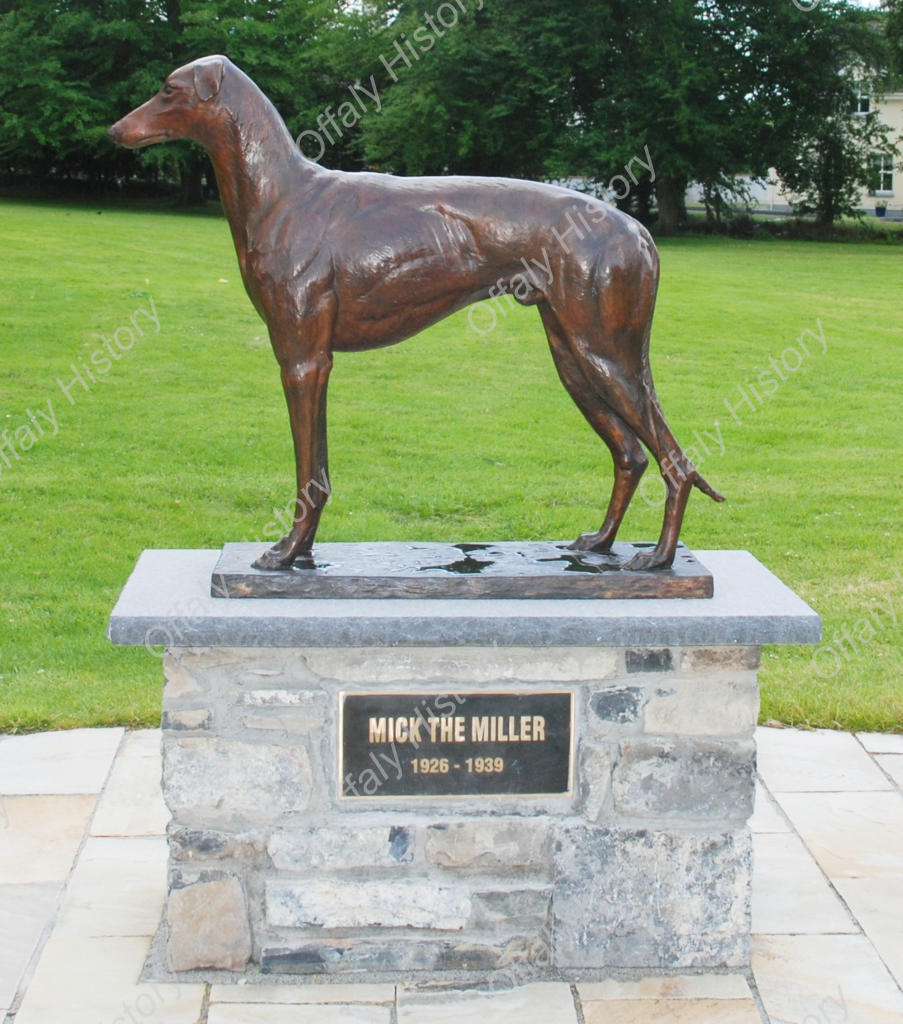
Killeigh commemorates its famous local greyhound ‘Mick the Miller’ with a beautiful bronze piece by Elizabeth O’Kane. Cadamstown remembers local boxer Dick McRedmond in a lovely stone bust by Dermot Scully. In Ballycumber the wonderful little ‘Pilgrim’ trudges wearily to Clonmacnoise along the Erry Way in a delightful work by local artists Gerry Dooley and Lorie Quinn.
It is acknowledged by everyone that in Offaly both semi-State and local authorities have been to the forefront in providing good public art. The ambitious installations provided by Bord na Mona in the Lough Boora Discovery Park make it one of the best sculpture parks in Europe and it is the calling card of Offaly Tourism. Through its operation of the Percent for Art scheme, Offaly County Council has provided many imaginative and successful works in every part of the county, most recently Holger Lonze’s ‘Cruinne’ in Geashill and the ‘Marker Stone’ on top of Croghan Hill by Ciaran Byrne.
A son of Banagher – Johnny McEvoy
The elephant in the room however, is that almost all of these are in rural, village or remote locations and therefore their theme and siting is relatively uncontentious. A proposal to install a major piece of sculpture in the centre of any of the principal towns of the county on the other hand would immediately raise the questions of where, who, why, by whom and at what cost and inevitably cause a row. Nonetheless, busy central public spaces, both existing and planned, should now be the first choice locations for new artwork and these issues must be faced and a reasonable public consensus sought.
Edenderry’s progressive landlord – the third marquis of Downshire – 1845
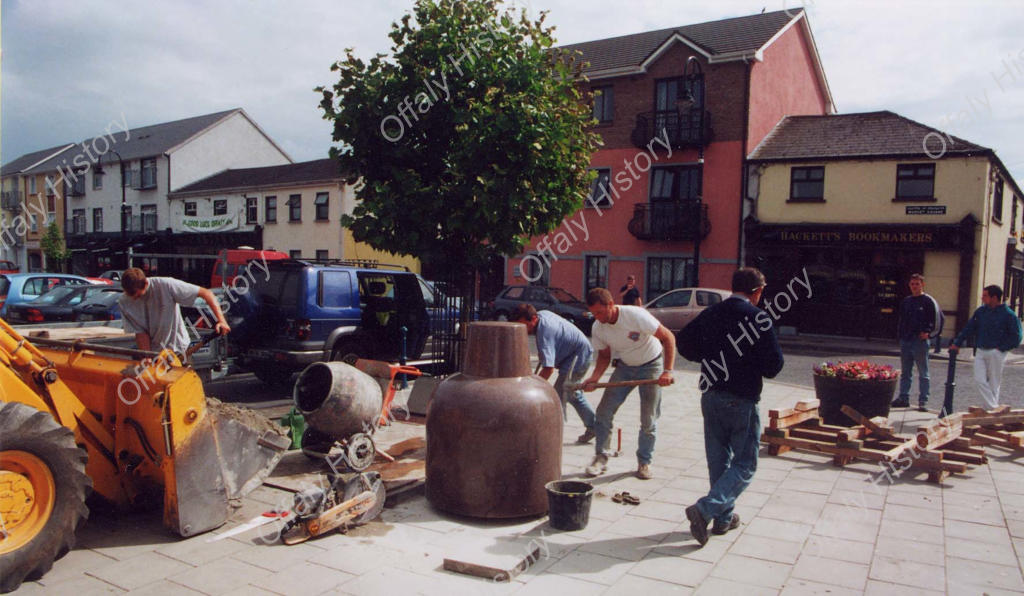
The county capital, Tullamore town centre has only three significant sculptural works, the two long established War Memorials and the 1999 ‘Pot Stills’ in Market Square by Eileen McDonagh. The recent Street Enhancement Scheme which might have provided the opportunity for the installation of a significant new work, instead inexplicably and without giving public notice, required the removal of the Memorial to the Dead of the Great War from O’Connor Square, despite its designation as a Protected Structure. Following an outcry and Ministerial intervention, it was saved but its generous planted setting vanished and it now stands looking a little lost and unhappily compromised by car parking. A more considered and consultative approach to our urban heritage is urgently required
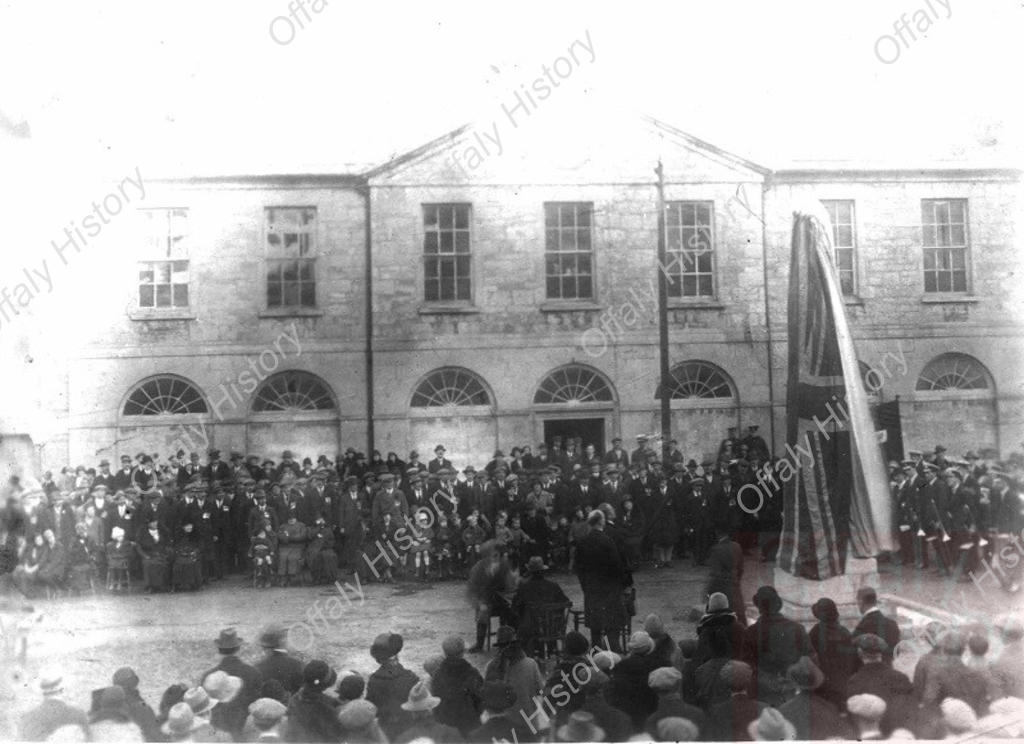
Pot Stills in Market Square 1999Unveiling the Great War memorial in Tullamore in 1926 Widows of those killed were seated
A Phoenix arises?
The installation of a fine new piece of sculpture to adorn the historic centre of Tullamore is long overdue and the imminence of a new town plan presents the opportunity for its delivery. Hopefully, unlike its predecessor, the new plan will include a coherent vision for the preservation and enhancement of the town’s architectural heritage.
It might also follow the lead of other local authorities and outline the role that urban art would play in making the centre more attractive and even suggest where new sculpture or installations might be placed. The Offaly County Council Public Art Working Group could then initiate a debate as to appropriate subjects. One relatively uncontentious idea that has been around for years and which would certainly stimulate the imagination of a talented artist, would be that of the Phoenix- the symbol of the town.
This is now the time to start the debate on how Tullamore can celebrate its history, remember those who made a contribution to it and furnish its historic centre with new and exciting public art.
In the time leading up to Heritage Week 2020, and conscious of the restrictions on movement, lectures and classes, we are starting a new blog to issue every Wednesday. This will be on Sources for Offaly History & Society. We will draw on the extensive material in our library at Offaly History Centre, Bury Quay, Tullamore, the county’s Offaly Archives at Axis Business Park and the Local History Collection at Offaly Libraries. The aim being to build a helpful online resource to assist Offalians and those interested in our past and now spread across the world. We want to hear from you with what you would like to see covered and to get your feedback on what we are doing. We will continue to publish our history articles on the Saturday blog at offalyhistoryblog.wordpress.com
`Arising from the Covid-19 virus due to government advice regarding public gatherings a private funeral will take place, but may be viewed on the Church website.`
This notice is now a regular feature of obituary notices in current newspapers and website dealing with death notices.
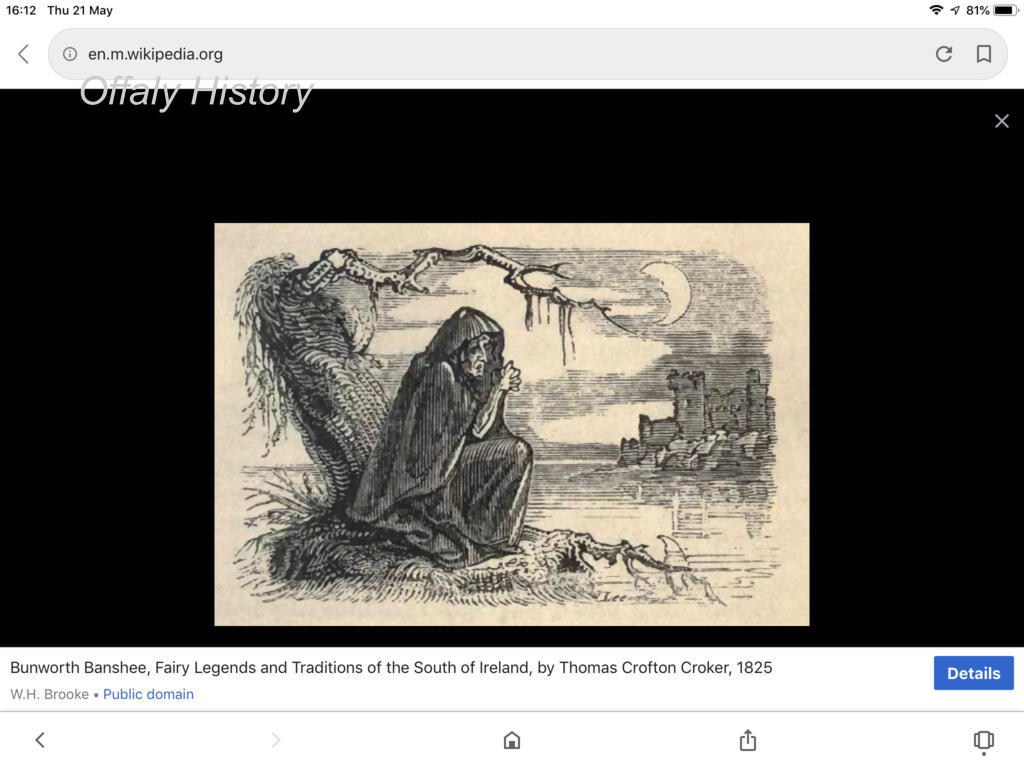
The story I wish to relate deals with an earlier time, from the early 50s, and I hope to recreate an image of the funeral process back then in west Offaly. It was a time when the medical condition of a sick person or indeed a visit by a doctor to such a person was not the only omen that death was imminent. A much more reliable harbinger of such an event was when a report came in, that the `banshee` had been heard. My grandfather, Michael Claffey originally from Bloomhill, near Ballinahown, totally believed in the banshee. He was a well-read literate man, yet if someone was ill in the parish, he would not show much concern until it was reported that the cry of the banshee had been heard. Once that occurred, it was good night Vienna, as far as he was concerned. He would then just wait for the inevitable, which from my memory always seemed to happen.
Michael Scott’s Williams shop in Patrick Street from 1942 and lost with the move of Five Star to what was later Quinnsworth and Tesco .
The contemporary arts scene in Ireland from the 1940s to the 1970s and to a certain degree in Offaly also, was dominated by the friendship between the architect Michael Scott and the Jesuit priest Fr. Donal O’Sullivan. Both Scott and O’Sullivan were close friends of Desmond Williams, the managing director of Irish Mist and a director of Williams’s whose commercial interests extended beyond the famous whiskey brand to a chain of grocery shops and pubs in Offaly and Westmeath. Williams and his wife Brenda, whose father Oliver St John Gogarty had been an early supporter of the painter Jack B. Yeats, owned many superb works by the artist.
The 12 June 2020 marks the 98thanniversary of the disbandment of the historic Southern Irish infantry regiments of the British Army at Windsor Castle. Disbandment was brought on by economic cuts to the British Army and in part due to the Anglo-Irish agreement. The Royal Irish Regiment, Connaught Rangers, Leinster Regiment, Royal Munster Fusiliers, Royal Dublin Fusiliers (and South Irish Horse) all surrendered their colours to King George V for safe keeping. The ceremony took place at 11:30am in St. George’s Hall in Windsor Castle. During the ceremony the King made a promise to safe guard these highly prized colours. The ceremony finished with a royal salute and God Save the King played.
The colour party detachments for each regiment consisted of the regiment’s commanding officer, then three officers and three non-commissioned officers (NCO) for the 1stand 2ndbattalion respectively. One of the NCOs on whom this honour fell was John Thomas Cannon of the Leinster Regiment’s 2nd Battalion. This is John’s story.
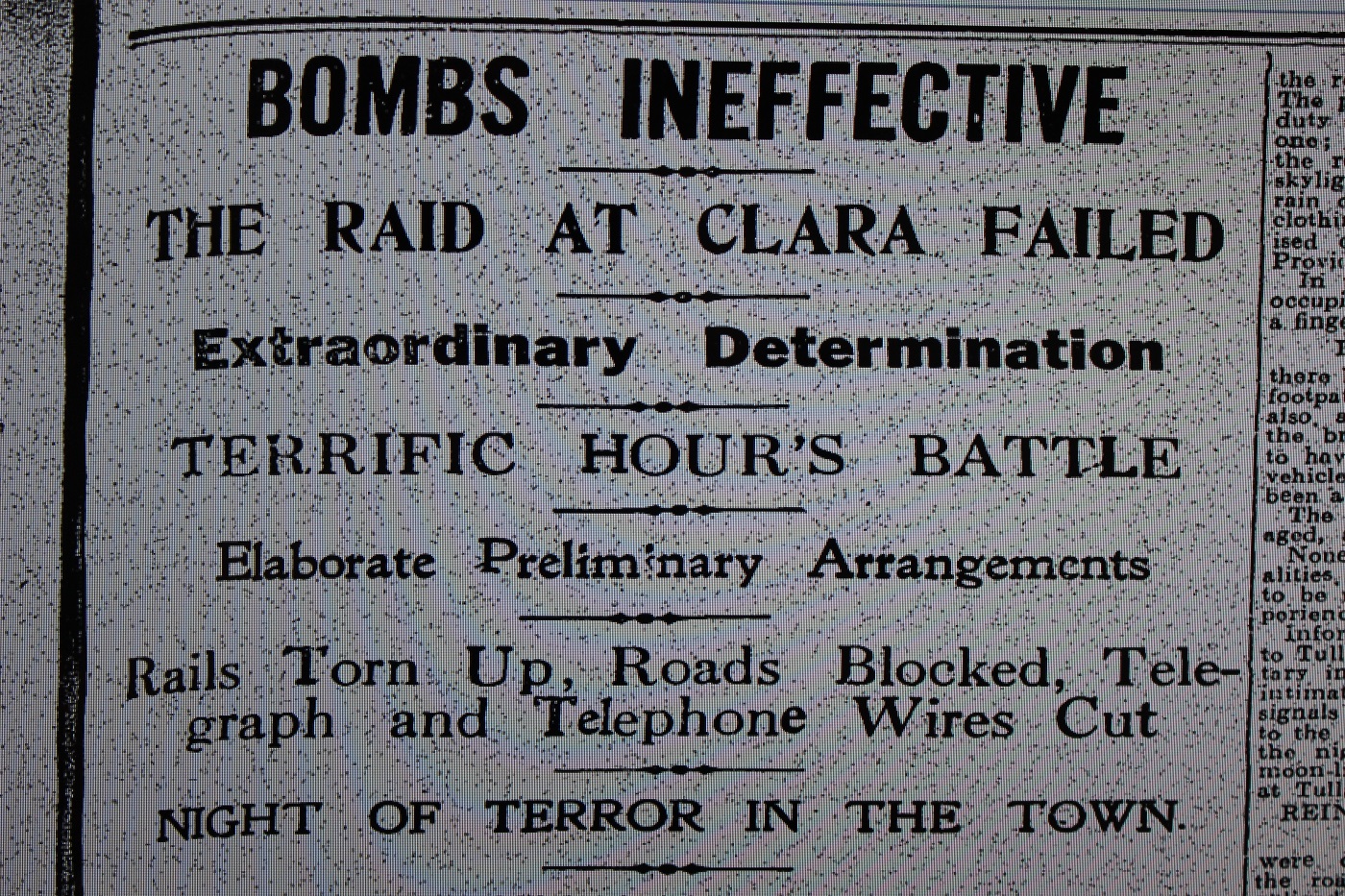
Reporting the outcome of the Clara barracks attack of 2 June 1920
‘While some counties have done much in the matter of publicizing their part in the fight for freedom, very little has been heard of the part played by Offaly in that great struggle, and yet it was within the borders of this historic county that some of the bravest and most daring deeds were done. It is not right, he said, that these should be allowed to pass into complete oblivion, and it is hoped the writing of this story of the Clara R.I.C. barrack attack will encourage others into penning the complete story of Offaly’s fight during that critical period of Irish history.’ These were the words of P. O’M. in 1960, basing his account on that published in the local press on 5 June 1920. (P O’M was brought to our attention as Paddy O’Meara who wrote a number of good articles on Clara history and was a local news correspondent.) The witness statement of Séan O’Neill, a manager in P.J. White’s Clara shop (Bureau of Military History) supports the press reports of the time. So to do the recollections of Harold Goodbody (forthcoming). IRA man and county councillor Sean Robbins of Clara was critical as was Fergus O’Bracken, writing to vindicate the role of his father, overall IRA commandant Peadar Bracken, in the episode.
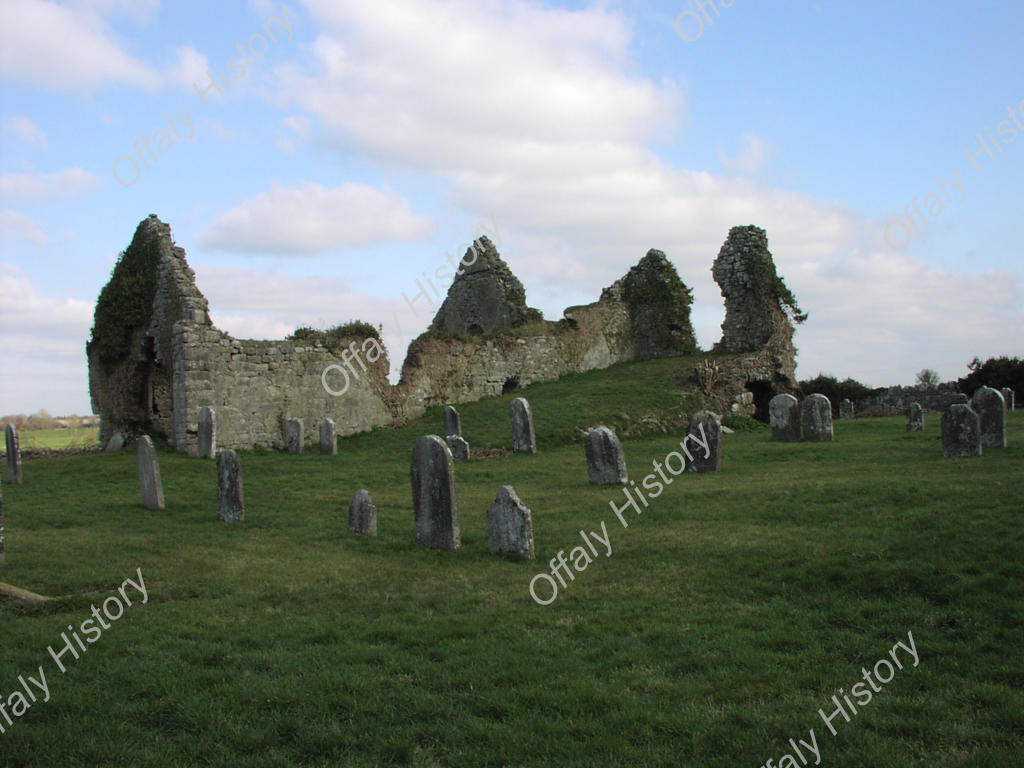
The old cemetery at Lynally where Dames and Rector Coffey are buried. No stone has been found for Dames.
The Longworth family and George Dames of Tullamore
Reading in the National Archives some time ago I came upon a small envelope of papers that Athlone-born Revd George Stokes had put together on the Longworth family. He was constructing a family tree and it was that family’s connections with Athlone that appealed to him. The envelope included two Wills. One was that of George Dames of Tullamore, dated 1662, who died in June, 1666. In it, Dames is described as a yeoman. The Dames and the Longworth families intermarried in successive generations and it is no surprise that this Will was filed with some of the Wills of the Longworth family. They were both Cromwellian families that settled in the midlands.








 offalyhistoryblog