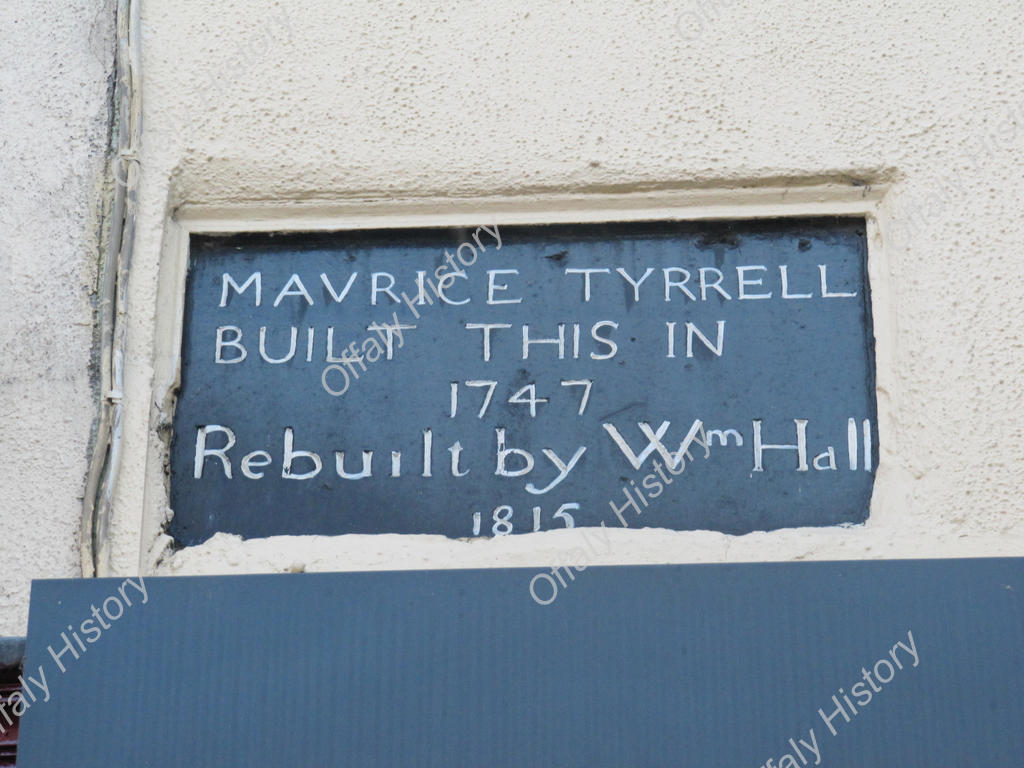
Now that more young people can get our walking and cylcling we give you this suggested tour to find the datestones in and about the town of Tullamore. We are giving a free copy of Tullamore a Portrait to the first five entries received with one or more additions to this list. Entries will be drawn from the barrel. So email us at info@offalyhistory.com headed Tullamore Datestone Quiz. Our blog is published every Saturday and we are providing a second issue on Wednesdays during the Covid Period.
Clonmacnoise from the Harris’s edition of Ware’s Antiquities (Dublin 1739) showing the work of Blaymires and Dempsy his companion.
It must be conceded that the unassertive landscapes of County Offaly have never been a great source of inspiration to painters, most of whom just made a quick stop at historic Clonmacnoise before dashing on to record the West of Ireland.
Yet, others took the trouble to look more closely (or were paid to do so) and found inspiration in its lush farmland, bogs and woods, slow rivers, rolling hills and ancient ruins. Happily, their numbers have grown in the recent past.
The Cotton Map
The first, and in my opinion the finest, artistic image of Offaly is the Cotton Map of 1565. Prepared to assist the Elizabethan Plantation, this is an imaginative creation more akin to Harry Potter’s ‘Marauder Map’ or Robert Louis Stevenson’s chart of Treasure Island than a realistic cartographic exercise. One wonders if its unknown compilers ever visited Offaly or were relying on travellers’ tales.
The balloon fire of 10 May 1785 (235 years ago tomorrow) is perhaps the best known event in the history of Tullamore. Today we are reminded of it every time we see the town crest and in the past with the annual celebration – the Tullamore Phoenix Festival. The first premium whiskey from the new Tullamore DEW (Phoenix, 2013) was in honour of that tradition. It is hardly surprising that it should be so. The event caught the imagination at the time and was widely reported in the national newspapers and by visitors in their publications thereafter. Unfortunately, many turned to the Wikipedia of those days – the previous fellow’s account – and did not seek to get all the facts and record them. What we are left with then are the few contemporary accounts from national newspapers, the comments of a succession of visitors who seemed to rely on the diary entry of John Wesley in 1787, and the notes of Charles Coote in his published survey of King’s County (Offaly) in 1801. Wesley, the great preacher and founder of Methodism, unlike Coote, would have known the town well as he visited the place some twenty times from the late 1740s to the 1780s. Why are there so few accounts?
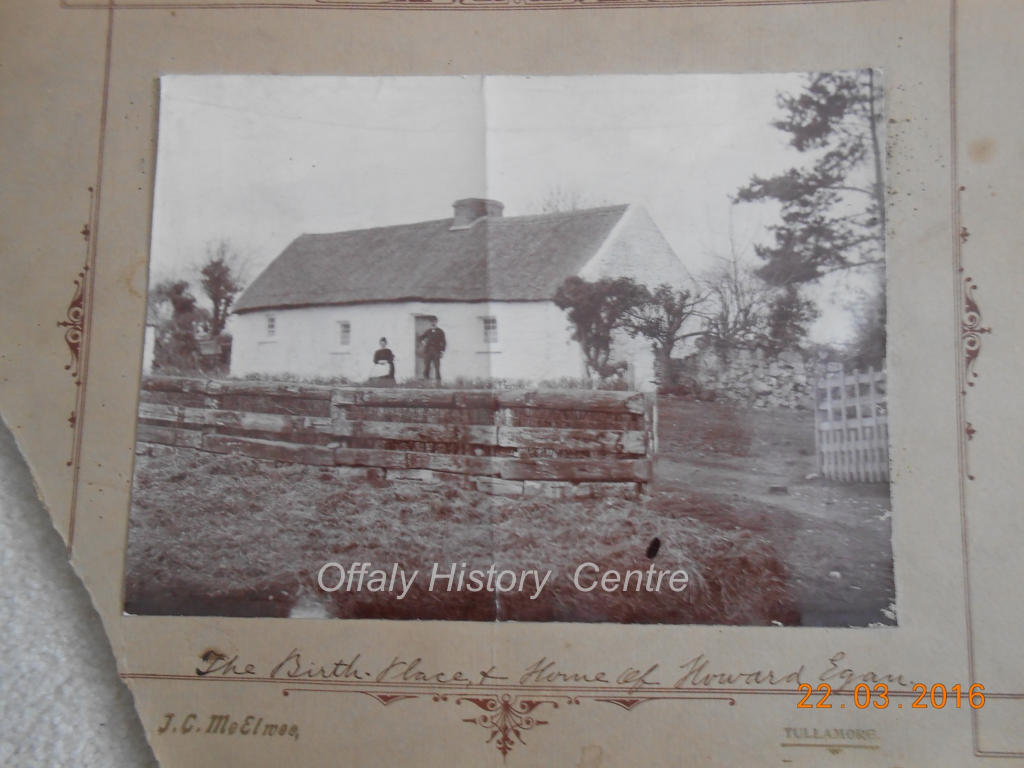
A view of the Egan Cottage, Meelaghans, Tullamore, County Offaly, birthplace of Edward Egan. This view of c. 1905–15 is reproduced from William M. Egan (ed.), Pioneering the West, 1846 to 1878. Major Howard Egan’s diary etc. Utah, 1917. Reprinted c.1995. The home of Howard Egan, now famous in American Mormon history
A new book comprising a selection of fifty of the poems and ballads of Edward Egan of the Meelaghans, Tullamore has just been published by Offaly History. The book was edited by Michael Byrne, Anne O’Rourke and Tim O’Rourke and is a fitting tribute to a man who died 80 years ago and in his time was revered throughout the midlands for his timely poetic commentaries on the social and political scene in his native county and his appreciation of all that was beautiful within a day’s walk of his home place.
Durrow Abbey in 1914. The First World War had just started.
Leaving to one side the work of the Ordnance Survey in the 1830s, the work of Petrie at Clonmacnois, and that of Cooke at Birr in 1826 and 1875, the references to and work done or written up on the historical sites of north Offaly in the nineteenth century are hard to come by. Fr Cogan published historical material on the Offaly parishes in the diocese of Meath in his three-volume work, 1862-1870; Thomas Stanley corresponded with the Royal Society of Antiquaries (RSAI) in 1869 in regard to the nine-hole stone or bullaun at the Meelaghans while Stanley Coote contributed an illustration of Ballycowan Castle for the Memorials of the Dead – a published record from the 1880s to the 1930s of selected tombstone inscriptions in Ireland and in County Offaly.
Home Rule/Rome Rule. A china mug with a portrait of Pope Pius X (1903-14) who increased the devotionalism of the Catholic church, who promulgated the Ne Temere decree concerning the children of mixed marriages, whose orders on the role of women in church music (1903) was commented on by the Morkan sisters in James Joyce’s story ‘The Dead’, and who oversaw the excommunication of Fr. George Tyrrell (1861-1909) on a charge of heresy, whose childhood had been spent at Dangan’s Farm between Portarlington and Mountmellick. He also enjoined the admission of children to regular communion at the age of reason. (Autobiography … of George Tyrrell, 2 vols. 1912, p.20-22)
We welcome a new contributor to the blog this week with this article by John Stocks Powell. Enjoy and remember we have almost 190 articles to read at http://www.offalyhistoryblog. Like to get it each week and share to your friends.
There is a hierarchy of sources for the historian, local historians and those with the wider landscapes. The principal material is the written word; evidences from the time, written archives, and later written published assessments such as county histories, church memoirs, Ph.D. studies gone to print. On-line developments have made for more in quantity, and more exciting revelations, from the checking of dates on Wikipedia, or the digitised sources such as Irish and British newspapers online, and directories. Yet we know the old cliché that history is written by the winners, and that is especially true when trying to write about the history of the losers, the poor, and the illiterate. Every source has its importance.
1. The Morpeth Roll (Courtesy of Castle Howard Archives)
The Morpeth testimonial roll comprises a farewell address signed by approximately 250,000 people (according to contemporary sources) on 652 individual sheets of paper. These sheets were subsequently joined together to create a continuous length of paper, approximately 412 meters in length (over three times the length of Croke Park), which was rolled onto a mahogany spool. It was presented to Lord Morpeth at the Royal Exchange, Dublin, in September 1841 following his defeat in the 1841 general election which consequently led to his departure as Chief Secretary of Ireland. For many years the testimonial roll remained hidden away in a basement at Castle Howard, Yorkshire, but it is now on loan at Maynooth University thanks to the generosity of Simon Howard, owner of Castle Howard and the efforts of Professor Christopher Ridgway, Curator and Professor Terence Dooley, Director of the Centre for the Study of Historic Irish Houses & Estates. This unique document has huge research potential, whether looked at as a pre-Famine census substitute, a family heirloom, a genealogy resource or a politically motivated document in its own right. Moreover, it has the potential to provide a unique insight into Irish life, society and politics in pre-Famine Ireland. As a pre-Famine census substitute it is unparalleled and its importance is multiplied by the scarcity of census material from this period. The document also provides empirical evidence of mass political involvement.
We welcome a new contributor this week to our series of articles on the history of County Offaly. John Dolan writes about Seir Kieran in this fine piece. John was born in Tullamore, now retired, and has a degree Archaeology and Celtic Civilisation. He speaks regularly to historical societies in Dublin. Part 2 will be published next Wednesday. Seir Kieran is the ‘island parish’ in Offaly belonging to the diocese of Ossory. Our blog articles are brought to you twice weekly during these weeks of the plague to hopefully provide some inner peace through historical inquiry. You now have 182 to chose from and can join the 150,000 views since 2016.
Seir Kieran on the boundary of Meath and Munster
The parish of Seir Kieran is one of the many early Christian sites that remain under reported and hidden in today’s world. Since its destruction by ‘the O’Carrol and the English’ in 1548 and similar to many other Offaly early churches, it has dropped into insignificance.
Seir Kieran is now mainly known for the history of its GAA club rather than its claim to be a Christian site before the arrival of St. Patrick.
Last week’s article on the cholera outbreak in Offaly in 1832 attracted a huge readership. This week Dr O’Neill (a Mucklagh, Tullamore native) contributes this piece on Pandemics in Ireland. The Offaly History research team has added some local material on the effects of the Spanish Flu (1918–19) in the county and some pictures by way of further reading. Enjoy and stay positive. Read our 179 articles posted to offalyhistoryblog and catch up on Camus.
The Offaly County Hospital, Church Street, Tullamore, had 50 beds while the population in 1841 was twice what is is now.
Cholera was the epidemic disease most feared around the world in the nineteenth century.A letter from Tullamore of 1832 describes the devestating disease of cholera. ‘We had 165 deaths. All bridges to the town are cut and broken. Every house is shut up and there is no such thing as business. Men who would eat their breakfact in perfect health would be buried before dinner.’
In the eighteenth century neighbouring countries began to suffer from the disease and in the nineteenth century it attacked Europe. Cholera spread around the world in great epidemics from its traditional base in the Indian sub-continent and carried with it high mortality rates, severe suffering and terrifying symptoms. These began in 1817 but the first wave did not reach Europe and was halted temporarily at the shores of the Caspian Sea. From there in 1829 it spread rapidly through Europe. It arrived in Ireland around St Patrick’s Day 1832. This was the most serious cholera outbreak in Ireland in the nineteenth century and it has been estimated that 25,378 people died during that epidemic. The Irish death rate was high when compared to other countries for the same period.





 offalyhistoryblog