When renowned Offaly archaeologist Caimin O’Brien, cited Sir Edmund Spenser’s inclusion of a verse on Croghan Hill in his most famous poem, The Faerie Queene, in Stories from a Sacred Landscape: from Croghan Hill to Clonmacnoise; the curiosity bells began to ring. This was an amazing revelation and posed questions as to how Spenser was familiar with Croghan Hill and its religious history? Had he visited the area? When did he visit? What were the circumstances pertaining to his visit? And latterly, the question arose as to whether it was possible that this visit influenced him in some distinctive way? And furthermore, whether that influence was positive or negative?
The Summer of 1921was heralded as having some of the best Irish weather days in ten years.1 Many people used the opportunity to cycle their bicycles along the countryside roads and lanes, whilst keenly observing the fields of green and gold ripening barley. The slight breeze gently blowing the ears of grain with the browny blue hues of the Slieve Bloom mountains to the southwest as background. The farmers were looking forward to a decent crop that year, and to attract good prices when selling to the local malt houses, brewers, and distillers. They would be able to take on additional seasonal labour to get the harvest in on time. After yet another long Winter, much needed outdoor activity and laughter was a recipe for relief from the underlying and not too far off reality of political turmoil, criminality, and civil strife. ‘The Truce that came into effect on 11 July 1921 officially ended what is now most often referred to as the War of Independence and came as the culmination of the most violent six months of the war.’2 ‘Relieved civilians celebrated the arrival of peace and Volunteers returned home to bask in newfound freedom, safety, and adulation.’3 But sadly, it was to be a summer that would be remembered not for the good weather alone.
Change is always about but perhaps more so since ‘Nine Eleven’ 2001 and March 2020 than we care to appreciate. Changes in eating out in Tullamore’s streets in recent days would have come as a shock to our predecessors of 1914. We are not Spain as Brewery Tap owner, Paul Bell, recently remarked but the fine weather and the adoption of coffee over tea are all helping. In the interior things are changing too. The love of banking halls is gone and now it is all doors and screens as new ways of working come in. The new county offices inTullamore (2002), and in many other buildings, may yet have to be reconfigured, and as for nightclubs what are we to do. On top of that some Tullamore municipal councillors are talking of revisiting our list of Protected Structures to remove those buildings that cannot be sold and are falling down.
All this talk of change, inside and out, suggests that we look again at what we had in the way of streetscapes before that period of great turbulence when Ireland was on the verge of Home Rule and Partition was unmentionable. It was ‘The Sunday before the War’ time. Thanks to the work of photographer Robert French (1841–1917) and the Lawrence Studio (1865–1942) we can look back, not in anger or nostalgia, but in awe at what was achieved in our towns over the period from the 1740s to 1914, but more especially in the years of growth and prosperity from 1891 to the First World War.
The Lawrence Collection of some 40,000 photographs are well known. Perhaps less so that the online catalogue from the National Library (nli.ie) is in large format, high resolution, for the Offaly towns, allowing us to dig down/zoom in to see the detail that escapes one looking at the ubiquitous printed photograph in the pub or the tablemat. There are almost 200 Lawrence photographs for the Offaly towns and villages. For Tullamore there are at least 17, for Birr over 70, Banagher 3, Clara 20, Edenderry over 16, Portarlington 18, Kilcormac 12 including four placed in County Cavan, Clonmacnoise at least 33, Kinnitty 3, Mountbolus 1, and perhaps more to be identified. These figures are estimates and likely to change such as one of the earliest for Tullamore (late 1890s perhaps) that became available in recent years, or at least better known and the subject of this blog.
A very fine book from Kieran Hickey and Allen Lane (1973)(more…)
There are many people of note from Clara, but two particularly can be seen as associated with the period of Partition; David Beers Quinn and Vivian Mercier. Despite the ongoing War of Independence, the British government passed the Government of Ireland Act in December 1920, providing for the setting up of two parliaments in Ireland. The 3rd May 1921 marked the formation of the United Kingdom of Great Britain and Northern Ireland, so partitioning the island of Ireland. Vivian Mercier and David Beers Quinn had just reached their 2nd and 12th birthdays respectively. Although born a decade apart, in terms of Protestant identity, they represent different socio-economic backgrounds, illuminating what it was to be Protestant and Irish in the South of Ireland.
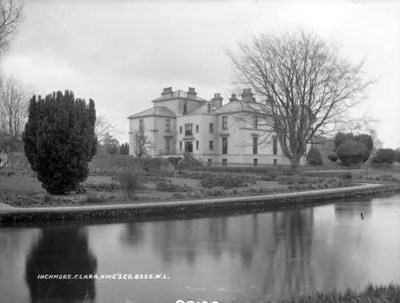
Inchmore where David Quinn worked as a gardener.
David Beers Quinn’s father, also named David, was a member of the Church of Ireland from Tyrone, He was employed as a gardener at the Goodbody house, Inchmore. His mother, Albertina Devine was also a member of the Church of Ireland from Cork with English parentage. Mercier’s father was from a Methodist family of Huguenot origin and his mother from a Church of Ireland clerical background from Monaghan. They lived in Cork Hill, Clara. The Mercier family, like the Goodbody family, were millers. Mercier’s father was born in Durrow, near Abbeyleix, Laois and was employed as a commercial clerk in jute manufacture at the Goodbody mills.
Vivian Mercier
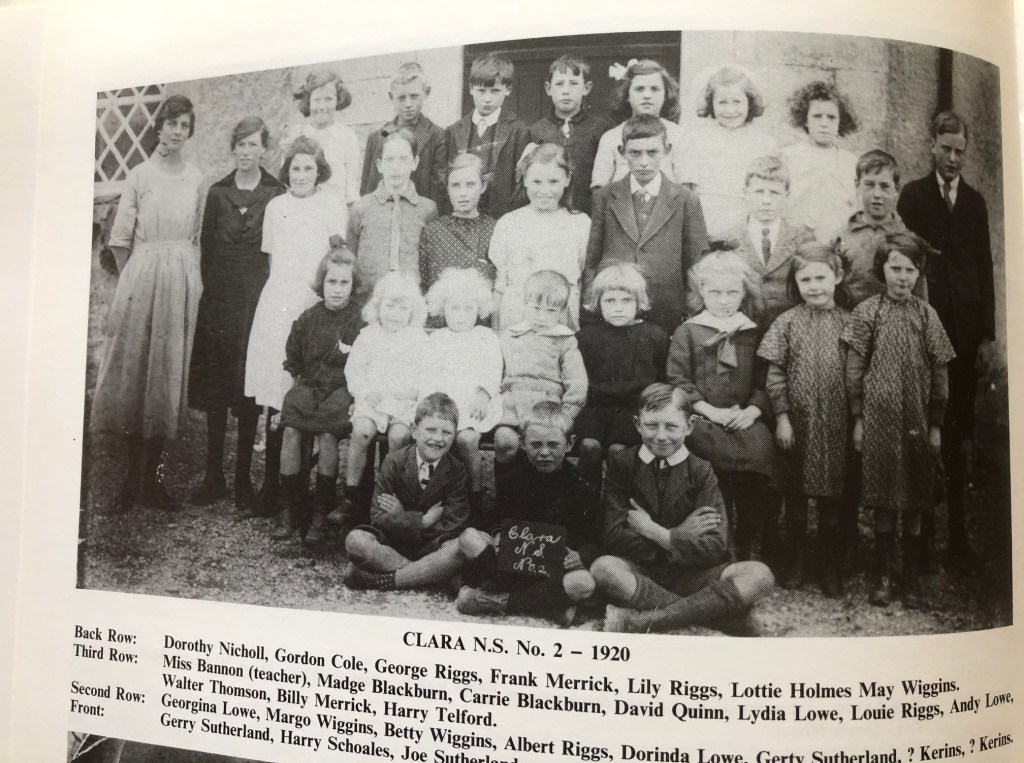
The partition of Ireland affected the education of Quinn and later Mercier. Quinn and Mercier attended Protestant National Schools, Quinn attending Clara No 2 Protestant school and Mercier, Abbeyleix South National School. Why Mercier attended school in Abbeyleix is unknown as the Clara National School was still under the tutelage of Miss Bannon who taught Quinn. However, it is known that Mercier corresponded regularly with Mrs Thompson, a later teacher at the school in Clara. Possibly the Mercier family had moved out of Clara due to unrest to the comparative safety of his father’s family home in Abbeyleix, approximately 60km south.
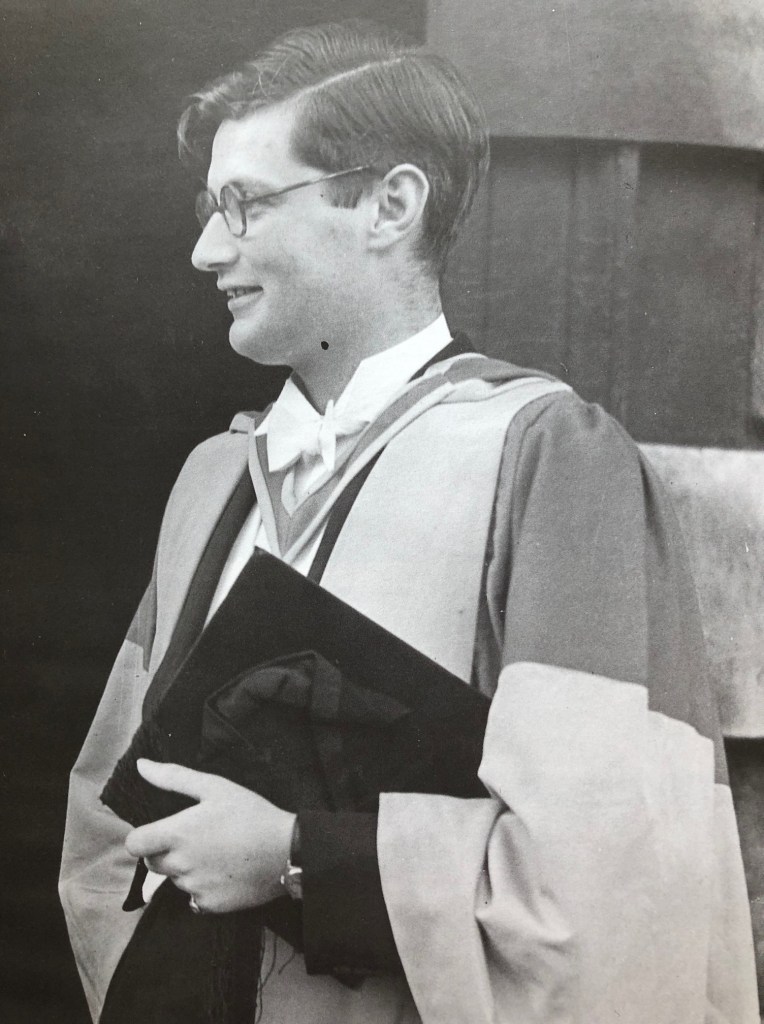
David Beers Quinn taking a look at one of his editions of Drake’s Voyages for the Hakluyt Society.
Quinn’s parents came to realise that their son was gifted. Finding good Protestant Irish education for a child from a working-class family was almost impossible if they stayed in rural Southern Ireland. The family moved to Belfast in 1922 where his father gained employment and in 1923 Quinn was able to attend the prestigious Royal Belfast Academical Institution. He continued his studies as an undergraduate at Queen’s University, Belfast between 1927 and 1931.
Mercier similarly left the South for Northern Ireland for his secondary education, attending the Portora Royal School in Enniskillen, one of the Public Schools founded by Royal Charter in 1608 by James I. Samuel Beckett (1906 –1989) was a former pupil. Critique of Beckett’s writing, particularly ‘Waiting for Godot’ was to shape much of Mercier’s career. Mercier and Beckett shared an affluent background and Huguenot descent in common.
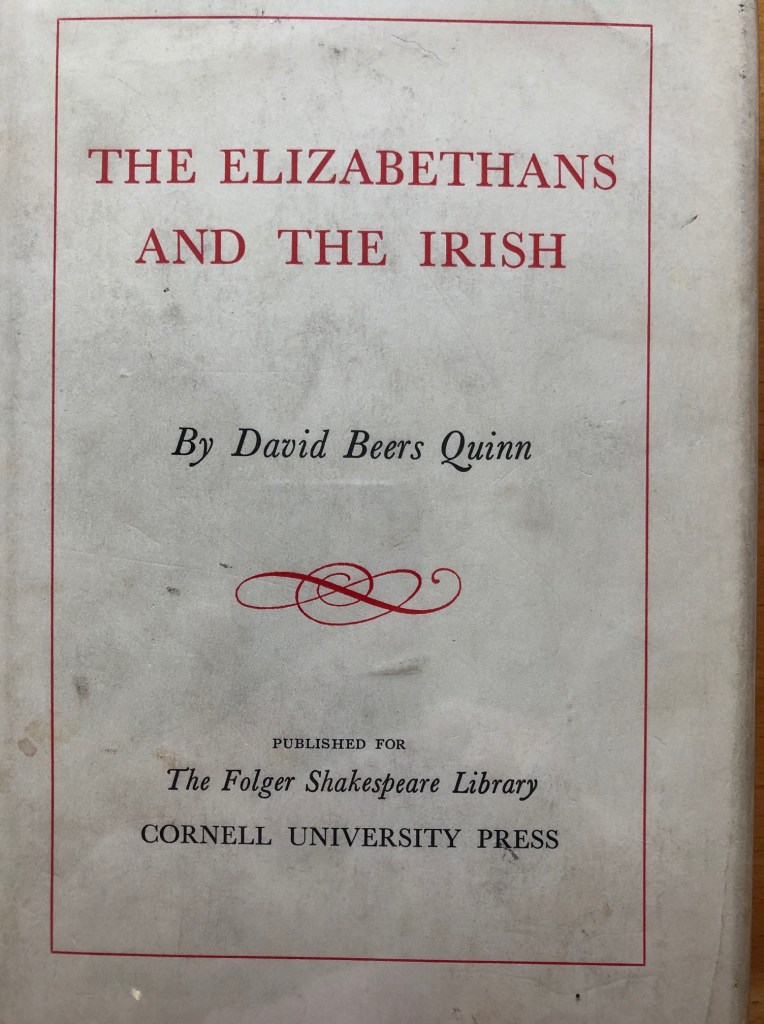
Quinn attended Queen’s College, Belfast (QCB) from 1927 to 1931 and then went to London University for his Masters’ Degree which he was awarded in 1934. There followed an academic career starting at Southampton (1934–9) and QUB (1939–44). After wartime secondment to the BBC European Service in 1943, Quinn moved to University College, Swansea the following year where he remained until 1957 when he moved to Liverpool university until 1976. Between 1976-1978 and 1980-1982 he was Senior Visiting Professor at St Mary’s College of Maryland. Alongside his academic teaching career, he wrote extensively on the voyages of discovery and colonisation of America. Many of his publications appeared as volumes of the Hakluyt Society. However, he continued to engage with Irish history writing The Elizabethans and the Irish (1966). Quinn also contributed substantially to both the second and third volumes of the New History of Ireland series (1987, 1976). However, his enduring influence on Irish history has been to link England’s involvement in Ireland with concurrent adventures in the Atlantic. Quinn married Alison Robertson whom he met whilst at Southampton in 1937. They were both politically active in radical politics. Alison worked with him particularly after their children grew up. She moved beyond indexing his work to becoming co-author and co-editor of several of his later publications.
One of Quinn’s first books. Still well thought of and now rare.
Mercier attended Trinity College, Dublin between 1936 and 1939. In 1940 he married American, Lucy Glazebrook. Whilst studying for his PhD, he worked as a journalist for the Church of Ireland Gazette and contributed to the Bell, a magazine of literature and taught at Rosse College. Mercier pursued an academic career at Bennington College, Vermont City (1947–8) before moving to City College, New York, where he taught English 1948–65. He married Gina di Fonzi in 1950. He became known as an academic who enjoyed teaching. He co-edited, the anthology A thousand years of Irish prose (1952), which became a standard teaching resource. He also compiled Great Irish short stories (1964). During regular visits to Dublin in the 1950s, Mercier studied Irish with Trinity and UCD academics. These studies gave rise to The Irish comic tradition (1962), dedicated to Gina, which broke new ground by combining Irish-language and Anglo-Irish material in support of its central thesis that comedy preceded tragedy in Irish literature and that it was possible to trace a degree of continuity between work in both languages, paying particular attention to Swift and Beckett. Although initially receiving a hostile response, the book is now generally regarded as a key text in the development of Irish studies. In 1965, due to Gina’s declining health, Mercier moved to the University of Colorado as professor of English and comparative literature. Gina died in 1971. In 1972 Mercier was visiting lecturer at the commemoration by the American University of Beirut of the fiftieth anniversary of the publication of Ulysses. Mercier married the Irish author, Eilis Dillon in 1974 and took up his last academic position as professor of English at the University of California, Santa Barbara. During these years Mercier and Dillon moved between California, Italy, and Dublin. Mercier retired in 1987 and he and Dillon moved permanently to Ireland. Here he reviewed books, contributed to literary journals and was a popular speaker at summer schools. He was writing a summative two-volume study of Modern Irish Literature when he died and his wife edited it and had it published in 1994.
Vivian Mercier
Quinn’s obituary in the Irish Times at the time of his death in April 2002 suggests his initial interest in the history of colonisation may have derived from his childhood years. He came from a Church of Ireland ‘colony’ within a ‘colony’ of the Quaker Goodbody family set inside a predominantly Catholic town. In 1998 Quinn wrote an affectionate account of his childhood years growing up there, explaining the relationships between different sectors of the community.
Mercier similarly was influenced by growing up in Clara, believing his experience of going to school ‘under the curious gaze of Catholic contemporaries whose world differed so widely from his own’ as separating him from the Protestant populations around Dublin who were confident in their own identity.
David Quinn at School through the Fields, Clara 1920with Miss Bannon (teacher) and a former OH member May Wiggins. The roll books are now in Offaly Archives.
David Quinn died 19 March 2002, predeceased by his wife Alison who died in 1993. He was survived by his three children. Mercier died whilst on a visit to London on 3 November 1989. He was buried with his parents in Clara after an ecumenical funeral service at St Patrick’s cathedral, Dublin. He was survived by his wife and three children. Quinn and Mercier had diverse careers but it would seem that growing up as Protestants in Clara at a time of when religious communities were divided, influenced the work of them both. Their legacy to Irish scholarship is significant.
Sylvia Turner, May 2021 with thanks to James Gibbons for additional material
Bibliography
N. Canny and K. O. Kupperman, ‘The scholarship and legacy of David Beers Quinn, 1909–2002’, The William and Mary Quarterly, lx (2003), 843–60; ODNB
The grand jury system in Ireland was a precursor to the county council or local authority system we know today, and the records generated by the grand jury and its offices reveal the history of towns, cities and boroughs all over Ireland. Unfortunately this body of records suffered significant losses during the twentieth century. On 25 May 2021, Beyond2022:Virtual Record Treasury of Ireland in association with Local Authority Archivists and Records Managers (LGARM) hosted a research showcase to mark the centenary of the burning of the Custom House during the War of Independence, an event which resulted in the destruction of the archive of the Local Government Board for Ireland. This event was echoed just over a year later with the destruction of the Public Record Office of Ireland at the beginning of the Civil War and whose losses in terms of documentary destruction is being valiantly and virtually rebuilt by the Beyond2022 team. The top floor of the PRO was where the grand jury records from all over the country were kept and ultimately perished during that terrible fire. Between the fire in the Custom House and the more well known 1922 PRO(I) fire, vast quantities of records relating to local government were destroyed.
In the Pigot directory of 1824 Birr was described ‘as far the most considerable of any of the towns in the King’s County. It is situated on the river Birr [Camcor], and adorned with a fine castle, built by the family of the Parsons, the residence of the second earl of Rosse, the proprietor of the town. This town it was said has since been rebuilt by the present earl’. Birr was the leading town in the county from the 1620s until the 1840s but began to loose out because of the lack of an easy and direct link with Dublin, and it being that bit more distant from the capital and less central for local administration. The decline would accelerate after 1900 with the loss of political and administrative influence. By the 1820s Birr had new Protestant and Catholic churches (the latter nearing completion at the time of the census and the publishing of the Pigot directory), two Methodist chapels and a Quakers’ meeting house. The charitable institutions of Birr, were a fever hospital and dispensary, supported by county grants and annual subscriptions; a Sunday school for children of all denominations; a free school for boys, and another for girls. Birr had a gaol and a courthouse (from c. 1803), where the sessions were held four times a year. The prisoners were sent to Philipstown, which was the county town until 1835 for trial for serious crimes. From 1830 when the new gaol was built in Tullamore Birr prison was more a holding centre only. The ruins of the old church near the castle wall are still visible. One mile from the town were the barracks, ‘a large and elegant building, capable of holding three regiments of soldiers’. Birr has two large distilleries and two breweries, which, it was said, gave employment to the poor of the town.
When the well-known musical historian Terry Moylan drew my attention to the Offaly poet John de Jean Frazer, I was forced to confess I had never heard of him, much to my shame. I made enquiries about him and surprisingly few had knowledge of him. Shannonbridge native, James Killeen, currently resident in Illinois, was able to tell me that Master John Lane, who taught in Shannonbridge National School, was aware of him and mentioned him. He always referred to him as Frazer, finding the de Jean a bit much. James also told that Francis Reddy, the son of Michael Reddy M.P. used to enthuse about the Nationalistic poetry of Frazer.
The object of this Blog is to rescue from the mists of time the name and career of this significant Birr poet. Writing in the first half of the 19th century John de Jean Frazer, has left a considerable body of work. His work is hard to source outside the major libraries and college archives.
This is a shame, as his poetry has not been published in a sole collection for a long time. It would be wonderful if this Blog were to give an impetus to someone to undertake such a project, as I feel his writings should be more readily available.
The questions I shall try to answer are, who was he, where did he hail from, what are his most notable works, what were his politics, his religion and his family details.
He is said to have been born and reared in Parsonstown, now Birr, King`s County, however like a lot of things about him there is a degree of uncertainty. On the 100th anniversary of his passing in 1952 The Westmeath Independent did a piece where it said tradition claimed he was from Moystown, near Clonony Castle. There is also a suggesting that he may have been from near Ferbane, guess his poem `Brosna`s Bank` lend a bit of credit to all these claims.
There is some conjecture as to the exact year he was born. We know his date of death was 23rd March 1852, at which time he is recorded as being 48 years old, suggesting he was born in 1804. The current Birr Tourism Brochure gives his year of birth as 1804. However ` A Compendium of Irish Biography 1878` by Alfred Webb gives his date of birth as 1809. Webb also gives his year of death as 1849 which we know is incorrect, so it seems Webb may have needed a better editor. I am inclined to accept the 1804 figure, especially as I discovered his wife was born in 1800.
He is believed to come from a Presbyterian family, but unfortunately records of Presbyterian births/baptisms for Birr only commence in 1854. His family were said to be from Huguenot stock. I have been unable to unearth details of his parents.
‘A rich and dazzling Celtic bewilderment, a perpetual challenge to the eyes and a perpetual delight.’ T.D. Kendrick (Archaeologia 86, 1936)
Saint Manchan’s shrine is one of the most remarkable survivals from Ireland’s medieval past, having been safely kept and venerated in the same locality since its creation in the early twelfth century. This masterpiece of medieval art is now proudly and reverently displayed in the rural parish church of Boher in County Offaly, not far from its original home at the ancient church site of Lemanaghan. St Manchan’s shrine is a gabled-reliquary, taking the shape of steeply pitched roof or tent, and is fitted with carrying rings, which enabled it to be carried in procession by two bearers using poles. It is not only the largest reliquary surviving from medieval Ireland but is also the only remaining example of its type. It enshrines what are believed to be the bones of its eponymous saint, St Manchan, whose death is recorded in AD 664.
The role of religious orders in Irish society is a subject which frequently arouses passionate debate and, like many other debates, often generates more heat than light as extreme positions are taken, with members of orders seen as either saints or demons. The sisters of the Tullamore Mercy Convent are held in high esteem for their educational and charitable work and have always been willing to learn and to adapt with changing times.
The Sisters of Mercy have had a presence in Tullamore since 1836, when the original sisters came on the flyboat from Portobello down the Grand Canal, from the mother house in Dublin’s Baggot Street, founded by Catherine McAuley.
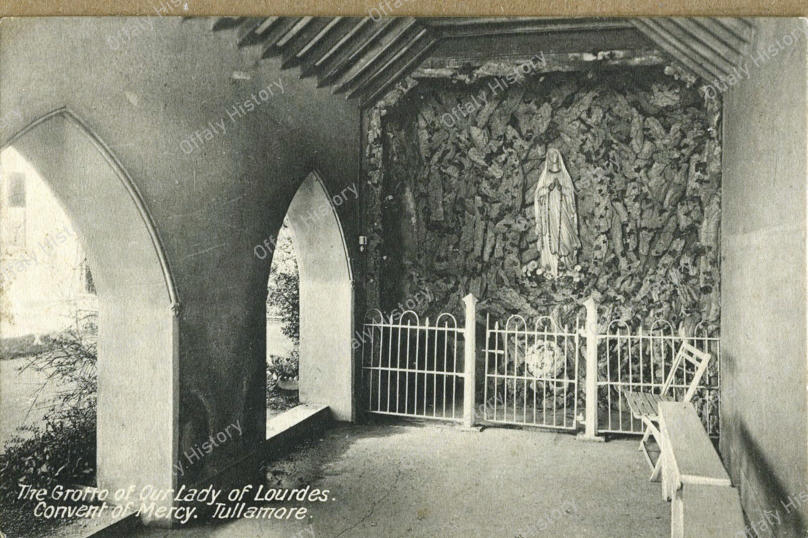
A favourite in the month of May during the rosary processions in Tullamore convent
St Joseph’s Convent was the first foundation outside Dublin by an order which was to become the largest order of women religious in the English-speaking world.
Brought to Tullamore at the request of the then parish priest, Father O’Rafferty, it went on to play a major role in local history, as well as to found convents in other locations.
In writing about the order, I am conscious of my own dealings with it as a young boy, having attended the old St Joseph’s NS (where St Philomena’s is now located) from 1965-68. In those days, the norm was that boys attended there for the first three years of schooling, until First Communion, when they departed either for Scoil Bhríde or, as in my own case, to the primary school then run by the Christian Brothers in Coláiste Choilm.
The girls then continued for another year or two until moving to St Philomena’s, which was then based in Harbour Street, in what is now St Mary’s Youth and Community Centre.
I have good memories of the four nuns who taught me in St Joseph’s – the late Sister Bernadette Nevin was my first teacher in Junior Infants, and she was followed by Sister Scholastica (now Sister Kathleen), Sister Regina (who later moved to teach in the USA) and Sister Columba (now Sister Nuala).
Sr Bernadette, teacher to so many in her early years
I cannot presume to speak on behalf of my female counterparts regarding their memories at more senior primary and secondary classes, that is something they would have to outline themselves. During my schooldays and for many years thereafter, the Sisters of Mercy ran three primary schools in Tullamore – in addition to St Joseph’s and St Philomena’s, they ran Scoil Mhuire on the other side of the town – in addition to the Sacred Heart School, the only all-female secondary school in Offaly.
In addition to such a major role in education, I am conscious of their involvement as nurses in the local hospital, where a separate convent, the Sacred Heart convent, long existed, as well as their work in Riada House and its predecessor, the old County Home.
One also thinks of the order’s legacy in terms of setting up the Day Care Centre at Whitehall, the old launderette on Convent Road and of course involvement in the development of youth services and work with Travellers.
The convent (1836-41) and the first girls’ secondary school of 1911 at Convent Road
By the late 1980s, the effect of declining vocations was already beginning to be felt – the appointment towards the end of that decade of Ann Cooney as the first lay head at St Philomena’s was followed by that of Geraldine Byrne at St Joseph’s in 1992 and Máire McRedmond at Scoil Mhuire in 1999. At secondary level, Sheila McManamly became first lay principal at the Sacred Heart School in 1991, when Sister Ann O’Neill kept her promise to do no more than six years as head following the retirement of the late Sister Dolores Walsh.
Second level girls at Tullamore convent in 1914
St Joseph’s Convent has been linked to a number of foundations away from Tullamore – in addition to the Kilcormac convent, which has closed in recent years (with the remaining sisters moved to Tullamore), it is worth noting the role in founding convents in Derry and in Costa Mesa in Orange County, California.
Sisters from Tullamore have also served in Zambia and Kenya as well as Iceland.
With the remaining sisters predominantly elderly, the time will come when few will be aware of their work, but the legacy remains in schools and youth services. Those of us of a certain generation are well aware of the great work done by Sisters Ann and Genny, among others, in the youth services, and the order’s generosity in donating the old St Philomena’s to become the Youth Centre in 1980.
We also remember the work of Sister Veronica Gilsenan in helping bereaved families, as well as her work with Travellers and others in need – at a personal level, I recall her going to see my father when he was dying in Our Lady’s Hospice in Dublin in 1990.
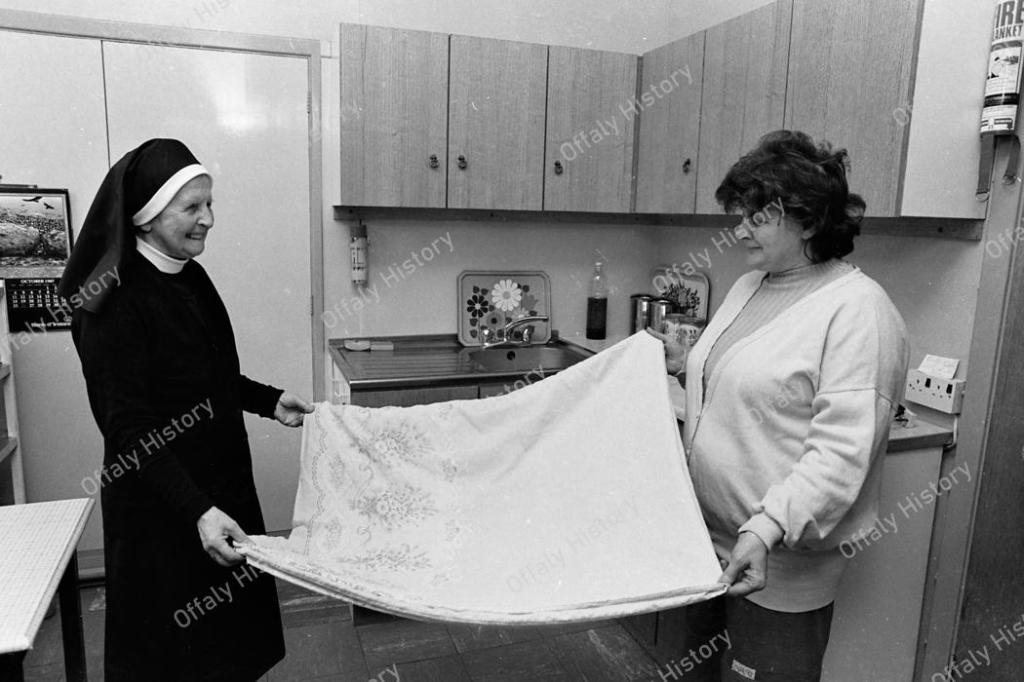
Sister Veronica and friendsabout 1990
In assessing their work, we have to remember that they often reflected the mores of their time and as sisters aged, they often re-evaluated positions they previously took for granted.
From conversations I had with sisters down the years, I could see they were quite pragmatic in coming to terms with the changing position of women and the adjustments in social mores.
While Offaly has a huge range of Early Christian church and monastic sites it would not have been noted for crannogs, unlike its neighbour in Co. Westmeath. Surprisingly, Offaly has 13 crannog sites recorded in the National Monuments database, however they are in many ways different from the usual picture of the small, man-made island in a lake. Many of these crannogs are located close to natural esker and drumlin routeways and survive as wetland settlements in or close to bogs. One third of Offaly is covered by peatland.
Crannogs in Ireland.
The name crannog is obviously the Irish names of ‘crann’ for tree and ‘óg’ in this case referring to small and not young. But we will see that ‘small tree’ does not account for the size and scale of wood used in the construction of these lake dwellings which are generally in open bodies of water.
There is no agreed figure for the number of crannogs in Ireland. Some have suggested 1,200 over the whole country while others take the number over 2,000! Crannogs were constructed in the sixth and seventh centuries and occupied and used up to the end of the seventeenth century. As a monument in the landscape that has changed considerably with the reduction in water, lake and river levels, along with the drying out of the bogs since the Middle Ages, it is only by accident that a new crannog is discovered. (more…)






 offalyhistoryblog