Introduction
Amongst the recently announced projects for the rejuvenation of the centre of Tullamore is the long promised opening of the ‘Hidden Bridge’ behind the County Library and the linking across it of O’Connor Square and Church Street by a new public park. Though the age and function of the bridge are obscure, clues may be found which shed light on not just its genesis but also those of Tullamore itself.
Settlement Types
As humans began to leave the forests and gather together for trade and security, three distinct models of settlement began to emerge. One was the elongated village street which developed along a well travelled trail. Another was the crossroads ie. a meeting of four trails creating a junction around which housing and businesses clustered.The third was the village green form, where several trails came together around an open marketplace.
In Offaly the best examples of the first are Banagher, Shannonbridge, Daingean or Edenderry with their long main streets. Ferbane is a good example of the second type. Killeigh, Cloneygowan, Geashill and Clara which share the same feature of a triangular fair green, are good examples of the last.
Into which category therefore does Tullamore fall?
Early Maps
The Cotton map of the mid to late 16 th century shows the central Midlands as mainly woods, trackless plains and bogs. Apart from ‘Dinian’ (Daingean), Killeigh is the only settlement noted
Tullamore first appears as a distinct settlement on the Moll Atlas of 1728 which shows the Tyrellspass to Birr road as the main route from Westmeath to Tipperary and crossing the Ballycowen River river just south of a hamlet noted as ‘Tullymore’. No other roads into this village are shown.
The first map which shows the layout of the town of Tullamore itself is Taylor and Skinner’s 1777 volume which describes the routes of all the main roads traversing Ireland at that time, but does not purport to be a reliable guide to the streets or form of the towns through which they pass. The guide shows the north -south Kilbeggan to Birr road crossing the river and intersected by the east-west Philipstown (Daingean) to Clara road at a point just south of the present canal bridge. A small chapel is shown on Church Street and a nobleman’s seat close by. The Tyrellspass to Birr road is shown entering the town from the north east and meeting the Philipstown/Clara road at a T-junction, but does not continue further southwards. Were it to continue in a straight line however, it would arrive at the river at precisely the location of the ‘Hidden Bridge’ at the rear of the Library which suggests that this was once its destination.
William Larkin’s Survey of 1809 is a little more detailed and shows seven roads radiating out into the countryside from a central point- again presumably the river crossing. The arrival of the Grand Canal in 1798 had interrupted this road pattern north of the river.

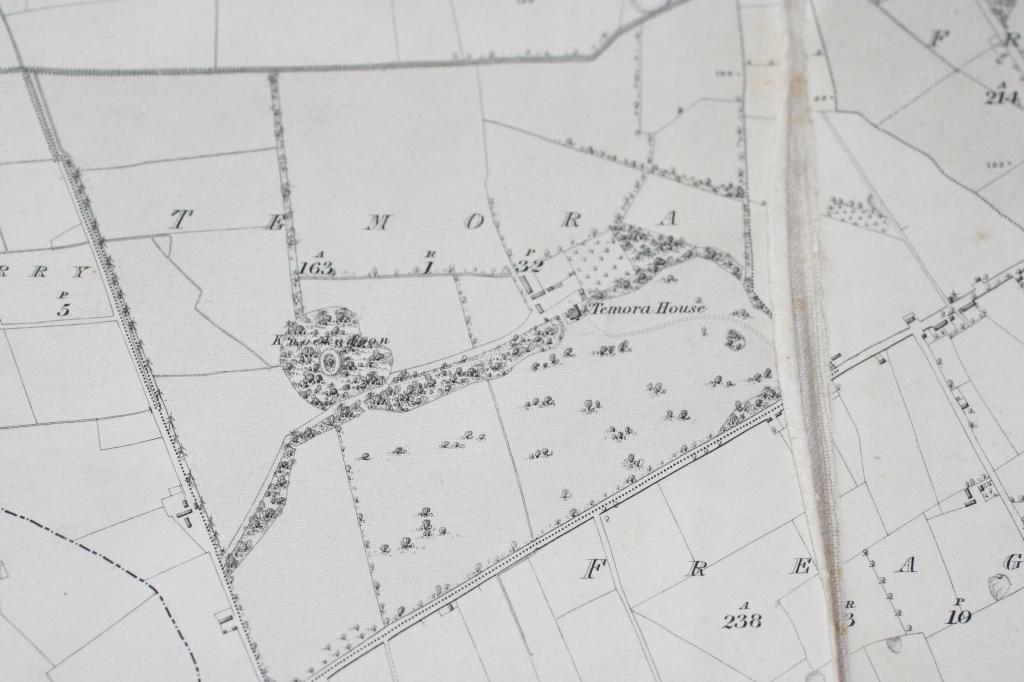
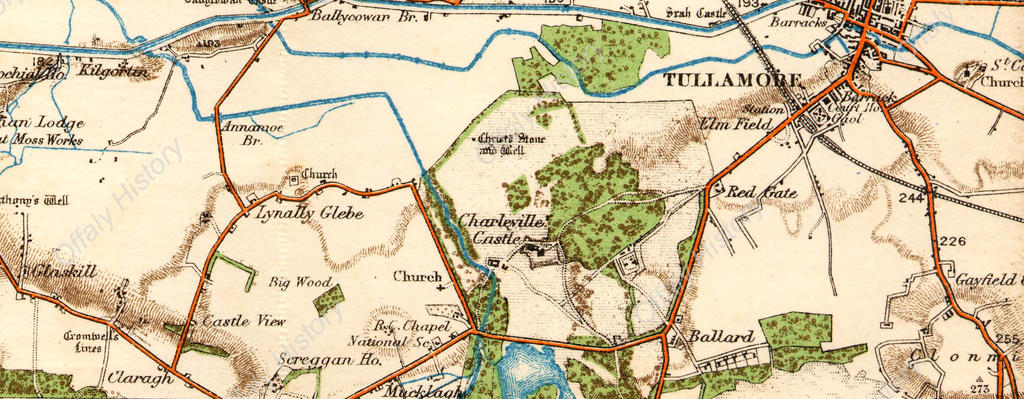
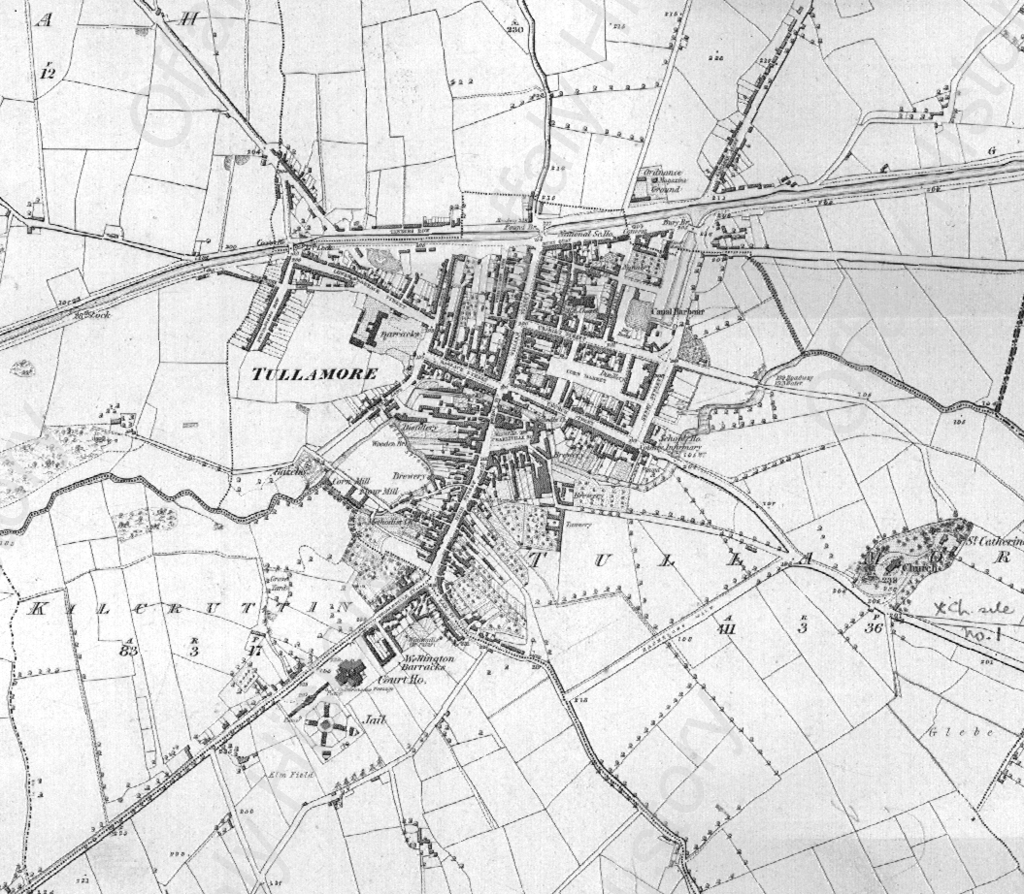
Some indication of the age of these radial roads may be drawn from an examination of the first really reliable map of Tullamore-the Ordnance Survey of 1838. Field boundaries which are not continuous across road lines suggest land ownerships of some antiquity and therefore longer established routes. The clearest example of newer roads interrupting established field boundaries is visible in Bachelors Walk, laid out in 1815 while the relatively recent vintage of Tanyard Lane and the road to Geashill are evident also. However, the Killeigh, Kilbeggan, Rahan and Charleville radial roads which have differing boundaries on either side, are clearly much older.
The North Eastern Radial
Of particular interest however is the north eastern entry to the town from the Tyrrellspass direction and the former direct route to Birr according to Moll. Having cut through the esker at Derrygolan, the road takes a direct and straight line to enter Tullamore at Puttaghan along a route formerly known locally as Rapparee Alley; at which point (according to Taylor and Skinner) it suddenly meets the east-west Philipstown-Clara road and proceeds no further. The discontinuous boundaries on either side northwards of this junction suggests a route of some antiquity. We can only speculate as to why it does not continue further to its projected and natural destination point -the river crossing suggested by Moll’s map.
Roads evolve along desire lines of movement and historically the focus of all the other radial roads entering Tullamore was the river crossing. As there were no physical obstacles to interrupt the original line of the Puttaghan Road, we can only surmise as to the reasons for its discontinuance or abandonment.
Combining the Moll Atlas and Taylor and Skinner’s Map it would appear that the road originally ran past the ruined castle recorded in 1620 as being in the ownership of Sir John Moore and which was located somewhere in the Church Street/O’Carroll Street area. Indeed the castle may have originally been built to ensure the security of that ancient road.
In 1710 Sir John moved the family seat of the O’Moores from Croghan to Tullamore and built a new house somewhere near the old castle. It is possible but conjectural that some years later the Puttaghan road was decommissioned by Sir John to increase and protect the pleasure grounds around his new residence. Traffic from the north east would now meet a T-junction at the northern edge of his estate and travel westwards along the Philipstown- Clara road to meet with what was by then, the main Kilbeggan-Birr road and then proceed southwards along it to ford the river.
Though this diversion might have inconvenienced travellers, it should be noted that in 1786 Sir John’s successors rerouted the Tullamore- Birr road around their new demesne at Charleville for this very reason.
The Old Bridge
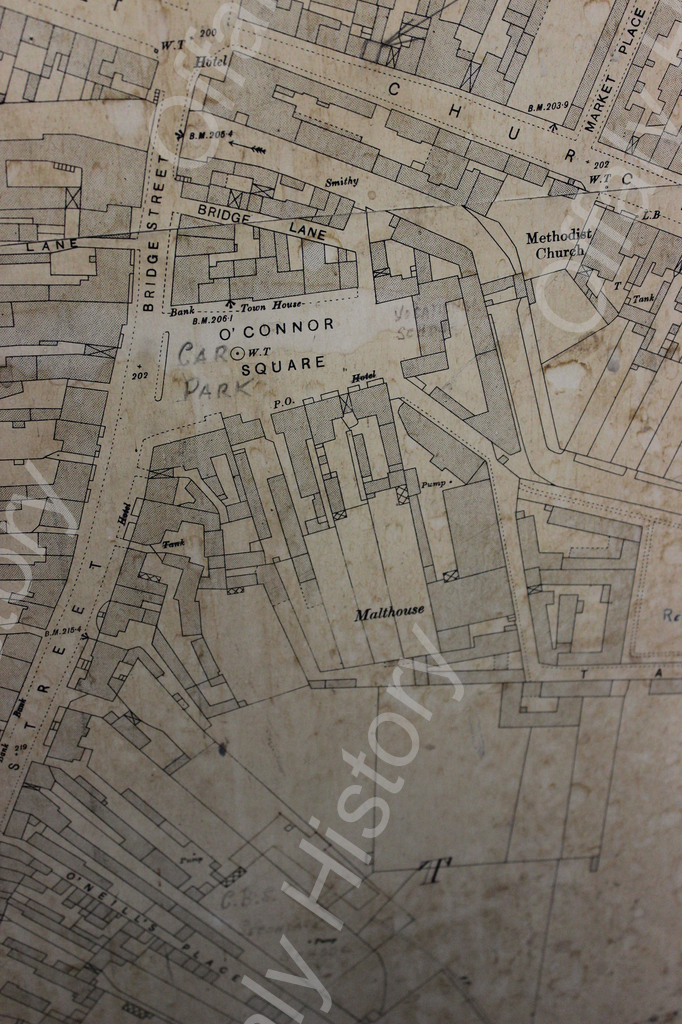
What then was the function of the bridge between O’Connor Square and Church Street and which has been hidden out of sight for many years? The sharp cutting of the stonework of its central abutment suggests that it is not an ancient structure, but we have no precise information as to when it was erected; in particular we don’t know if it predates or succeeds the bridge to the west which was provided on the site of the former ford sometime around 1775.
The eminent chronicler of the history of the town, Dr. William Moran conjectures that ‘It was probably about the time (early 18c.) the fair green and the cornmarket were opened, that the first bridge over the river was built to enable farmers from the south side of the river to bring their produce to market’. He then goes on to surmise that ‘Two short stretches of road, one each side of the river, connected this bridge with the already existing Philipstown-Birr road.The inconvenience of having to make this little detour, in order to cross the river by the bridge was soon felt; and the present bridge was built to replace the old one’
The provision of the western bridge to replace the ford at present day Bridge Street does not explain why the eastern bridge should have been enclosed and abandoned. It would still have been the more direct route between the two market places of the town and of greater convenience to cattle drovers and wheeled traffic.
The other eminent chronicler of the history of Tullamore Michael Byrne, suggests that property records indicate that the eastern bridge is of a later date than 1775 and was a private facility and an internal link within a single business premises-as was common in the other brewing, tanning and distilling businesses of the town that utilised the river as a source of water or for the discharge of effluent.
I think it is possible to argue that neither Dr. Moran nor Michael Byrne have fully explained the genesis of the bridge and that we have to go back to an earlier date to understand the reason for its location; whatever about the date of its construction.
I believe that, as in the case of its companion to the west, the natural extension of the radial line of the approach roads into Tullamore suggests that it may have been built on the site of an earlier ford-indeed that the entire river between both bridges may have originally been shallow enough to have been fordable. The drainage scheme of the early 1950s deepened this section of the river between Church Street and Bridge Street by removing the rocky outcrop which facilitated the fording of the river at this point.
If this earlier crossing point existed, it is probable that prior to the construction by Sir John Moore of his new house in 1710, all of the radial roads met together at a point to the south of the river. If I am correct in this, a triangular fair green with the fordable river running through and surrounded by houses on the three sides (Church Street being its northern side) would have been the most likely original urban form.
The neighbouring villages, Killeigh, Clonygowan, Geashill and Clara, display such triangular layouts. As may be seen from comparative plans, the form and dimensions of their central village greens are almost identical to each other. (illus.). The village green which I submit may have been the form of Tullamore up to the end of the 17th c. would have been similar to them in scale and shape.
It is possible also that Frankford (Kilcormac) originally formed around a Fair Green of similar scale though the triangular block is now much compromised by infill housing.

A New Theory
As ‘Tullymore’, Geashill, Killeigh, Clonygowan and Clara appear on Moll’s map of 1728 it is possible therefore that all five or even six villages all formed in the mid to late 16th c, as the plantation of Leix-Offaly began to transform the economy and settlement pattern of this particular area of the Midlands.
It is also possible that some time in the early 18th c. the direct route into Tullamore from the north east and which crossed the river to culminate in the fair green of Tullamore-today O’Connor Square- was enclosed into the estate of Sir John Moore and the connection discontinued.
Over the years, the triangular form of the original village green evolved into ‘The Market Place’ and later into Charleville Square. From 1740 onwards it was reduced in scale and became more rectangular and formal. Eventually the land on its northern side, between it and the river was enclosed to build the Market Hall in 1789.
Meanwhile, the lands on either side of the river at the location of the former crossing had come into the ownership of the Quaker Thomas Wilson, who together with his partner Thomas Pim conducted a wool combing and tannery business at the rear, backing on to the river. The lands then passed through the hands of Gideon Tabuteau and on to Joseph Manly who operated a brewery and maltings. They were later acquired by the Tarletons who operated a milling business. It is possible that any of these commercial families may have erected the private stone cut bridge.
I suggest therefore that the bridge behind the County Library is relatively new but that it is located on an earlier crossing point of the river which existed up to the end of the 17 th. century and which gave direct access from the farming hinterland on the north east to the central marketplace of Tullamore.

If I am right, the long promised and eagerly awaited opening to the public of the ‘Hidden Bridge’ will reestablish part of an ancient route which was once an integral part of the original village of ‘Tullymore’.