
This short article is the first in a series designed to look at the growth of Tullamore over the period from 1622 and to take key dates in the development of the town. Suggested dates will include 1622, 1716, 1764, 1785, 1804, 1835, 1900, 1923, 1948, 1966 and 2000. These dates coincide with particular events, or the availability of documentary sources that may allow us to draw some conclusions about the state of Tullamore at varying times over the last four centuries. Rather than take matters in chronological order we are going to look for some key moments in the stages of growth. One such was the completion of the canal to Tullamore in 1798 and its extension to Shannon Harbour in 1804. During that six years Tullamore had served as the depot and terminus for the new waterway to the west and south. The opening to Shannon Harbour and the link to the Shannon may have been seen by some as marking the end of the new canal hotel and harbour in Tullamore with business moving further west and travellers no longer having to stop over in the town. That was not the case. The hotel client base weakened to almost nothing by the 1840s and so did passenger traffic. Commercial traffic was continued on until 1960.
(more…)Category: Rahan
-
Christmas Reading from Offaly History – twelve new titles of Offaly interest, one for every day of the Festive Season. Another bumper year for local studies. Blog No 337, 4th Dec 2021
All the books here can be purchased from Offaly History (Bury Quay, Tullamore and online) and at Midland Books, Tullamore. You can also view/ borrow at Offaly Libraries and consult at Offaly History Centre.
Rathrobin and the two Irelands: the photographs of Middleton Biddulph, 1900-1920. Michael Byrne (Offaly History, Tullamore, 2021), 330 pages, 280×240, hardcover, €24.99.
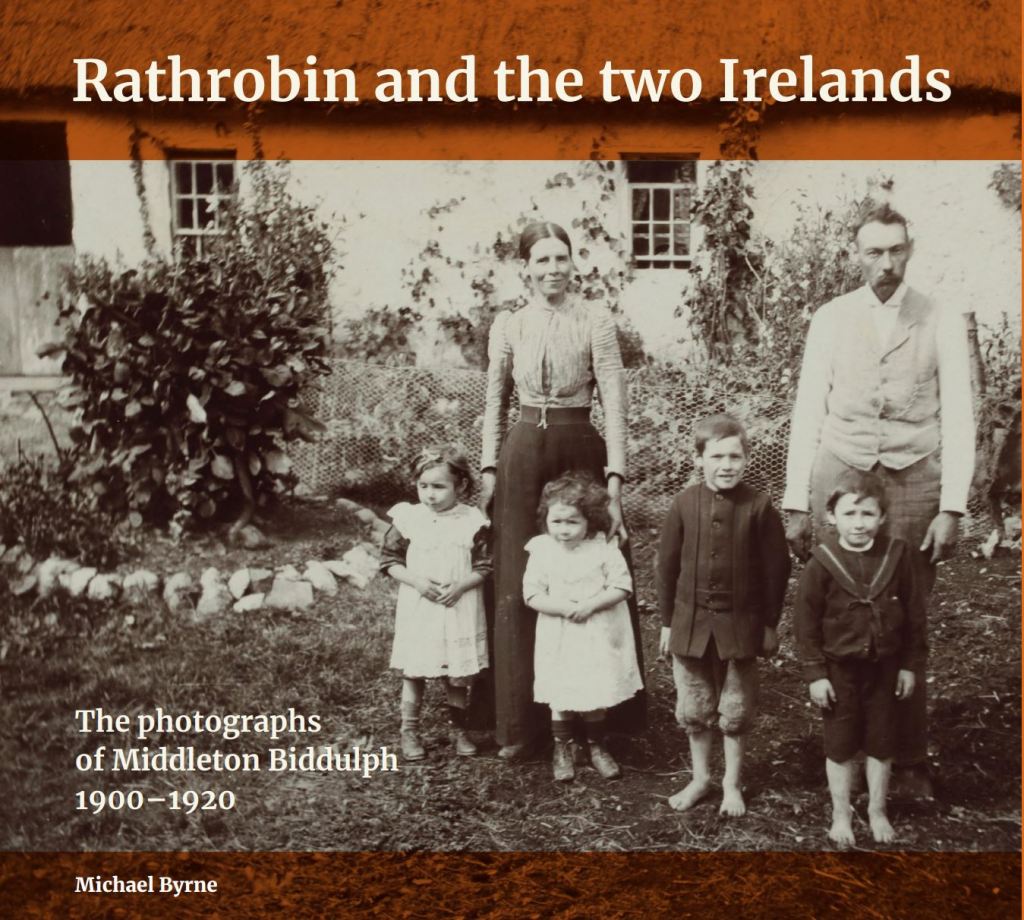
Rathrobin is a book that keeps on giving. Its 250 Biddulph photographs from the 1870s to 1920s, all carefully captioned, depict the two Irelands – unionist and nationalist, Catholic and Protestant, landed and cabbage garden. What is interesting about the pictures of Colonel Biddulph (1849-1926) of Rathrobin near Mountbolus are the nuances. He was of the lesser gentry, was a tenant of the Petty Lansdownes, and was well aware of the Plantations of the 16th and 17th centuries. He appreciated the needs of the farm labourers and was decent to his own tenants, staff and farm workers. His entire estate was not much more than a 1,000 acres. Biddulph’s circle was also the lesser gentry and those who served it such as land agents, bankers and clergy. The Catholic Protestant divide was strong but landed Catholic families did mix in Bidduph’s set, but not merchants or traders (even if very rich). Biddulph had an empathy with his farm workers and their families and sought their advancement. Many local families were photographed, together with the farming activities of his own employees.
Biddulph’s story, and that of his associates and friends, is illustrated by a selection of over 300 pictures in all, of which 250 are from the Biddulph Collection in Offaly Archives, and fifty more to illustrate the introductory essay and provide the all-important context. The essay and the photographs provide a more nuanced understanding of Ireland in the revolutionary period of 1900–23. Biddulph’s wonderful house at Rathrobin that he had so carefully ‘restored’, and all his farm improvements, were lost in the Civil War in 1923. Many other big houses from Ashford, to Ballyfin, Durrow, Brookfield, Screggan Manor and Charleville are also recorded in this volume. Some such as Brockley Park in Laois are now gone thereby making this an important work of record. The photographs by Middleton Biddulph were taken at a crucial moment in Ireland’s history. Their publication now could not come at a better time. Rathrobin is the portrait of one small estate and Killoughy parish in Offaly from the 1650s to the 1920s, but the story is of national interest. T.E. Lawrence spoke of the Arab Revolt, perhaps in Ireland we can talk of the Irish Revolt and not the full circle Revolution. You decide.
Rathrobin was supported by the Decade of Commemorations Unit in the Department of Tourism, Culture, Arts, Gaeltacht, Sport and Media
(more…)
-
The D.E. Williams branch shops in the midlands, 1884–1921: A revolution in retailing. By Michael Byrne. Blog No 306, 31st July 2021
There are only a few studies available on the development of retailing in Ireland, either of a general nature or in connection with particular firms. It is well known that in the first half of the nineteenth century and up to the Famine years retail outlets were not widely available and many in the smaller towns were no better than huxter shops. There were exceptions and that is clear from the photographs of c. 1900 of shops such as Williams. Egan, Goodbody and Lumley (in Tullamore); O’Brien in Edenderry and O’Meara and Fayles in Birr. In looking at the revolutionary period from 1912 to 1921 to mark the decade of centenaries it is also worth looking at revolutions in other areas such as transport, energy and shopping. Like the political revolution retailing exhibited signs of stress after 1921 and did not recover until the coming of the supermarkets to the provincial towns in the 1960s.

The Williams head office with the Barrack Patrick Street shop to the right before more intensive motorised transport from 1915. Branch house managers were appointed of which the last under the old system (before the switch to supermarkets) was T.V. Costello. The trade directories, and from the 1840s the valuation records, will facilitate investigation of retail outlets. By the 1860s living standards had improved and this is reflected in the increasing number of shops; per capita tobacco consumption rose to English standards about 1870 and per capita consumption of tea was not far off the English level by the end of the 1870s. The considerable economic progress of the early 1870s, began to slow down by the end of that decade. The 1880s is looked on as a period of industrial crisis with industries closing down in all the principal towns, or destroyed by fire as with the Goodbody tobacco factory in Tullamore and the Birr distillery in 1889.The railways and the canals (especially in the midlands) facilitated the easy removal of heavy goods and livestock from towns all over Ireland, but it also left it easier to import foods easily and cheaply. As a result, the Irish industrial base (such as it was, especially in southern Ireland) receded while the retail and services sector began to grow albeit slowly.
(more…)
-
Saint Manchan’s Shrine – Art and Devotion in 12th Century Ireland. Blog No 287, 15th May 2021
‘A rich and dazzling Celtic bewilderment, a perpetual challenge to the eyes and a perpetual delight.’ T.D. Kendrick (Archaeologia 86, 1936)
Saint Manchan’s shrine is one of the most remarkable survivals from Ireland’s medieval past, having been safely kept and venerated in the same locality since its creation in the early twelfth century. This masterpiece of medieval art is now proudly and reverently displayed in the rural parish church of Boher in County Offaly, not far from its original home at the ancient church site of Lemanaghan. St Manchan’s shrine is a gabled-reliquary, taking the shape of steeply pitched roof or tent, and is fitted with carrying rings, which enabled it to be carried in procession by two bearers using poles. It is not only the largest reliquary surviving from medieval Ireland but is also the only remaining example of its type. It enshrines what are believed to be the bones of its eponymous saint, St Manchan, whose death is recorded in AD 664.
(more…)
-
Teresa Wyer (1868–1959): the first woman chairperson of a public board in County Offaly and prominent in Sinn Féin in the revolutionary years. By Owen Wyer and Michael Byrne. Blog No 280, 17th April 2021
Teresa Wyer was born in Ballykeenaghan, Rahan, Tullamore, County Offaly on 29 November 1868. She was the third youngest of eleven children of Michael and Anne Mary Wyer. Teresa Wyer went to Rahan National School and thereafter to Killina Secondary School. She joined the Convent of Mercy Athy, County Kildare on 22 February 1890 where she was called Sr Mary Baptist. She left the convent in 1900 and ran a shop and public house at No 6 Church Street bought by the first author’s grandfather, Owen Wyer, brother of Teresa Wyer, from Abraham Colton, the Tullamore auctioneer and hotelier in early 1901. Owen Wyer was also a Sinn Féin activist and chaired a great Sinn Féin meeting in Rahan in September 1917.

Drama in Tullamore from the Gaelic League, c. 1906 with a backdrop of a painted view of William/Columcille Street. Owen Wyer is second from the right in the back row. Church Street was a busy commercial street at that time with at least five public houses, a hotel and a number of private residences. Wyer’s neighbours included the long-established Warren family drapery stores with two shops. In 1901 Teresa Wyer (then describing herself as 30) was living with her brother over the public house and they had a shop assistant and servant living with them. Owen Wyer was a maltster with the Egans of Tullamore and she a publican. By 1911 she described herself as a grocer and aged only 36, single and with four assistants living over the shop. Teresa Wyer married James Wyer from Ard, Geashill on 24 February 1914.
(more…)
-
Agriculture in Offaly on the eve of the Great Famine. By Ciarán Reilly. Blog No 255, 16th Jan 2021
On the eve of the Great Famine in 1845 the backwardness of Irish agriculture was seen by many as the reason for much of the country’s economic woes. About Irish farmers, it was stated that they knew nothing of the ‘English’ method of farming or indeed welcomed its arrival. However, there was amongst many Irish landlords, and their agents, a growing understanding of the benefits of the ‘science’ of agriculture and many had willingly adopted such methods in the management of their estates. In particular, many land agents were the leading pioneers of better agricultural practice. The employment of agriculturalists; the establishment of agricultural societies and the trips undertaken to observe foreign models of agriculture all highlight the progression of Irish agriculture by the early 1840s.
(more…)
-
Dancing in Ireland since the 1920s: Your recollections needed. Maria Luddy. Blog No 248, 19th Dec 2020
Many readers and their parents will have great recollections of the dancing scene in Ireland. You can help write the history. Share your thoughts and send on the stories needed to build a picture of the dancing scene in Ireland. Many will recall Je t’aime played in the 1960s in St Mary’s Hall, or the Harriers, Tullamore. But what about the County Ballroom and the parish halls in Clara, Birr, Rahan, Killeigh and so many more. Did dancing bring about the ‘ruin of virtue’?
Dancing has always been a source of expression, fun and entertainment in Ireland. People danced at the crossroads, in each other’s houses, at social events, festivals, and in licensed dancehalls all around the country. From the early twentieth century the Catholic hierarchy became particularly concerned with the opportunities that might arise for sexual immorality in dancehalls. In October 1925 the bishops and archbishops of Ireland issued a statement which was to be read at ‘the principal masses, in all churches on the first Sunday of each quarter of the ecclesiastical year.’ The statement referred to the ‘evils of dancing’ and it was ‘a grave and solemn warning to the people with regard to the spiritual dangers associated with dancing’. The statement noted: ‘We know too well the fruit of these [dance] halls all over the country. It is nothing new, alas, to find Irish girls now and then brought to shame, and retiring to the refuge of institutions or the dens of great cities. But dancing halls, more especially, in the general uncontrol of recent years, have deplorably aggravated the ruin of virtue due to ordinary human weakness. They have brought many a good innocent girl into sin, shame and scandal, and set her unwary feet on the road that leads to perdition’. The behaviour of the men did not elicit much comment. From the mid-1920s and throughout the early 1930s there were constant references in the newspapers to the problems of dancehalls and motor cars. In 1931 Cardinal McRory combined the two and saw a growing evil in ‘the parking of cars close to dancehalls in badly lighted village streets or on dark country roads. Cars so placed are used … by young people for sitting out in the intervals between dances’. ‘Joy-riding’ had a very different connotation in the period than it does now. Reporting on a sermon by the bishop of Galway, the Irish Independent noted that ‘joy-riding’ was conducted by ‘Evil men – demons in human form come from outside the parish and outside the city – to indulge in this practice. They lure girls from the town to go for motor drives into the country, and you know what happens… it is not for the benefit of the motor drive. It is for something infinitely worse’.
(more…)
-
Fr Michael Kelly, of O’Connor Square, Tullamore and a citizen of Zambia. From the Sources of Offaly History Series, No. 9, oral history from the Diaspora, or the scattered Offalians around the world. Blog No 228, 30th Sept 2020
How many Offaly people have emigrated? They have stories we would like to hear and to archive for Offaly History Centre. This is some of Michael Kelly’s story. You have one too, whether living at home or abroad. So sit down and start writing. The words will flow. Thanks to Michael Kelly SJ for this report. He appears on a postage stamp and is an honorary citizen of Zambia and of Tullamore. We will add this latest report to the almost 250 stories we hold from Offaly people who wrote it down or talked to us. Like our offalyhistoryblog to receive it free every week and sometimes twice a week. Almost 70,000 views so far this year

ON MONDAY, August 22, 1955, a young Irish Jesuit stepped off a plane at the City Airport (which is now a Zambia Airforce base in Longacres). It was his first visit to Africa, and he fell in love with it. He talks about the cheerfulness, generosity and openness of the Zambian people, as well as their suffering. A mathematics genius, he dedicated his life to educating young Zambians, and later to the fight against HIV and AIDS. Sixty-five years later, Father Michael Kelly says he is now looking forward to going home. And by “home”, he is not referring to his native country – Ireland – but to Heaven.
(more…)
-
The King’s/ Offaly County Council election of June 1920: ‘remarkable, memorable, and revolutionary’. Blog No 202, 6th June 2020
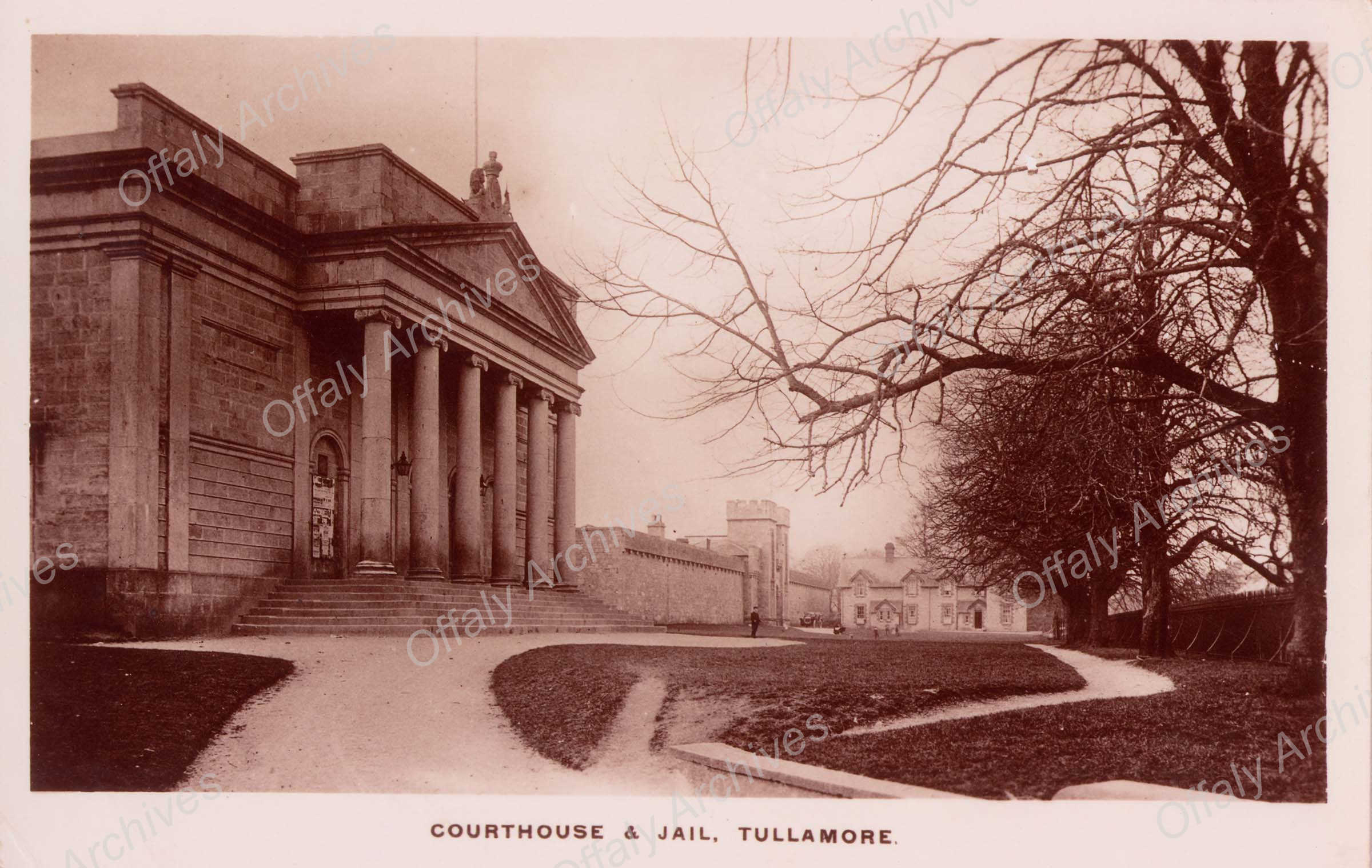
The seat of civil and judicial governance in Offaly about 1910 and the place of correction in the background with the houses of the ‘turnkeys’, Charleville Street, Tullamore. The verdict of county secretary James P. Kingston on the county council elections of 2 June 1920 was that the election was not just remarkable and memorable but revolutionary. Kingston believed it was even more revolutionary than the 1899 elections that saw only three members of the old grand jury transfer to the new county council. In that election James Perry Goodbody was elected for Clara unopposed and William Adams defeated distiller and grand jury member Bernard Daly to secure the Tullamore seat. Goodbody was a leading Quaker businessman and Adams a large farmer and publican. Adams retired from the council in 1912 and was succeeded at the council by his son P.F. Adams who was married to Rosaleen Egan, a daughter of Henry Egan, chairman of the county council from 1899 to 1910. Goodbody served on the council as chair of the Finance and Proposals Committee from 1900 and was vice-chairman of the council from 1912. Both P.F. Adams and James P. Goodbody sought election to the new council of 1920 in the first post-war elections and both were defeated. Sinn Féin secured 19 of the 21 seats and acceptable Labour men two seats. For Secretary Kingston the election was also a turning point as he was forced out of office within a year, just as his predecessor Thomas Mitchell had been in 1899.
-
Some Offaly Wills of the Dames and Longworth families of Tullamore, Greenhills (Rhode) and Glynwood, and that of Sir William Petty with lands in Ballyboy barony. Tim O’Neill. Blog No 199, 23rd May 2020
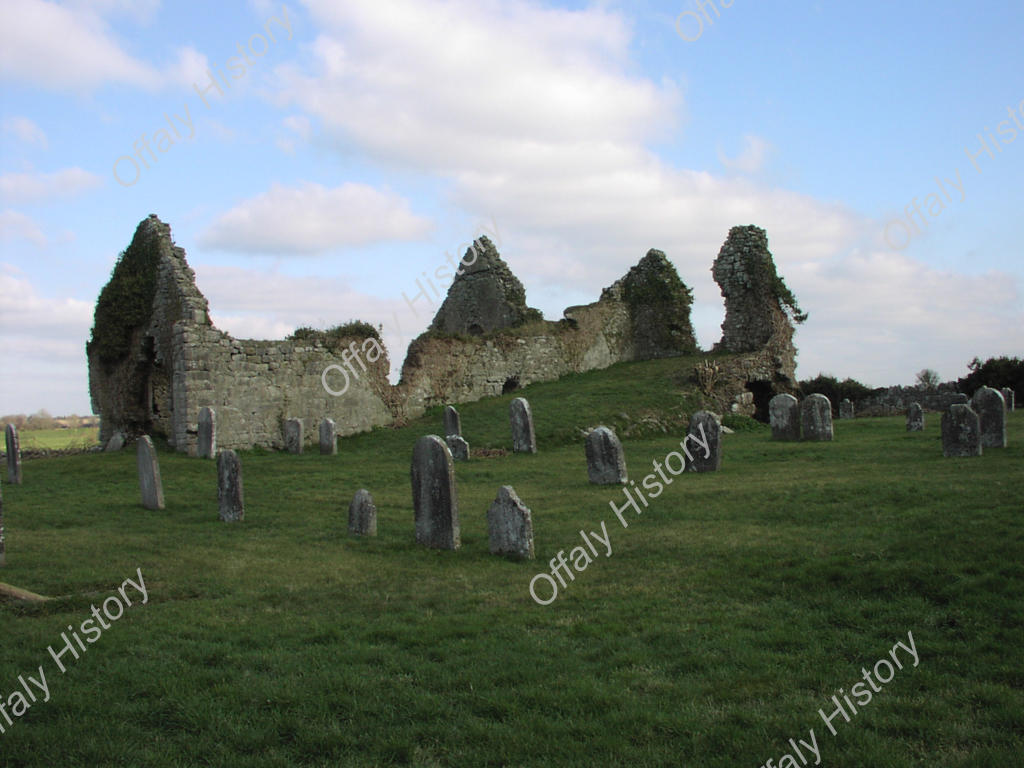
The old cemetery at Lynally where Dames and Rector Coffey are buried. No stone has been found for Dames. The Longworth family and George Dames of Tullamore
Reading in the National Archives some time ago I came upon a small envelope of papers that Athlone-born Revd George Stokes had put together on the Longworth family. He was constructing a family tree and it was that family’s connections with Athlone that appealed to him. The envelope included two Wills. One was that of George Dames of Tullamore, dated 1662, who died in June, 1666. In it, Dames is described as a yeoman. The Dames and the Longworth families intermarried in successive generations and it is no surprise that this Will was filed with some of the Wills of the Longworth family. They were both Cromwellian families that settled in the midlands.

