T.D. Sullivan was one of the most high-profile political figures to be targeted by the London administration under the Crimes Act for publishing what they considered dangerous material that could incite opposition and violence against the police from carrying out their duties of evicting tenants who were unable to pay their rents. The Irish National League was established with the aims of bringing about the end of rack-rents (extortionate rents) and ownership of the soil by the occupier and a nationwide fund was in place for several years to prevent as many evictions as possible. However, publicising this opposition and encouraging the people to come together in the newspapers now placed a target on the backs of editors who began to be arrested and imprisoned for encouraging the ‘Plan of Campaign’ and Sullivan was the latest editor to be arrested and conveyed to the notorious Tullamore Jail. He arrived in Tullamore on December 7 1887 and upon his arrival met the Governor of the Prison, Captain Fetherstonhaugh, who was extremely frosty in his reception to such an illustrious new inmate and Sullivan was astonished to learn that despite his being regarded as a first class misdemeanant, he would be sharing a cell with other inmates. The Tullamore Town Commissioners were immediately on the ball to try and make contact with the political prisoners now incarcerated and to assess their wellbeing in this institution that gained notoriety for its deplorable unsanitary conditions and the treatment of the prisoners subjected to hard labour.
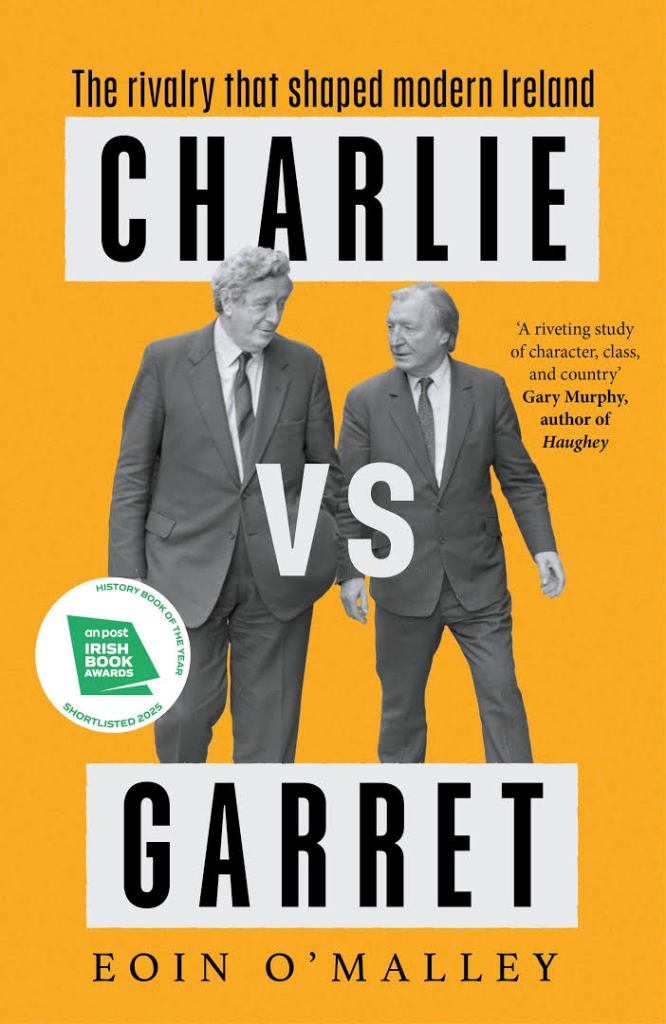
Today we mark the 100th anniversary of the birth of that hugely popular politician Garret FitzGerald. An intellectual in politics he was greatly respected in Ireland, Britain and Europe. Recent estimates such as that of Eoin O’Malley’s Charlie vs Garrett (2025) have not been so flattering to his handling of the economy in the 1980s. And yet his achievements and those of John Bruton have underestimated their roles in bringing peace to Northern Ireland.
FitzGerald, according to the DIB life by Patrick Maume (summarised here) was one of the most influential Irish political figures of the late twentieth century, known for his intellectualism, his commitment to European integration, and his efforts to modernise Irish society. Born in Dublin to the prominent revolutionary and cabinet minister Desmond FitzGerald and his wife Mabel McConnell, Garret grew up in a household steeped in politics, culture, and international connections. His parents’ mixed religious backgrounds—his father Catholic, his mother Protestant—shaped his lifelong interest in reconciling Irish identities and overcoming sectarian divides.
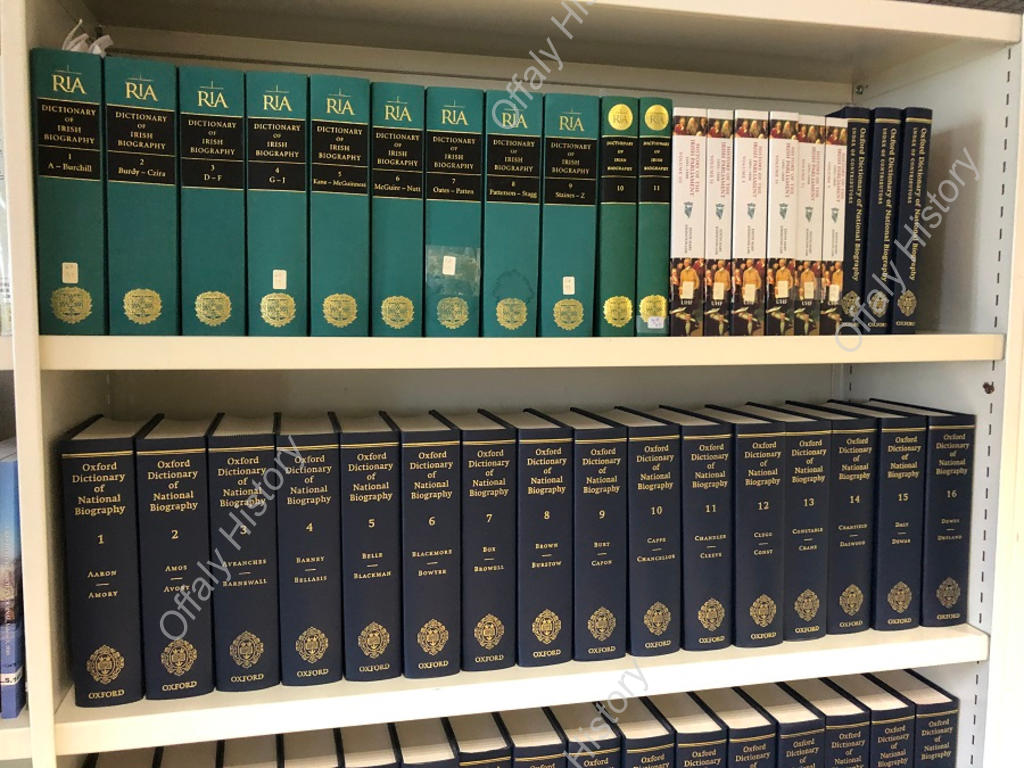
The DIB (above in green binding) runs to eleven printed volumes and is now online and free to use – a wonderful resource.Pic from Offaly History Centre.(more…)
Offaly History Lecture at Offaly History Centre, Bury Quay, Tullamore, R35 Y5V0 On Monday 26th January 2026 at 7. 30 p.m. following the AGM at 7 p.m. Offaly History presents a lecture about the recently launched “Voices of Offaly” resource available from http://www.offalyistory.com. The collection now comprises over 300 recordings of Offaly People captured over the past 30-40 years. Presented by Aidan Barry and Shaun Wrafter.
The illustrated lecture with voices will include: 1. An overview of the resources available on the new “Voices of Offaly” website. 2. A chance to listen to short audio clips which will give a flavour of the recordings available on the website.
1. Overview of the Website The website is organized into several key sections:
The demesne of Charleville must rank as one of the last unspoilt areas of tranquillity in the vicinity of Tullamore and is much loved by the inhabitants of the town who are proud of the great oaks still surviving after hundreds of years and of the great Gothic mansion of Charleville Forest. The demesne is about one mile south of Tullamore on the Birr Road and encloses some 1,142 acres, most of which is planted with oaks, ash, elms and some conifers.
Charles William Bury, then Lord Tullamore and soon to be earl of Charleville (1806), commenced building his castle in 1801 and completed the work of fashioning the demesne in the gothic sturm und drang manner by 1812. It was then the romantic period in literature and still is for many who walk in the demesne today. The old pre 1740 name for Charleville was Redwood and the first mansion house of Redwood was erected in 1641. When Charles Moore, Lord Tullamore, purchased the house and demesne in 1740 he called it Charleville. The old house was close to the existing farmhouse with the grotto of 1741 to the rear of the reconfigured river Clodiagh flowing through the demesne.
The map of c. 1809 of the demesne with the original road direct from Tullamore to Mucklagh and before the new winding avenue was laid out by J. C. Loudon.No houses were permitted on Charleville Road until 1900 (save that for the agent. This house was called Elmfield, built in 1795 and demolished by OCC for the new Aras in 2000-02.
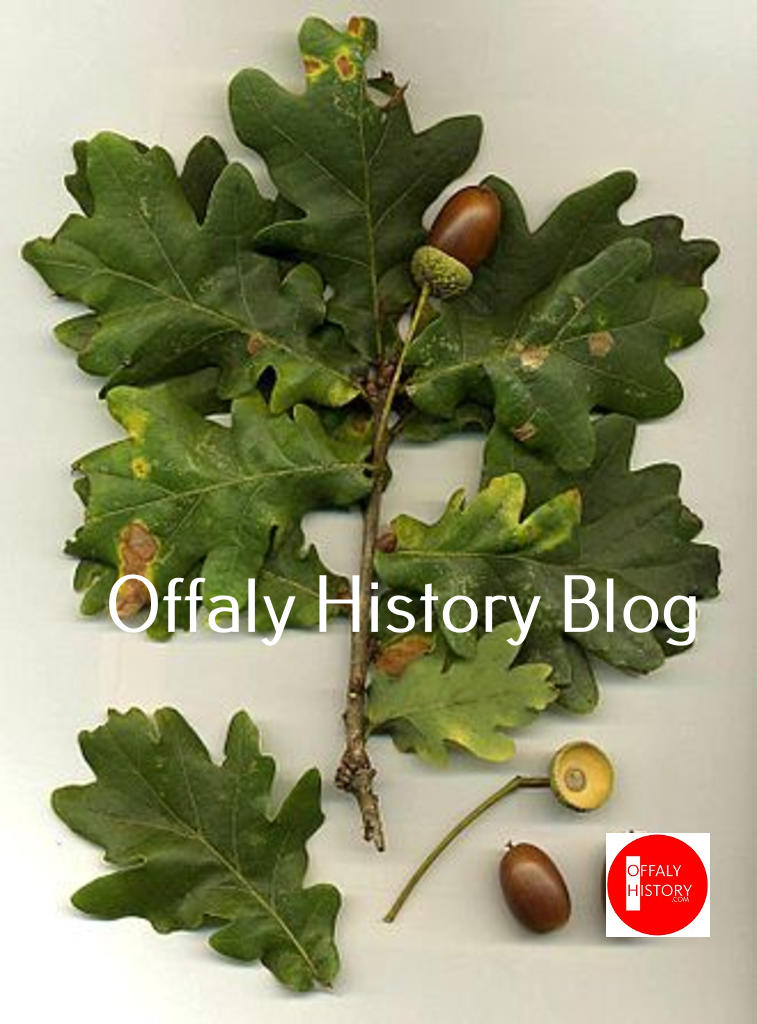
Perhaps in deference to the oak trees in the vicinity Charles William Bury called his new house ‘not Charleville Castle but Charleville Forest. Already there was one giant tree known as the “King Oak” dominating like a watch tower the carriage drive to the town’. Look at the span of its gigantic arms. One branch on the right of the photograph stretches 30 yards parallel to the ground. The Bury family believed that if a branch fell, one of the Burys would die, so they supported the great arms with wooden props. Of course there was nothing they could do to protect the trunk. In late 1963 a thunderbolt splintered the main trunk from top to bottom. The tree survived, but the head of the family, Colonel Charles Howard-Bury, then of Belvedere, Mullingar dropped dead a few weeks later.
Growing up in our house in Clonminch outside of Tullamore, I came to detest that mawkish dirge about the Lake Isle of Innisfree. My grandfather, who had once visited the island, was obsessed by the poem and insisted that I recite it at every party. He even named our house after it. Later, as a young town planner, I blamed the wretched verse for the rash of holiday homes that were beginning to appear in every beauty spot in Ireland and cursed Yeats who had provided the moral justification for this desecration. If a well known poet could simply arise and go and build in whatever idyllic place he chose, why shouldn’t everybody else? But – would Yeats get planning permission? I would put that to the test.
Skating on Charleville Lake, Tullamore was a popular pastime when I was a young lad. I remember the cold icy winters of 1962, 1982 and 2010. I can recall as a young man the Tullamore people skating on Charleville Lake in 1962. I am a long time now in D 4 but I got down a few weeks before Christmas of 2020 to the nice butchers in Tullamore – old Tormey’s was still going strong and then you had, Hanlon’s, Crossan’s of Main Street, Ray Dunne and Fergus Dunne, and a few more I would not know. I was sorry to see Grennan’s main shop closed for now in 2020. I miss Paddy Mac’s, Cleary’s and Joe ‘the Butch’ Kearney and not forgetting Dunne’s butchers off the Square. It was Treacy’s later. Liver we got a lot of and sheep’s hearts in that fine shop. Many old friends gone to the heavenly pastures. I always like to get my turkey in Tullamore and a nice ham even though I am out of the town now for over forty years. What with the bacon factory open until 1989, and now Tullamore Meats, the town has a long tradition in fine food. Come to think of it the bacon factory did a huge business in turkeys back in the 1940s and 1950s when my father was rearing same.
Ireland’s peatlands have long been a defining feature of the country’s landscape and identity—vast, open expanses that have shaped communities, powered homes, and inspired generations. But in recent years, these peatlands have entered a new chapter. TRANSITION, a striking new photographic book, captures this moment of profound change with sensitivity and depth.
In 2019, a High Court ruling mandated that commercial peat harvesting on bogs over 30 hectares would now require planning permission. This shift accelerated the decline of industrial peat extraction, a process already underway as awareness grew of the ecological importance of peatlands. These landscapes, once seen primarily as fuel sources, are now recognised as vital carbon sinks and havens for biodiversity.
TRANSITION captures this story through objects in time – each one a tangible link to the past, a marker of the present, or a symbol of the future. Structured in a unique A–Z format, the book presents a curated collection of items that reflect the evolving relationship between people and peatlands. These objects are thoughtfully juxtaposed to highlight the dramatic changes in land use, environmental values, and cultural identity. Each item occupies a liminal space, bridging the industrial legacy of peat harvesting with the emerging ecological renewal.
ROSE-TINTED: Memories of the Tullamore Swimming Pool inevitably come through rose-tinted glasses. Some can be explained: The glorious weather – you didn’t go to the pool unless the weather was good. But there were heatwaves!! I vividly remember tar bubbling up on red hot road surfaces beyond Hop Hill Church, destroying the soles of our bare feet or God forbid THE NEW SANDALS!! from Owen Marron’s sweet smelling leathery shoe shop [in Patrick Street]
The making of O’Connor Square, Tullamore: People, Houses and Business will be launched on Wednesday 10 December 5 p.m. at the Brewery Tap, Tullamore. The Brewery Tap is the longest established business in the square dating back to the 1830s as a pub and brewery. The lease of the site was dated to 1713 with the property in possession of the Brennan and Thornburgh families, later Deverell, Egan, Adams, Carragher and now Paul and Cathy Anne Bell.
We look forward to meeting you at the launch where savouries and tea/coffee will be served. Parking will be available at this time and should not cost more than 1 euro for an hour. Walkers and cyclists go free.
At the same event we launch Offaly Heritage 13. This the 13th issue of the Offaly History Journal It’s another bumper issue with over 330 pages and well-illustrated, €19 soft and €25 hardback. The issue is dedicated to the late Christy Maye – a great friend to Offaly History.
The two books are now available from Offaly History Centre, Midland Books and at www.offalyhistory.com for online.
Offaly Heritage 13. This the 13th issue of the Offaly History Journal is now available and will be launched on 10 December at the Brewery Tap at 5 p.m. It’s another bumper issue with over 330 pages and well-illustrated, €19 soft and €25 hardback. The issue is dedicated to the late Christy Maye – a great friend to Offaly History. The new book is now available from Offaly History Centre. Midland Books and online at http://www.offalyhistory.com. The new book on The making of O’Connor Square will also be launched at this event. Signed copies will be available on the evening.
Offaly Heritage 13 (2025)
Editors: Michael Byrne, Dr Mary Jane Fox. Obits editor Kevin Corrigan
Introduction by Helen Bracken, President Offaly History
It was 2003 when the first issue of Offaly Heritage was published. Now 22 years on we are publishing our thirteenth volume. With so many other demands it has proved difficult to produce a volume every year. Instead, we prefer to produce a large volume every two years.
Offaly Heritage 13 is another bumper issue and very much on a par in quality with the issues since no. 9 was published in 2016. It is a tremendous achievement and benefits from the pro bono work of the editors and contributors.


 offalyhistoryblog