The Tullamore and County Offaly Agricultural Show may be described as a unique cross urban/rural community undertaking and a traditional family day out attracting up to 60,000 people to the show. The Tullamore show was rekindled in 1991 by a small group of local people representing urban and rural communities. The Tullamore and Co. Offaly Agricultural Show Society Ltd was founded in 1990 and since its inception the Tullamore Show has grown to become one of Ireland’s largest and finest one day shows with entries from the 32 counties. In the early years of the 1990s the Tullamore Show was held in the grounds of Charleville demesne and castle in the month of August.
A 2018 show launch courtesy of the Show Gallery(more…)
If walls could talk and archives survived, what would we learn about GV no. 48 High Street, Tullamore. A lot over its 275-year history so far. The number in the first printed valuation map of 1854 was no. 48. It is convenient to use this as the street was built by 1820, except for the Presbyterian church of 1865.
O’Connor Square and High Street were the principal streets in Tullamore from the 1740s to the 1960s. Charles Moore, the second Lord Tullamore, and from 1757 to his death in 1764 earl of Charleville, gave leases for substantial houses in High Street and these included the former Motor Works, the Round House, Mr Price building and Colonel Crow’s (no GV 48).
Most of the surviving houses in High Street date from the 1740s to the first fifteen years of the 1800s. Yet there is evidence of the commencement of a street here from 1713 with the building of houses GV 1, 2 and 3, followed in the 1740s and 1750s by GV 4, (O’Connor Square west for our purposes, from Bridge Centre entrance to the G.N. Walshe shop) and GV 5 and 6 High Street (Conway and Kearney and Guy Clothing). Both the northern and southern ends of High Street face important open spaces: the northern end forms the west side of O’Connor Square, and the southern end broadens out to form a triangular open space at the junction of O’Moore Street and Cormac Street.
High Street has been known by its present name since the early 1700s. However, until the early-nineteenth century High Street also included what is now Bridge Street. The street is uniformly wide throughout even allowing for the fact that some of the houses had railed-in areas to the front. Most of these, but not all, were destroyed by the 1970s.
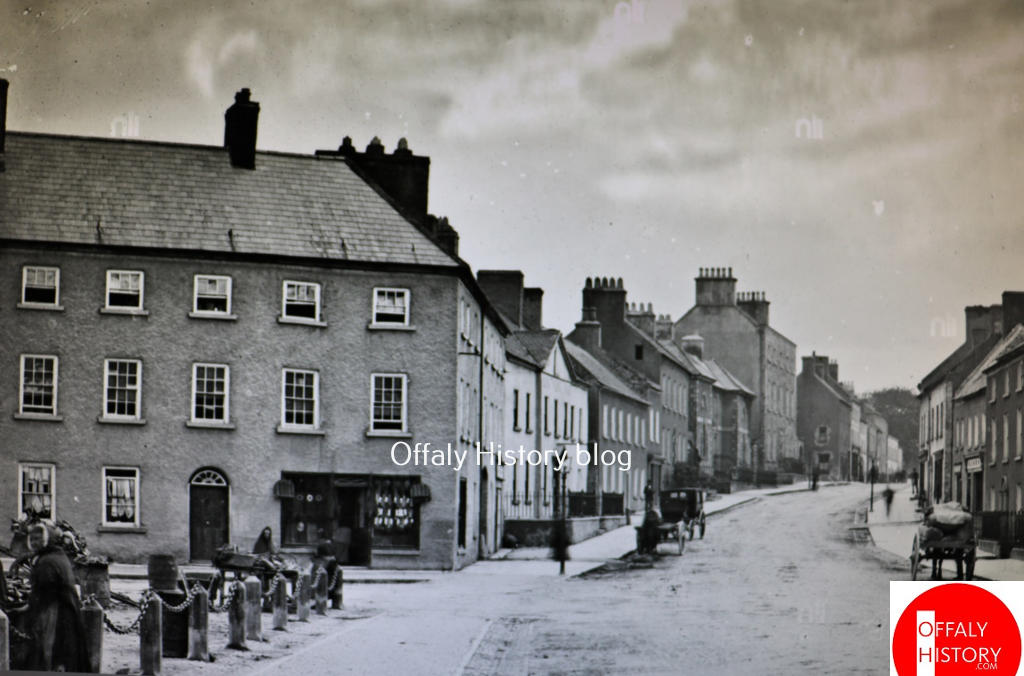
This photograph of O’Connor Square and High Street was taken about 1900, or a little earlier (and preserved courtesy of the National Library) and shows the fine corner building erected by the distiller Joseph Flanagan in 1787 with its original glazing bar/windows and Georgian doorcases. This is the large building from the former Willie and Mary Dunne’s shop (GV 49) to the William Hill bookmaker’s office, beside Gray Cunniffe Insurance. Like the Adams-Tullamore House at the junction of O’Moore Street and Cormac Street it is a substantial three-storey house closing off the square on the southern side with some ten bays to O’Connor Square and six to High Street. The building was carefully planned as can be seen from this lovely old photograph, courtesy of the National Library of Ireland. This is the earliest surviving view of the building. South of it is no. 48 (with carriage outside).
Col. Crow’s is a fine three-storey, seven-bay house with a Gibbsian door-case and open-bed pediment. The building, for many years known as Colton’s Hotel, has now two shopfronts and the original railings and low wall fronting the basement were removed in the mid-1970s.The building has lost its original glazing bars. From the early Lawrence photograph of c. 1900 we can see that a third storey was added soon after the existing hotel was purchased by Abraham Colton. It was then that a pediment to the roofline was removed and the third floor added. It was not so unusual to add a floor and there are examples of it in Columcille Street with Galvin’s and Dolan’s.
This house was built in 1750 for Colonel Thomas Crowe and survived intact until about 1974. Part of the large garden was used in the building of the Rose Lawn housing scheme in the late 1980s. The house to the south was demolished in 1940 to make way for the new Ritz Cinema, opened in 1946 and demolished in 1980. Roselawn of 21 houses was completed about 1990.
The abolition of Tullamore Town Council in 2014 evoked many memories for me of my years covering that body and its predecessor, Tullamore Urban District Council (UDC) from 1988 to 2007 for the Offaly Express, and for a year and a half before that for the Offaly Independent. I also covered a number of meetings as a freelancer for the Express following my ill-fated return from England.
When I first covered the council, I had the advantage of knowing all the councillors. Six of those early councillors are now deceased – Ernie McGuire and Lar Byrne of Labour, Billy Bracken of Fine Gael (FG), Ann Fox of Fianna Fáil (FF) and independent representatives May Keeley (who, in 1974, was the first woman ever elected as a councillor in Tullamore) and Anne O’Toole.
Mag Léna is of interest for two events that occurred in the early historic period. The first event is the pseudo historic Battle of Mag Léna. The second event was the significant Synod of Mag Léna and the Letter of Cummain, part of the Irish church row with Rome over the dating of Easter.
Both incidents caused a split in Ireland!
What’s in a name?
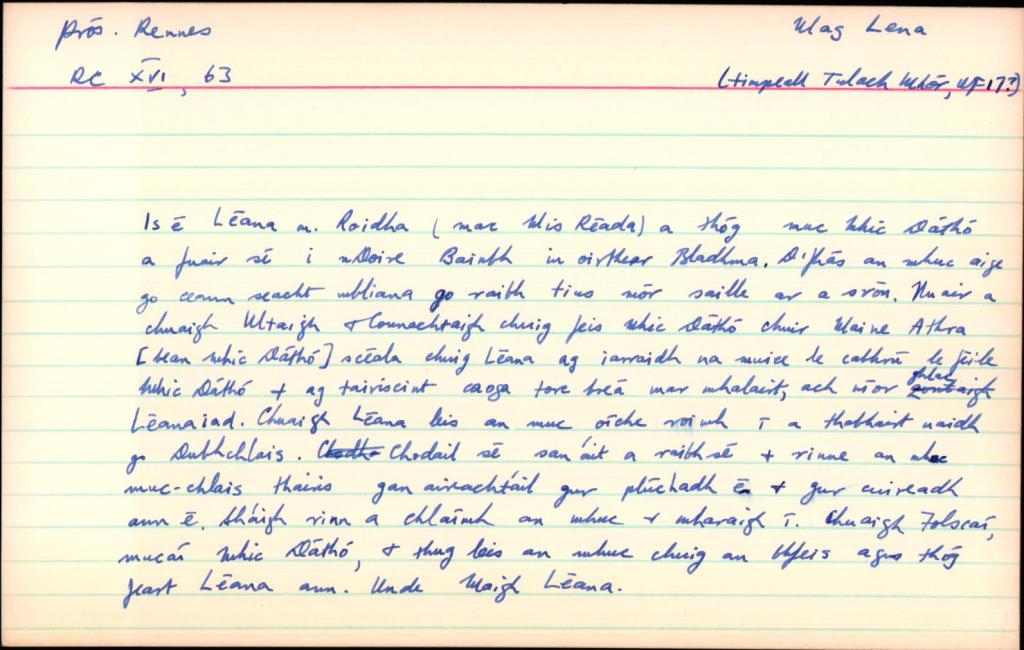
Mag Léna is mentioned in logainm.ie as Moylena and places it in the parish of Kilbride, Co. Offaly. Mag or Magh translates as a plain or open country, there is no information provided on the meaning of the word Léna. Unusually, there are no additional references other than the basic location details, also this older relic from the original card index system below. A 13th century manuscript mentions Cath Mhuighe Léana. Magh Léana is mentioned elsewhere. In his Survey Letters we find O’Donovan used a variety of spellings for the name – Moylena, Moyléna, Moyleana, Moleany and Moy-leana.
Logainm index card for Mag Léna.
As usual there are difficulties with the older Gaelic placenames and how they were recorded over time. Today the only memory of the name is in Tullamore, where the Moylena road joins the Clara Road and eventually joins the Rahan Road through Glendaniel.
The dismantling of the barrack structure of the British military establishment advanced rapidly in the aftermath of the signing of Anglo-Irish Treaty in December 1921. The great exodus in Offaly began in February 1922. The newly issued Offaly Independent (absent since November 1920 due to its destruction by the British military) was now able to report that
11 March 1922 Offaly Independent
, “They are going with a vengeance,” but now it is the army of occupation, not the natives of the country, that is leaving our shores, going while a great sigh of relief goes up, and no pang of regret is felt at the departure of those who held is in bondage for so long. What a change the front of St. Conleth’s School in Daingean now presents from what it did a short time ago. The front gates are now thrown open for the first time in nearly two years, as when the local police barrack was destroyed the splendid group of houses inside the gates of St. Conleth’s School which had been used for the purpose of housing some of the tradesmen employed in the institution were commandeered and used as a barrack for police and Black and Tans until Wednesday of last week when the evacuation took place. From an early hour on that morning the residents of the barracks were astir and it was easy to see that something out of the common was about to take place. Before long it was evident that the long-wished for hour had come and that the Crown forces were about to clear out, bag and baggage. At mid-day lorries arrived from Edenderry carrying the Black and Tans from that district, and all assembled at the Grand Canal Bridge, Daingean for the final parting. Such musical instruments as accordions, mouthorgans, etc., were produced and the disbanded heroes made the welcome ring to the strains of “Come back to Erin” (we hope they won’t). “It’s a long way to Tipperary”, “You’ll Remember Me”, and other items. The townspeople viewed the scene unmoved and the farewells were not returned. On the following day the members of the old R.I.C. force prepared to leave Daingean, and by Friday not a single policeman was to be seen in the place, while a new force guarded the town (OI, 11 2 1922).
Work continues on the Irish Mist Liqueur book to be published by Offaly History with the support of Creative Ireland in October. The book will have 240 photographs and a good quality text by a number of contributors. This product was the first such liqueur in Ireland and employed up to sixty people before its sale to C&C and move to Clonmel in 1985. In this extract from the new book John Flanagan (the production manager up to 1985) looks at the closing of the famous Sally Grove warehouse, no. 13, forty years ago this month. It was located close to where the Central Hotel was built on the new Main Street after 2000. Sally Grove warehouse had great maturing qualities for whiskey and so was the last to go of the old system of maturing in oak casks. Tullamore distillery ceased production in 1954, but with 400,000 gallons in stock it remained open to dispose of that resource. The development of Irish Mist was part of the solution to overstock and helped use up some of the over supply available. That was only the beginning for a product that was uniquely associated with Tullamore and the Williams family.
John Flanagan writes:
The B. Daly & Co Ltd distillery was founded in Tullamore in 1829 and held the licence to distill and warehouse whiskey. Later, Pot Still, Malt and Grain whiskeys were all produced in the distillery. After 1900 the bottling of all the whiskey was done at the Bond Store at Bury Quay, under the Tullamore Dew brand name. ‘Give every man his dew’ was the famous slogan thought up by Daniel E. Williams, the owner of the distillery in succession to Michael Molloy and Bernard Daly. Other brands were bottled too, including a special brand called ‘Private Stock’ for the directors only.
208 years ago, the Battle of Waterloo took place in Belgium. The armies under the command of the Duke of Wellington defeated Napoleon, putting an end to the Napoleonic Wars, which had begun in 1803. To mark the victory and acknowledge the men that fought at the battle, a campaign medal was decided upon by the House of Commons. Rather than given for acts of bravery, it was given to all those involved in the campaign. Similarly, other counties in the coalition issued medals of their own, however the medals issued by the British were named to the recipient, making it possible to trace them. In today’s post, we will look at one of these Waterloo medals, which was awarded to Private John Dargin of the 54th Regiment of Fo
John Dargin was born near the parish of Kilbride or Tullamore. He enlisted in the British Army on 6 May 1812 and was a labourer. Assuming he would have been around 18 years old at the time of his enlistment, this would place his birth around the 1790s.
This week we provide an extract from the book to be published in November 2023 on Irish Mist Liqueur, a unique Tullamore-based product for almost forty years. Many homes have the Irish Mist Soldier in pride of place on a dresser so here is some more information about it from John Flanagan, the production manager with Irish Mist for twenty-five years. The book will be published in the autumn. You can email us to reserve a copy for you. No money now thanks. The book has support from Creative Ireland and Offaly County Council.
The Irish Mist ceramic figurine was made by Coronetti, Cunardo, Italy. Each one was individually hand-painted by different artists in the factory. The figurine is a replica of an Irish soldier (officer) in the Austrian army about 1756. The Austrian connection is associated with the founder of the recipe for Irish Mist Liqueur who was Austrian. Irish Mist was known as the Legendary Liqueur.
The closure in 2012 of Offaly Express, where I served as a staff reporter from 1988 to 2007, marked the end of an era in local journalism.
When I was a schoolboy, living in Tullamore, the dominant local paper was the Offaly Independent, though the Midland Tribune circulated to a degree from Birr. The growth of Tullamore led to a feeling that a specifically local paper was needed, and in 1978, the Tullamore Tribune was launched, under the editorship of the late Geoff Oakley. He remained in that post until he retired in 1994, when he was succeeded by Ger Scully.
The Offaly Express emerged as a sister paper of the Portlaoise-based Leinster Express, which began to circulate around Tullamore in 1984, though it already had a presence in Edenderry and the eastern half of Offaly. Much of the credit for the Offaly edition must lie with the late Kevin Farrell, who would surely have enjoyed the irony of the fact that his death in July 2012 took place the very day on which the Offaly Express ceased publication and that it had to hold on to report the sad news of his passing.
High Street is still the principal street in Tullamore and this has been so for the past two hundred years. It, together with Bridge St., O’Connor Square, O’Moore St., and Cormac St., deserve detailed attention because of the quality of the surviving urban fabric. The same might be said of the terrace in Church St. and Bury Quay/Convent Road Terrace. Patrick St. has a few houses of very high quality. The designation of principal street applies to the quality of the surviving houses and not to extent of business, or the number of those living in the houses as owner occupiers of the original residences. A walking tour of O’Connor Square and High Street, Tullamore organised by Offaly Historical and Archaeological Society on 18 June 2023 has promoted this review of what we have published so far on High Street (see the articles listed in the appendix to part 2 of this article (next week) and all online at http://www.offalyhistory.com). This work is supported by the Heritage Council.



 offalyhistoryblog