Home Rule/Rome Rule. A china mug with a portrait of Pope Pius X (1903-14) who increased the devotionalism of the Catholic church, who promulgated the Ne Temere decree concerning the children of mixed marriages, whose orders on the role of women in church music (1903) was commented on by the Morkan sisters in James Joyce’s story ‘The Dead’, and who oversaw the excommunication of Fr. George Tyrrell (1861-1909) on a charge of heresy, whose childhood had been spent at Dangan’s Farm between Portarlington and Mountmellick. He also enjoined the admission of children to regular communion at the age of reason. (Autobiography … of George Tyrrell, 2 vols. 1912, p.20-22)
We welcome a new contributor to the blog this week with this article by John Stocks Powell. Enjoy and remember we have almost 190 articles to read at http://www.offalyhistoryblog. Like to get it each week and share to your friends.
There is a hierarchy of sources for the historian, local historians and those with the wider landscapes. The principal material is the written word; evidences from the time, written archives, and later written published assessments such as county histories, church memoirs, Ph.D. studies gone to print. On-line developments have made for more in quantity, and more exciting revelations, from the checking of dates on Wikipedia, or the digitised sources such as Irish and British newspapers online, and directories. Yet we know the old cliché that history is written by the winners, and that is especially true when trying to write about the history of the losers, the poor, and the illiterate. Every source has its importance.
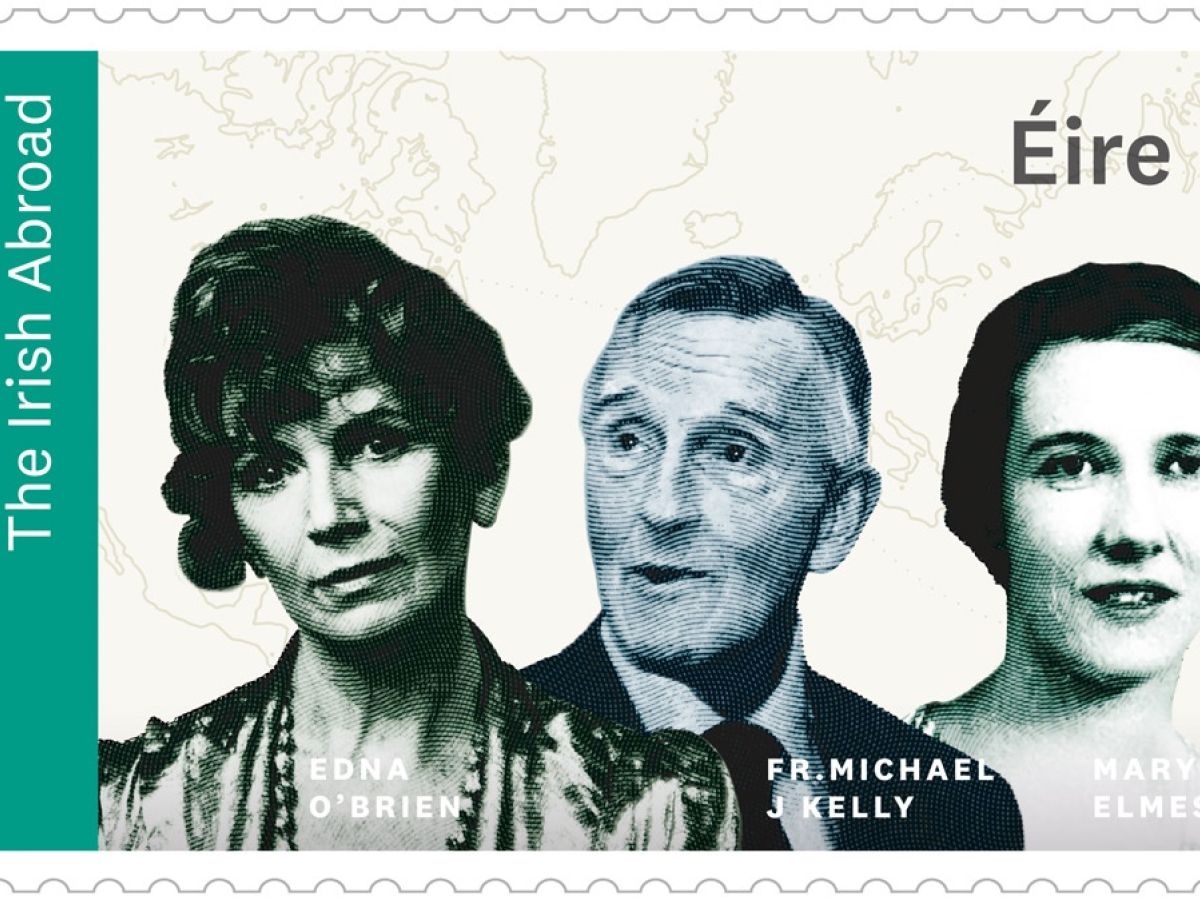
Fr Michael Kelly features on the stamp alongside two other Irish emigrants: the accomplished author and Tuamgraney, County Clare-born Edna O’Brien and Mary Elmes (1908-2002) from Cork, the humanitarian worker particularly renowned for saving the lives of 200 Jewish children in France during the Holocaust.
We are bringing you a special Easter Sunday blog to celebrate the work of Fr Michael Kelly, the Tullamore man who appears on a new Irish stamp marking the work of emigrants and providing his personal reflection at this time. Fr Kelly has been in the Jesuit ministry for 65 years working in Zambia. His family lived in O’Connor Square and his father was a director of P. & H. Egan, Tullamore. Two of his brothers were also with the Jesuits. Fr Michael writes of the current virus difficulties and reflects on his time growing up in Tullamore. (more…)
It was lately announced that Drayton Villa, Clara and some lands adjoining are to be acquired by Offaly County Council for public purposes. Offaly History asked Michael Goodbody to contribute this piece on the story of this important house. He is currently working on ‘One Hundred years of Clara History’ to be published later this year and from a preview we can say that it will represent an important contribution to the story of Clara from the 1840s to the 1940s. Thanks to Michael Goodbody for the article and the pictures. We have added the subheadings.
Drayton Villa (courtesy Stephen Williamson)
Drayton Villa, built by Lewis Frederick Goodbody in the mid-nineteenth century, is largely untouched by more recent additions and alterations, so that many of its original features are intact. The main block of three bays, with a basement underneath, dates from 1849. There can be no disputing this date for it is recorded by Lydia Goodbody – future sister-in-law of Lewis – in her diary entries for that year.
Columcille Street about 1914 with the new Scally drapery of 1912, next a Scally shoe shop and no, 5 was McMichael’s Medical Hall, now Dolan’s Pharmacy. Thomas Acres was the developer of most of the street and notice the uninformity in roofline save in the most profitable area near Hayes’ Cross.
Is Dolan’s Pharmacy in Pound/William/Columcille Street, Tullamore the oldest family pharmacy in Ireland? It almost certainly is now that so many of the old family pharmacies have been bought up by pharmacy chains. Up to the decade ending 2020 it was the one area of shopping in Tullamore that was still largely locally controlled and in the same family for generations. One thinks of Dolan’s (the Dolan and later the O’Connell family since the 1940s); Quirke’s Medical Hall (Carragher’s from the 1930s until 2019); Fahey’s from 1955; and Adams’s in Bridge Street since the 1940s and still in the family. Up to twenty-five years ago there was not much above seven pharmacies in Tullamore but that changed in 2002 with deregulation as to the number permitted vis a vis the population served. Even by that time pharmacy chains were growing in strength with one company (Unicare) having fifty outlets, but seventy percent of the market outlets were still controlled by independent pharmacists. Today Tullamore has thirteen pharmacies and new locations at Ardan Road (2), Clonminch Road (1), Church Road (2) and Main Street (1). The town centre still has five around the former Hayes’ Cross with three in Bridge Street, Patrick Street (1) and Columcille Street (1).
Last week’s article on the cholera outbreak in Offaly in 1832 attracted a huge readership. This week Dr O’Neill (a Mucklagh, Tullamore native) contributes this piece on Pandemics in Ireland. The Offaly History research team has added some local material on the effects of the Spanish Flu (1918–19) in the county and some pictures by way of further reading. Enjoy and stay positive. Read our 179 articles posted to offalyhistoryblog and catch up on Camus.
The Offaly County Hospital, Church Street, Tullamore, had 50 beds while the population in 1841 was twice what is is now.
Cholera was the epidemic disease most feared around the world in the nineteenth century.A letter from Tullamore of 1832 describes the devestating disease of cholera. ‘We had 165 deaths. All bridges to the town are cut and broken. Every house is shut up and there is no such thing as business. Men who would eat their breakfact in perfect health would be buried before dinner.’
In the eighteenth century neighbouring countries began to suffer from the disease and in the nineteenth century it attacked Europe. Cholera spread around the world in great epidemics from its traditional base in the Indian sub-continent and carried with it high mortality rates, severe suffering and terrifying symptoms. These began in 1817 but the first wave did not reach Europe and was halted temporarily at the shores of the Caspian Sea. From there in 1829 it spread rapidly through Europe. It arrived in Ireland around St Patrick’s Day 1832. This was the most serious cholera outbreak in Ireland in the nineteenth century and it has been estimated that 25,378 people died during that epidemic. The Irish death rate was high when compared to other countries for the same period.
The Anvil editon of 1979 included the six pages on O’Malley’s torture as did the American edition, Army without banners (1937)
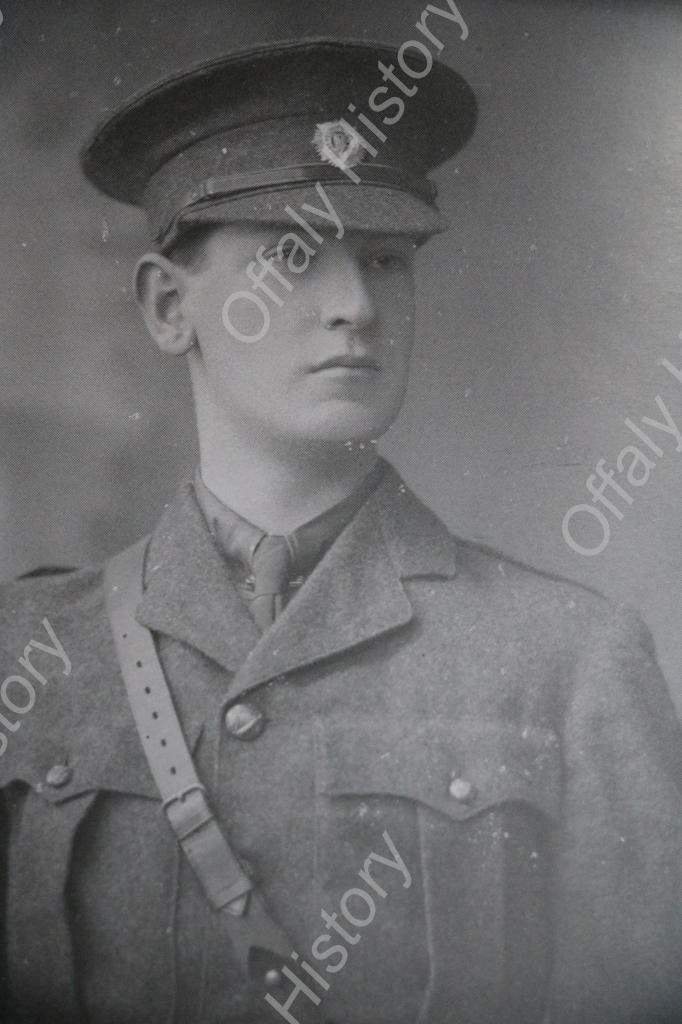
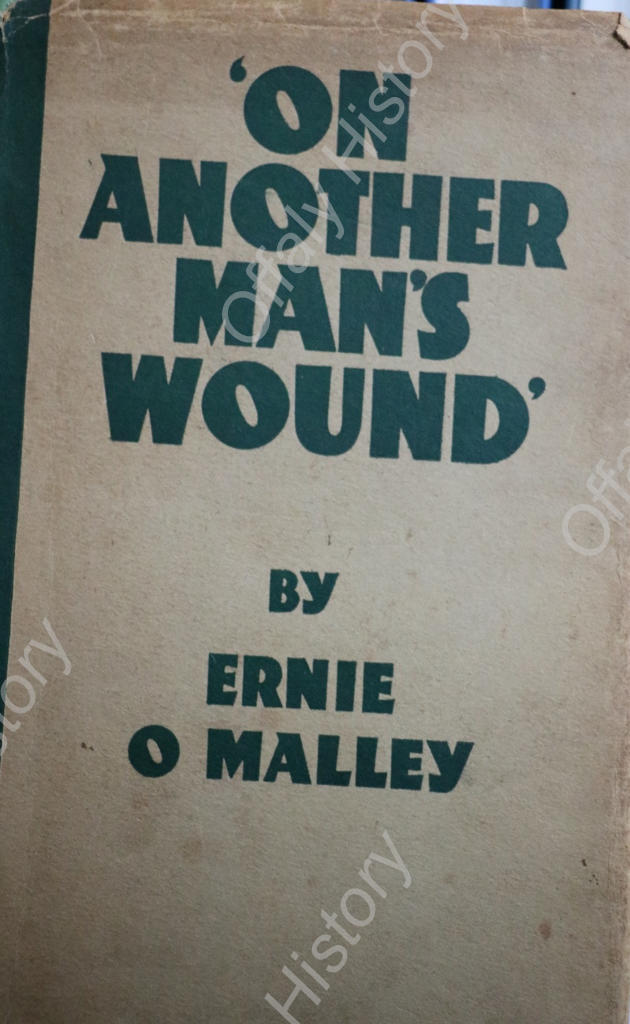
Ernie O’Malley was in Tullamore in April 1918 helping the Volunteers with the work of the North King’s County by-election (won by Sinn Féin without a contest because of overwhelming support in the aftermath of proposed imposition of conscription. This extract is from O’Malley’s famous account of the War of Independence years – On another man’s wound – first published in 1936. This extract from the Anvil edition of 1979 with the original pagination shown in square brackets. ‘On Another Man’s Wound, is primarily an account of that war, the only work of high literary quality to emerge directly from the violence. Upbringing had combined with temperament to make him half an alien in his own country. This gave him the detachment of a natural observer; the war forced him to live close to the people:’
Dick Mulcahy
[76] Mulcahy [Dick Mulcahy Assistant Chief of Staff] told me to report to the director of Organisation I found Micheal Collins in his office on Bachelor’s walk Dublin. He was pacing up and down. We shook hands. He jerked his head to a chair to indicate that I should sit; he took a chair which he tilted back against the wall. On shelves were green membership cards, heaps of The Irish Volunteer Handbook, and stacks of white copies of the organization scheme. Behind his desk was a large map of Ireland marked with broad red streaks radiating from Dublin. He was tall, his shoulders were broad; his energy showed through rapid movement. A curving bunch of hair fell on his forehead; he tossed it back with a vigorous head twist.
Michael Collins in 1917. O’Malley was no great fan of Collins
“I’m sending you to Offaly, there’s an election coming off [the by-election of April 1918]. I want you to organise a Brigade in that county. There are a few good chaps in Tullamore and they’re on the run. He had a strong singing Cork accent his brown eyes studied me fixedly. He pointed out companies on a map and mentioned officers’ names.
“It looks like conscription” he said. “That’ll make some slackers wake up.
He pointed out communication routes on the wall map. I was to improve and keep them tested by despatch riders. He gave me a bundle of organization schemes, instructions for the preparation of emergency rations, lists of equipment that could be made locally. “Read that and see what you think of it.” He handed me notes on the destruction of railways, bridges and engines with and without explosives.
[77] It was signed by Rory O’Connor, Director of Engineering. He crossed to the window whilst I read. “My bail is up, he said. “They’re looking for me now.” “They” meant the “G” men, who carried out political arrests in Dublin. Collins had been arrested by for a Volunteer recruiting speech; he had been released on bail. That was unusual. Volunteers were not allowed to accept bail. “Two nights ago “G” men brought off a raid; they found empty packing cases and a pile of cartridge wrappers in a store. Bruton said: This looks as if there were brains behind it; I bet it’s that fellow from Mountjoy Street” Collins laughed; it meant himself “Good luck now, Earnán” he said, as he shook hands. As I walked across O’Connell Bridge I wondered at the risks he ran, coming and going to and from his office, whilst detectives watched for him.
The first edition of 1936 produced in London and Dublin
Austin Stack of Kerry who had recently fought a jail war in Belfast was in Tullamore with Darrel Figgis. Stack had a quizzical turn in his deep brown eyes which he half shut when he told a long story. He was grave and quiet; he spoke slowly. Figgis was not popular; it was thought that he was too vain. Stories were told about his Christ like beard. His manner, his insistent focus of attention for his words, was of the porcupine quill effect of an artist amongst those who thought of nationality alone. He was egotistical; it could be seen in his face and mannerisms; his image was reflected in the half suppressed smiles of his listeners. He had come from another life; he would find it hard now, I felt. I had read his novels: Children of Earth was the best book I had read about the West of Ireland. He was pleasant when he talked to me of his books; but he had unfortunate habit of making enemies. Eamonn de Valera was due to arrive. There was intense excitement; work speeded up. Volunteers, Cumann na mBan, and Sinn Fein Clubs arranged a parade. I heard a new song: “Convict 95” his number when on penal servitude.
“Twas in Kilmainham prison yard our fifteen martyrs died
And cold and still in Arbour Hill they are lying side by side,
But we will yet pay back the debt for the spirit is still alive.
In men who stood thro’ fire and Blood and Convict 95.
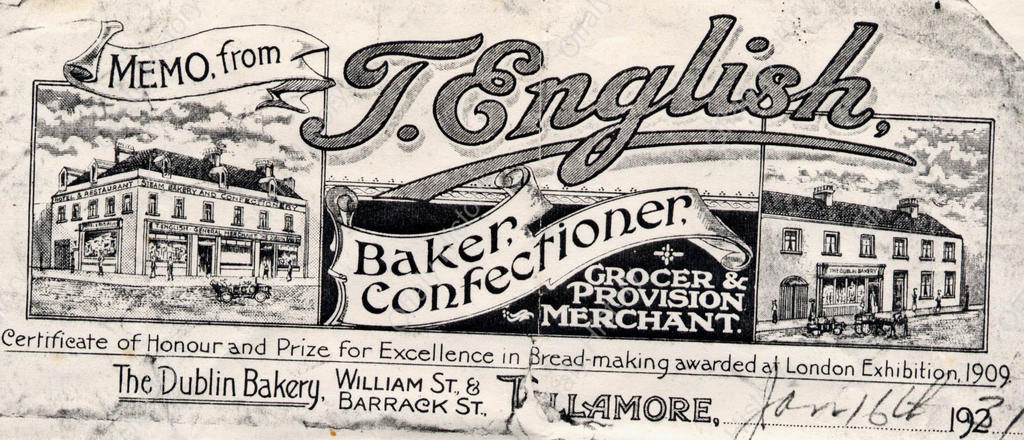
Enlgish’s Hotel and restuarant at the juntion of Columcille Street and Patrick Street. A view of post 1914.
Eoin Plunkett was with me in English’s Hotel when de Valera walked in. We made a machine spring to attention [78] and remained tense, glued with admiration till he spoke to us and asked us to sit down. He was tall and lean; his hair rifted on his forehead. His face was long and sallow. He wore rimless glasses. He had a very deep voice that welled up, a fairly immobile face save when he spoke, and then the muscles, to one who had watched them in repose, played tricks. On the platform there was a hard unemotional feel to his voice and he twisted his body in emphasis.
His gravity we noticed most; he was patient and kindly to the many demands for his signature. “Have you seen Dev?” I would be asked in the country. It was easy to take on heroic build of one had seen or talked to any of those whom the people admired.
An Irish Convention called by Lloyd George had been in session for nine months; Sinn Féin refused to send representatives. It met and talked. The Irish vote in Australia had helped to defeat conscription there; a second referendum would succeed, Premier Hughes said, if the English could in any way settle the Irish Question. Irish Americans fighting for small nationalities and to make the world safe for democracy made their government anxious to have some patch-up in Ireland. The first draft of a conscription Bill was passed in England the same say that Lloyd George announced the failure of the convention; an emasculated Home Rule Bill was to be given as a gift. In England conscription had been imposed by degrees; in Ireland all males between eighteen and fifty-one could be taken. As a nation Ireland was not deeply concerned with the world war. Proganda about territorial violation and outrages could be paralleled at home. The people had long watched politicians play their thimble trick at the Imperial circus: “Walk up gentlemen. See freedom is here. You cannot lose. You give your youth and you take your chance.” The wild Irish who always looked for fight, who were never happy unless smashing heads with ponderous shillelaghs now wanted to fight to prevent themselves from fighting. What an Irish bull; the dear, delightful Irish, so picturesque and such charming brogues; they were broths of people; they were entirely.
A meeting of political enemies was held in Dublin. [79] They issued a statement: “The passing of the Conscription Bill must be regarded as a declaration of war on the Irish people.” The Irish Parliamentary Party left the House of Commons as a protest. Labour carried out a day of general strike. A parish fund was organised to raise money. In Offaly committees and subcommittees worked on Transport and Food supply; statistics were compiled; offers of help came from strange places. I paraded battalions in Tullamore; we were skirmished and manoeuvred through towns and the country side followed by police. Officers were arrested and at once replaced. To save the officers I commanded the companies of a parade in turn. I was not interfered with. In small towns I drew my gun when police asked me my name.
In daytime I could now enter a town to practise quick mobilization. Shop boys, carpenters, shop owner’s clerks, fell into line quickly. They practised bayonet fighting with brush handles up and down streets; they sat on pathways or in halls to listen to my talks from the destructions of railway plant to street fighting.
Men relieved each other during the day to mould lead to buck shot; gun cartridges were collected and refilled. Jewellers and locksmiths made revolver springs; they repaired weapons. Telegraphic clerks held classes with buzzers and tappers or taught Morse to signallers; harness and boot makers worked at belts and equipment, smiths and carpenters made pikes and pike handles. Cumann na mBan sewed signalling flags and haversacks. They gathered medical supplies made splints and packed first field dressings.
Shops were raided for cartridges and detonators, quarries for explosives. Volunteers came to houses whose owners were hostile or had permits from the police; the police searched Volunteer and friendly houses for arms. One raiding party would often followed close on the other.
Railways would be destroyed when conscription came; through communication routes by road were worked out. There were many branch lines in Offaly and Westmeath. Some companies were always on duty. Day and night, despatch riders on bicycles tried to improve time speeds. All despatches had time sheets; the time was checked by [80] each company through which they passed. The time sheet from Dublin to Castle bar or to Tralee would be lengthy. Despatches were hidden in the collar or tie; sewn up in the coat, put in a part of the bicycles or in socks. The despatch might be a smelly remnant when it reached its last station.
I was told that warrants had been issued for my arrest. I changed my sleeping quarters frequently. In Clara I slept in the house of a publican [presumably P.J. White’s]. The owner came into my bedroom one night. He found two improvised hand grenades on the floor and a revolver beside my bed. He hurriedly made piles of empty porter barrels at points inside the back wall to help my escape.
Much more to be found here.
[Stopped at Philipstown/Daingean]
Three Royal Irish halted me in Philipstown. They carried revolvers in black holsters. “What’s your name?” the sergeant asked in a deep voice; the thumb of his right hand was stuck behind his broad flat belt.
My name is O’Malley, do you want more information? I half drew my gun from inside my coat. The police were irresolute. They had evidently intended to arrest me. I waited. The sergeant took out a note book; he wrote quickly with a pencil. They watches as I cycled away.
Daingean town in 1910-18
People remarked that officers had been afterwards arrested for drilling when I had been afterwards arrested for drilling when I had been in charge or for carrying out my orders. Some said I was a spy and that the police did not want to arrest me. A few women said I was leading the boys astray. I met mutterings in many forms.
In an island of the Bog of Allen which covers a large part of eastern Offaly I had a farmer friend. “We’ll give them what’s what in the bogs” he said “if it wasn’t for them bloody peelers less than a snipe id never get in here.” He had a white horse for me. “When fighting begins up you get and lead us all against the English” I liked the white horse. He was a fine mettlesome beast and he could “lep a house,” but he savoured of the range mark. I could see myself stuck up to my middle in bog water or crawling close to gorse and heather instead of leading a procession against the near post. I was in Athlone. I had met an Irish battalion sergeant- major from the castle barracks. He had been fifteen years [81] in the British army and had seen much fighting. A tall man, sturdy with independence; he was resilient in will trained muscle. He had a well handled, pointed moustache. He was willing with some soldiers to help us capture the magazine; they would fight, if nessacary, during the raid, and they would join us when conscription came. I received a despatch from Collins; I was to go to South Roscommon at once.
A short note on the 1918 by-election in North King’s County/Offaly, Michael Byrne (see Offaly Heritage 9 for the full article)
The sitting MP for North King’s County, E.J. Graham, died in a Dublin hospital on 26 March 1918, aged only 51, thereby creating the possibility of another contested war-time by-election in North King’s County/Offaly in April 1918. His death brought about the election of Dr Patrick McCartan, the Sinn Féin candidate, without a contest. McCartan had been defeated in the Armagh South by-election of February 1918, but was returned in North King’s County after the hint of a contested election. He was again returned unopposed for the entire county in December 1918 at the general election. He too was an imposed candidate continuing a tradition broken only in December 1914. His non-contested by-election came in the wake of the big demonstrations against conscription in Tullamore and everywhere else. What looked like compromise on the part of IPP leader Dillon was recognition that the win for the IPP in Armagh South would not be repeated. The Tribune had stated in its editorial of 6 April 1918 that Dr McCartan was a certainty and that the greatest enthusiasm existed for Sinn Féin. ‘The electors state that they are only anxious to give the party a better reverse than it got in 1914.’
Patrick McCartan
The Sinn Féin by-election campaign began at the end of March with meetings in every parish in the constituency after Sunday mass and speeches from visitors Dan McCarthy, Austin Stack, Stephen Mara, Joseph McGuinness and in Tullamore from Tribune editor, Seamus/James Pike, the draper Michael Berrill and P.J Bermingham. There was broad acceptance of the Midland Tribune view that McCartan would succeed and confusion in the IPP as to who might stand. All parts of the constituency were said to be solid for Sinn Féin save perhaps Tullamore ‘which is pretty evenly divided’. On Sunday 8 April De Valera spoke in Tullamore (the meeting was chaired by Bermingham.) on Ireland’s ‘fateful hour’ and the right of Ireland to self-determination. De Valera had first spoken in the town in the aftermath of his East Clare victory in July 1917. Meanwhile the vacancy in the IPP candidature was not and would not be filled. When deputations from both Nationalists camps in Tullamore (the IPP and Graham supporters) met John Dillon, the IPP leader who succeeded Redmond in March, it was to tell him that they would agree on one candidate. But the conscription crisis was about to overtake the matter of an IPP candidate and Dillon told the deputation that now was not the time for a local contest. Notwithstanding this prohibition it appears that John Dooly of Birr, the chairman of the county council, was selected. Dillon persisted and Dooly withdrew his candidature. McCartan was duly elected on 19 April 1918 with sixty nominations and no opposition. Lyons points out that the conscription crisis could not have come at a worse time. In the three by-elections fought since the beginning of 1918 – South Armagh, Waterford City and East Tyrone – the IPP had beaten off the challenge of Sinn Féin. As so often before the government had stepped in to revive Sinn Féin fortunes. That said the lack of a suitable candidate for North King’s County and a local press united against the IPP made the chance of winning the seat highly remote. McCartan went to take the seat again in the general election of December 1918 without a contest.
In August 1939 the Irish travel writer Richard Hayward set out on a road trip to explore the Shannon just two weeks before the Second World War broke out. His evocative account of that trip, Where the River Shannon Flows, became a bestseller. The book, still sought after by lovers of the river, captures an Ireland of small shops and barefoot street urchins that has long since disappeared.
Eighty years on, inspired by his work, Paul Clements retraces Hayward’s journey along the river, following – if not strictly in his footsteps – then within the spirit of his trip. From the Shannon Pot in Cavan, 344 kilometres south to the Shannon estuary, his meandering odyssey takes him by car, on foot, and by bike and boat, discovering how the riverscape has changed but is still powerful in symbolism. Paul Clements will be giving an illustrated lecture on Monday 17 Feb. at 8.00 p.m. at the Offaly History Centre, Bury Quay, Tullamore ‘The spirit of the Shannon: a journey along the River Shannon in Richard Hayward’s footsteps’ Admission is €5 and includes tea and biscuits. So why not come along to hear and see this wonderfully illustrated talk.
Offaly Archives’ local government collections cover an extensive range of local government organisations – from grand juries, infirmaries, rural district councils, town commissioners, poor law unions, county councils, committees of agriculture and urban district councils. The material from the collections was acquired since the 1950s and covers roughly two hundred years of history.
Recently, the local government collections, as well as a number of donated collections of private origin, have been relocated from Offaly County Library to purpose built archival facilities at Offaly Archives, Unit 1F, Axis Business Park, Clara Road, Tullamore. Offaly Archives is the joint archival repository of Offaly Historical and Archaeological Society (Offaly History) and Offaly County Library, and is administered by Offaly History.
During the summer of 2019, I worked on providing online catalogue descriptions for the local government collections in preparation for their move. Descriptions for the collections were created using Michael Murphy, Anne Coughlan and Gráinne Doran’s 2003 publication Grand Jury to Áras An Chontae, which provides breakdowns of Offaly Archives local government collections, as well as detailed information relating to the formation of Offaly’s local government structures, their various duties, lists of members and historical points of interest.
Background: Ireland 1850 to 1918
The emergence of an Irish Catholic religious revival can be traced back to mid-1770s. Tony Fahey writes of the ‘Catholic Revival in Ireland’, being a major feature of 19th century Irish history affecting politics, culture and social structure.
The punitive Penal Laws discriminated against and marginalised the Catholic church and were instrumental in ensuring that the 18th century Irish Catholic church was in disarray. Certainly, it was disorganised, had few priests and often places of worship and human internment, were by law, positioned away from places of population density. (more…)





![A000b Courthouse, Philipstown [Daingean]](https://offalyhistoryblog.com/wp-content/uploads/2020/02/a000b-courthouse-philipstown-daingean.jpg?w=1024&h=483)


 offalyhistoryblog