Moore Hall is an imposing two-story house over basement with two-story porch projection in cut stone, and coach arch and stables (now demolished). The façade is of three bays. The house is one of the finest in Tullamore, a fact that may escape notice because of its closeness to the street. In the front railing ironwork is the last gas lamp stand in Tullamore. This is the only surviving vestige of the era of gas lighting from 1860 to 1921.
During the twentieth century a tradition arose of a Christmas bird, usually a turkey, being sent from Ireland to extended members of the family who had emigrated to the Britain. They arrived in a canvas bag packed in straw. The Second World War disrupted the tradition. It did not resume immediately after the War as the British Government thought that birds would be traded on the black market in contravention of food rationing as explained by the New Ross Standard 22nd October 22nd 1948.
The growth of the soccer club and the rugby club from the mid-1960s led to increased pressure on the grounds such that from time-to-time fixture lists had to be substantially revised so that a pitch would be available. The soccer club enjoyed a tremendous burst of success right through the 1960s while the rugby club was fielding a 2nd XV from the mid-1960s. It was this pressure on the resources at Spollanstown that, more than anything else, led to the dissolution of the Sports Club in 1971. But a secondary factor was the collapse of the carnivals and marquee dancing as a profitable venture from 1966. Thereafter for some five years substantial revenue was earned from Saturday night dancing. These Saturday night hops were largely the responsibility of the rugby club and the profits generated made the argument for independence irresistible. In January 1968 the rugby committee noted that the Sports Club had had a disastrous year financially and would be down £300 but for the profit of £540 from the Saturday night dances. The view of the meeting was that the rugby club wanted a home of its own even if this meant leaving Spollanstown. Soon after the Sports Club met and agreed to dispose of the bungalow built for the caretaker adjacent to the grounds for the sum of £2,650 to pay off the liabilities of the trustees.
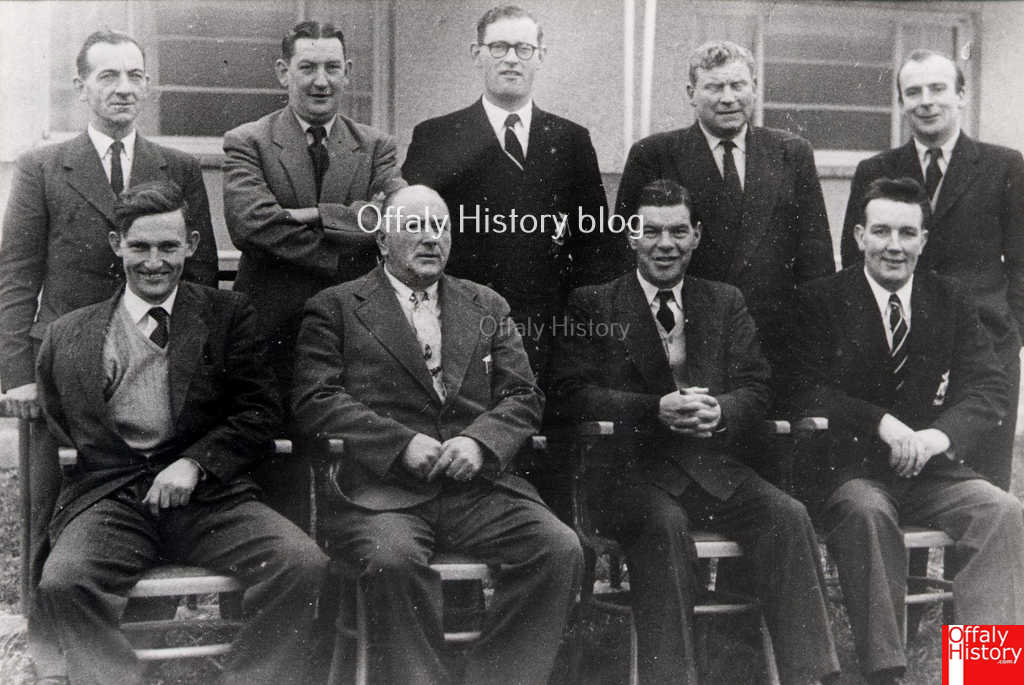
First trustees of the Tullamore Rugby and Soccer Club, 1956. Back row: T. Kelly, G. Smyth, H.L. Egan, W. Champ, D. Kilroy; front row: Terry Adams, W. Stephens, J. Kilroy, O. McGlinchey.(more…)
Oliver Mulpeter was heard to say he ‘would not miss it for the world’ and carrying the national flag which he proudly bore as the nephew of one of the wounded soldiers, he was among the first to arrive.
The commemoration was to honour soldiers of the National Army who were wounded in a Civil War ambush, two of whom died some weeks later. Relatives of all four casualties gathered for a roadside ceremony on a bitterly cold January day with traffic thundering past inches away on that busy road between Raheen and Geashill in North Offaly.
An honour guard of soldiers of The Irish Defence Forces Veterans group was present led by Declan Sheridan. They came to attention and gave the salute as the ceremony progressed – a poignant mark of respect to their comrades-in-arms of a century ago, their presence there an important and vital element of the event.
It was one hundred years to the day that the ambush took place at that spot, within sight of old Raheen chapel, on a bend of the road overlooked by rising ground. The ambush party opened fire with rifles and a Lewis gun from both sides of the road on a platoon of fourteen soldiers marching from their Geashill garrison to Sunday mass. Luckily the Lewis gun jammed, otherwise casualties would have been much higher.
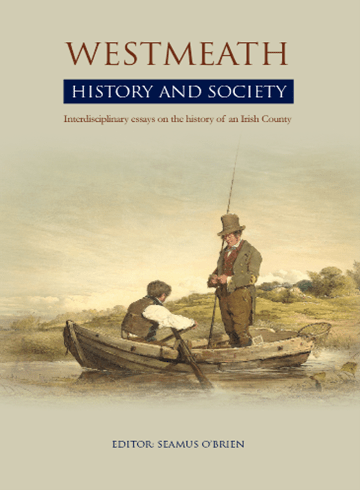
The Mullingar and Athlone launches of Westmeath History and Society have provided two interesting and original addresses on the status of local history in Westmeath, our neighbouring county. The Offaly History and Society volume was published in 1998 and is long out of print. A few copies were secured by Offaly History some years ago and are offered for sales as scarce titles. We thank our friend Dr Harman Murtagh for a copy of his address on 31 3 2022 and we have added some pictures for our readers. Enjoy the address in Athlone and you can get the book at Offaly History Centre and online at www.offalyhistory.com, over 900 pages, hardback, €60.
My friends,
This is the south Westmeath launch of this magnificent volume, Westmeath history and society.
A week ago it was launched in north Westmeath by the archbishop of Dublin, the very Reverend Dr Farrell; south Westmeath must make do with the most irreverent Dr Murtagh.
The book is 900 pages long. As the archbishop observed in Mullingar, it’s about the size of a concrete block: in my view, its only fault is that it’s rather heavy to hold in bed.
Westmeath history and society is one of a series of county books – incredibly it’s the twenty-ninth in the series. The series has been appearing at the rate of a volume a year since 1985.
The series founder, general editor and manager from the start is Dr Willie Nolan, aided and abetted by his wife, Theresa. Their contribution to Irish society and to local studies is without equal. In France they would undoubtedly be awarded the Legion of Honour; in Britain surely Sir Willie and Dame Theresa? In Ireland, and here in Athlone, we can offer at least our enormous admiration for their magnificent achievement – twenty-nine county volumes of this size down, and only three to go! Wow!
As a native son of the county, it gives me great pleasure to be invited to launch Westmeath: History and Society. Interdisciplinary Essays on the History of an Irish County, the 29th volume in the Irish County series; this volume of thirty-five essays covering themes from the prehistoric to the present era utilises a multidisciplinary approach to explore at the county level broader regional and national themes. It contains contributions from historians, geographers and cartographers, archaeologists and Irish scholars (Cathal O Háinle –Westmeath Bardic Poetry). It charts the economic, social, religious and political life of the county. The aim is to achieve an understanding, rather than to produce desiccated informatio
The scene at the railway station [Tullamore] will long be remembered. Long before the hour for arrival of the train, the stream of people to the station premises and surroundings was continuous. There was joy everywhere and the light and hope that the glad tidings brought were seen in the faces of the huge gathering. The railway station premises were thronged while from every point of vantage round about it people awaited the home-coming of the boys whose familiar faces they yearned to see once more.
Ballykinlar autograph courtesy Offaly Archives. For further on this see Offaly History and Decade of Centenaries/ gallery. ‘Autograph books were an important aspect of the material culture of the camps and the internees signed each other’s books with political quotes, inspirational messages, and artwork depicting the camps or political ideals. Although prisoners were released from the camps following the Truce in 1921, anti-treaty republicans were again interned in prison camps such as Tintown in the Curragh during the Civil War.‘ – Offaly Archives
Late 1921 was a time of ferment in Offaly. Once the Truce was announced in July 1921 attention turned to matters such as reforms in public health that would see the county infirmary along with the workhouses at Edenderry and Birr closed. The former workhouse at Tullamore was now to serve as county hospital and ‘county home’. It was a major reform pushed through by Sinn Féin who dominated much of local government, save in the urban councils of Birr and Tullamore. As more people were pushed out of the institutions and the economic situation deteriorated the demand for home help grew. Some of the ratepayers were concerned but not the Midland Tribune which was then owned by Mrs Margaret Powell who was one of the few women involved in the Birr local health committees.[1] Her editor from 1912 to late 1940s was James Pike from Roscore, Screggan. Four women sat on the Tullamore Hospitals and Homes Committee chaired by Mrs Wyer. Pike in an editorial on 17 December 1921 was to describe it as a momentous week with the secret debates in the Dáil. Offaly Technical Committee did not wait for the outcome of the Dáil debate and supported the Treaty almost immediately.[2] Supporters included the chairman Fr O’Reilly, Kilcormac, Revd John Humphreys and James Rogers as did Revd R.S. Craig.
There are only a few studies available on the development of retailing in Ireland, either of a general nature or in connection with particular firms. It is well known that in the first half of the nineteenth century and up to the Famine years retail outlets were not widely available and many in the smaller towns were no better than huxter shops. There were exceptions and that is clear from the photographs of c. 1900 of shops such as Williams. Egan, Goodbody and Lumley (in Tullamore); O’Brien in Edenderry and O’Meara and Fayles in Birr. In looking at the revolutionary period from 1912 to 1921 to mark the decade of centenaries it is also worth looking at revolutions in other areas such as transport, energy and shopping. Like the political revolution retailing exhibited signs of stress after 1921 and did not recover until the coming of the supermarkets to the provincial towns in the 1960s.
The Williams head office with the Barrack Patrick Street shop to the right before more intensive motorised transport from 1915.Branch house managers were appointed of which the last under the old system (before the switch to supermarkets) was T.V. Costello.
The trade directories, and from the 1840s the valuation records, will facilitate investigation of retail outlets. By the 1860s living standards had improved and this is reflected in the increasing number of shops; per capita tobacco consumption rose to English standards about 1870 and per capita consumption of tea was not far off the English level by the end of the 1870s. The considerable economic progress of the early 1870s, began to slow down by the end of that decade. The 1880s is looked on as a period of industrial crisis with industries closing down in all the principal towns, or destroyed by fire as with the Goodbody tobacco factory in Tullamore and the Birr distillery in 1889.The railways and the canals (especially in the midlands) facilitated the easy removal of heavy goods and livestock from towns all over Ireland, but it also left it easier to import foods easily and cheaply. As a result, the Irish industrial base (such as it was, especially in southern Ireland) receded while the retail and services sector began to grow albeit slowly.
On the eve of the Great Famine in 1845 the backwardness of Irish agriculture was seen by many as the reason for much of the country’s economic woes. About Irish farmers, it was stated that they knew nothing of the ‘English’ method of farming or indeed welcomed its arrival. However, there was amongst many Irish landlords, and their agents, a growing understanding of the benefits of the ‘science’ of agriculture and many had willingly adopted such methods in the management of their estates. In particular, many land agents were the leading pioneers of better agricultural practice. The employment of agriculturalists; the establishment of agricultural societies and the trips undertaken to observe foreign models of agriculture all highlight the progression of Irish agriculture by the early 1840s.
The architect and town planner Frank Gibney (1905-1978) is today recognised as one of the most talented, influential and prolific housing designers of mid-20th c. Ireland.
Responsible for almost six thousand local authority dwellings in every part of the country, his deep concern for human scale and for good living standards delivered homes of a quality which have stood the test of time, while today many of their contemporaries have been altered or demolished.
Principal amongst his many achievements are the six Midland bog villages built in the 1950s for Bord na Mona workers, which were inspired by the aspirations of Patrick Pearse and Eamon de Valera for national self-sufficiency and which have been described by the Yale University Press/Royal Irish Academy volume on Irish architecture as ‘models for rural living’. These beautiful urban set pieces are cherished by their proud present day inhabitants and beg the question as to why contemporary housing policies have not emulated their success.
Gibney designed housing estate at Clarecastle, County Clare
Gibney’s numerous and extraordinarily ambitious town planning schemes founded on Garden City and Beaux Arts principles, were less successful, being proposed at a time of cultural conservatism and financial stringency. His passion for plans based on aesthetic principles which would preserve the best of towns while creating new and beautiful public areas found little local response. Nonetheless, he was engaged by many Irish towns and cities including Waterford and Drogheda to chart their future and elements of his proposals are still capable of fulfilment today.




 offalyhistoryblog