Two local historians have collaborated to create a new lavishly illustrated book exploring the meaning behind the regularly used phrase ‘That Beats Banagher! and Banagher Beats the Devil! The book was written by Kieran Keenaghan, a retired businessman and engineer living in Banagher and James Scully, a retired primary school teacher originally from Tullamore and now living just outside of Banagher in Clonfert, Eyrecourt, County Galway.
The book, designed and printed by the Guinan Brothers, Ciarán and Diarmuid, at Brosna Press, Ferbane, explores the Banagher phrase that dates back to 1787 and how history formed the saying which became a humorous expression of amazement used since all around the country, throughout Britain and across several continents.
Tullamore in the Sixties was launched to great acclaim on 6 December. Most of the contributors living in Ireland participated in the proceedings with three to five minute talks. The book was launched by architect, town planner and artist Fergal MacCabe. A few of his own watercolours grace the contents of this 450 page book with extensive essays (from 18 writers) and 350 pictures. The book is available from Offaly History Centre, Bury Quay, Tullamore and Midland Books and the pop up at Bridge Centre. It can also be ordered on line.
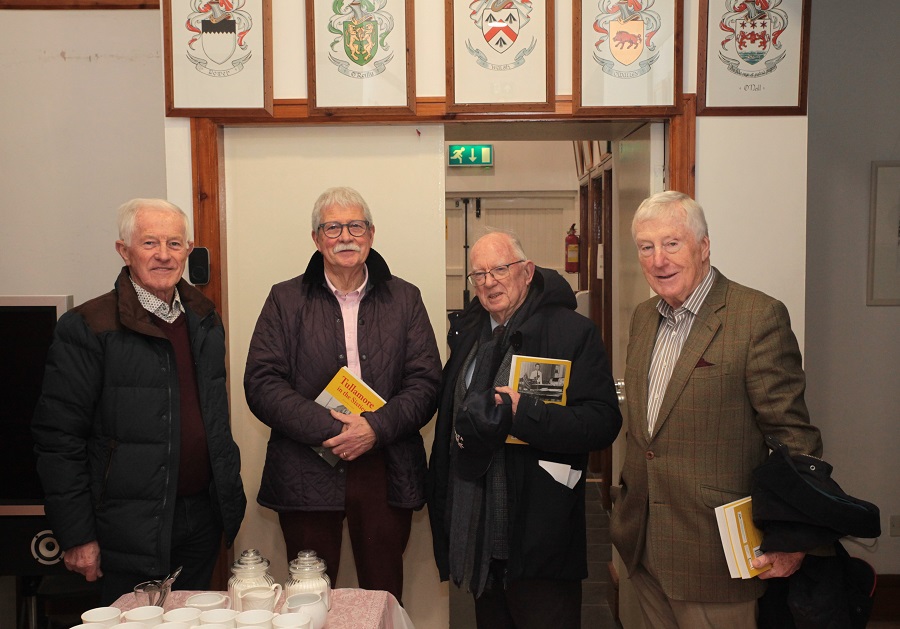
Some of the contributors to Tullamore in the Sixties
This volume of essays brings together the contributions of eighteen people who kept a keen eye on developments in Tullamore in the 1960s. Perhaps none more so than the late Joe Kenny who came to Tullamore in the 1950s as a vocational schoolteacher and was held in high esteem for his sound judgement and abilities as an impartial chairman. In that capacity he was the inaugural president of Tullamore Credit Union in 1963. Fergal MacCabe, as a Tullamore native, with a professional life in architecture and town planning in Dublin, brings a unique contribution by way of his recollections of Tullamore in the 1950s and his review of the first town plan of the 1960s. The same can be said of Vincent Hussey as a planning officer with Offaly County Council with his recollections of Tullamore since the 1960s. Niall Sweeney, an engineer and former Offaly County Manager, takes a close look at the provision of public infrastructure in Tullamore over the period from the 1960s to 2014. The late Jack Taaffe, as town clerk in Tullamore in 1970–72 demonstrates just how underfunded urban authorities were in those years. He went on to become county manager in Westmeath presiding over the progress of the county from 1981 to 1988. Michael Byrne looks at the history of business in Tullamore and sought to cover the principal enterprises of the 1960s in manufacturing, distribution, shopping, entertainment and dancing. Noel Guerin, as a former employee of ‘the bacon factory’, was able to write of a company that employed up to 100 people in Tullamore over forty years and made the name of the town famous for the Tullamore sausage. Ronnie Colton, from his own extensive involvement in the motor business brings a knowledge from the garage floor and sales yard that few others can match.
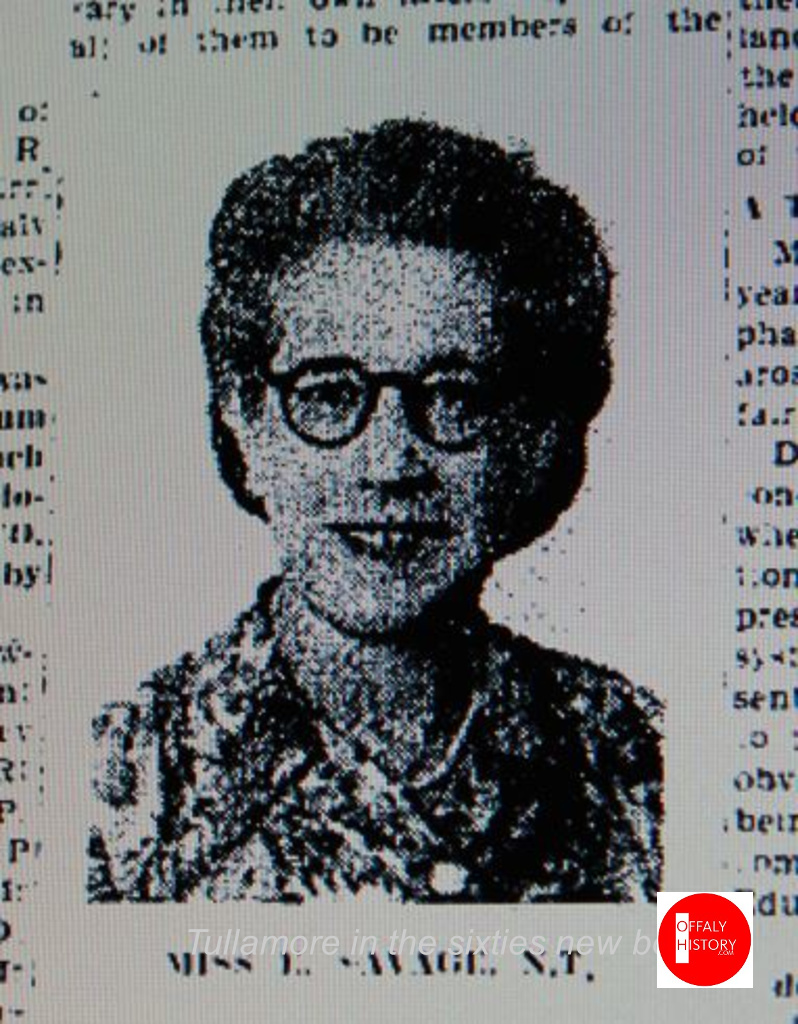
Miss Savage, a well-loved teacher in the Mercy primary school
Alan Mahon, as the grandson of an innovative cinema proprietor, recalls two cinemas in Tullamore whose cultural contribution is perhaps forgotten now but was all important to the people of Tullamore and district over a period of sixty or seventy years, if one takes it from the commencement of the Foresters cinema (later the Grand Central) in 1914.
Sport, so important to so many, brings us to the essay by Kevin Corrigan who looks at a formative decade leading on to the GAA Senior Football All-Ireland victories in the 1970s. Kevin had the challenging job of reducing to a short essay what could fill twenty books were one to address in detail each of the sporting activities that came to the forefront in the sixties.
The recording of my mother Josephine was made in 2006 as part of my research on local history and my mother’s interpretation of it. At the time, little did I know the significance that it would have, not just from a local history record perspective but also in a deeply personal context.
Our family connection here in Tullamore began in 1923, when a young Dublin native, Josephine Moore came to work at McCann’s as a housekeeper. This building later became the Tullamore Enterprise board ( now occupied by Jigsaw) Cormac Street. She married William Gorman, a local man. My mother, also called Josephine, was born in 1928. Mum left school aged 14 and she would have been the first to admit that she lacked a proper education. In those unkinder days, walking to school barefoot and being put to clean up in the home economics room by the nuns after the wealthier girls had cooked was all too often a regularity. She would have liked to have had a career as a nurse she often said.
The changing face of Offaly towns in the early 1900s: An illustrated history edited by Michael Byrne with contributions from Paul Barber, Stephen Callaghan, Grace Clendennen, Kevin Corrigan, Michael Goodbody, Ger Murphy, John Powell, Laura Price, Ciarán Reilly and Brendan Ryan (Offaly History, Tullamore, 2024, 368 pp). Available from Offaly History Centre and Midland Books Tullamore and online at www.offalyhistory.com. ISBN 978-1-909822-38-2 (hard back), €27.99. The book will be launched at Offaly History Centre, Bury Quay, Tullamore – beside the new Aldi and Old Warehouse. It is already available at the Centre, online at http://www.offalyhistory.com and at Midland Books, Tullamore. If you cannot attend in Tullamore we have a launch at Giltrap’s of Kinnitty on Thursday 21 Nov. at 7. 30 p.m. We will have copies in Bridge Centre for the Christmas Sale 14 to 24 December.
A rambler to Geashill in 1936 recorded his thoughts on the railway station, the village itself and the poems of Edward Egan who lived close by at the Meelaghans. The railway station closed about 1961, and Edward Egan better known as ‘The Poet’ Egan was in his last years when Rambler visited in 1936. For all the praise for Egan there were few at his funeral in Killeigh old churchyard. Nor is there any tombstone to mark his name.
The registration of motor vehicles began in 1904 and the early registers are now in Offaly Archives. In the period from 1904 to 1923 about 820 motorised vehicles were registered in Offaly. This would include motorised bicycles and some registrations from other counties. In the first year 14 motor cars and 20 motor cycles were registered in Offaly.[1] The Birr-based King’s County Chronicle published the first list in 1909 of 68 registered motor vehicles and commented:
In view of the fact that motoring has come to stay it will be of interest to publish a list of gentry in the King’s County, whose means have enabled them to add this new form of locomotion to their personal luxuries. Through the courtesy of Mr. C.P. Kingston, Secretary of the King’s County Council, we are enabled to place the full list before the readers. C indicates the four-wheel coach, and B the bike petrol machine. The code letters for this County are I.R. …. It should be added that there are several local owners in Birr not in this return whose registration is entered in other counties, for example:- Mr. Dunn-Pattison, I.K. 113; Dr. W.A. Morton, I.K., 357; J.W. Nolans, V.S. 8243; Captain Dalrymple, 10, 187; H. Gairdner, R.I. 853; Dr. D’Alton, R.I. 846; G.A. Lee, I.K. 236; J. Green, I.K. 237; C. Ludgate, R.I., 488; Captain Cowan, R.I., 542.[2]
120 years has passed since the motor vehicle and driver licences registrations had been introduced in the UK and Ireland. The King’s Co (Offaly) county council was responsible in the collecting and registering drivers’ details and collecting fees. There were motor vehicles on the county roads from the late 1890’s, although there was no administration register for them. With the increase in motor transport on the roads by 1900 the council adopted rules of the roads act.[1] This included a twelve mile per hour speed limit in the country and eight mile per hour in the towns and villages. Bicycle and motor car owners must carry lights between sunset and sunrise, and a driver of a bicycle or motor vehicle dismount if they encounter a horse driven carriage, wagon or any other beast of burden until they were clear of the area to continue driving their motor vehicle. This law was updated 25th May 1901.[2]
The inside cover label of the 1904-23 King’s County vehicle registration ledger. Athlone Printing Works was owned by Thomas Chapman and was a subsidiary of the Westmeath Independent Newspaper (1883-1920). Courtesy Offaly Archives
In November 1903 at a meeting of the county council in Tullamore courthouse the council adopted regulations under the 6th section of the new Motor Car Act, which would come into force on the 1st January 1904.The principal rules were that “The county shall keep a numbered register of cars and motor bicycles; owners of motor register, and pay a fee of 20s, and in the case of motor cycles 5s. On the change of ownership, a re-registration fee of 10s for a car and 2s:6d for motor cycles. Persons driving any motor vehicle must be licenced and pay a fee of 5s per year. The legal age to obtain a licence was seventeen”.
The task of motor vehicle/licence administration was carried out by the council secretary’s office headed by Charles P. Kingston a local Birr native.
In the summer of 1903 Ireland received the letter (I) for its first licence plate letter and each county received a second letter in alphabetical order of counties. Offaly then (King’s Co) receiving the letter (R). Each vehicle was issued with its own alphanumeric number starting with IR.1 as the first vehicle registration. There were two categories for vehicles, private and public convenience, the latter being hired out by its owner to anyone who possessed a driving licence. Registration numbers could be transferred from one type of vehicle to another type and be registered in another county where the owner may have resided. This continued in many counties up to the early 1970’s.
The first people to embrace this new technology were affluent industrial families and large landowners were among the first motor vehicle owners in the county. Clergy and police were also encouraged to use motor transport for their day-to-day activities. The increase in vehicle registrations in the county from 1904 can be describe as slow and steady. From 1st of January 1904 to 23 February 1911, one hundred vehicles were recorded, and from 2nd November 1912 showed 150 vehicles registered. However, the beginning of the first world war, saw a large increase in registrations that included commercial vehicles. From the beginning of the 20th Century to the late 1920’s saw an increase in commercial businesses activity in the county. Road transport became more important for the supply of goods to branch houses throughout the midlands and beyond. Buildings in the county towns were re-developed and enlarged with new facade advertising a wider choice of imported goods. This can be seen more evident in the textile merchant businesses such as the many drapery buildings of the larger towns.
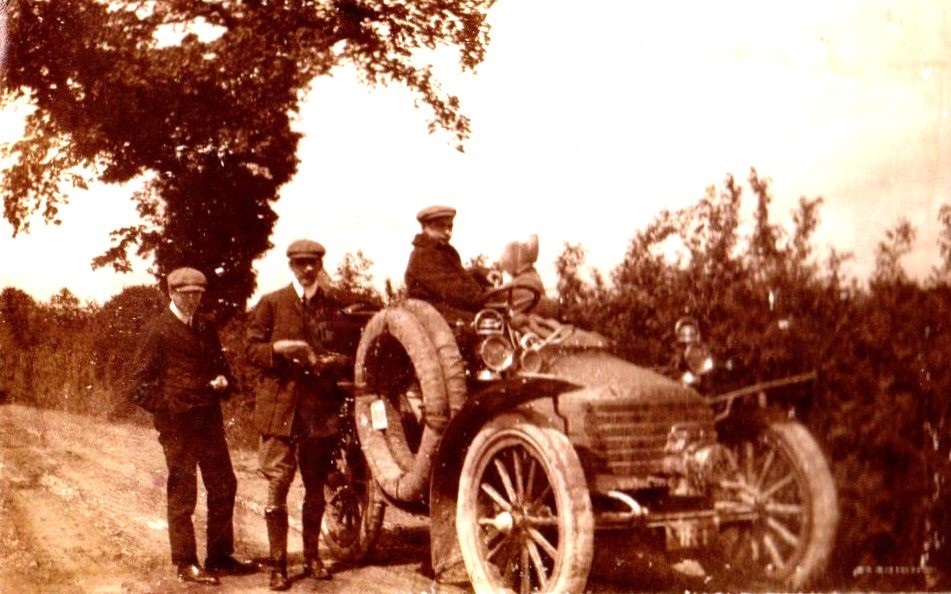
Motor Tour of the west of Ireland in 1906 , James Perry and party aboard IR 1 Wolseley[3]
The first vehicle registered in King’s Co (Offaly) IR.1 was a Wolseley 10 hp black car lined red for private use, James Perry Goodbody, Inchmore Clara.[4] The Wolseley Tool and Motor Car Co, Ltd Adderley Park, Birmingham. This company was acquired in 1901 by Vickers, Sons & Maxim engineering empire with Senior engineer Herbert Austin taking over the design of the car and motor.
This Wolseley power plant was a horizontal flat twin cylinder motor, chain drive to the back wheel, top speed 20 mph designed by Austin, and the first wholly British car to be mass produced from their Birmingham factory in 1902.The price with 36-inch tyres was £380.00. This registration number would stay in use on different vehicles in the Goodbody family well into the mid 1920’s.
D. E. Williams Ltd with their first registered motor lorry IR 164 registered 25th March 1913.Commer lorry 25hp painted red 2 1/2 tons trade[5].
D. E. Williams also registered IR 165. A four-seater Ford model T Car on the same date for trade. These new Ford cars were aimed at the commercial traveller and services that could now attend multiple destinations in one day’s drive and return. They came equipped with electric lights and window wiper, a hod and inflatable tyres that could the repaired quickly. Ford dealerships springing up all over the country in this period.
This new mode of transport had an impact on other professions such as: Agricultural consultants, Bank Managers, Doctors, legal administration and policing, Political, Religious and Sporting assembly’s and events etc.
Another large merchant business in the town with sixteen shops and licenced premises, across the midlands with their main office on Bridge St. was P & H Egan Ltd. Over the years this company built up a transport department and on 16th July 1915 they registered their first motor lorry, a Commer 2 ton for trade registered IR 236.
From 1912 local garages started to appear in the town. Robert H. Poole in Bridge St. was a motor and cycle agent with a large garage, service department and car hire. He was an accomplished competition cyclist and started selling Triumph motorcycles from 1904, also sales of used motor vehicles and in 1915 Ford and Overland cars.
James Arthur Kilroy, started his hardware, Ironmonger and garage supplying Ford model T cars from 1914 and later Maxwell five seat touring cars. James registered IR 162, a 3 HP Premier Motorcycle, 23 February 1913.
The first resident of Tullamore to register a motor vehicle was James Hayes b.1863 lived in Charleville street with his family. He was manager of the Charleville Arms Hotel and was a justice of the peace for many years at local petty sessions. He registered a Ford (Model T) car IR.11 in 1913 for commercial use, transporting guest around the area with a morning run to the town’s railway station. This car was assembled at the Henry Ford & Sons ltd factory Trafford Park, Manchester.
In 1914 Charles Kingston applied to the county accountant John Mahon for an increase in salary for himself and the county surveyor as well as additional staff to cope with the increase in road works across the county.[6]
As other smaller businesses were expanding around the town, Thomas English baker and general merchant William St. Registered a 20hp motor van IR 205, on 23ed April 1915 and held this number until 1923.This was a re-released Ford Model T, new to the market in late 1914 and was targeted at smaller local delivery business. This was a turning point for commercial transport as no longer did business owners need to burden the cost of horse drawn delivery carts and a man to look after them.
John H. Wakefield with his 1926 Ford Model TT delivery van[7]
There is also a separate short index for Vehicles with registrations from outside of the county.
For example, John Henry Wakefield was a store assistant and driver for Joseph A. Lumley grocer, William St. On the 6th May 1916 John registered a Ford model T four-seater car RI 2971 (Dublin). In July 1917 he set up his own grocery business (Central Stores) on the corner of Bridge Lane and Bridge Street, now part of the Bank of Ireland building. He then transferred this number to his new Ford delivery van. These new ford vans were capable of carrying up to one ton with its long wheel base and factory-made body. This limited the speed between 15-20 mph.
Registration of motor vehicles during the war period was slow as most of the motor manufactures changed production to supply the WD (War Department) with transport of all types of machines, equipment as well as munitions. By 1919 the motor market became saturated with repurposed military machines, that drove down prices. As well as returning soldiers and mechanics struggled to find employment in garages, this led to low wages and high unemployment in the country.
From January 1920 the first signs of change hung over the country with outbreaks of hostility against the Crown Forces from the Republican Army, and the pursuing War of Independence continued until December 1921, and was followed from June 1922 when the Civil war began.
During these years registration of motor vehicles was slow. From 1922 most vehicles were taken off the roads by their owners, as they were being targeted and used for transporting armouries and republican volunteers to and from ambushes around the county. Other cars were adopted with armoured plate on the sides to protect the drivers and passengers as the country fell into lawlessness. Garages, general merchets were targeted constantly with fuel stores raided along with anything of value, the owners threatened and intimated into selling up or in some cases burning of premises and homes. This was the case with Robert Poole Tullamore and George Lee Castle St Birr, both men and families had sold out and eventually emigrated.
By 1924 motor registrations had bounced back with most large industries purchasing goods vehicles. (3) D. E. Williams Barrick St. (2) P&H Egan, Ltd Bridge St. (1) M.J. & L. Goodbody Clara. James Kilroy High St (Hackney). (1) Joseph A. Lumley William St.
By the mid 1920’s car sales started to increase, this led to another new garage in Tullamore.
O’Conner Square mid 1920’s[8] L-R: Rafters Drapery Store with facade of advertising. George N. Walshe premises, fire engine parked outside his shop. Access to his garage was through the gate to the left of this building. This was an old coach yard and stable building. Building to the right of Walshe was Egan’s brewery house, Daly’s shop and arch entrance to Egan’s brewery and stores houses. The town switched to electric lighting in 1921.
Other families in the area that would go on to set up their own garage and motor works shortly after the first Motor Registration ends. Frank Hurst, O’ Moore St. started his Motor works in 1926, repairing agriculture machinery (Irish made Fordson tractors and small stationery engines) that was now replacing the work horse. Among his many staff was a young George Colton (1899-1931) Gorteen, Killeigh, motor mechanic who worked for G. N. Walshe before joining F Hurst Motor Works.
Unfortunately, the vehicle registration ledger is incomplete and ends in June 1923. There are no motor vehicle registration legers known to exist between 1923 and 1945.
Offaly Archives is the depository for all motor licences ledgers from 1904-1928 however there is also a gap from 1928-45 for licence registration’s (OFCC 10/5/1). The surviving ledgers are a wonderful source of information to anyone with an interest in early motor transport in the county and the early pioneers who embraced this technology.[9]
See also: James Perry Goodbody, Offaly’s leading industrialist and county council member for 21 years (1853-1923) By Michael Byrne April 19, 2023 Offaly History Blog.
Our thanks to Tomas Ó Helion for all his research for this blog article on a subject that touches most of us. A second article on this subject will be published in the Anniversaries Series in October 2024.
The word duel supposedly has its origin in the Latin duellum, roughly translated as a war or battle between two. Ancient history, religious accounts and myth are all full of accounts of Champion Warfare as elite warriors battled for the glory of their respective peoples. When David slew Goliath, Achilles dispatched Hector outside the gates of Troy or when Cu Chulainn faced off against the fighters of Connacht, they were engaging in a form of single combat common across the world. Later still, during the Middle Ages many European societies condoned ‘Trial by Combat’ as part of their legal system. One of the last examples of such a contest in Ireland occurred at Dublin Castle in 1583.
A Family Feud, the O’Connors of Uí Fháilghe
For centuries the kingdom of Uí Fháilghe (consisting of the eastern region of modern county Offaly) was ruled by the O’Connor clan. During the 16th century, the family featured as a regular irritation and occasional ally for English administrators based in Dublin Castle. The situation was further complicated by internal dynastic rivalries within the clan and alliances between the O’Connors and Fitzgerald Earls of Kildare.
The last official great chief of the clan, Brian O’Connor Faly, married the daughter of the Earl of Kildare, engaged in a prolonged struggle for supremacy with his brother Cathaoir, fought in Silken Thomas’s Rebellion and lead numerous raids into the English controlled Pale.
Pardoned by Henry VIII in 1541, he was regranted his lands later in the decade, but rebelled in conjunction with Cathoair and the O’Mores of Laois in 1548. The Gaelic Irish leaders suffered serious reversals. Cathoair was executed in 1549, Giollapádraig O’More died while imprisoned in England and Brian’s political power was diminished. By the time of his own death in the cells of Dublin Castle in 1560, the kingdom of Uí Fháilghe had already on its way to being dismantled.
In 1556, Parliament passed an act to enable the government to carry out Plantations in O’More and O’Connor territory. As a result, Uí Fháilghe became King’s County, named in honour of King Phillip II of Spain, the husband of Queen Mary I of England.
Despite the major reverses which the O’Connors had suffered, some branches of the family continued to retain importance under the new dispensation. Moreover, the tendency for internal feuding had not entirely abated.
In 1583, Connor McCormac O’Connor alleged that several of his followers had been killed on the orders of Tadhg Gilpatrick O’Connor. In response Tadhg claimed that those killed had collaborated with a noted rebel. The case was referred to the lord justices. Having considered the matter, the Master of the Rolls, Sir Nicholas White suggested that the issue could be resolved by single combat.
The Bermingham town in Dublin Castle about 1895.
So, on the September 12th a large crowd of legal officials gathered in the inner courtyard of Dublin Castle to view the kinsmen do battle. Having been searched for hidden weapons, both men striped to the waist, shook hands and swore on the bible to refrain from the use of “enchantment, sorcery, or witchcraft”. (1)
The combatants were each armed with a sword and a shield, and the contest was a prolonged one. Badly wounded, Connor McCormac O’Connor attempted to effect a killer blow but overextended himself and lost his footing and was beheaded. (2)
Honour is Everything –Codes duello
While the notion of a duel to resolve legal issues had already begun to diminish by the time the O’Connors met in Dublin Castle. The idea of single combat as a means to settle disputes involving personal honour would prove to be a more persistent.
The importance of retaining personal honour and responding to any perceived slight was common across the globe. Especially in militarised societies with large numbers of young aristocratic men, but it found particular popularity in Renaissance Italy. It was there that duelling with rapiers first gained widespread popularity and some of the first of the so-called code duello were drawn up.
These rules, under which duels were fought, were developed in the hope that a well-regulated encounter would restore honour, reduce bloodshed and remove the danger of personal disagreements spiralling into family feuds.
The offended party issued a challenge to reassert their honour after a perceived slight. The second’s role was to patch up some form of face-saving compromise between the aggrieved parties and falling that to ensure that the duel was fought in a fair manner.
The many duels were fought without serious injury to either side, but the details of such encounters were rarely recorded. So much of what we know about duelling is drawn from fatal confrontations.
Duels were not designed to end in death, but rather to re-establish the equilibrium amongst the sons of aristocratic families. Nevertheless, deaths did occur, sometimes as the result, distain for proper duelling procedure or the temperament of the combatants and often because of the rudimentary medical skills of the time.
The rise of duelling corresponded with the demise to of the Gaelic Ireland, the confiscation of large tracts of land and the eventual emergence of the Anglo-Irish landed elite as the great beneficiaries of the Nine Years War, the War of the Three Kingdoms and the Williamite War. It was from such families that duelling would draw its adherents in the century that followed.
The New Order
In 1725 it was reported in the Ipswich Journal…
‘They write from Dublin, that on the 8th of Aug, a Duel was fought Parsonstown in Kings County, between Michael Moore of Cloghan, of the Said county, esq and Captain John Eyre of Feddan, in county Tipperary; at which were present among several other persons, lieutenant Bagnall, and quartermaster Charles Armstrong; and that the said Moore in the attack, tumbled, fell down, and lost his sword, upon which the said Eyre seized it, and pursued Moore with both swords in order to stab him, which the said Amstrong endeavouring to prevent, and putting his own sword into Moore’s hands to defend himself, the said Eyre run upon Armstrong (naked as he was and no party to the quarrel and stabbed him in the breast, of which he instantly died.’ (3)
Captain Eyre was subsequently acquitted of murder.
The Eyres had arrived in Ireland as Cromwellian settlers during the 17th century and were soon closely associated with county Galway. To this day the main square in Galway city and the village of Eyrecourt in the east of the county, bear the marks of that association. The Moores were a long-standing aristocratic family dating back to the Norman invasion. Having obtained Cloghan castle at Lusmagh early in the 17th century, they threw their support behind the Royalist and Jacobite causes. Despite this, they retained some of their holdings, until the reality of mounting debts forced a sale at the Encumbered Estate Court in 1852. The Armstrongs had first gained fame as Border Reivers operating in the Debatable Lands along the border between England and Scotland during the 15th and 16th centuries. Many Armstrongs travelled to Fermanagh in the hope of benefiting from the Plantation of Ulster. A few generations later a branch of the family had begun to establish a dynasty in the former stronghold of the MacCoughlan Clan in the west of King’s County, amassing estates containing thousands of acres with country houses at Banagher, Ballycumber and Gallen Priory outside Ferbane.
Duelling continued to grow in popularity throughout the 18th century, but how it was carried out would change greatly during that time as pistols replaced rapiers as the preferred weapon of choice for duelists.
The rise of duelling
To a certain extent firearms served to level the playing field. Previously, taller men with a greater reach, the more athletically able and those with training in swordsmanship went into battle with considerable advantages. The greater availability of pistols gave the unfit, untrained short man at least a fighting chance. But this equality of opportunity, probably also contributed to a rise in the number of duels being fought. The phenomenon is said to have peaked in the 1770s. In November 1774 it was reported …
Kilcormac about 2017
‘On Wednesday last a duel was fought at Frankford between Mr. George Drought and Mr. Alex. Comins, Ganger, when the latter received a ball in the right arm, which broke the bone.’ (4)
In 1777, representatives from Tipperary, Galway, Sligo, Mayo and Roscommon drew up a new code duello at the Clonmel summer assizes. These 25 ‘commandments’ would go on to provide a framework under which future duels were fought in Ireland, Britain and the United States. Duelists were expected to keep a copy of these rules in their pistol case.
‘a meeting took place last week, near Birr, in the Kings County, between a Mr. Dillon and a Mr. Moor, both living in the neighbourhood of that town, in consequence of some dispute at a hunting match. On the first discharge, Mr. Dillon received his antagonist’s ball through the groin’ (5)
Echoes of Rebellion
Henry Peisley L’Estrange was born at Moystown House around 1776. His family traced their roots to Norfolk and during the 17th century had amassed thousands of acres between Clonony and Shannonbridge in the west of King’s County. The family was also closely connected with military life and following the resignation of Laurence Parsons as commander of the King’s County Militia in the March 1798, L’Estrange replaced him. During the Wexford Rising, he played a prominent role in the Battle of Bunclody/Newtownbarry, when forces under his command initially retreated in the face of a rebel advance before regrouping, counterattacking and inflicting serious losses on Rebels led by Fr. Mogue Kearns.
Ballycumber House – home of John Warneford Armsrong, about 50 years ago. Picture by Rolf Loeber
John Warneford Armstrong was born at Ballycumber in 1770, 45 years after his unfortunate relative Charles Armstrong met his death while attending a duel between John Eyre and Michael Moore. A commissioned officer in the King’s County Militia, and in May 1798 Warneford Armstrong was approached by two radical lawyers John and Henry Sheares, who attempted to induce him to defect to the United Irishmen cause and bring his militia detachment him. Instead, he reported the matter to his superior Colonel L’Estrange who advised him to play along with the conspirators while reporting the details of his meetings. Eventually the Sheares were arrested, and Armstrong later appeared as prosecution witness at their trial in July. Convicted of high treason, the brothers were hanged, drawn and quartered outside Newgate Prison, with their remains buried in the crypt of St Michan’s church. During the Rebellion Armstrong took command of troops in Kildare and North Wicklow, where he was known for the ferocity of the methods, he used to suppress United Irish activity. (6)
In the summer of 1799, the Kings County Militia prepared for deployment to the Channel Islands. It’s not known what caused the outbreak of bad feeling between two of the regiments officers but in June it was reported that
‘Thursday last a duel was fought on the banks of the canal, near Dublin, between Colonel L’estrange and Captain Armstrong, both of the King’s County Militia; the exchanged a case of pistols, but neither received the least injury’ (7)
Both men lived to fight another day. L’Estrange died at Bath, England in 1824.
Armstrong was regularly villainized in nationalist literature and song…
‘We saw a nations tears,
Shed for John and Henry Sheares,
Betrayed by Judas, Captain Armstrong’
It was a characterisation that Armstrong robustly rejected, arguing that he had acted at all times in accordance with his duty as an officer. Returning to Ballycumber, he was the recipient of a large government pension. Described as an indulgent landlord, but a stern magistrate, on his death in 1854, he was buried at the Armstrong family vault at Liss church.
My paternal great-great grandfather was James Corcoran (c. 1801 to c. 1848), a tenant farmer/freeholder who, in the mid-1820s, had dominion over approximately 44 acres (current measurement) in the townland of Crissard in County Laois. At that time Crissard was often referred to as “Cropard,” with numerous variations on the name since. “Crissard” appears to be the official townland name, although local residents today favour “Crossard.”
In 1823 James married Elizabeth Conlon. Elizabeth was almost certainly from either Crissard or perhaps from one of two adjacent townlands; Wolfhill or Kellystown. Below is a cut-and-paste record from the Ballyadams R.C. Parish marriage records identifying their February 5, 1823 marriage. Note “Cropard” as the place name.
James and Elizabeth would go on to have six children between 1824 and 1846; Margaret, Mary, Frances, William, Honora and Patrick. A long gap between the birth of fifth child Honora in 1833 and sixth and final child Patrick in 1846 initially had me wondering if I had the “right” Patrick but all was quickly confirmed upon locating the baptism records for the children, all confirming the parents as James Corcoran and Elizabeth Conlon.
Aside from the Tithe record and baptism records for James and Elizabeth’s first five children, the next credible record(s) that I find of James are at least six newspaper entries in the Leinster Express between 1839 and 1842 where James, along with numerous other County Laois (Queens at that time) residents were seeking the right to vote. I never determined if James secured voting rights.
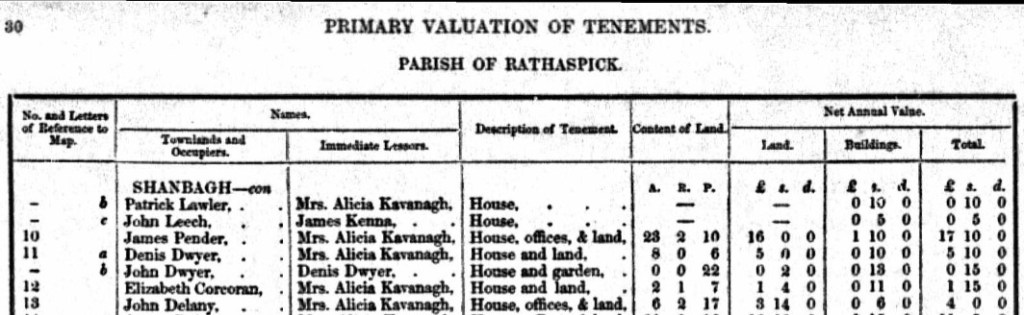
Following the early 1840s newspaper references, James appears in the record of son Patrick’s March, 1846 baptism. This is the final written reference to James. Then, in 1850, we find Elizabeth Corcoran in the Griffith’s Valuation records living as head-of-household in the townland of Shanbagh (Shanrath today), two miles to the east of Crissard (see below). The 11-shilling valuation of her residence suggests fourth class housing, an indication that she may have been living in mud hut poverty, as were seemingly most of her immediate neighbours.
I have little doubt that this is the correct Elizabeth Corcoran, owing in large part to the landowner listed for Elizabeth’s residence; one Alicia Kavanagh, a resident of nearby Wolfhill. The connection between these two women was likely tied to Alicia owning the land in Wolfhill on which the Roman Catholic Chapel of that time was located, which was almost certainly the church where my Corcoran ancestors would have worshipped.
Remains of the original Wolfhill R.C. Chapel, the ruins ofwhich are found in present day St. Mary’s Church Graveyard
James disappearance from the records after 1846 and Elizabeth’s subsequent appearance as a head-of-household in 1850 strongly hints that James died during this four-year period, which not coincidentally was the time of the Famine.
The Famine, and likely the death of James, triggered emigration of three and quite possibly four of the Corcoran children, including my great-grandfather William Corcoran who departed for New York in 1850, one year after his sister Frances Corcoran left for New York in 1849 and one year prior to sister Margaret (Corcoran) Knowles emigrated to New York in 1851; classic Irish “chain immigration” on display! There is strong circumstantial evidence that sister Honora Corcoran followed suit in 1852, although definitive proof is teasingly lacking.
I was able to trace the lives of William, Frances and Margaret until their deaths in New York. Frances, the first to emigrate, arrived in New York City, married another Irish immigrant named Patrick O’Brien, and remained in Manhattan until passing in 1895. More interestingly, William Corcoran and Margaret (Corcoran) Knowles relocated to Clinton County in the northeastern corner of New York State, both eventually landing in the rural Crissard-like town of Beekmantown, on the same road, just two houses/farms apart. Another Knowles, Patrick Knowles, the older brother of Margaret’s husband Dennis Knowles, lived on and farmed the property between William and Margaret’s; a little cluster of Crissard emigrants living in an environment in which they likely would have taken some comfort. Other Irish immigrant families surrounded the Corcoran/Knowles clan; families with surnames such as Conroy, Kearney, Mullen and Golden.
Margaret’s life in New York was sadly marred by two events. The first was the death of her and Dennis’ two young Irish-born children, Mary and Michael Knowles, both of whom died in New York City during the six months that the family lived there before relocating to Beekmantown. The second tragedy was the passing away of Margaret herself in 1861, at age 37. Brother William did not purchase his land in Beekmantown until 1863, so he was never reunited as a neighbor to his sister, although they did live in the same County for 10+ years, which no doubt allowed for close interaction.
William would marry another Knowles, Catherine Knowles, in 1869 (see St. James Church record below – “Knowles” is misspelled as “Noles”). Catherine was the Beekmantown-born daughter of Patrick Knowles and a niece of Dennis Knowles, further tightening the Corcoran/Knowles bond in Beekmantown. But in another grim twist, Catherine would die in 1871, only 10 days after giving birth to her and William’s second child and daughter, Anna Corcoran.
William quickly remarried in 1872 to Julia Kilroy (later “Gilroy”), Clinton County-born daughter of another Irish immigrant couple from County Cavan; Patrick Kilroy and Alice Keenan.
William and Julia would have one child, my grandfather, John Corcoran, in 1877. Upon William’s death at his Beekmantown home/farm in 1904, John inherited the farm where he would follow in William’s footsteps for over two decades, before losing his 300+ acres of land to the economic scourge of the Great Depression.
John Corcoran (c. 1900)
John would marry Margaret Dowd, with the couple going on to have four children of their own; my father Francis Corcoran, Mary Corcoran, Ruth (Corcoran) Martin and Florence (Corcoran) Tusa. The direct line Corcorans, including my brother, sister and I would remain in Beekmantown until 1975, at which point my father was transferred to Albany, New York for work, resulting in my siblings and I all dispersing after marriage, but all still making our homes in upstate New York.
My brother and I each have a son and daughter, with both of our sons living in upstate New York, ensuring at least one more generation of Crissard-origin Corcorans leaving their footprints, however small, in the same geographic area as our Irish immigrant William Corcoran.










 offalyhistoryblog