
The first article in this recent series to mark the 400th anniversary of the grant to Sir John Moore of Croghan and Tullamore of a licence to hold fairs and markets and establish manorial government was about Tullamore in 1804–7 and was based on two surviving Grand Canal maps. The earliest surviving comprehensive map of Tullamore is that of 1838 and can conveniently be found at osi.ie and its Geohive platform. The purpose of this article is to review the street plan and buildings of the town of Tullamore as shown on part of the Ordnance Survey six-inch sheet no. 17 of which the first edition was published in 1838. It will take three or four blogs to view the 1838 map of Tullamore and in OS fashion and matching the design of Tullamore town from the 1790s we can proceed in gridiron format from the north west of the town to the south east.
(more…)Category: Sources for Offaly History & Society
-
The Courts of Assize in Offaly and the ceremonial display of British power in Ireland before 1922. By Michael Byrne, Blog No 368, 26th March 2022
The memorial to the Offaly Volunteers who fought in the War of Independence was unveiled on the lawn of the county courthouse, Tullamore in 1953. It was Peadar Bracken (1887–1961) former OC Offaly Brigade and from 1922-3 the Tullamore district court clerk who ensured that the IRA Volunteer monument was placed on the lawn of the courthouse. Besides, a site in O’Connor Square was not an option from 1926 when the war memorial was completed. Given that it was principally to the Tullamore courthouse that the feared judges of the assizes would arrive it has strong symbolism. The Volunteer monument was completed in 1939 but not unveiled until 1953 due to the difference between the Free Staters (National Army) and the Republicans.

Memorial to members of the Old IRA at the county courthouse, Tullamore As noted in an earlier article in Offalyhistoryblog the last of the assizes was held in July 1921 with Judge Wiley presiding and a large force of military to protect him as the symbol of the British state. Now with the marking the 100th anniversary of the Treaty and the departure of Crown forces from Ireland it seems appropriate to look again at the twice-annual display of British power in the assize towns of Ireland.
(more…)
-
A look back at Tullamore town on key dates since 1622: Tullamore in 1804. By Michael Byrne, Blog No 363, 9th March 2022
This short article is the first in a series designed to look at the growth of Tullamore over the period from 1622 and to take key dates in the development of the town. Suggested dates will include 1622, 1716, 1764, 1785, 1804, 1835, 1900, 1923, 1948, 1966 and 2000. These dates coincide with particular events, or the availability of documentary sources that may allow us to draw some conclusions about the state of Tullamore at varying times over the last four centuries. Rather than take matters in chronological order we are going to look for some key moments in the stages of growth. One such was the completion of the canal to Tullamore in 1798 and its extension to Shannon Harbour in 1804. During that six years Tullamore had served as the depot and terminus for the new waterway to the west and south. The opening to Shannon Harbour and the link to the Shannon may have been seen by some as marking the end of the new canal hotel and harbour in Tullamore with business moving further west and travellers no longer having to stop over in the town. That was not the case. The hotel client base weakened to almost nothing by the 1840s and so did passenger traffic. Commercial traffic was continued on until 1960.
(more…)
-
The Decade of Centenaries – Independence and its legacy for women’s role in society. By Sylvia Turner, Blog No 360, 26th Feb 2022
One of the ironies during the first two decades of the 20th century is as women were beginning to gain equality with men, it was taken away during the next two decades by the Government under Éamon de Valera. Such inequality between men and women has led to repercussions across Irish society until the present day. According to Amnesty International , violence against women is both a consequence and a cause of inequality between men and women. There is widespread concern that this has now reached endemic levels, as acknowledged in the debate in Parliament following Ashling Murphy’s murder on 12th January 2022. Reasons why the situation has developed in a predominantly rural country of just five million people needs to be addressed if it is to be resolved.
The promise of equality for women with men had been included in the 1916 Proclamation. This was realised and the new Irish Free State enshrined equal voting rights into its Constitution in 1922. Following Independence and the ensuing Civil War, Éamon de Valera, who opposed the Treaty, broke away from Sinn Féin and formed a new party called Fianna Fáil and led it into the Dáil in 1927. He gained popularity and won elections in 1932. An example of his popularity can be seen in the Midland Counties Advertiser on 28th June 1934.
(more…)
-
The parish of Clonmacnoise (in the diocese of Meath and King’s County/Offaly) by Revd Patrick Fitzgerald, c. 1814–16. Presented by Offaly History. Blog No 345, 5th Jan 2022
An account of Clonmacnoise in the early years of the ninteenth century was published by William Shaw Mason (c.1774–1853), as part of his three-volume A Statistical Account or Parochial Survey of Ireland, drawn up from the communications of the clergy (1814–19). Included in this survey is one Offaly parish – that of Clonmacnoise, published as part of vol. 2 in 1816, pp 142-150.
Shaw Mason was born in Dublin in 1774 and died there in 1853. He was for many years involved in the pursuit of history and was secretary to the Commissioners of Public Records. One attractive sinecure he had was Remembrancer or receiver of first fruits.
Patrick Fitzgerald
The contributer of the Clonmacnoise piece was the local vicar, Patrick Fitzgerald. Fitzgerald noted that there was no town in the parish save Shannonbridge which had a few slated and 280 thatched houses.The parish had 586 families, comprising over 3,000 of a population with only eight Protestant families. Potatoes and milk were the basic foodstuffs with some fish. English was the usual tongue with only some Irish spoken. Patron Day was 9th September as it still is but at that time 3,000 to 4,000 people would attend. The principal owners of land in the parish were Lord Rosse, Rev. Henry Mahon, Edward Armstrong-Frazier and H. P. Lestrange. The number of Protestant families must have one of the lowest in the county and can be conrasted with Ballyboy and Killoughy in 1826 with 7,250 RC and almost 500 Protestants.

Clonmacnois* is the ancient and modern name of the parish. It is situated in the barony of Garrycastle in the King’s County and in the diocese of Meath. Longitude 80 5 ’west; latitude 530 20’ North. (The name Clonmacnois evidently derived from the word ‘Cluain’ meaning a retired lawn, or small nook of land, free from rocks, near a river. . .) Its boundaries are on the north the river Shannon, from which it is separated from the county of Roscommon; on the east, by Kilcleagh and Lemanaghan parishes on the south, by Thesaurin parish, and on the West by part of Thesaurin parish, and by the Shannon which divides it from Galway and Clonfert.
The length of the parish from East to West is about eight Irish miles and the breadth from North to South is about three. About 3723 acres are arable and fit for pasture; the meadow ground is in general indifferent; there is a little upland meadow, as it mostly lies along the banks of the Shannon. But it contains more than double the above named number of acres of bog, as a large branch of the great Bog of Allen runs up into the parish, including every kind of soil. It contains upwards of 12,000 acres.
There is no river in or adjoining to this parish except the Shannon which mears it as already mentioned. A lake called Clonsalagh, which is computed to cover ninety acres, produces good pike and perch and some eels. This sheet of water is situated nearly in the centre of the parish, and derives its name from the townland in which it is. On the North and East, it is surrounded by hills, which, if planted, would produce a fine effect, and on the south and west by a large bog. The parish abounds with hills, the tops of which are allotted to pasturage as all the valleys are tilled and produce fine crops of corn; though the general appearance of the soil which is very light and sandy, might lead at first view to an opposite conclusion. There are neither mountains nor woods here, nor have there been any remarkable indigenous plants found.

Mines, Minerals, &c.
Limestone is the general substratum of the soil in all parts, when mixed with bogstuff and clay; it makes excellent compost for the purposes of manuring.
Modern Buildings, &c.
The high road leading from Ballinasloe to the counties of Meath and Kildare runs through the parish, in a direction East and West. Another crosses it nearly from North to south, and there is also a third road, but this is of very little note. It can boast but of one town that of Shannonbridge so called from a very handsome bridge built across the river. Here is a small barrack capable of accommodating a company of soldiers. A large tower and battery are building and in a state of great forwardness on the western (or Connaught) side of the bridge. This is the great pass from that province to Leinster. A Magazine has already been erected behind the barracks. There is no market held here, the want of which is severely felt by the soldiers, who are obliged to purchase their meat at Ballinasloe, six miles distant.
The village contains a few slated houses of two stories high and the rest, to the number of 280 are thatched. In consequence of the great number of artificers employed in the military works house rent has increased rapidly. The average rent for building ground amounts to ten shillings per foot. Its inn is nothing more than a stopping point, but the village contains several shops for retailing spirits without licence better known throughout the country by the name of Shebeen Houses.
It is singular, that not a possessor of a fee simple estate resides in the parish, neither, if we except the glebe house, is there is more than one good slated house in it, which belongs to Mr. Coughlan who holds about 200 acres of land, on which he resides.
Ancient Buildings, &c.
The Abbey of Clonmacnois is situated near the river Shannon. It was built about the year of our Lord 561 at which time it was held in high veneration. The Churchyard annexed to it contains nearly two Irish acres; it is one of the greatest burial places in Ireland, upwards of four hundred corpses are supposed to be buried there annually. There are also the remains of ten other chapels of lesser note, now totally in ruins. A door of one of them is very curiously and very beautifully carved. About half quarter of a mile thence, are the remains of a Bishop’s palace, now wholly in ruins, some of the walls are the only parts that have as yet escaped the ravages of time. In the church-yard are two large Round Towers one about 62 feet high, and 56 in circumference; its walls are 3 feet 8 inches thick, and the other is 5 feet 6” high, 7 feet in diameter and three feet thick. Here are also two large crosses, one of which is marked with some rude carving and bears an inscription in antique and unknown characters. At a small distance stands what appears to have been a religious house for nuns; it is also in ruins, no part of the building remains, except a single arch. A full account of this interesting place may be found in Archdall’s Monasticum and Ledwidge’s Antiquities of Ireland.

The landowners in the parish, none of whom was resident. From Shaw Mason, ii (1816), p. 150. Present and Former State of Population &c.
From every information that could be procured it appears that there are 586 families in the parish, comprising of 1618 males and 1558 females. Eight only of these families are Protestant, the rest Roman Catholic. The people in general are very comfortable and dress neatly, some in grey frize, and some in coarse blue cloth. Potatoes and milk form the general food, to which is often added fish procured from the Shannon and the lake. The poorest keeps one cow, and some have three or four. There are very few who do not keep one horse for work, and some have two.
The fuel is turf. This is plentiful and of good quality. The houses are in general very neat and comfortable, mostly built of stone and mortar. One person only is named here as having lived to 90 years of age. Few arrive to 70.
The Disposition and Genius of the Poorer Classes
The people here are very industrious. They are courteous to strangers but have a stubborn disposition in their intercourse with each other. Their general language is English, although they sometimes speak Irish to one another.
There is but one patron day held here, on 9th of September in honour of St. Kieran their tutelary saint and this is numerously attended. From 3000 to 4000 people assemble there to do penance from different parts of Ireland, even from the county of Donegal. Tents and booths are erected round the churchyard for the accommodation of the people. This assemblage continues for two days and often ends in quarrels. Its abolition would be a desirable circumstance. Some persons have been obliged to keep to their beds for weeks in consequence of beatings received at such meetings.
The Education and Employment of Children.
The children are brought up to husbandry. Some parents send their children to the petty schools in the neighbourhood, during the idle season of the year. When asked why they did not send them regularly and constantly, their answer was that they could not spare them from the work. The girls are generally employed in spinning.
There are no public schools. The parish clerk keeps a licensed Protestant school, which is very badly attended, not more than fifteen children receiving instructions from him. There are, however, three Roman Catholic schools, whose average number of pupils fluctuates from forty to eighty. In harvest time and spring, the number sinks much lower, in consequence of the children being kept to assist in the agricultural labours. The quarterly salary for tuition is 1s. 8d. for reading and spelling 3.s 4d. for writing and arithmetic. There is no public library nor any collection of Irish or other manuscripts relating to Ireland.
Religious Establishments; Tythes &c.
Clonmacnois is a vicarage in the gift of the Bishop of Meath, and is not united to any other parish. About two miles and a half from the church stands the glebe house, where the vicar resides on a glebe of about forty acres. All sorts of grain pay tythes. Wheat, bere and barley are set at from 10s. to 12s. per acre; oats and flax at eight shillings, neither meadow, potatoes, nor rape pay tythes. Sheep pay at the rate of £1.13s. 4p. per hundred. The tythe is but indifferently collected. Some indeed pay punctually, but others very badly. There are two Catholic chapels in the parish, with a priest to each.
IX Modes of Agriculture Crops Etc.
The inhabitants adhere very tenaciously to the old modes of agriculture. Burning for manure is much practiced, it is called ‘boiting’. The ground when thus prepared, is planted with potatoes, then wheat, barley and oats. The wages of the labourers are 10d. per day in summer and 3d. in winter without victuals but is somewhat higher in harvest. The stock is chiefly cows, horses and sheep of the old Irish breed. The general acreable rent, particularly for late takes is from a guinea and a half to two guineas, but on old takes, from 15s. to a pound. No duty services or payments are exacted from the tenants. Most of the land is set in small farms of from about 10 to 15 acres but there are a few of 25 acres. There is neither market nor fair, nor even a pound or a constable in the parish.
X Trade, Manufactures, Commerce, &c.
None
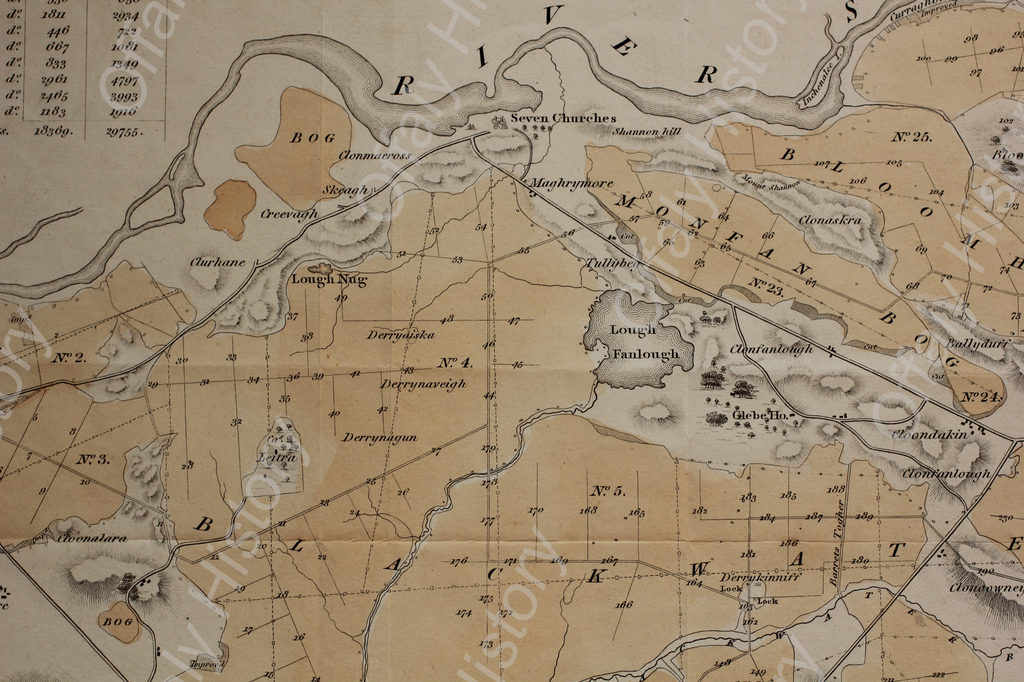
XI. NATURAL CURIOSITIES
The list of incumbents from the First Fruits’ Records.
The Reverend Philip Barret, Clerk, was collated on 26th day of May 1743 to the vicarage of Clonmacnois in the King’s County, and Diocese of Meath.
Stephen Bootle, 14th July 1762, Vicarage Clonmacnois, King’s County.
Joseph Pasley, 4th February 1763, Vicarage Clonmacnois, King’s County
William Donaldson, 7th November, 1764 Vicarage, Clonmacnois King’s County
John Baily instituted 15th December 1778, Vicarage Clonmacnois, King’s County – episcopally united to the Rectory of Ballygart in County Meath.
John Fitzgerald, instituted 10th October 1799 Vicarage, Clonmacnois, County Westmeath.
-
The ‘Elite’ of Tullamore skating at Charleville Lake on St Stephen’s Day 1864. By Cosney Molloy. Blog 344, 30 Dec 2021
Skating on Charleville Lake, Tullamore was a popular pastime when I was a young lad. I remember the cold icy winters of 1962, 1982 and 2010. I can recall as a young man the Tullamore people skating on Charleville Lake in 1962. I am a long time now in D 4 but I got down a few weeks before Christmas to the nice butchers in Tullamore – old Tormey’s is still going strong and now you have, Hanlon’s, Crossan’s of Main Street, Ray Dunne and Fergus Dunne, and a few more I would not know. I was sorry to see Grennan’s shop closed for now. I miss Paddy Mac’s, Cleary’s and Joe ‘the Butch’ Kearney and not forgetting Dunne’s butchers off the Square. It was Treacy’s later. Liver we got a lot of and sheep’s hearts in that fine shop. Many old friends gone to the heavenly pastures. I always like to get my turkey in Tullamore and a nice ham even though I am out of the town now for over forty years. What with the bacon factory open until 1989, and now Tullamore Meats, the town has a long tradition in fine food. Come to think of it the bacon factory did a huge business in turkeys back in the 1940s and 1950s when my father was rearing same.
(more…)
-
King’s County Infirmary – its closure in 1921 in an era of change. By Aisling Irwin. Blog 342, 22nd Dec 2021
King’s County Infirmary was established under the reign of King George III with the passing of the Irish County Infirmaries Act of 1765. This act enabled the creation of infirmaries in thirty Irish counties. During the redevelopment of Tullamore town by the Earl of Charleville, a new infirmary building was erected in 1788 on Church Street and was further extended in 1812.
The County Infirmaries Act was enacted to provide healthcare to the poor which fulfilled the eighteenth century philanthropic ideals of the landed gentry who supported these institutions through donations and subscriptions. King’s County Infirmary was supported by an income consisting of parliamentary funds, grand jury presentments, governor subscriptions, donations, and patient fees. The infirmary was managed by a Board of Governors who paid subscriptions for their position on the board which gave them absolute control over the infirmary including staff appointments and patient admissions. Governors were made up of local gentry and landowners such as the Earl of Rosse, Lord Digby, and prominent business owners such as the Goodbody family.
While surviving records are limited, the Board meeting minute books provide a colourful insight into the running of an infirmary in late 19th and early 20th century Ireland. The Infirmary’s Surgeon, Dr James Ridley, was linked to a scandal that pervaded the county in 1887 and 1888. Ridley, who also acted as one of the Tullamore jail physicians was reported to have died by suicide on the morning he was due to give evidence at the inquest into the death of John Mandeville, a national league activist. Mandeville who was imprisoned under the Irish Crimes Act of 1887 was subject to harsh and cruel punishment at the hands of his jailors and died shortly after his release from prison.
(more…)
-
Tullamore: ‘A good business town’. By Fergal MacCabe. Blog No 341, 18th Dec 2021
Why has there been so little public interest in the conservation of the architectural heritage of Tullamore?
Sharing a pot of tea in the Brewery Tap in the early 1980s with a well-known local builder, I remarked that demolition and redevelopment rather than conservation and reuse always seemed to be the first choice option. His reply, which I have never forgotten, was that new buildings which responded to modern needs were always preferable because ‘Tullamore is a good business town’. Change had always brought benefits and the future held more attraction than the past.
I understand that sentiment. Unlike Birr or even Edenderry, Tullamore has always been seen to be go ahead and dynamic; looking forward always and never backwards. That progressive approach was sustained by active business organisations and extended to the areas of arts, culture and local history also. It created a vibrant, attractive and always interesting atmosphere.
Nonetheless, little concern was ever publicly expressed for the protection of the town’s architectural heritage and the role it might play in its advancement. This derived partly, I believe, from a perception that since there were no buildings earlier than the mid 18th century, the fabric of the town was relatively new and was therefore of little or no artistic interest or value. This attitude was reflected in the non-existence, even to the present day, of any local civic group or architectural preservation society or even an Offaly branch of An Taisce. Birr might have its Chapter of the Irish Georgian Society, Tullamore despite its large inventory of 18th c. buildings, didn’t follow.
(more…)
-
Christmas Reading from Offaly History – twelve new titles of Offaly interest, one for every day of the Festive Season. Another bumper year for local studies. Blog No 337, 4th Dec 2021
All the books here can be purchased from Offaly History (Bury Quay, Tullamore and online) and at Midland Books, Tullamore. You can also view/ borrow at Offaly Libraries and consult at Offaly History Centre.
Rathrobin and the two Irelands: the photographs of Middleton Biddulph, 1900-1920. Michael Byrne (Offaly History, Tullamore, 2021), 330 pages, 280×240, hardcover, €24.99.
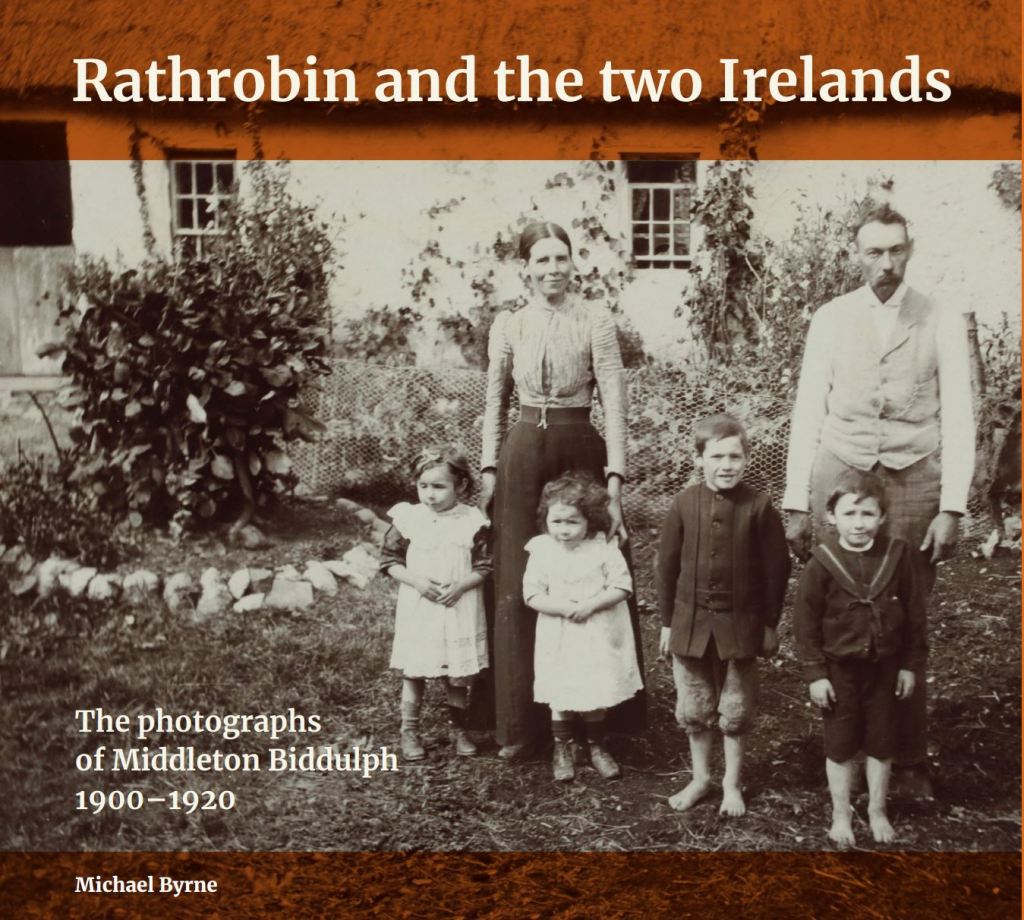
Rathrobin is a book that keeps on giving. Its 250 Biddulph photographs from the 1870s to 1920s, all carefully captioned, depict the two Irelands – unionist and nationalist, Catholic and Protestant, landed and cabbage garden. What is interesting about the pictures of Colonel Biddulph (1849-1926) of Rathrobin near Mountbolus are the nuances. He was of the lesser gentry, was a tenant of the Petty Lansdownes, and was well aware of the Plantations of the 16th and 17th centuries. He appreciated the needs of the farm labourers and was decent to his own tenants, staff and farm workers. His entire estate was not much more than a 1,000 acres. Biddulph’s circle was also the lesser gentry and those who served it such as land agents, bankers and clergy. The Catholic Protestant divide was strong but landed Catholic families did mix in Bidduph’s set, but not merchants or traders (even if very rich). Biddulph had an empathy with his farm workers and their families and sought their advancement. Many local families were photographed, together with the farming activities of his own employees.
Biddulph’s story, and that of his associates and friends, is illustrated by a selection of over 300 pictures in all, of which 250 are from the Biddulph Collection in Offaly Archives, and fifty more to illustrate the introductory essay and provide the all-important context. The essay and the photographs provide a more nuanced understanding of Ireland in the revolutionary period of 1900–23. Biddulph’s wonderful house at Rathrobin that he had so carefully ‘restored’, and all his farm improvements, were lost in the Civil War in 1923. Many other big houses from Ashford, to Ballyfin, Durrow, Brookfield, Screggan Manor and Charleville are also recorded in this volume. Some such as Brockley Park in Laois are now gone thereby making this an important work of record. The photographs by Middleton Biddulph were taken at a crucial moment in Ireland’s history. Their publication now could not come at a better time. Rathrobin is the portrait of one small estate and Killoughy parish in Offaly from the 1650s to the 1920s, but the story is of national interest. T.E. Lawrence spoke of the Arab Revolt, perhaps in Ireland we can talk of the Irish Revolt and not the full circle Revolution. You decide.
Rathrobin was supported by the Decade of Commemorations Unit in the Department of Tourism, Culture, Arts, Gaeltacht, Sport and Media
(more…)
-
The 14th and 15th earls of Huntingdon of Sharavogue, Shinrone and the Birr barracks scandal. By Stephen Callaghan. Blog No 335, 1st Dec 2021
Warner Francis John Plantagenet Hastings was born on 8 July 1868 at 54, St Stephen’s Green Place, Dublin. He was the son of Francis Power Plantagent Hastings, 14th Earl of Huntingdon, and Mary Anne Wilmot Westenra. The title of Earl of Huntingdon was an English peerage title originally created in 1065, the current title is its seventh incarnation which was created in 1529.
The 14th Earl married Mary Anne Wilmot Westenra 15 August 1867, who was the only daughter of Colonel Honourable John Craven Westenra, of Sharavogue, King’s County – a member of the Irish Whig party.
The family acquired lands in Waterford and King’s County. In the latter they lived in Sharavogue House. The house was originally built in the 1820s and was described as containing drawing and dining rooms of the finest proportion, a library, seven bedrooms, servant apartments, stables, coach houses and offices. A walled garden and 100 acres of land. Later additions to the house were made by notable Irish architect Sir Thomas Deane.
(more…)
 offalyhistoryblog