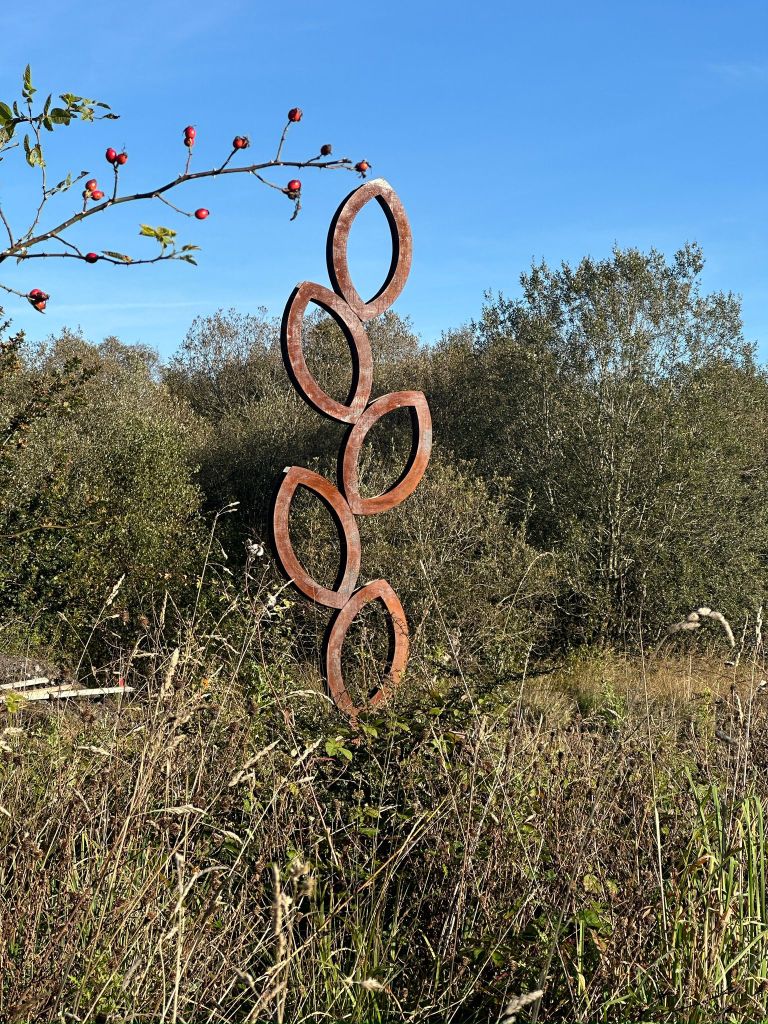
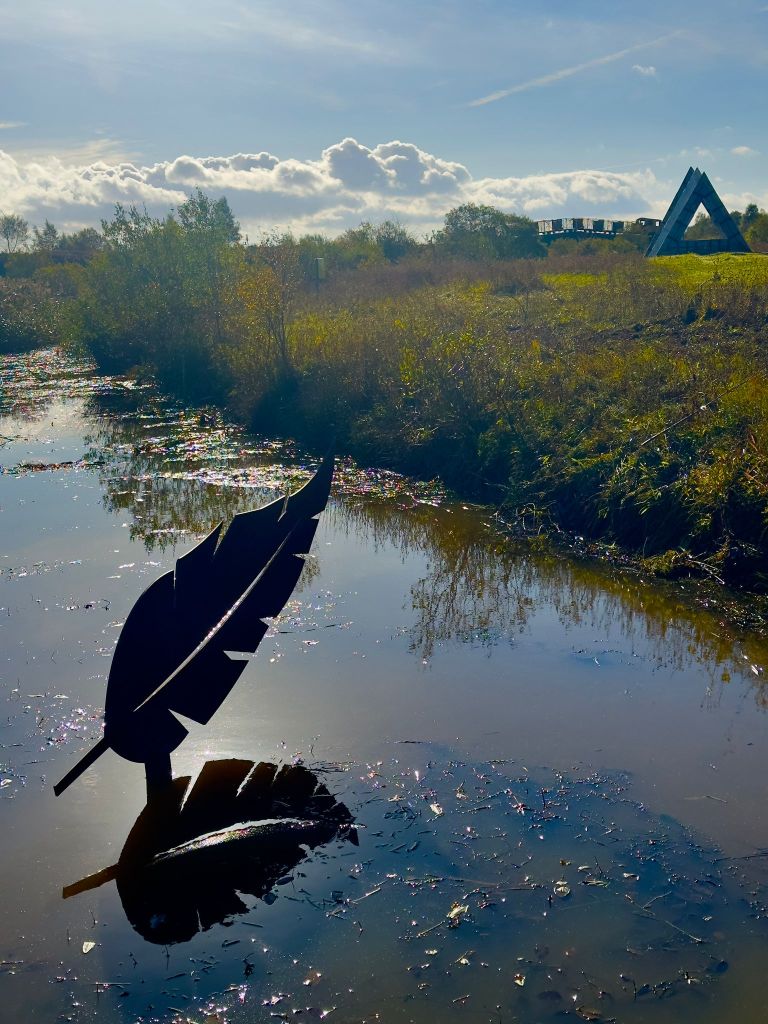
Two new sculptural works by artist Kevin O’Dwyer have been officially launched at Lough Boora Discovery Park, marking the first major additions to the park’s sculpture collection in over a decade. The works, titled Regeneration and Light as a Feather, reflect the park’s evolving story of transformation from industrial peatlands to a landscape of ecological restoration, culture and public enjoyment.
Regeneration draws inspiration from the seed as a symbol of renewal, growth, and cyclical change. Rising vertically from the ground, the work acknowledges the industrial history of the site while pointing toward its continued regeneration.
Light as a Feather offers a contrasting visual language — a suspended, airy form that engages with space, balance, stillness and the quiet expansiveness of Boora’s open horizon.
“Lough Boora is a place shaped by change, resilience and imagination,” said Kevin O’Dwyer. “These works are rooted in the landscape’s capacity to hold memory while continually becoming something new. O’Dwyer says it has been an honour to contribute to this next chapter in the park’s cultural and environmental renewal.”
One Wednesday morning in November 2013, as I painstakingly ascended several flights of stairs to reach the summit of the Offaly Adult Education building in Tullamore to inquire about the Leaving Certificate subjects of History and English, my mind raced at breakneck speed—not out of excitement for the prospect of taking the course, but in search of a plausible excuse to leave the building as soon as possible and avoid any interaction! This was the last place I wanted to be, but relentless pressure from my ex-wife, Orla, forced me to bite the bullet and investigate the prospect of returning to education. Orla displayed foresight as she observed something within me that she believed could thrive in the classroom environment. Unsurprisingly, I disagreed! I was more familiar with the confines of the construction industry! But to appease her, I agreed to ask about the course, with no intention of signing up! Nonetheless, my cunning plan was shattered faster than the speed of light when I was offered a place starting that same Wednesday morning. A sense of shock and horror enveloped me. Firstly, I was six weeks late beginning the course, and secondly, I had to walk into a room of students, most younger than me!
This volume of essays brings together the contributions of eighteen people who kept a keen eye on developments in Tullamore in the 1960s. Perhaps none more so than the late Joe Kenny who came to Tullamore in the 1950s as a vocational schoolteacher and was held in high esteem for his sound judgement and abilities as an impartial chairman. In that capacity he was the inaugural president of Tullamore Credit Union in 1963. Fergal MacCabe, as a Tullamore native, with a professional life in architecture and town planning in Dublin, brings a unique contribution by way of his recollections of Tullamore in the 1950s and his review of the first town plan of the 1960s. The same can be said of Vincent Hussey as a planning officer with Offaly County Council with his recollections of Tullamore since the 1960s. Niall Sweeney, an engineer and former Offaly County Manager, takes a close look at the provision of public infrastructure in Tullamore over the period from the 1960s to 2014. The late Jack Taaffe, as town clerk in Tullamore in 1970–72 demonstrates just how underfunded urban authorities were in those years. He went on to become county manager in Westmeath presiding over the progress of the county from 1981 to 1988. Michael Byrne looks at the history of business in Tullamore and sought to cover the principal enterprises of the 1960s in manufacturing, distribution, shopping, entertainment and dancing. Noel Guerin, as a former employee of ‘the bacon factory’, was able to write of a company that employed up to 100 people in Tullamore over forty years and made the name of the town famous for the Tullamore sausage. Ronnie Colton, from his own extensive involvement in the motor business brings a knowledge from the garage floor and sales yard that few others can match.
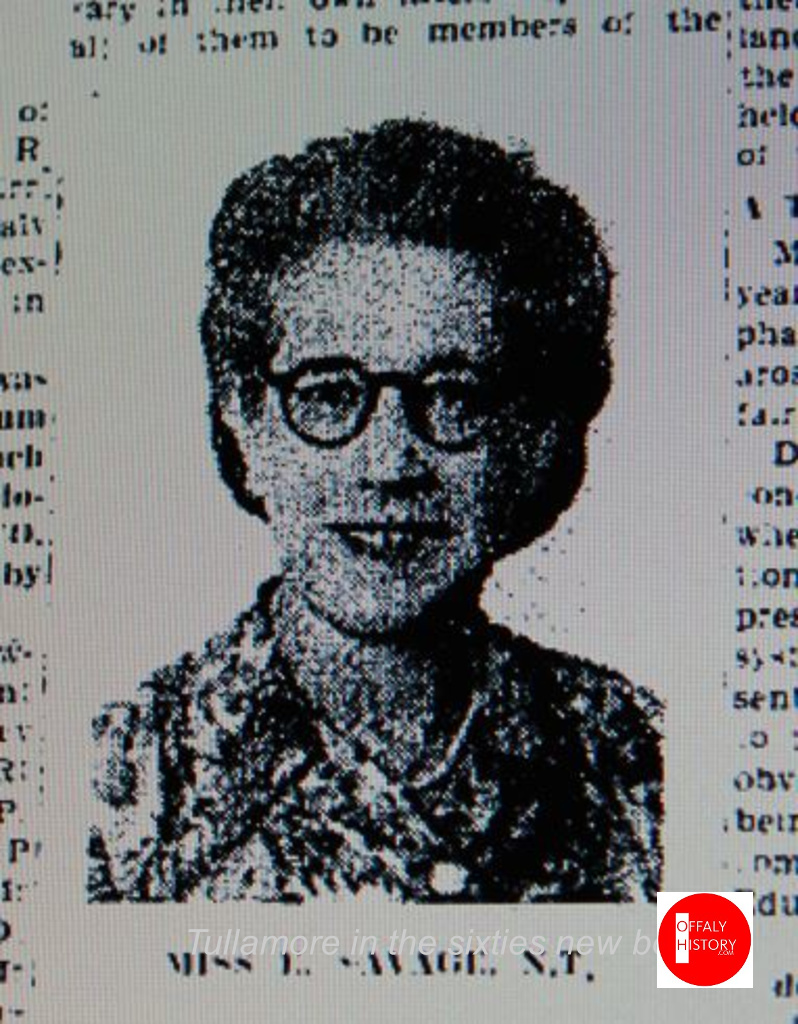
Miss Savage, a well-loved teacher in the Mercy primary school
Alan Mahon, as the grandson of an innovative cinema proprietor, recalls two cinemas in Tullamore whose cultural contribution is perhaps forgotten now but was all important to the people of Tullamore and district over a period of sixty or seventy years, if one takes it from the commencement of the Foresters cinema (later the Grand Central) in 1914.
Sport, so important to so many, brings us to the essay by Kevin Corrigan who looks at a formative decade leading on to the GAA Senior Football All-Ireland victories in the 1970s. Kevin had the challenging job of reducing to a short essay what could fill twenty books were one to address in detail each of the sporting activities that came to the forefront in the sixties.
Memories of Offaly can best be described as opening a diary into life in Co Offaly, over the last 50 or 60 years. The author of the book is Aidan Grennan, from Killina, Rahan. Aidan is to be congratulated on his second book. Both books are available from Offaly History Centre and online at http://www.offalyhistory.com
‘It is a nostalgic glimpse into the people and events in the county within my own life-time’ said Aidan. He commented: ‘I think it’s important now and then, to take a look-back over the years. I love nostalgia’, though we have to live in the present.
Violet Magan (aged 48), a sister of Shaen Magan, was acting as land agent to Colonel Biddulph of Rathrobin, Mountbolus, Tullamore and had continued to run the estate business of after the burning of Rathrobin House in April 1923. She was born in 1876 and was well known in the midlands as a volunteer worker with the Irish Agricultural Organisation Society ((I.A.O.S.) and went everywhere on her bicycle. Colonel Biddulph departed Ireland in a hurry in June 1921. It was soon after the killing of two RIC men in an ambush at Kinnitty. At the end of June there took place the killing of two brothers at Coolacrease near Cadamstown over land or over obstruction of the IRA or being alleged informers. The jury is out on this, but it can be said that many of the big house burnings were in the interest of securing for distribution the remaining demesne and home farmlands of the once big landlords. The Biddulph brothers of Kinnitty and Mountbolus had up to 2000 acres most of which they farmed themselves. Colonel Biddulph had about 700 acres and gave good employment in the area and was popular with his workers and tenants. His brother Assheton of Kinnitty had died in 1916 and the lands were in course of being sold in 1921-22. Shaen Magan was the husband of Kathleen Biddulph, the favourite niece of Col. Biddulph was was childless.
Pollagh also spelt as Pullough, is located in a small village in County Offaly, it is in the Civil Parish of Lemanaghan. A small parish, it extends from Ballycumber to Ferbane. Pollagh village can be found on the north side of the canal. The Parish lies in the territory of Dealbhna Eathra of the MacCoghlans – an ancient people. It has a rich heritage in its archaeology including the important monastic site, churches, and ringforts and the famous castles.
One of The townlands that we come along as we work our way down the line is Pollagh, the name in Irish is Pollach, meaning Place full of Holes.
Townland
Area
Pop in 1841
Pop in 1851
No. of Houses in 1841
No. of Houses in 1851
Pop in 1871
Pop in 1911
No. of Houses in 1871
No. of Houses in 1911
Pollagh
907
267
168
43
33
282
223
42
50
An interesting profile in the fall and rise of the population due one assumes to the successful brick industry.
Frank Mitchell (1912–97) was a distinguished but unassuming academic, environmental historian, archaeologist and geologist. While he had many academic writings his best known book was The Irish Landscape (1976) about which he was typically modest. In 1990 Mitchell published ‘a semi-autobiography’ The way that I followed. The title was a play on Robert Lloyd Praeger’s, The way that I went (Dublin, 1937). Praeger in his peregrinations was less kind to Laois and Offaly than Mitchell with Praeger’s observation that neither county need detain us long (p. 235) and ‘there is not much of special interest’ (p. 237). Westmeath he found to be more hospitable than Offaly having less than half of the amount of bog in Offaly and more pasture. We may look at the Praeger account in another blog
This article looks at the north Offaly towns featured in Major (later general) Vallancey’s report carried out in 1771 and designed to support the construction of the new Grand Canal line to Tullamore and the Shannon. Vallancey was then a young engineer, employed to report to the Commissioners of Inland Navigation and his findings were published in, AReport on the Grand Canal or Southern Line (Dublin 1771).[1] This report is useful as a window on some of the north King’s County (hereafter generally referred to as Offaly) towns and villages.[2]
Down the Decades was launched in Rahan Hall in November 2023 with a large audience and since then the new book by Tom Minnock has proved to be extremely popular with more copies printed to meet the demand. We asked Tom Minnock to tell us in this blog article about how the book came about.Born in 1922, the life of George Griffith tracked the life of the new Irish State, down through the decades. George never left his native Clonshanny giving him a local perspective on community life in the area during a fascinating period in the history of Ireland and the world.George Griffith died in March 2022.
Tom’s book is a collection of George’s reflections on that century up to 2022. Tom has set the context both locally and globally for each decade.
Tom Minnock writes:
The book is out there now and it is a peculiar feeling that is hard to put into words as something that you have spent countless hours living with takes wings. A few random words sketched out on a large note book and transferred on to a computer screen had grown and grown over time. How did this come about and why do I think it was important to publish it and expose myself to my community to be judged? I would like to share the journey and in doing so challenge you all reading this to consider writing or sharing your stories with somebody who will set them down for a future generation to ponder and continue the process.
This week we look at the background to the Vallancey report on the Offaly towns carried out in 1771 to facilitate the construction of the new Grand Canal line from Dublin to the Shannon. Vallancey was then a young engineer, employed to report to the Commissioners of Inland Navigation and his findings were published in a little known and very scarce pamphlet, AReport on the Grand Canal or Southern Line (Dublin 1771).[2] This report is useful as a window on some of the north King’s County (hereafter generally referred to as Offaly) towns and villages and all the more so because of the scarcity of published accounts of the midland towns prior to 1800.[3] The report was published in the same year as that of John Trail who was at the time employed by Dublin Corporation.[4] Vallancey was writing with a mission. He was being paid to spin the story of the benefits that would come from inland navigation and to highlight the difficulties with road transport and its adverse impact on competition and pricing of commodities so as to bolster the arguments in favour of canal construction and satisfy those who were paying his consultancy fees.
Why not contribute to our series of blog articles on the Grand Canal in Offaly – info@offalyhistory.com.