This week we look at the background to the Vallancey report on the Offaly towns carried out in 1771 to facilitate the construction of the new Grand Canal line from Dublin to the Shannon. Vallancey was then a young engineer, employed to report to the Commissioners of Inland Navigation and his findings were published in a little known and very scarce pamphlet, AReport on the Grand Canal or Southern Line (Dublin 1771).[2] This report is useful as a window on some of the north King’s County (hereafter generally referred to as Offaly) towns and villages and all the more so because of the scarcity of published accounts of the midland towns prior to 1800.[3] The report was published in the same year as that of John Trail who was at the time employed by Dublin Corporation.[4] Vallancey was writing with a mission. He was being paid to spin the story of the benefits that would come from inland navigation and to highlight the difficulties with road transport and its adverse impact on competition and pricing of commodities so as to bolster the arguments in favour of canal construction and satisfy those who were paying his consultancy fees.
Why not contribute to our series of blog articles on the Grand Canal in Offaly – info@offalyhistory.com.
During the twentieth century a tradition arose of a Christmas bird, usually a turkey, being sent from Ireland to extended members of the family who had emigrated to the Britain. They arrived in a canvas bag packed in straw. The Second World War disrupted the tradition. It did not resume immediately after the War as the British Government thought that birds would be traded on the black market in contravention of food rationing as explained by the New Ross Standard 22nd October 22nd 1948.
The growth of the soccer club and the rugby club from the mid-1960s led to increased pressure on the grounds such that from time-to-time fixture lists had to be substantially revised so that a pitch would be available. The soccer club enjoyed a tremendous burst of success right through the 1960s while the rugby club was fielding a 2nd XV from the mid-1960s. It was this pressure on the resources at Spollanstown that, more than anything else, led to the dissolution of the Sports Club in 1971. But a secondary factor was the collapse of the carnivals and marquee dancing as a profitable venture from 1966. Thereafter for some five years substantial revenue was earned from Saturday night dancing. These Saturday night hops were largely the responsibility of the rugby club and the profits generated made the argument for independence irresistible. In January 1968 the rugby committee noted that the Sports Club had had a disastrous year financially and would be down £300 but for the profit of £540 from the Saturday night dances. The view of the meeting was that the rugby club wanted a home of its own even if this meant leaving Spollanstown. Soon after the Sports Club met and agreed to dispose of the bungalow built for the caretaker adjacent to the grounds for the sum of £2,650 to pay off the liabilities of the trustees.
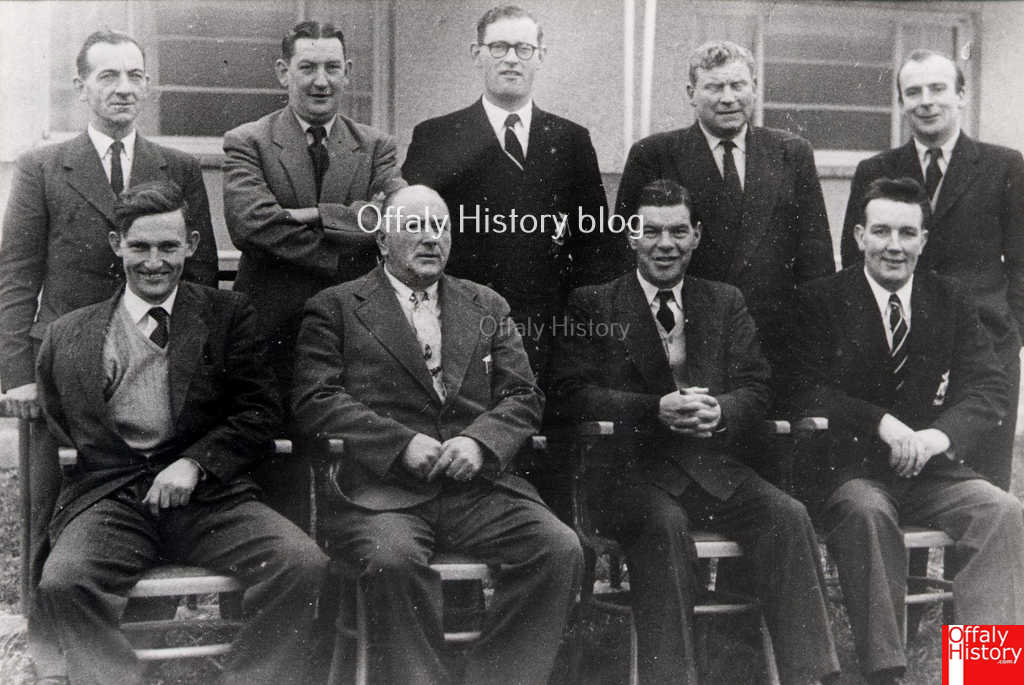
First trustees of the Tullamore Rugby and Soccer Club, 1956. Back row: T. Kelly, G. Smyth, H.L. Egan, W. Champ, D. Kilroy; front row: Terry Adams, W. Stephens, J. Kilroy, O. McGlinchey.(more…)
As evidence of the climate crisis increases across the world, the need to find alternative forms of energy to fossil fuels has intensified. According to the Sustainable Energy Authority, Ireland imports a little over 70% of the energy used with the EU average, being 58%. Ireland’s. Transport accounts for the most demand, with over 95% of transport energy coming from fossil fuels. Other than environmental factors, being dependent on importation of fossil fuels has led to concern about energy security due to the geo-political climate, specifically today, the Russian Ukraine War.
As a country without its own oil and a limited supply of gas and coal, peat has historically been an important fossil fuel for Ireland, providing it with some energy self-sufficiency.(Geological Survey Ireland) In recent decades, however, there is growing recognition that burning peat for fuel is not sustainable as not only is it a highly carbon inefficient fuel, intact peatlands are an efficient carbon sink, whereas damaged peatlands are a major source of greenhouse gas emissions. “. . . Ireland has more than half the European Union’s remaining area of a type of peatland known as raised bog, one of the world’s rarest habitats and, scientists say, the most effective land form on earth for sequestering carbon . . (New York Times 4 October 2022)
The Tullamore and County Offaly Agricultural Show may be described as a unique cross urban/rural community undertaking and a traditional family day out attracting up to 60,000 people to the show. The Tullamore show was rekindled in 1991 by a small group of local people representing urban and rural communities. The Tullamore and Co. Offaly Agricultural Show Society Ltd was founded in 1990 and since its inception the Tullamore Show has grown to become one of Ireland’s largest and finest one day shows with entries from the 32 counties. In the early years of the 1990s the Tullamore Show was held in the grounds of Charleville demesne and castle in the month of August.
A 2018 show launch courtesy of the Show Gallery(more…)
Kitchen, parlour and bedroom – transforming a house into a home
Traditional Architecture in Offaly: History, Materials and Furniture by Rachel McKenna (Offaly County Council, 2022) is a wonderful new addition to the growing collection of quality publications on the county of Offaly and its place in Irish heritage. For long neglected by the travel writers who took the coastal route the county has made up for that oversight since the late 1970s with a whole series of publications. The writer is the county architect and well placed to observe the changing scene and to appreciate what was distinctive about the habitations of the ordinary people (the third and fourth class housing of the 1841-61 censuses) and what has survived to the present day. As the CE of Offaly County Council has written in the Preface
First established under the 1881 Land Act, the Irish Land Commission began as a regulator of fair rents, but soon evolved into the great facilitator of land transfer. However, over emphasis on these aspects of its work can sometimes camouflage its equal significance as the main instigator and architect of rural reform. There is no doubt that for most of its existence from 1881 to 1992 the Land Commission was the most important state body operating out of rural Ireland where its long tentacles spread into every nook and cranny. [Come to Professor Dooley’s lecture on Monday in Tullamore – see details below.
Huge Crowd Gather in Bracknagh Community Hall for viewing of Film
Bracknagh Community Hall was full to capacity on Thursday last for the viewing of a film on the Ballynowlart Martyrs and the Turf Co Operative 101. The event was organised and hosted by the newly formed Bracknagh Heritage Group (A sub group of the Bracknagh Community Association). The guest speaker was Larry Fullam, local historian and researcher from Rathangan. Tony Donnelly extended a warm welcome to the large gathering. Mary Delaney, on behalf of the heritage group introduced and welcomed both Larry Fullam and Amanda Pedlow (Offaly Heritage Officer). Amanda addressed the audience on the supports provided by the Heritage Council for viable local projects.
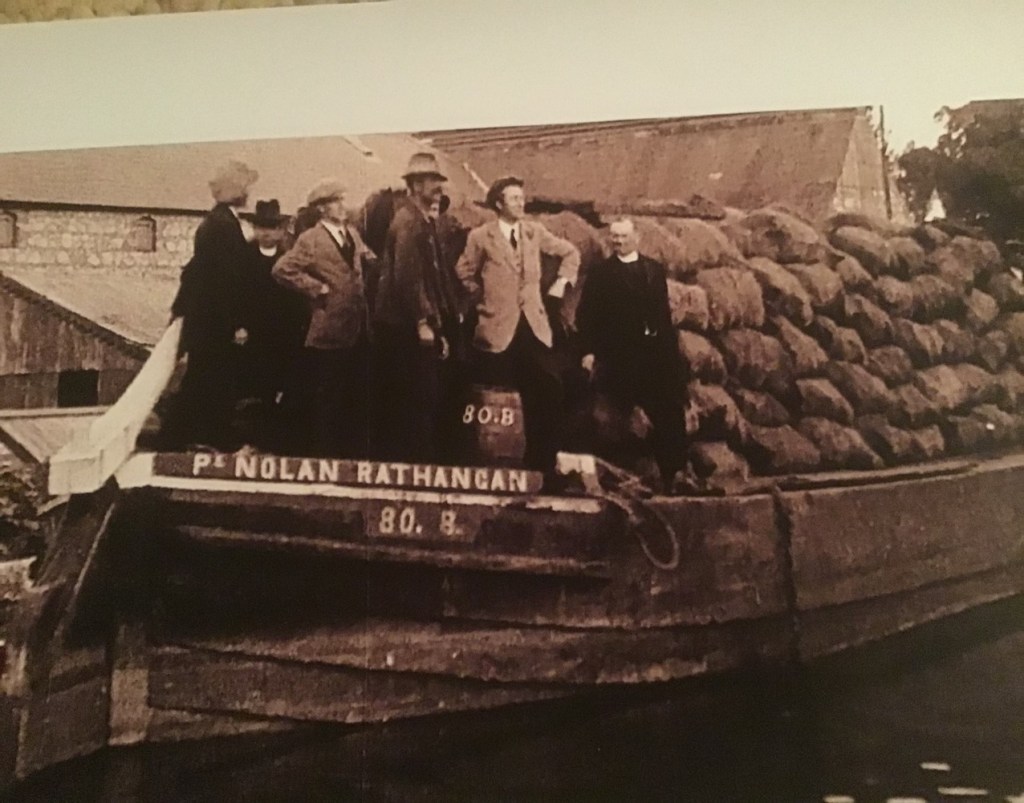
Larry spoke on how in 1917 a local priest Fr Kennedy with the help of Fr O’ Leary from Portarlington had the remains of the victims of a fire at Ballynowlart church in 1643 exhumed and reburied in the grounds of the St. Broughan’s church. The story of Ballynowlart attributes the setting alight of the church on Christmas Day in 1643 to Cromwell’s forces. A congregation of 108 people, who were attending Christmas Mass all died, with the exception of two, who were said to have escaped. The film produced by Pathe showed Fr Kennedy handling the exhumed skulls of the victims and preparing them for reinternment in Bracknagh in 1917. The second part of the film centered on how in 1921 (one hundred and one years ago), as part of the Government’s selling of bonds and fundraising, the Bracknagh Turf Co Operative exported sacks of turf to New York to raise money to fund the then, newly formed, Dail Eireann. Larry donated a number of photographs of the stills from the film to the Bracknagh Heritage Group.
The last time a film on Ballynowlart was shown was in 1964 in the cinema in Portarlington. This event was organised by the late Harry Milner of Walsh Island and was attended by a huge crowd from the Bracknagh area, many of whom are still part of the community of Bracknagh today. The Bracknagh Heritage group are very grateful to Larry for his in-depth research and knowledge and for providing us with a great insight into Bracknagh’s past.
The members also expressed their appreciation to all those who attended Thursday evening’s event and are delighted to see the interest and enthusiasm for local history in the area.
The group intend to pursue the following projects in the near future. The real story of the Ballynowlart Martyrs. The monastic site of Saint Broughan at Clonsast. The Impact of Bord na Mona in the area. The Story of John Joly and the extended Joly family.
Lord Ashtown and his role in evicting tenants from the Bracknagh area in the mid 19th century, and how some Bracknagh emigrants were banished to places like Oneido in New York.. The RIC Barracks in Ballynowlart and The Mill at Millgrove. It was highlighted at the conclusion of the meeting how the Catholic Church, built at the peak of the Irish Famine celebrates 175 years this year. The group extend;’/ thanks to Lisa Quinn, Chairperson of the BCA for facilitating the event.
Mary Delaney
(on behalf of the Bracknagh Heritage Group, which include. Francis Cunningham, Mary Crotty, Mary Briody, Barry Cunningham, Tony Donnelly & Aidan Briody).
People from Bracknagh gather outside Portarlington Cinema 1964 after watching a film on the Ballynowlart Martyrs (Photo courtesy of Larry Fullam) Bag of Turf from the Bracknagh Turf Co-Operative destined for New York 1921
All the south midland towns declined during the fifty-year period after the Famine with the exception of Clara where the Goodbody jute factory provided employment for 700 workers in the 1880s. The towns of Birr and Banagher were most severely hit. The decline of Birr was exacerbated by the final closure of the large military barracks in Birr in 1922. The previous year the Birr workhouse was closed and amalgamated with Tullamore. At a time of depression and scarce employment opportunities it was not surprising that the county capital, Tullamore, should seek to draw to itself whatever job opportunities existed in the public service sector, but it was to cause a good deal of resentment in Birr up to the 1950s.
Several of my ancestral families came from Ireland in the early to mid 1800s. They came from Counties Dublin, Armagh, Tyrone, Westmeath and King’s (now Offaly) and surrounding midlands counties. The one common factor was that they all migrated to Quebec, settling in several small communities in the area just southeast of Quebec City across the St. Lawrence River.
After a generation, many of those families moved to western Canada or the United States, often settling together. Many went to Wisconsin and Michigan where they worked in the logging industry and farmed. In the next generation, some married into other Irish families, so studying one’s family gradually evolved into studying several. My families were among those settling in Jacksonport, Door County, Wisconsin.
I had always wondered how and when these Church of England/Ireland families got to Ireland from England and Scotland, then migrated to the same places in North America. What did they have in common? There are no relevant ship manifest lists for British Isles migrants going to Canada since it is a part of the British Commonwealth, and it was not like going from one country to another.
I have an old family Bible with some information, but for the most part all I had to go on was Canadian census records or church records which gave a child’s birthplace and age, indicating approximately when the families left Ireland, and if I was lucky, a more specific birthplace. Usually, specific meant only a county. Family lore told of one or two Bagley children being born in Clara, Kings County. Other names of the Quebec families appeared in the Irish Midlands, so I concentrated my research there.