
Bogs are in the news again and were very much so 200 years ago this month because of the phenomenon known as ‘the moving bog at Kilmaleady [Kilmalady big] near Clara’. It was reported in the national press (there was no local press back then) and in 1825 in Brewer’s account of Ireland. It had earlier appeared in the Freeman’s Journal for 21 July 1821. The Freeman’s Journal for 29 June 1821 reported that : On the 26th June great confusion was caused in the district of Clara by the south front of Ballykillion bog (a large and extensive of one of about one and a half square miles, and a depth of about 25 feet) moving with great violence and carrying before it everything in its way. It tore up the meadowlands and carried it along on its surface. Its direction was across an extensive valley. It dislodged a river and ran with extensive violence against an opposite hill, then recoiled and ran down the valley until it met another hill and road that checked its progress, after which it piled up in large broken fragments an immense heap of bog from 20 to 40 feet deep and covered about 150 acres of choice meadow and pasture land. This land was let from £2 to £3 an acre and was the property of the representatives of the late George Clibborn of Moate. ‘Its progress was awful and the noise tremendous. The people were enabled with difficulty to drive off their stock. The water is now confined and the river is stopped up, and the most serious apprehensions are entertained that the water will again put the huge mass in motion. It is estimated that a thousand acres of meadow will be destroyed unless timely prevented by immense labour.[Here the writer advocated the need for drainage of bogs and the want of employment.] . .
(more…)Category: Agriculture
-
Agriculture in Offaly on the eve of the Great Famine. By Ciarán Reilly. Blog No 255, 16th Jan 2021
On the eve of the Great Famine in 1845 the backwardness of Irish agriculture was seen by many as the reason for much of the country’s economic woes. About Irish farmers, it was stated that they knew nothing of the ‘English’ method of farming or indeed welcomed its arrival. However, there was amongst many Irish landlords, and their agents, a growing understanding of the benefits of the ‘science’ of agriculture and many had willingly adopted such methods in the management of their estates. In particular, many land agents were the leading pioneers of better agricultural practice. The employment of agriculturalists; the establishment of agricultural societies and the trips undertaken to observe foreign models of agriculture all highlight the progression of Irish agriculture by the early 1840s.
(more…)
-
MEMOIRS OF AN EMPLOYEE OF THE MIDLAND BUTTER AND BACON COMPANY, TULLAMORE. By TARA and Offaly History. Blog No 242, 28th Nov 2020
The well-known geographer, T. W. Freeman, provided us with a useful summary of the work in the Tullamore bacon factory in his geographical survey of Tullamore published in 1948:

An advert of 1965 The Midlands Co-Operative Society began its career as a creamery in 1928, and was at first intended to absorb the milk supplies of the neighbourhood for butter – making, but as these were never sufficiently great the trade in eggs and poultry became more important. Like the two private firms mentioned above [Williams’s and Egan’s], the Co-Operative Society buys and sells over a wide area, which includes the two counties of Leix and Offaly, the whole of Co. Galway, and parts of Tipperary, Roscommon, and Meath . Altogether the Society handles some 30,000 cases of thirty dozen eggs, of which three-quarters are exported to Britain, and approximately 24,000 turkeys, 5,000 geese, and 18,000 hens per annum, mainly for export or the Dublin market. Butter is bought from other creameries, made into one – pound rolls, and sold. In 1945, a bacon factory was added; the pigs are bought in Co, Offaly, and the produce sold in much the same area as that covered by the eggs and poultry trade. The scarcity of pigs at present means that the factory is working below capacity. The Society also has a sawmill using local timber for making cases and firewood and runs retail shops in Tullamore town and at Clonaslee: in all, it employs 180 workers, with 80 extra in the Christmas turkey season, and 20 extra in the main egg season, from February to May: most of this labour is drawn from the towns.
(more…)
-
The Maynooth Local Studies Series, recent issues, the Offaly volumes and the entire series listed here. Sources for Offaly History and Society, number 10. Blog No 230, 7th Oct 2020
The current issue of Irish Historical Studies (no. 165, May 2020) has a featured review of five issues from the Maynooth Local Studies series published in 2019. That brought the number issued to 144. We attach the list to 144 for your convenience and we bring to your attention the latest batch of four. Raymond Gillespie is the quiet man behind the series and who has acted as general editor since its inception in 1995. The reviewer in IHS, Maura Cronin, reminds of his characterising local history as being ‘primarily about people in places over time’. Place is described as the bedrock of local history, but it must be seen in the context of the actions of people and the pivotal role of historical research is looking for the forces of disruption and of cohesion. What brought people together and what drove them apart.
The four new issues of 2020
Four new volumes have been published in the Maynooth Studies in Local History series (general editor Professor Raymond Gillespie). The volumes by Denis Casey, Emma Lyons, Brendan Scott and Jonathan Wright and can be ordered via Offaly History Centre.
(more…)
-
The Story of Bog Butter. By John Dolan. Blog No 224, 13th Sept 2020
Bog butters are large white or yellow waxy deposits regularly discovered within the peat bogs of Ireland and Scotland. They represent an extraordinary survival of prehistoric and later agricultural products, comprising the largest deposits of fat found anywhere in nature. Often found in wooden containers or wrapped in animal bladders, they are considered to have been buried intentionally by past farming communities. While previous analysis has determined that Irish bog butters derive from dairy fat, their precise characterisation could not be achieved due to chemical compositional alterations during burial in subsequent years. They generally produce a distinctive, pungent and offensive smell.
The largest Irish example weighed 23kg (50lbs) from a find in the Galtee Mountains in 1826. Bog Butter is primarily held in the National Museum with some held by local museums.
(more…)
-
The Great Famine in Shinrone & South Offaly. Ciarán Reilly . Blog No 206, 27th June 2020
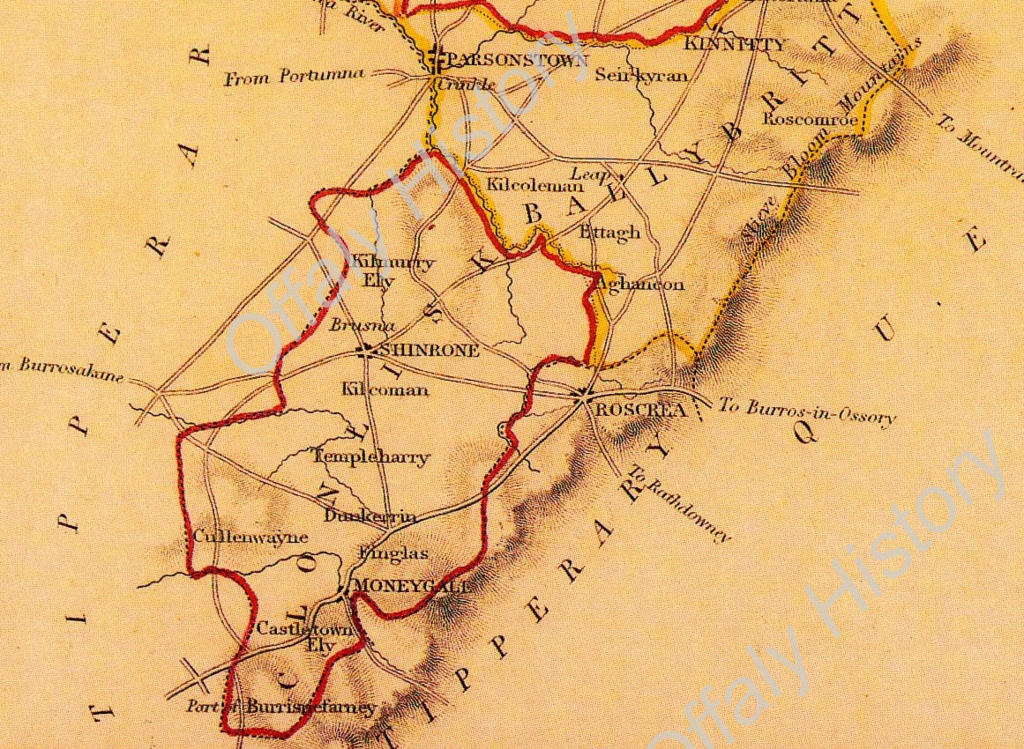
A document in the National Library of Ireland sheds important light on the fate of the inhabitants of a part of county Offaly during the years of the Great Famine. Here the names and circumstances of almost 500 people in the village of Shinrone and its hinterland are included on a register for relief, which was provided during the summer and autumn of 1846. Among the names may well be an ancestor of Barack Obama, 44th President of the United States of America. While Obama’s Irish heritage has been well documented in the past, not least during his visit to Ireland in 2011, few descriptions survive of how the Great Famine directly impacted the Kearney families and their community. It is hoped that this document will be transcribed and made available in Offaly Heritage in the near future.
-
‘Killing the pig in 1950s West Offaly’. By Pádraig Turley. Blog No 181, 21st March 2020
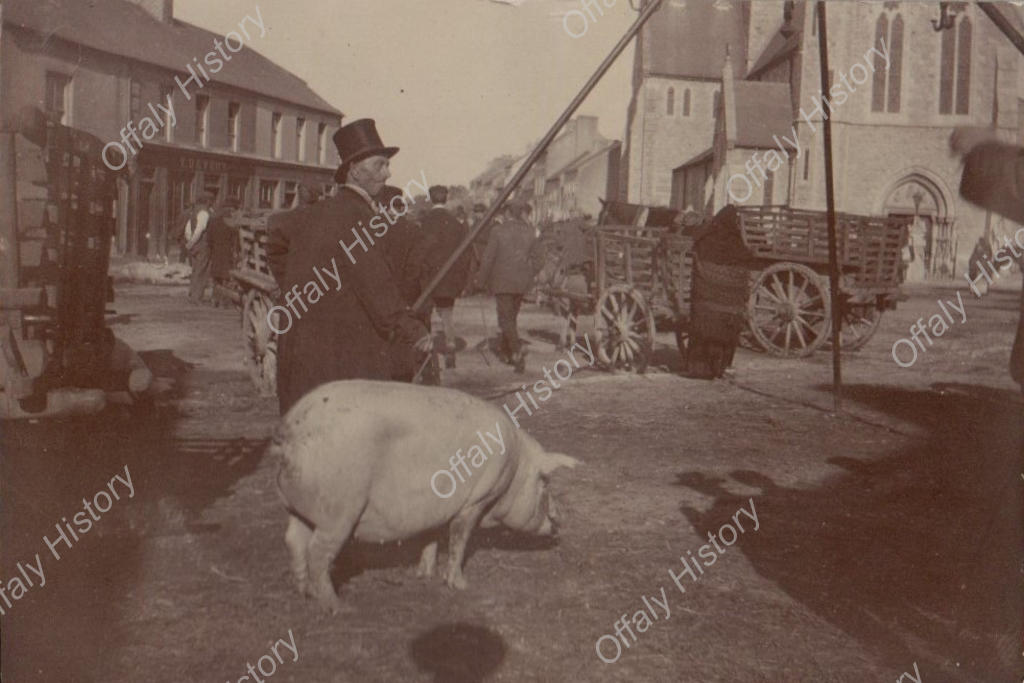
Selling a pig at Clara Market about 1900. Courtesy of Michael Goodbody The killing of the pig was an event, which occurred twice a year on our farm in Clerhane, two miles north of the village of Shannonbridge, during my childhood. The particular event I am going to relate happened in the early 1950s, certainly no later than 1953. I remember this because reports of the Korean War, were perpetually on the wireless. My grandfather Michael Claffey took a keen interest in that war, which was very remote to the folk in Clerhane.
So I was about eight or nine years of age when this happened. We are very much talking about the pre iPhone/iPad era. Back then it was not possible to take instant photos, which one could post to some social media platform. One can only imagine in today`s world how the image of the killing of a pig would horrify the viewer, and would no doubt release a stampede of trolls. The outrage would be immense.
-
A D. E. Williams Limited Tullamore maltster for fifty years tells his story. By the late Michael Power of Marian Place, Tullamore. Blog No 174, 8th Feb 2020

The old floor malting process for hundreds of years ceased in Tullamore in 1969. Cover pic is of Water Lane now entrance to Main Street, Tullamore. Courtesy of Fergal MacCabe. The Williams company of Tullamore (1884–1996) was in the malting business from 1892. Other Tullamore firms included Egan, Tarleton and B. Daly, the Tullamore distillery. In this article Michael Power tells his story. This piece was first published in Jip-cat, pig’s head, petticoats and combinations: our lives, our times in Tullamore and surrounding districts; editor Feargal Kenny. Tullamore: Tullamore Active Retirement Association, 2002 (available from Offaly History Centre).
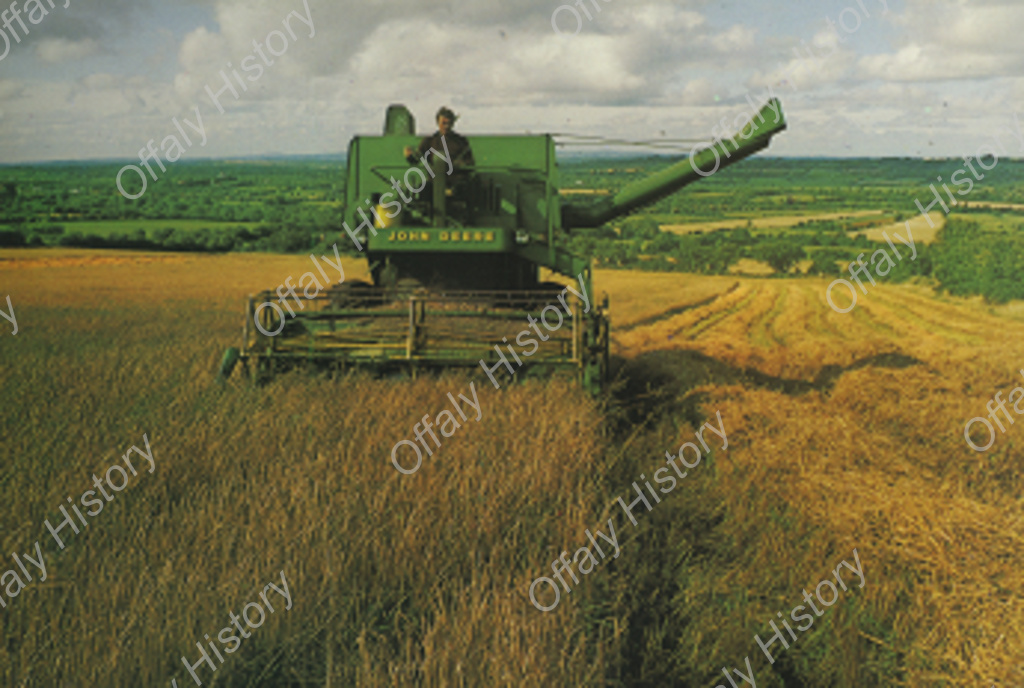
Modernisation of agriculture in the 1970s As a seasonal worker in the Maltings, you started in September when the harvest came in and wound up in May when the malting was over. I became a permanent worker [at Williams/B Daly/Tullamore Distillery [in 1932 and remained there for fifty years. The work was hard, labouring work, carrying sacks, working in the malthouse, screening malt and barley and carrying sacks of grain.
-
Shackleton’s photographs of Tullamore and west Offaly in the 1890s. Michael Byrne. Blog No 162, 16th Nov 2019
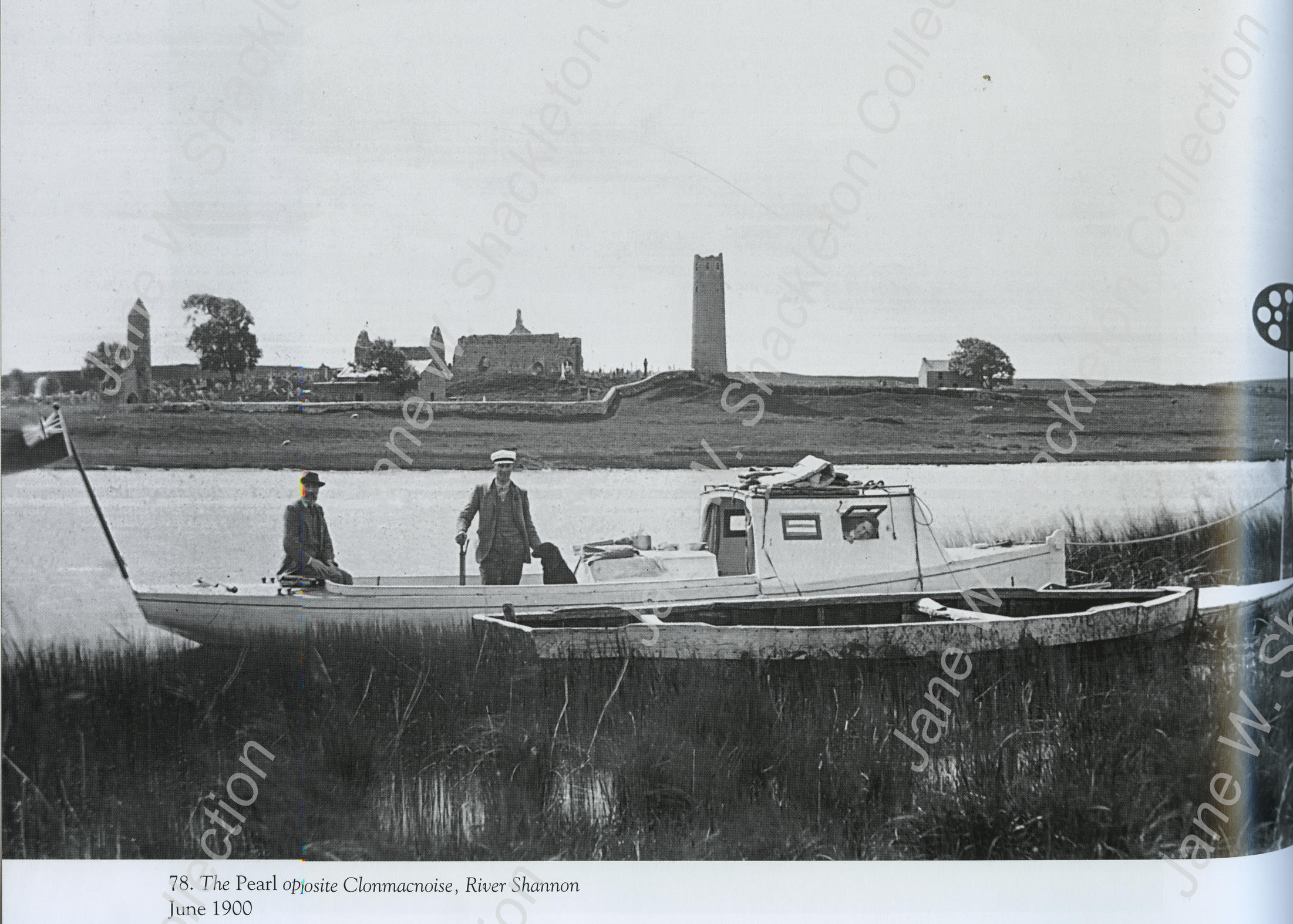
Jane W. Shackleton’s Ireland compiled by Christiaan Corlett (Cork, 2012) is an attractive large format publication from the growing stable of books issued by Collins Press and consists of 180 well produced photographs by Jane Shackleton. Jane Shackleton (nee Edmundson) was born in 1843 and in 1866 married Joseph Fisher Shackleton of the famous Ballitore, County Kildare family of Quakers. Thirteen Shackletons are included in Richard S. Harrison’s, Dictionary of Irish Quakers (second edition, Dublin, 2008) including Jane’s husband, Joseph Fisher Shackleton. Like his father he was a miller and in 1860 took over the Anna Liffey Mills in Lucan.
-
Memories of Rural Electrification and the Arrival of the ‘Electric’ in County Offaly An Oral History Project John Gibbons. Blog No 154, 28 Sept 2019
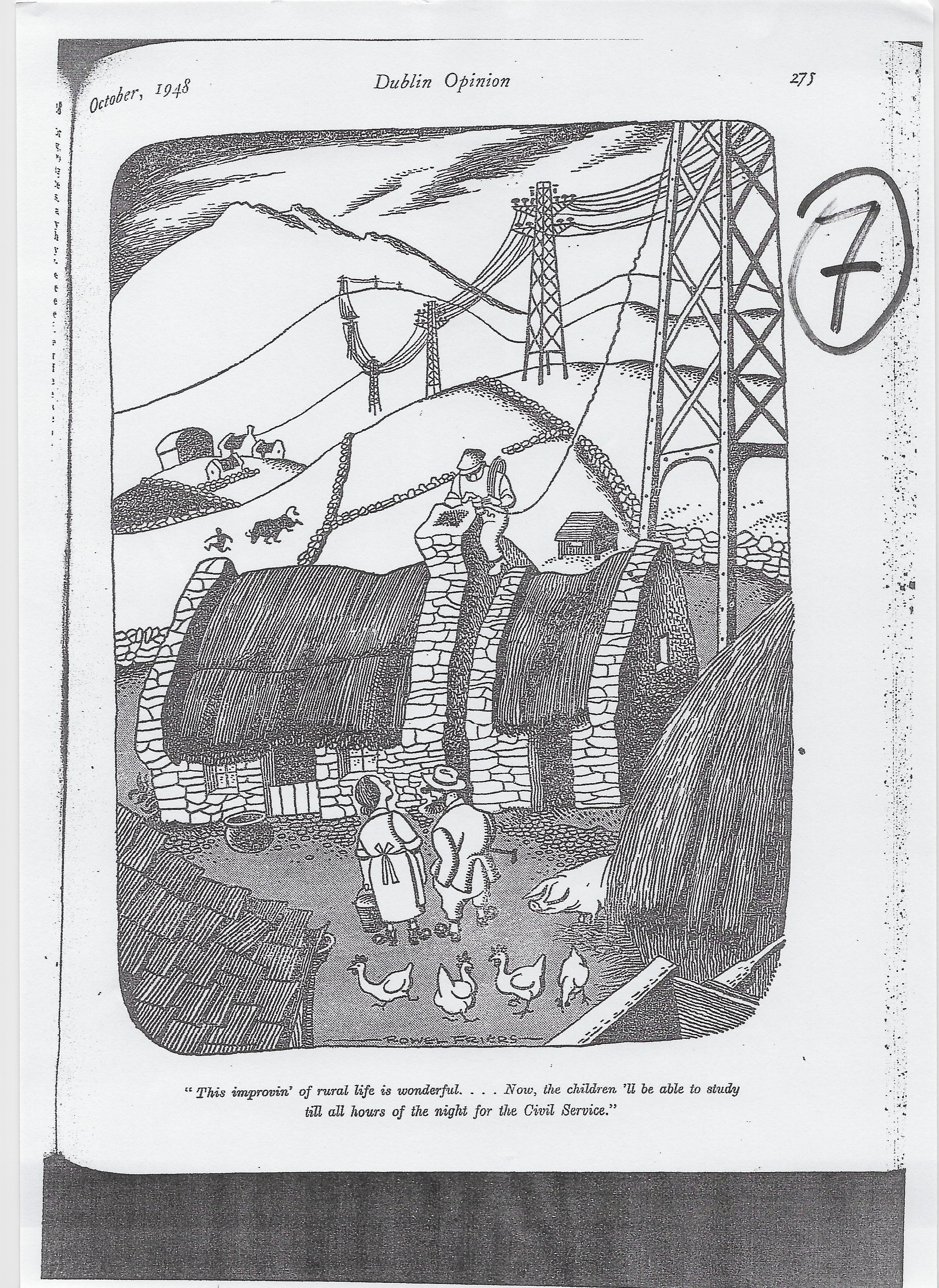 In October 2014, following an introduction by Amanda Pedlow and Stephen Callaghan, an understanding was reached with the late Stephen McNeill, the then President and Micheal Byrne Secretary of the Offaly and Archaeology Society for them to assist and source interviewees in connection with my project to record persons talking about their memories of life around and about ‘The arrival of the rural’ in Offaly, to date I have recorded over 30 persons in Offaly. Since August 2016,utilising excepts from recordngs, a 45 minute audio/slide presentation which was shown by me to members of History Societies in Edenderry, Tullamore, Rhode, in March 2019 a fourth presentation was shown to members of the Ballinteer Active Retirement Association. A fifth presentation is scheduled for showing in Bury Quay, Tullamore in early 2020.
This Blog seeks to briefly explain aspects of the Rural Electrification Scheme in Ireland and what Michael Shiel in his book called The Quiet Revolution (Dublin 1984) [JPG0292]

