This is a new 20-minute video recording on the history of the Society, now better known as Offaly History with lots of interesting photos especially recorded for Heritage Week. We want to thank all who have contributed to making it so successful so far with activities across the county, and continuing until Sunday. The lecture on Larkin’s maps and their predecessors we shall post next week, also a video on the Durrow Pattern. Our next lecture is on 5 September on Michael Collins and is important. More information next week.
A PowerPoint presentation narrated by Michael Byrne explores the identities of Castle Street in Birr as part of a project to know and appreciate our distinctive town centres. This Streetscape project is in partnership with Offaly County Council and part funded by the Heritage Council.
An initiative promoted by the Heritage Council as part of its Streetscapes Project
Castle Street about 1857. Courtesy of Birr Castle Archives
The focus of this study is Castle Street in the town of Birr. The street comprises a mix of about thirty commercial and residential properties close to the Camcor river to the south, Main Street and the old parish church to the north, and to the west Birr Castle. On the east at the Market Place or Market Square it opened into Main Street, Bridge Street and from the 1880s into the new Brendan Street.
Castle Street about 1920.
The market house stood from the 1620s where the memorial to the Manchester Martyrs was placed in 1894. Surprisingly, when the market house was taken down in the late 1700s it was not replaced with a new building. Castle Street varied greatly in character from the strong residential houses of two and three-storeys to the robust commercial warehouses close to the boundary of the castle, attracted by the availability of water-power and facilitating in the 1800s the development of distilling, brewing and malting houses. Castle Street was also the principal marketplace in Birr with markets held each week and large fairs three or four times per year. There was a strong base in agri-business in the street and this in turn created businesses such as draperies and boots and shoemaking to cater for the farming clients from the prosperous hinterland. That Castle Street was intimately bound up with the rural economy is clear from the surviving early photographs of the 1900s and one of 1856–7. The early photograph is by Mary Rosse and is of a market day in Castle Street.[1] This would make it the earliest surviving photograph of a busy street in Offaly, as most others are not before 1890 or 1900.
Castle Street about 1970, courtesy Birr Castle Archives
[1] David Davison, Impressions of an Irish Countess: the photographs of Mary countess of Rosse, 1813-1888 (Birr, 1989).
Crotty’s Church, Castle Street
Click on the blue Offaly History Blog to open the video from an email
Exploring Castle Street, Birr: the buildings, business and people.
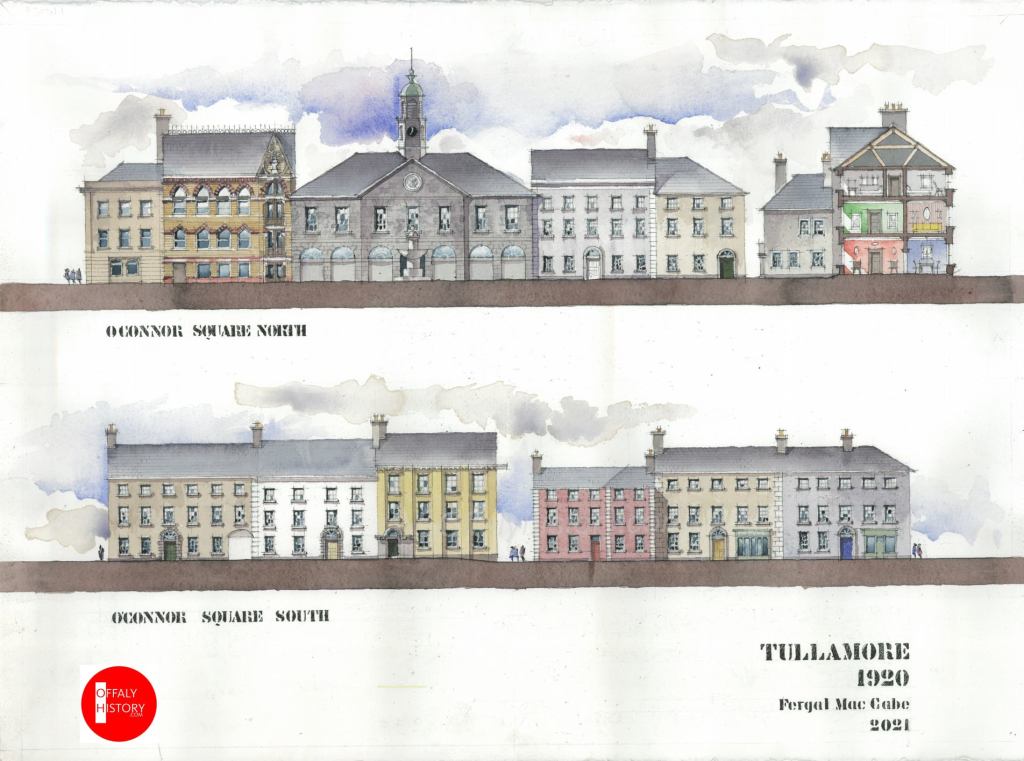
A PowerPoint presentation narrated by Michael Byrne explores the identities of O’Connor Square, Tullamore as part of a project to know and appreciate our distinctive town centres. This Streetscape project is in partnership with Offaly County Council and part funded by the Heritage Council.
The Making of O’Connor Square, Tullamore since the 1700s: the buildings, business and people
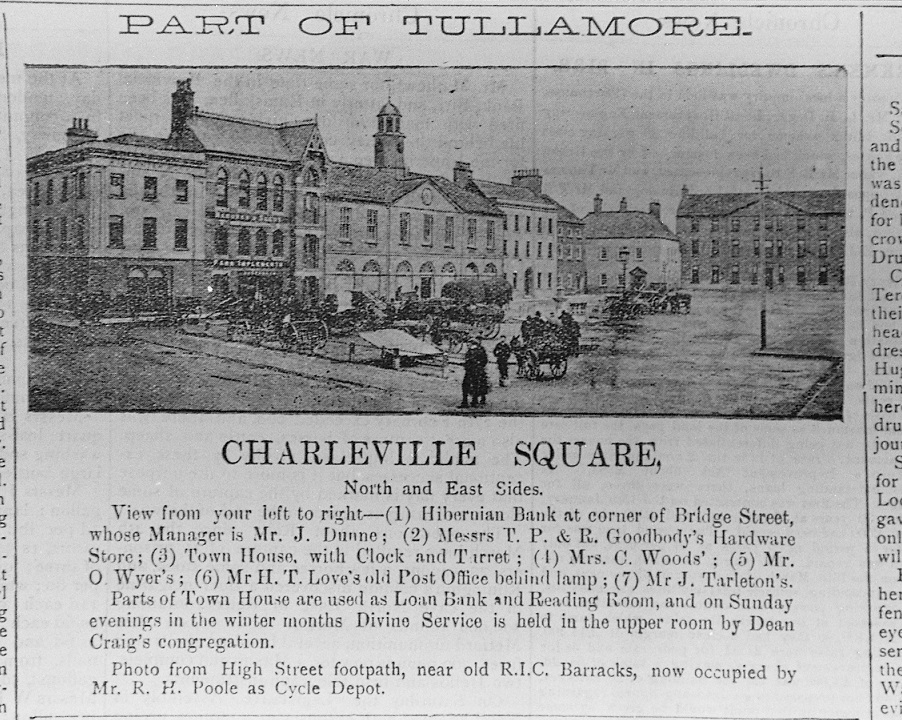
O’Connor Square is Tullamore’s most impressive open space and the gradual development of this area into its principal square is reflected in its fine houses, market house and the variety of names it has had. Despite the course of building for over some fifty years, from 1740 to 1790, it has a uniformity of scale even with the much later vocational school of 1936–37, now the Tullamore Library. In 1713 this area was simply known as the Market Place and, with the opening of one-third of the square in 2019 to pedestrian access only, is now enjoying a comeback to its original function as a meeting place, albeit now to barter ideas and stories and not agricultural produce. Our thanks to the Heritage Council and Offaly County Council for supporting this project and rejuvenation of the square. A special thanks to Fergal MacCabe for his watercolours that bring out so much of what is wonderful about townlife.
Take a look at the video below for more about Tullamore’s meeting place and prime residential location for so long.
Tomorrow, we look at Castle Street, Birr over 400 years of history in that one street.
This weekend sees the start of Heritage Week 2022 and a very welcome return to exploring the county in person with some great material coming on-line too from Offaly History. We are launching six new videos via Offaly History YouTube and Heritage Week 2022. Our thanks to Amanda Pedlow, county heritage officer for all who work in coordinating the programme. She writes:
With over 30 events here is a reminder for Saturday’s events as a starter’…@offalyheritage @HeritageHubIRE Our thanks to Fergal MacCabe for the use of three of his wonderful watercolours of Srah Castle (1588), Ballycowan (1626) and Bury Bridge (1801).
Bridge Street, that narrow street that we rush through so many times each week, but have to stop at lights whether on foot or by car (or bike), is as old as the town itself. Here is the river that divides the town, was a source of water and power for milling and, because of this, a base for settlement. The bridge may date back to the 1720s and was in use from that time. The township of Tullamore dates back to the 1620s at least, but it was another 100 years before we learn of the first leases granted by Lord Tullamoore for buildings where the Bridge House now stands. Further on can be seen a date-stone in Douglas Jewellers giving a date of 1747. It was also at this time that the Tormey and Flynn shop properties were built by Edward Briscoe. The site of the Bank of Ireland may have been occupied by cabins, but it was in the 1780s that the houses here were built and later on that it got its Portland stone façade. Bridge Street had only six leaseholders from Lord Tullamoore/ later the earls of Charleville. The sites were generous with a large frontage. That of the Bridge House was 55 ft, followed by that of Tyrrell (now Douglas and the Foxy Bean restaurant) followed by the Vaughan leasehold (where now is the vehicular and pedestrian entrance to the Bridge Centre). Across the street was the Ridley, Acres and Briscoe leaseholds.
This article is part of our contribution to the Heritage Council’s historic towns initiative and to quote:
Many of our city, town and village centres are historic places with their own distinct identities. Sustaining these is a complex process that in many cases involves the conservation and re-use of existing buildings, the care of public spaces and the provision of community facilities. The conservation and interpretation of this heritage makes our towns interesting, unique and attractive to residents and visitors. In support of the Town Centres First policy set out in the Programme for Government: Our Shared Future (2020), the Historic Towns Initiative (HTI) is a joint undertaking by the Department of Housing, Local Government and Heritage and the Heritage Council which aims to promote the heritage-led regeneration of Ireland’s historic towns.
This year’s That Beats Banagher Festival will take place over next weekend Friday to Sunday, 22 to 24 July with a multiplicity of literary, heritage, cultural and sporting events including a food and craft fair in the Bridge Barracks Yard at the West End on Saturday, 12 noon to 4.30 p.m. craft workshops, children’s events, water events, children’s outdoor cinema and other surprise events. We are a day early with the blog to help promote this interesting festival.
Book Launches
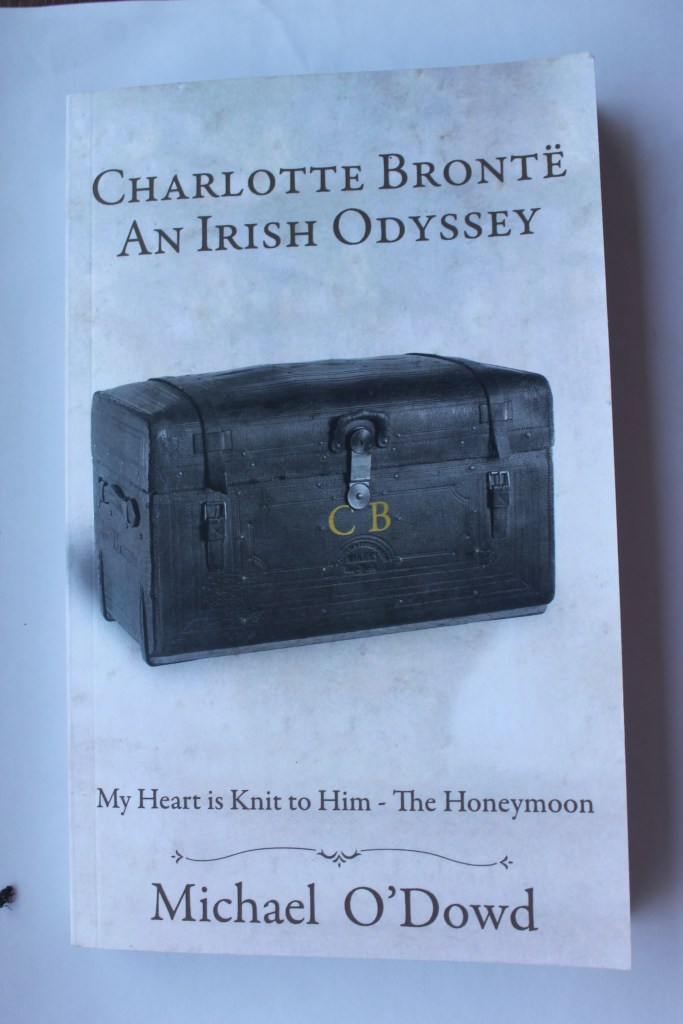
The programme is particularly strong on literary events with the launch of two books on Charlotte Brontë’s honeymoon in Ireland, the first called Arthur & Charlotte, by Pauline Clooney (published by Merdog) and the second, Charlotte Brontë: An Irish Odyssey by Michael O’ Dowd (published by Pardus Media). Pauline & Michael recently spoke with much acclaim at the prestigious Bradford Literary Festival under the title No Net Ensnares Me: Charlotte Brontë Abroad. The event will be held at 6.30 p.m. on Friday 22nd July in the Long Room in The Crank House.
Dr Richard Butler will showcase the building of Offaly’s courthouses and prisons in the years between roughly 1750 and 1850 in a lecture at Offaly History Centre, Bury Quay, Tullamore and via Zoom on Tuesday 12 July 2022. The presentation will place individual buildings in Tullamore, Birr, Daingean and elsewhere in the context of changing political and social events throughout Ireland in these years, highlighting local agendas alongside those of the British administration in Ireland. Illustrated with historic architectural drawings, old and new photographs, the lecture will also highlight schemes that were never built as it traces the ways in which the appearance of Offaly’s towns was transformed in these years by new public architecture. The lecture will incorporate new research on Offaly’s history undertaken in recent years by historians based in the county such as Michael Byrne alongside volumes such as Andrew Tierney’s new Buildings of Ireland guide for Central Leinster and the speaker’s recently published book, Building the Irish Courthouse and Prison: A Political History (Cork University Press, 2020).
Charles William Francis Bury, the fourth Earl of Charleville, came of age on the 16th of May 1873. Celebrations were delayed to the end of May so as to confine the party and the guests staying at the castle to one week and ending with the marriage of the earl’s sister to Captain Edmund Hutton on 5 June 1873. As stated in article no. 5 in this series the young earl died in New York on 3 November 1874 without marrying and was succeeded as fifth earl by his uncle Alfred. The latter died childless on 28 June 1875 and so the Charleville title died with him. The fourth earl’s sister, Lady Emily, succeeded to the estate while yet a minor. She married in 1881 but was a widow by 1885. Lady Emily died in 1931 having spent much of her widowed life abroad and was succeeded by her only surviving child Lt Col. Howard Bury (died 1963 aged 80). He inherited Belvedere, Mullingar from his cousin Brinsley Marlay in 1912 and sold the contents of Charleville Castle in 1948. As Lt Colonel Bury died childless the estate went back up the line to the children of Lady Katherine Hutton née Bury (died 1901). The celebrations of 1873 were poignant and the speeches full of irony. That the family had an excellent relationship with the Tullamore townspeople is clear from the speech of the parish priest Fr McAlroy who had succeeded O’Rafferty in 1857. Alas so little material has survived by way of letters or diaries of the speech makers of that exciting week in the history of Tullamore. As noted in the no. 5 blog the original address of Dr Moorhead on behalf of the town commissioners was donated by Professor Brian Walker to Offaly History. The late Brigadier Magan donated an important photograph of the 1873 wedding and pictures of the Hastings of Sharavogue in what we now call the Biddulph Collection in Offaly Archive.
The Hastings and Westenras of Sharavogue were among the guests at the Charleville wedding as also was Lord Rosse (the fourth earl) and the Bernards. Lords Digby and Downshire, the other big landowners in the county were absentees. This copy from Rathrobin and the two Irelands (Tullamore, 2021) available from Offaly History.(more…)
As part of the Tullamore 400th series and also in the context of research as part of a survey of Tullamore’s heritage in O’Connor Square and High Street, Tullamore we are pleased to present this article on one of the most attractive of the buildings of O’Connor Square. This is the building described by Andrew Tierney in Central Leinster in the Buildings of Ireland series (Yale 2019, p. 628) as ‘a ‘flamboyant three-storey Ruskinian Gothic warehouse’. The number 12 is from that in Griffith’s printed valuation of 1854 (GV 12). The number 71 (noted below) was part of the running series for the entire town of Tullamore in the manuscript valuation of 1843. the brick building was the first in Tullamore to be restored as to the facade (but not the interior) and incorporated in the Bank of Ireland Tullamore branch in 1979. It set a high standard for such work and wile not residential at least is well used and contributes to the streetscape, and very much so since one-third of O’Connor Square has now been pedestrianised.
O’Connor Square in 2020
To cite the Heritage Council’s own words on the Historic Towns Initiative:
Many of our city, town and village centres are historic places with their own distinct identities. Sustaining these is a complex process that in many cases involves the conservation and re-use of existing buildings, the care of public spaces and the provision of community facilities. The conservation and interpretation of this heritage makes our towns interesting, unique and attractive to residents and visitors. In support of the Town Centres First policy set out in the Programme for Government: Our Shared Future (2020), the Historic Towns Initiative (HTI) is a joint undertaking by the Department of Housing, Local Government and Heritage and the Heritage Council which aims to promote the heritage-led regeneration of Ireland’s historic towns.
Today, the most enduring reminders of the economic prosperity of Tullamore in the mid to late eighteenth century are the commodious stone town houses built by its prominent and successful citizens. Seven in particular are notable, all but one of which line High Street, the entry to the town from the south and also the approach road to the seat of the local landowner, Lord Tullamore.
Though one has been demolished and one significantly altered, the remaining ‘palazzi’ today represent a unique architectural feature of the town and all are included on the Register of Protected Structures. Several display the distinguishing features of the finest Georgian townhouses of the period, being set back from the street behind railings and with central imposing door cases reached by a flight of steps. Though displaying differences in design, the plot widths of each mansion are remarkably similar, probably reflecting the leasing policy of Lord Tullamore.






 offalyhistoryblog