In the second article on the quarries and stonecutters of Tullamore, I wrote about members of the Bracken family that left Ireland with their stonecutting skills and brought them to Australia. That was around 1910. However, stonecutters from the Ballyduff quarries had been emigrating and practicing their trade abroad for many years before that. Australia, in particular, was the destination for many. In this article, I will focus on two families, the Molloys and the Cronlys, and their involvement in stonecutting both at home and abroad.
At a time of economic stringency, the architect Michael Scott delivered several elegant retail buildings for a prominent midlands business family. These were executed in a Modernist style and incorporated natural materials in an innovative fashion.
D.E. Williams
In a recent Offaly History blog, Michael Byrne described the expansionary retail strategy of the notable Offaly commercial firm of D. E. Williams in installing high quality shops and pubs in virtually every town and village across the county in the period 1884-1921.
This courageous approach had not deserted the go ahead commercial family when during the Second World War, then modestly referred to as ‘The Emergency’, they ambitiously embarked on the redevelopment of their most prominent retail outlets in Dublin, Athlone and Birr and and most importantly, delivered a flagship shop and public bar in Patrick Street in Tullamore. To implement their progressive strategy they turned to Michael Scott.
Does anyone have a bottle of Birr whiskey now? The destruction of Birr’s last distillery in March 1889 was seen as a death blow to the town. The population of Birr in 1841 on the eve of the Famine was 6,336 persons with another 554 in Crinkill. However, the next eighty years saw a period of decline such that over the period 1861 to 1926 the population fell by 44.6 per cent or from 6,146 to 3,402. The decline was exacerbated by the closure of the distillery in 1889 and the military barracks in 1922. In 1921 the workhouse (erected c. 1840) was brutally closed and amalgamated with Tullamore.
Birr had strong associations with whiskey distilling from at least the 1800s. Probably the large military barracks at Crinkill acted as a stimulus to production. In 1818 only two distilleries were in operation in County Offaly and both were located in Birr. In competition with Birr was the Birch distillery at Roscrea. One of the Birr distilleries was that of Robert Robinson and was located at Castle Street and formed part of what was until the 1980s the Williams Waller Ltd grain handling depot (formerly Birr Maltings Ltd.), and now partly demolished with the remainder incorporated in The Maltings guest house. The second distillery, established in 1805 by the Hackett family, was located at Elmgrove on the eastern side of the town. A third distillery, described as the ‘old distillery’ in 1838 was located near what is now the Mill Island Park and part of which is incorporated in the Birr Technology Centre. Thus ample remains of all three distilleries still survive.
Kinnitty is very much on the tourist trail in Offaly and is arguably the finest planned village in the county. In this the second extract first published in 2011 in Paddy Lowry’s Kinnitty my home in the Slieve Bloom (2011) Paddy Lowry looks back to almost 100 years ago. Courtesy of Kilcormac Historical Society. Offaly History has some copies of this now scarce title for sale.
The launch of Kinnitty in 2011 with Amanda Pedlow, Paddy Lowry and Paddy Heaney. The two Paddys are now part of our heritage and we fondly remember them both.
Some of the locals in Kinnitty were fond of making up rhymes to annoy and tease each other and I remember when we were young the following would often be heard.
“Some of old stonies will hold their heads high, and carry with them to the grave the feeling that they have left their mark on many a church, and on many a building, and that in years to come, there will be people to admire the work they have left behind them, as we of this generation respect and understand the work of the men of long ago. All men hope for praise of some sort, and it is a nice thing to see a man smile when he knows you are in earnest in liking his work. We become children again, and are mightily pleased with ourselves and want to show that we can do even better.”
From the book Stone Mad by Seamus Murphy, stone carver, 1966.
In this article, I write about some of the fine buildings and monuments in other parts of Ireland built using limestone from the Ballyduff quarries. There is a section on aspects of the lives of stoneworkers in Tullamore in the 19th century, and finally I have a look at a couple of Tullamore families that were prominent in stoneworking over long time periods.
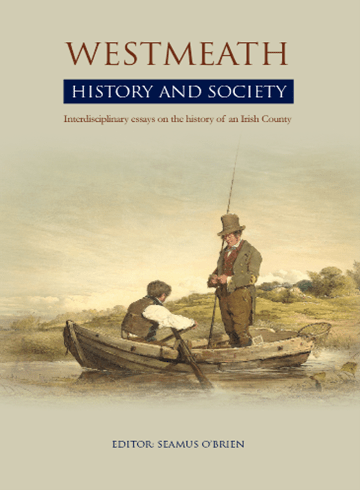
The Mullingar and Athlone launches of Westmeath History and Society have provided two interesting and original addresses on the status of local history in Westmeath, our neighbouring county. The Offaly History and Society volume was published in 1998 and is long out of print. A few copies were secured by Offaly History some years ago and are offered for sales as scarce titles. We thank our friend Dr Harman Murtagh for a copy of his address on 31 3 2022 and we have added some pictures for our readers. Enjoy the address in Athlone and you can get the book at Offaly History Centre and online at www.offalyhistory.com, over 900 pages, hardback, €60.
My friends,
This is the south Westmeath launch of this magnificent volume, Westmeath history and society.
A week ago it was launched in north Westmeath by the archbishop of Dublin, the very Reverend Dr Farrell; south Westmeath must make do with the most irreverent Dr Murtagh.
The book is 900 pages long. As the archbishop observed in Mullingar, it’s about the size of a concrete block: in my view, its only fault is that it’s rather heavy to hold in bed.
Westmeath history and society is one of a series of county books – incredibly it’s the twenty-ninth in the series. The series has been appearing at the rate of a volume a year since 1985.
The series founder, general editor and manager from the start is Dr Willie Nolan, aided and abetted by his wife, Theresa. Their contribution to Irish society and to local studies is without equal. In France they would undoubtedly be awarded the Legion of Honour; in Britain surely Sir Willie and Dame Theresa? In Ireland, and here in Athlone, we can offer at least our enormous admiration for their magnificent achievement – twenty-nine county volumes of this size down, and only three to go! Wow!
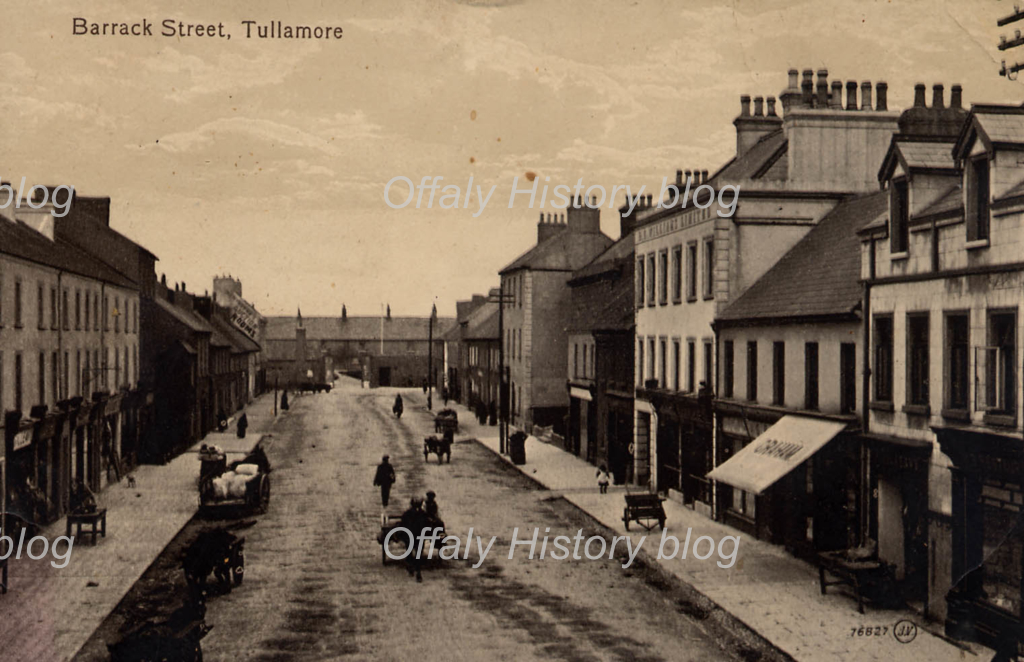
The barracks of 1716 was at the western end of Patrick Street and Hayes Hotel, dating to 1786, at the eastern end on the corner with Church Street and Bridge Street (now Boots Pharmacy). The barracks was destroyed in July 192 2on the retreat of the Republican soldiers from the town during the Civil War. Within fifteen years the site was fully taken up with urban council housing and a garda station built here in 1937 and rebuilt in 2002. The military barrack of 1716 brought about 100 soldiers to the town and is thought to have been a major factor in the town’s growth because of the increased demand for goods and services that followed its construction. After the 1870s, soldiers were stationed at Tullamore only at infrequent intervals.
Barrack/Patrick Street, Tullamore about 1910. The barracks dated to 1716 and destroyed in 1922.
The police moved into the old barracks about the year 1899. The building was occupied by the old I.R.A. in March 1922 when the British army quit the town as part of the Treaty settlement and was destroyed some four months later as the Republican soldiers left town in the course of the Civil War and before the arrival of the Free State army. Parts of the old walls survive and one can see the star-shaped fort pattern in the part of the wall opposite DNG Auctioneers.
Part of the old star-shaped fort style for the new barracks of 1716 erected in Tullamore(more…)
On Monday 21 February 2022 Offaly History will host a public lecture on the photographic work of Middleton Westenra Biddulph (1849–1926) of Rathrobin, Tullamore. The lecture will also be streamed via Zoom and will start at 8 p.m. at/from Offaly History Centre. Biddulph’s photographs of Offaly and midlands interest together with Big Houses in Ireland have been published in Michael Byrne, Rathrobin and the two Irelands (Tullamore, 2021).For the link to Zoom email info@offalyhistory.com. There is no charge.
The new large format book has over 300 photographs with context and captions and is available for €25 in hardback. The publication was supported by the Decade of Centenaries and took fourteen months to prepare.
Middleton Westenra Biddulph was born on 17 August 1849 at Rathrobin, Mountbolus, King’s County. He was one of six children and the eldest surviving son of Francis Marsh Biddulph (1802–1868) and Lucy Bickerstaff (d. 1896). She was born in Preston, Lancashire and they married in 1845 when F.M.B. was 45 and Lucy 24.[1] The Bickerstaff connection was to be an important one for the surviving sons of F.M.B. and led to a substantial inheritance in the 1890s for Middleton W. Biddulph (M.W.B.) and his brother Assheton who lived at Moneyguyneen, Kinnitty. F.M.B. was of a large family of eleven children. All were girls save their one surviving brother. F.M.B. lived with at least three of his sisters at Rathrobin, few of whom married and at least three emigrated to Australia or the United States.
In person and online. For link email info@offalyhistory.com(more…)
An account of Clonmacnoise in the early years of the ninteenth century was published by William Shaw Mason (c.1774–1853), as part of his three-volume A Statistical Account or Parochial Survey of Ireland, drawn up from the communications of the clergy (1814–19). Included in this survey is one Offaly parish – that of Clonmacnoise, published as part of vol. 2 in 1816, pp 142-150.
Shaw Mason was born in Dublin in 1774 and died there in 1853. He was for many years involved in the pursuit of history and was secretary to the Commissioners of Public Records. One attractive sinecure he had was Remembrancer or receiver of first fruits.
Patrick Fitzgerald
The contributer of the Clonmacnoise piece was the local vicar, Patrick Fitzgerald. Fitzgerald noted that there was no town in the parish save Shannonbridge which had a few slated and 280 thatched houses.The parish had 586 families, comprising over 3,000 of a population with only eight Protestant families. Potatoes and milk were the basic foodstuffs with some fish. English was the usual tongue with only some Irish spoken. Patron Day was 9th September as it still is but at that time 3,000 to 4,000 people would attend. The principal owners of land in the parish were Lord Rosse, Rev. Henry Mahon, Edward Armstrong-Frazier and H. P. Lestrange. The number of Protestant families must have one of the lowest in the county and can be conrasted with Ballyboy and Killoughy in 1826 with 7,250 RC and almost 500 Protestants.
Clonmacnois* is the ancient and modern name of the parish. It is situated in the barony of Garrycastle in the King’s County and in the diocese of Meath. Longitude 80 5 ’west; latitude 530 20’ North. (The name Clonmacnois evidently derived from the word ‘Cluain’ meaning a retired lawn, or small nook of land, free from rocks, near a river. . .) Its boundaries are on the north the river Shannon, from which it is separated from the county of Roscommon; on the east, by Kilcleagh and Lemanaghan parishes on the south, by Thesaurin parish, and on the West by part of Thesaurin parish, and by the Shannon which divides it from Galway and Clonfert.
The length of the parish from East to West is about eight Irish miles and the breadth from North to South is about three. About 3723 acres are arable and fit for pasture; the meadow ground is in general indifferent; there is a little upland meadow, as it mostly lies along the banks of the Shannon. But it contains more than double the above named number of acres of bog, as a large branch of the great Bog of Allen runs up into the parish, including every kind of soil. It contains upwards of 12,000 acres.
There is no river in or adjoining to this parish except the Shannon which mears it as already mentioned. A lake called Clonsalagh, which is computed to cover ninety acres, produces good pike and perch and some eels. This sheet of water is situated nearly in the centre of the parish, and derives its name from the townland in which it is. On the North and East, it is surrounded by hills, which, if planted, would produce a fine effect, and on the south and west by a large bog. The parish abounds with hills, the tops of which are allotted to pasturage as all the valleys are tilled and produce fine crops of corn; though the general appearance of the soil which is very light and sandy, might lead at first view to an opposite conclusion. There are neither mountains nor woods here, nor have there been any remarkable indigenous plants found.
Mines, Minerals, &c.
Limestone is the general substratum of the soil in all parts, when mixed with bogstuff and clay; it makes excellent compost for the purposes of manuring.
Modern Buildings, &c.
The high road leading from Ballinasloe to the counties of Meath and Kildare runs through the parish, in a direction East and West. Another crosses it nearly from North to south, and there is also a third road, but this is of very little note. It can boast but of one town that of Shannonbridge so called from a very handsome bridge built across the river. Here is a small barrack capable of accommodating a company of soldiers. A large tower and battery are building and in a state of great forwardness on the western (or Connaught) side of the bridge. This is the great pass from that province to Leinster. A Magazine has already been erected behind the barracks. There is no market held here, the want of which is severely felt by the soldiers, who are obliged to purchase their meat at Ballinasloe, six miles distant.
The village contains a few slated houses of two stories high and the rest, to the number of 280 are thatched. In consequence of the great number of artificers employed in the military works house rent has increased rapidly. The average rent for building ground amounts to ten shillings per foot. Its inn is nothing more than a stopping point, but the village contains several shops for retailing spirits without licence better known throughout the country by the name of Shebeen Houses.
It is singular, that not a possessor of a fee simple estate resides in the parish, neither, if we except the glebe house, is there is more than one good slated house in it, which belongs to Mr. Coughlan who holds about 200 acres of land, on which he resides.
Ancient Buildings, &c.
The Abbey of Clonmacnois is situated near the river Shannon. It was built about the year of our Lord 561 at which time it was held in high veneration. The Churchyard annexed to it contains nearly two Irish acres; it is one of the greatest burial places in Ireland, upwards of four hundred corpses are supposed to be buried there annually. There are also the remains of ten other chapels of lesser note, now totally in ruins. A door of one of them is very curiously and very beautifully carved. About half quarter of a mile thence, are the remains of a Bishop’s palace, now wholly in ruins, some of the walls are the only parts that have as yet escaped the ravages of time. In the church-yard are two large Round Towers one about 62 feet high, and 56 in circumference; its walls are 3 feet 8 inches thick, and the other is 5 feet 6” high, 7 feet in diameter and three feet thick. Here are also two large crosses, one of which is marked with some rude carving and bears an inscription in antique and unknown characters. At a small distance stands what appears to have been a religious house for nuns; it is also in ruins, no part of the building remains, except a single arch. A full account of this interesting place may be found in Archdall’s Monasticum and Ledwidge’s Antiquities of Ireland.
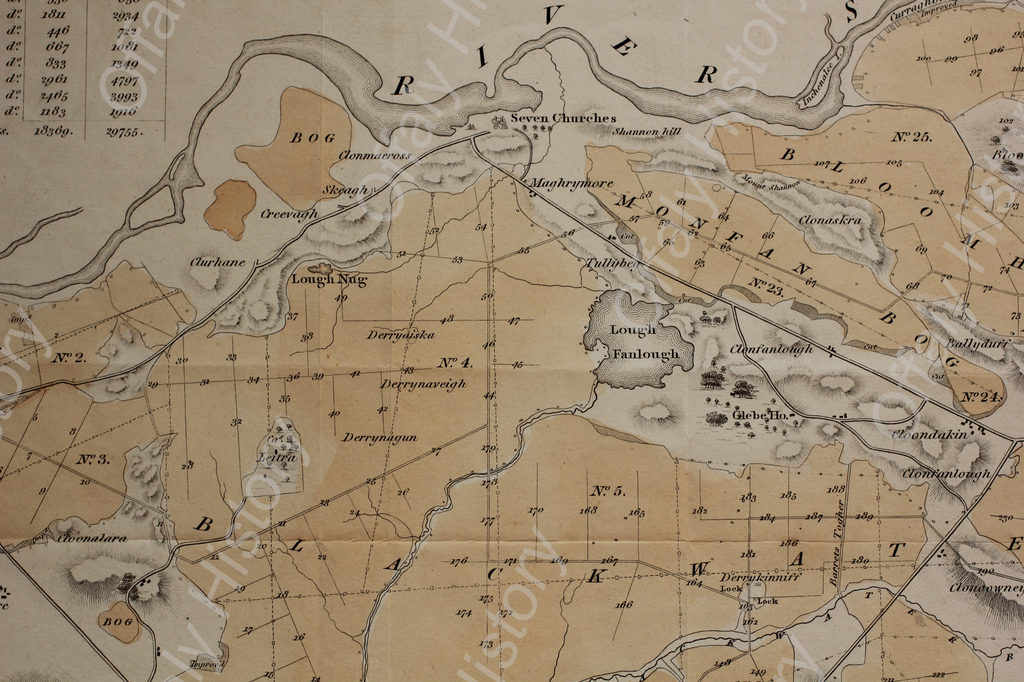
The landowners in the parish, none of whom was resident. From Shaw Mason, ii (1816), p. 150.
Present and Former State of Population &c.
From every information that could be procured it appears that there are 586 families in the parish, comprising of 1618 males and 1558 females. Eight only of these families are Protestant, the rest Roman Catholic. The people in general are very comfortable and dress neatly, some in grey frize, and some in coarse blue cloth. Potatoes and milk form the general food, to which is often added fish procured from the Shannon and the lake. The poorest keeps one cow, and some have three or four. There are very few who do not keep one horse for work, and some have two.
The fuel is turf. This is plentiful and of good quality. The houses are in general very neat and comfortable, mostly built of stone and mortar. One person only is named here as having lived to 90 years of age. Few arrive to 70.
The Disposition and Genius of the Poorer Classes
The people here are very industrious. They are courteous to strangers but have a stubborn disposition in their intercourse with each other. Their general language is English, although they sometimes speak Irish to one another.
There is but one patron day held here, on 9th of September in honour of St. Kieran their tutelary saint and this is numerously attended. From 3000 to 4000 people assemble there to do penance from different parts of Ireland, even from the county of Donegal. Tents and booths are erected round the churchyard for the accommodation of the people. This assemblage continues for two days and often ends in quarrels. Its abolition would be a desirable circumstance. Some persons have been obliged to keep to their beds for weeks in consequence of beatings received at such meetings.
The Education and Employment of Children.
The children are brought up to husbandry. Some parents send their children to the petty schools in the neighbourhood, during the idle season of the year. When asked why they did not send them regularly and constantly, their answer was that they could not spare them from the work. The girls are generally employed in spinning.
There are no public schools. The parish clerk keeps a licensed Protestant school, which is very badly attended, not more than fifteen children receiving instructions from him. There are, however, three Roman Catholic schools, whose average number of pupils fluctuates from forty to eighty. In harvest time and spring, the number sinks much lower, in consequence of the children being kept to assist in the agricultural labours. The quarterly salary for tuition is 1s. 8d. for reading and spelling 3.s 4d. for writing and arithmetic. There is no public library nor any collection of Irish or other manuscripts relating to Ireland.
Religious Establishments; Tythes &c.
Clonmacnois is a vicarage in the gift of the Bishop of Meath, and is not united to any other parish. About two miles and a half from the church stands the glebe house, where the vicar resides on a glebe of about forty acres. All sorts of grain pay tythes. Wheat, bere and barley are set at from 10s. to 12s. per acre; oats and flax at eight shillings, neither meadow, potatoes, nor rape pay tythes. Sheep pay at the rate of £1.13s. 4p. per hundred. The tythe is but indifferently collected. Some indeed pay punctually, but others very badly. There are two Catholic chapels in the parish, with a priest to each.
IX Modes ofAgriculture Crops Etc.
The inhabitants adhere very tenaciously to the old modes of agriculture. Burning for manure is much practiced, it is called ‘boiting’. The ground when thus prepared, is planted with potatoes, then wheat, barley and oats. The wages of the labourers are 10d. per day in summer and 3d. in winter without victuals but is somewhat higher in harvest. The stock is chiefly cows, horses and sheep of the old Irish breed. The general acreable rent, particularly for late takes is from a guinea and a half to two guineas, but on old takes, from 15s. to a pound. No duty services or payments are exacted from the tenants. Most of the land is set in small farms of from about 10 to 15 acres but there are a few of 25 acres. There is neither market nor fair, nor even a pound or a constable in the parish.
X Trade, Manufactures, Commerce, &c.
None
XI. NATURAL CURIOSITIES
The list of incumbents from the First Fruits’ Records.
The Reverend Philip Barret, Clerk, was collated on 26th day of May 1743 to the vicarage of Clonmacnois in the King’s County, and Diocese of Meath.
Stephen Bootle, 14th July 1762, Vicarage Clonmacnois, King’s County.
Joseph Pasley, 4th February 1763, Vicarage Clonmacnois, King’s County
William Donaldson, 7th November, 1764 Vicarage, Clonmacnois King’s County
John Baily instituted 15th December 1778, Vicarage Clonmacnois, King’s County – episcopally united to the Rectory of Ballygart in County Meath.
John Fitzgerald, instituted 10th October 1799 Vicarage, Clonmacnois, County Westmeath.
King’s County Infirmary was established under the reign of King George III with the passing of the Irish County Infirmaries Act of 1765. This act enabled the creation of infirmaries in thirty Irish counties. During the redevelopment of Tullamore town by the Earl of Charleville, a new infirmary building was erected in 1788 on Church Street and was further extended in 1812.
The County Infirmaries Act was enacted to provide healthcare to the poor which fulfilled the eighteenth century philanthropic ideals of the landed gentry who supported these institutions through donations and subscriptions. King’s County Infirmary was supported by an income consisting of parliamentary funds, grand jury presentments, governor subscriptions, donations, and patient fees. The infirmary was managed by a Board of Governors who paid subscriptions for their position on the board which gave them absolute control over the infirmary including staff appointments and patient admissions. Governors were made up of local gentry and landowners such as the Earl of Rosse, Lord Digby, and prominent business owners such as the Goodbody family.
While surviving records are limited, the Board meeting minute books provide a colourful insight into the running of an infirmary in late 19th and early 20th century Ireland. The Infirmary’s Surgeon, Dr James Ridley, was linked to a scandal that pervaded the county in 1887 and 1888. Ridley, who also acted as one of the Tullamore jail physicians was reported to have died by suicide on the morning he was due to give evidence at the inquest into the death of John Mandeville, a national league activist. Mandeville who was imprisoned under the Irish Crimes Act of 1887 was subject to harsh and cruel punishment at the hands of his jailors and died shortly after his release from prison.




 offalyhistoryblog