The Homan Potterton sale on 7 September 2021 at Adam’s, Dublin features three painters with Offaly connections. But first a word about Potterton. After secondary education at Kilkenny College and Mountjoy School he began studying to be a solicitor, but (great for him ) he switched to art history at Trinity with the formidable Anne Crookshank. He was the youngest director of the National Gallery of Ireland ever appointed (1979) but stayed for only eight years. He retired in 1988 out of frustration with the bureaucracy, the bullying Charlie Haughey, and his being unable to secure much needed funds for the gallery. That was back in the difficult 1980s. Had Potterton remained he would have been able to oversee the wonderful gallery there is today. All the great institutions saw money flow in from the 1990s with the support of EC funds and the lift in the economy from 1993. While he took over the editorship of the Irish Arts Review in the 1990s (then an exciting annual event) he later moved to France and we heard no more of him save for several family histories, a memoir and a novel.
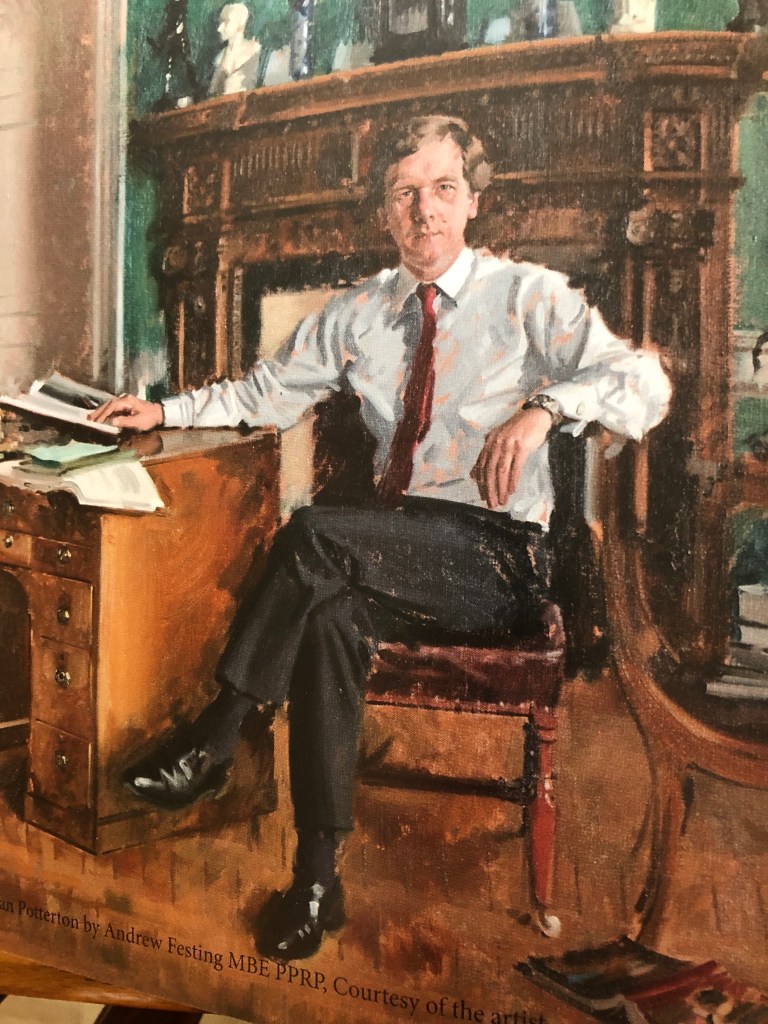
The jacket of Potterton’s memoir of 2017 with the arresting painting in the great classical style by Festing.(more…)
Over the years, Tullamore has been known as ’Towllaghmore’,‘Tullaghmore’ or ‘Tullymore’ -all anglicizations of ‘Tulach Mhór’ and most likely deriving from the high land to the south of the river. By the middle of the 19th c. the name of the now extensive town had morphed into ‘Tullamoore’- reflecting the influence of the Moore and later the Bury families and their ownership of all the lands around.
As urban developers, these skilled entrepreneurs with cultural pretensions reached their highest point during the overlordship between 1785 and 1835 of Charles William Bury, the first Earl of Charleville. Whether motivated by commercial considerations, a desire for social prestige and the admiration of his peers or by pure aesthetic sensibility, the development of Tullamore as promoted by Charles William, resulted in a coherent urban form which survived without much amendment into the middle of the 20th c., largely still exists today and will influence any future reconfiguration of the town centre.
There’s no shortage of very ordinary towns in Ireland but Tullamore certainly isn’t one of them. How could it be? After all it has its proud legacy as one of the original trading and transport hubs on the Grand canal from its arrival in the town in 1798. That early advantage over competing centres like Birr and Daingean was reinforced with the coming of the railway in 1854, allowing Tullamore to build on its status as an important transport hub and retail, administrative and merchant centre. On this basis, the town maintained at least the appearance of prosperity up to the present era. This early pre-eminence is reflected in the town’s exceptionally fine architectural legacy including an assemblage of late Georgian town houses, the civic space at O’Connor Square and individual gems such as the Tullamore Dew Whiskey Heritage Centre along with J.B. Keane’s Neo-Classical Courthouse.
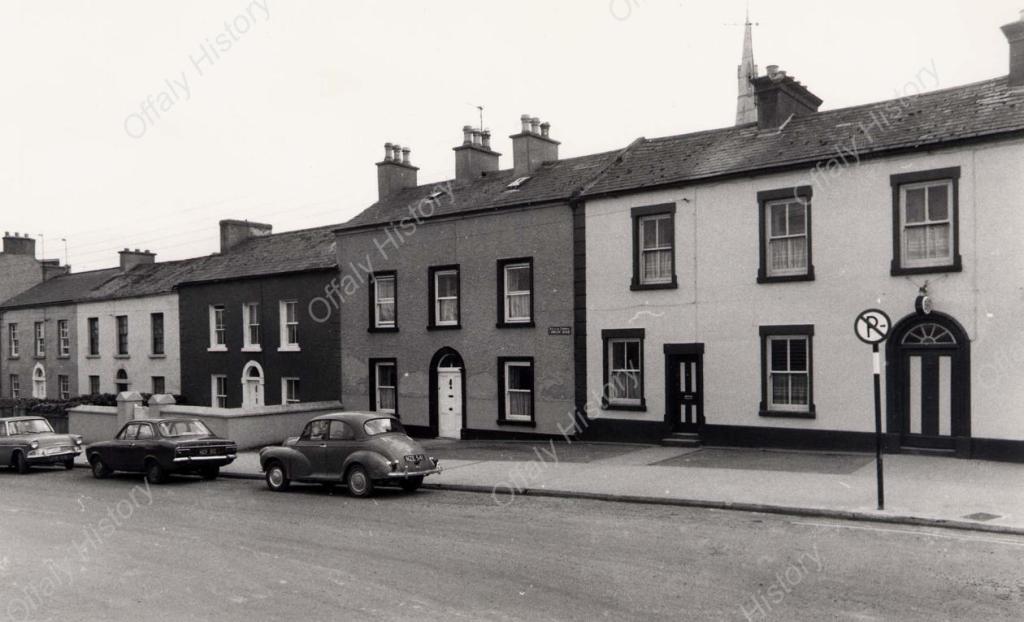
Late Georgian Terrace at Bury Quay/Convent Road, Tullamore. Mid1970s
So, while future prospects are certainly influenced by the legacy of the past, for urban centres like Tullamore factors such as economic performance and civic leadership will figure as the more immediate drivers.
There are only a few studies available on the development of retailing in Ireland, either of a general nature or in connection with particular firms. It is well known that in the first half of the nineteenth century and up to the Famine years retail outlets were not widely available and many in the smaller towns were no better than huxter shops. There were exceptions and that is clear from the photographs of c. 1900 of shops such as Williams. Egan, Goodbody and Lumley (in Tullamore); O’Brien in Edenderry and O’Meara and Fayles in Birr. In looking at the revolutionary period from 1912 to 1921 to mark the decade of centenaries it is also worth looking at revolutions in other areas such as transport, energy and shopping. Like the political revolution retailing exhibited signs of stress after 1921 and did not recover until the coming of the supermarkets to the provincial towns in the 1960s.
The Williams head office with the Barrack Patrick Street shop to the right before more intensive motorised transport from 1915.Branch house managers were appointed of which the last under the old system (before the switch to supermarkets) was T.V. Costello.
The trade directories, and from the 1840s the valuation records, will facilitate investigation of retail outlets. By the 1860s living standards had improved and this is reflected in the increasing number of shops; per capita tobacco consumption rose to English standards about 1870 and per capita consumption of tea was not far off the English level by the end of the 1870s. The considerable economic progress of the early 1870s, began to slow down by the end of that decade. The 1880s is looked on as a period of industrial crisis with industries closing down in all the principal towns, or destroyed by fire as with the Goodbody tobacco factory in Tullamore and the Birr distillery in 1889.The railways and the canals (especially in the midlands) facilitated the easy removal of heavy goods and livestock from towns all over Ireland, but it also left it easier to import foods easily and cheaply. As a result, the Irish industrial base (such as it was, especially in southern Ireland) receded while the retail and services sector began to grow albeit slowly.
In the Pigot directory of 1824 Birr was described ‘as far the most considerable of any of the towns in the King’s County. It is situated on the river Birr [Camcor], and adorned with a fine castle, built by the family of the Parsons, the residence of the second earl of Rosse, the proprietor of the town. This town it was said has since been rebuilt by the present earl’. Birr was the leading town in the county from the 1620s until the 1840s but began to loose out because of the lack of an easy and direct link with Dublin, and it being that bit more distant from the capital and less central for local administration. The decline would accelerate after 1900 with the loss of political and administrative influence. By the 1820s Birr had new Protestant and Catholic churches (the latter nearing completion at the time of the census and the publishing of the Pigot directory), two Methodist chapels and a Quakers’ meeting house. The charitable institutions of Birr, were a fever hospital and dispensary, supported by county grants and annual subscriptions; a Sunday school for children of all denominations; a free school for boys, and another for girls. Birr had a gaol and a courthouse (from c. 1803), where the sessions were held four times a year. The prisoners were sent to Philipstown, which was the county town until 1835 for trial for serious crimes. From 1830 when the new gaol was built in Tullamore Birr prison was more a holding centre only. The ruins of the old church near the castle wall are still visible. One mile from the town were the barracks, ‘a large and elegant building, capable of holding three regiments of soldiers’. Birr has two large distilleries and two breweries, which, it was said, gave employment to the poor of the town.
Long, long ago, a rocky outcrop on the bed of the river allowed local farmers to herd their livestock across to graze on the small hill on its southern bank. Over time, longer distance routes began to converge on the ford and a small village grew up to cater for travellers, an inn to change horses perhaps, a blacksmith possibly, but this is all conjectural as no traces or records remain.
In 1609 the soldier/settler John Moore bought a half share in the nearby but now long vanished castle and watermill of the Molloys and began to hold an annual fair. By the late 17th. century, ‘Tullymore’ as the old maps called it, was most likely a rural scene of some thatched cottages, an unpaved track and maybe one or two substantial houses (illus.).
A conjectural view of Tullamore in the 1620s when it was said to have a castle watermill and ten cabins. The castle was in ruins by the 1630s but the town then had two watermills on the river.
In time the ford was replaced by a bridge. This gave the small village a certain strategic importance, so in 1716, a military outpost was established to guard it. The security this brought and the provisioning needs of its garrison, attracted new settlers whose residences and businesses were facilitated by the ability of the river to receive household and commercial waste and provide a source of raw material and power. Soon, several flour mills, tanneries, breweries, distilleries and a linen industry had been established. Downstream of the bridge, the river channel was diverted into a large semi-circle, creating a mill stream to power even more industries.
We posted this blog on 21 April 2021 and reproduce it today to mark the passing of John Flanagan, the well-known builder and advocate for Tullamore and County Offaly. Up to that time we seldom wrote a blog on a living person but we made an exception for John Flanagan, the modest man from the Meelaghans, Puttaghan and New Road, Tullamore who has invested his whole life (so far) in making Tullamore a better place for people to live, work, bank and even pray in. We in Offaly History occupy offices at Bury Quay rebuilt for us in 1991-2 by the John Flanagan firm and now we also occupy Offaly Archives, another Flanagan development located at Axis Business Park, Tullamore. Perhaps his greatest achievement was the building of Tullamore Court Hotel. Great in that it was against the odds and had been talked about in Tullamore for thirty years but nothing was done.
As long ago as 1977 the Midland Tribune in a review of Tanyard Industrial Estate commented that John Flanagan was a man whose vision and initiative has given the Tanyard its new lease of industrial life. John Flanagan had by then been 24 years a-building so successfully that John Flanagan and Sons Ltd. was one of the best known contracting firms in the Midlands.
He purchased the Tanyard from Messrs. P. and H. Egan in the late 1960s, established his own offices there (modest of course with no frills) and almost immediately set about using some of the six-acre site to provide facilities for other local people to set up business and projects of various kinds. Some of the buildings on the property were suitable for conversion to new usage but John Flanagan also embarked on his own programme of factory construction. He subsequently purchased other premises in the same area from Messrs Tarleton. With about eleven firms thriving in the Tanyard already, about 3³/8 acres remain available for further development and Mr. Flanagan will be ready to respond to demand as it arises. The whole area was redeveloped in the 1990s and is now emerging as a retail sector in Tullamore, well adapted to the changing economy.
John Flanagan extreme right and beside him is loyal foreman, the late Jim Larkin – in late 1984 after the fire of 31 10 1983 at Tullamore Church.
While his industrial estate has been steadily expanding, so too had his own business as a contractor. In the 1970s his major undertaking included construction of R.T.E transmitting Station at Ballycommon; Tullamore Vocational School; the Post Office in Portlaoise; Farm Centres in Edenderry and Portlaoise; Housing Carlow (a scheme of 57 houses); factories for Messrs Paul and Vincent; in Tullamore and Irish Cables, Athlone.
The old Tanyard Lane c 1996 with the first block of apartments on the right completed and a new carpark under construction
Jobs in hands in the late 1970s included a scheme of 40 houses in Clara for Offaly County Council; the Bank of Ireland premises at Bridge St. O’Connor Sq., a Welfare Home in Edenderry; reconstruction work at St. Loman’s Hospital, Mullingar.
‘Mr Flanagan – who incidentally is Chairman of Banagher Concrete was actively in recent formation of a Chamber of Commerce in Tullamore and is the inaugural President of a body which is expected to make a very significant impact on the industrial and commercial life of the town and district.’
This week we return after almost four years to view the interior of one of the finest of the town houses in Tullamore. High Street and O’Connor Square were the premier streets in Tullamore from the 1750s and contain important buildings that give Tullamore an edge with its architectural heritage. Young on his Tour remarked on the fine houses here as early as 1770. Good work is being done at the former Kilroy house in High Street, now the home of Tanya Ross and George Ross This house of two storeys over a basement was built in 1786. We in Offaly History hope that more in our county will take on the task of restoring all that was distinctive and showed to advantage our native craftsmen. O’Connor Square is improving as is High Street, Cormac Street, Store Street, Deane Place and Convent Road. Full marks to Tanya and George Ross and thanks to Louse Dockery and House and Home for allowing us to reproduce this article from the magazine’s Jan/Feb 2021 issue, editor Ciara Elliot and Photographer: Philip Lauterbach . Our congratulations to all the local suppliers mentioned in this article. Take a bow one and all, but especially to Tanya Ross and George Ross. When was the first article on a house in Offaly? It was possibly Shepherd’s Wood (then the home of Desmond Williams and Brenda Williams) in 1958. Country Life featured important articles on Charleville Forest in 1962 and Birr Castle in 1965. We hope to add to this list in future blogs.
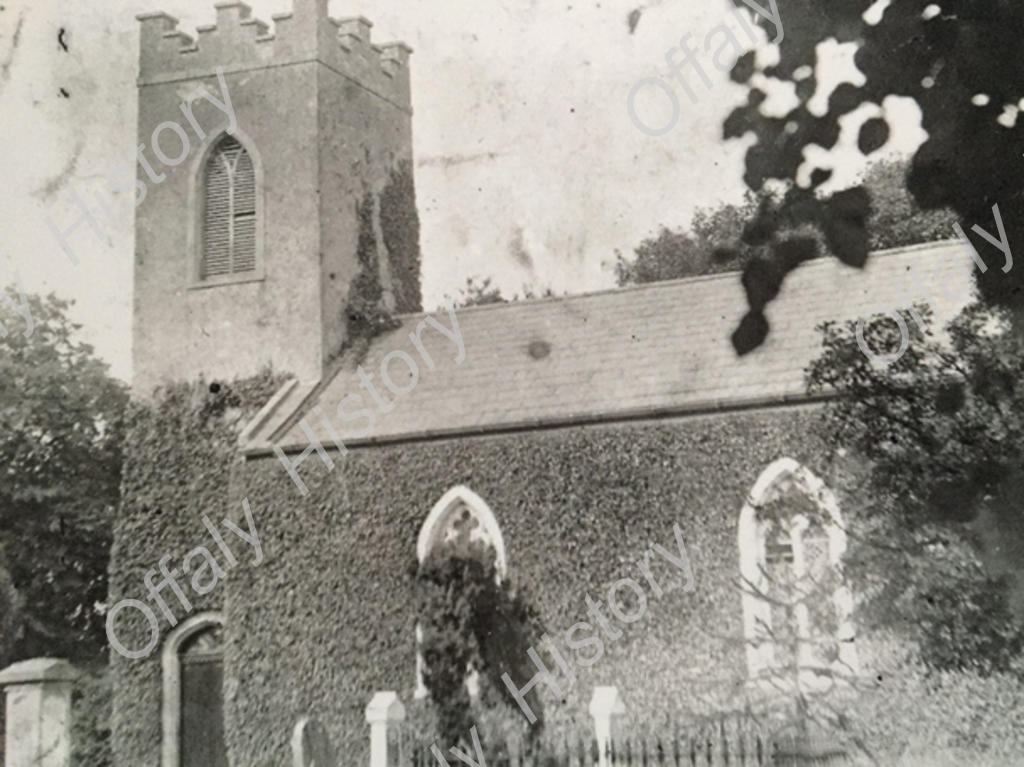
On a walk recently, listening to the crows squawking, I was reminded of a visit to Geashill parish church, dedicated to St Mary, in the diocese of Kildare and county of Offaly just over a year ago and hearing the same sound from the trees by the path to the church.
I have become very attached to the church as it is where my great–grandparents and grandparents were married and where many of my great–aunts and great–uncles were baptised and buried, sadly in unmarked graves. As the world comes to terms with the Covid–19 pandemic, I think of my grandmother, Elizabeth Kerin née Evans (1881–1967) who was born in Geashill. She lived through the tuberculosis epidemic of the early 20th century that killed her father and ten of her twelve siblings, the 1918–1919 influenza pandemic and the War of Independence (1919–1921), a particularly dangerous time for Protestants such as her remaining family in Geashill and her growing family living nearby in Clara.
My grandmother’s early life up to the 1920s was little known to her children and it is only in comparatively recent years that the tragedy she encountered in Geashill has been fully realised. Her only known relatives were her parents, two sisters and two brothers. Access to further information came to me 16 years ago when I contacted the incumbent of Geashill and Killeigh parish at the time, the Revd J. Leslie Crampton. He transcribed all the births and deaths he had for the family. The information concerning the true number of siblings she had and how many had died of tuberculosis, many as young adults, was truly shocking to my grandmother’s daughters and grandchildren. However, it has enabled us to appreciate all the more that the loving and caring person we knew who was sustained by her family and her faith. We realise now she also held the qualities of strength and resilience.




 offalyhistoryblog