On Monday 16 February 1953, a Banquet was held in Hayes Hotel Tullamore to celebrate two very significant achievements; the completion of the 74-house Pearse Park and the cutting of the sod for a further 106 houses later to be named Marian Place. These two estates, whose very names evoke the atmosphere of the period, would be joined in 1965 by Kearney Park dedicated to the well-known local politician Joe Kearney.The three schemes together represent a high point in local authority housing not just in Offaly, but in Ireland.
The large attendance that day included the Minister for Local Government Paddy Smith, the cream of Tullamore society; the clergy, politicians, administrators, police and solicitors, as well as those involved in the delivery of the estates. Buried at the bottom of the extensive list which appears in an entertaining frontpage account of the event in the Offaly Independent of the following Monday, but unidentified as such, was the designer of the schemes, the architect Donald Arthur ‘Bob’ Tyndall M.R.I.A.I. (d.1975). Tyndall who had spent his early career in Shanghai was also engaged to deliver the Tullamore County Clinic and is credited with several housing schemes in the Offaly area. In 1971 his practice became Tyndall Hogan Hurley and went on to become one of the most successful in Dublin, specialising in office and residential developments.
Tyndall was the latest in the line of designers used by Tullamore Urban District Council to implement an admirable housing programme over the previous fifty years.
Shannonbridge A History of Raghra c.1600-c.1900 was published in 2019. Research for it began many years ago when I decided to learn more about my family and family home in Shannonbridge, County Offaly. That interest spread to other houses in the village. When Brendan Ryan and I decided to write a book about Shannonbridge I concentrated on the genealogy of those who lived there in the past. Gradually the history and stories of families emerged. My main goal in writing the book was to pull the names of the people of Shannonbridge out of the past. Sometimes we found interesting stories but often we just learned their names and the bare facts of their lives. However it felt wonderful to put those names in a book, to prove those people had been there, to acknowledge their existence. They all played a part in the story of a village. Oh, they had hard lives! And yet, many survived and thrived. Their descendants span the globe. What struck me most in learning about them was that often their stay in the village was short-lived. Many of the families who settled in the village only stayed for a generation or two and are long gone now. Keeping track of people moving in and out was a challenge.
Now that we are all locked down in our various counties I miss my occasional trips to Offaly to visit old friends. I keep an eye on local news on line and love the Tullamore Tribune and the Offaly Express. I was dismayed the other day to see a report on the Express that Offaly ranked lowest in Ireland on a Liveability Index! What in the name of Heaven is a Liveability Index!! I decided to look into it all a little further. Seemingly a father and son (with obviously too much time on their hands!) decided to rate every county in Ireland on four (4!!) parameters. One criterion was natural amenity which they assessed by developing ‘a unique method of ranking the natural amenity of a particular area using the percentage of each area covered by water and mountains and attributed as urban’ (Leinster Express 16 Jan 2021 Lynda Kiernan). Having spent so many happy years in Offaly I would certainly disagree with the findings and would challenge that duo to explain them fully! The very fact that Offaly is not covered with water and mountain makes it one of the most attractive counties in Ireland. Offaly’s unique landscape is one of peace and tranquility. The wide open stretches of bog covered with the most wonderful heathers and gorse throughout the year make it a joy to behold in any season. A mid 19th century saying that when gorse is out of bloom, kissing is out of season is certainly true of midland scenery!
The architect and town planner Frank Gibney (1905-1978) is today recognised as one of the most talented, influential and prolific housing designers of mid-20th c. Ireland.
Responsible for almost six thousand local authority dwellings in every part of the country, his deep concern for human scale and for good living standards delivered homes of a quality which have stood the test of time, while today many of their contemporaries have been altered or demolished.
Principal amongst his many achievements are the six Midland bog villages built in the 1950s for Bord na Mona workers, which were inspired by the aspirations of Patrick Pearse and Eamon de Valera for national self-sufficiency and which have been described by the Yale University Press/Royal Irish Academy volume on Irish architecture as ‘models for rural living’. These beautiful urban set pieces are cherished by their proud present day inhabitants and beg the question as to why contemporary housing policies have not emulated their success.
Gibney designed housing estate at Clarecastle, County Clare
Gibney’s numerous and extraordinarily ambitious town planning schemes founded on Garden City and Beaux Arts principles, were less successful, being proposed at a time of cultural conservatism and financial stringency. His passion for plans based on aesthetic principles which would preserve the best of towns while creating new and beautiful public areas found little local response. Nonetheless, he was engaged by many Irish towns and cities including Waterford and Drogheda to chart their future and elements of his proposals are still capable of fulfilment today.
Originally known as Acres Hall after the eighteenth century building developer Thomas Acres, this fine house with its Georgian features is now home to Tullamore’s town council chambers. In 1986 the house was acquired by Tullamore Urban District Council who undertook a refurbishment programme and extensions to the north and south wings, and at the rear of the house, to accommodate new civic offices. While much of the house was subject to a major reconfiguration, the development attempted to be sympathetic and sought to retain the house’s external architectural simplicity. Acres built the house in 1786 and positioned it in a commanding elevated position at the confluence of High street, Cormac street and O’Moore street. The location of the house may be on the hill from which the town takes it name, Tulach Mhór (great hill). Acres Hall is listed as a protected structure in the Tullamore town development plan.
A new book detailing the history of Birr Military Cemetery has been published by Offaly County Council. Researched, written and designed by Stephen Callaghan the book gives an authoritative history of the cemetery and all those identified as buried there. While the cemetery only contains 52 inscribed memorials, the book gives biographical details of a further 230 people buried there. The memorials which survive are also examined and described in detail, including information about type, symbols and details about the materials used and the stonecutters who made them. The cemetery is one of the few surviving features of Birr Barracks and is an important link to the past. The people buried there are a mix of soldiers, soldiers’ wives and children, the latter make up most of the burials.
Hunston is the name of a townland in the west of Offaly, close to where the Brosna and Shannon rivers meet. It is unlike many place names in Ireland which relate to an anglicised geographical description. It originates from a planter family who came to Ireland from England in the 16th century during the first plantation of Ireland.
Following Henry VIII claimed of kingship over all of Ireland in 1541, the English wished to extend their control further than the area called the Pale around Dublin to the whole of Ireland. One way was to drive the Irish landowners off their land and replace them with English or Scottish settlers, called ‘planters’. The first plantation took place in the region now known as Offaly and Laois in 1556. It was from this area that the O’Connor and O’Moore clans had invaded the Pale. The Government divided the land into Counties. Present day Laois was named Queen’s County, after Queen Mary, daughter of Henry VIII and present-day Offaly was named King’s County after Mary’s husband King Philip of Spain. Forts were built at Maryborough (Portlaoise) and Philipstown (Daingean).
The current issue of Irish Historical Studies (no. 165, May 2020) has a featured review of five issues from the Maynooth Local Studies series published in 2019. That brought the number issued to 144. We attach the list to 144 for your convenience and we bring to your attention the latest batch of four. Raymond Gillespie is the quiet man behind the series and who has acted as general editor since its inception in 1995. The reviewer in IHS, Maura Cronin, reminds of his characterising local history as being ‘primarily about people in places over time’. Place is described as the bedrock of local history, but it must be seen in the context of the actions of people and the pivotal role of historical research is looking for the forces of disruption and of cohesion. What brought people together and what drove them apart.
The four new issues of 2020
Four new volumes have been published in the Maynooth Studies in Local History series (general editor Professor Raymond Gillespie). The volumes by Denis Casey, Emma Lyons, Brendan Scott and Jonathan Wright and can be ordered via Offaly History Centre.
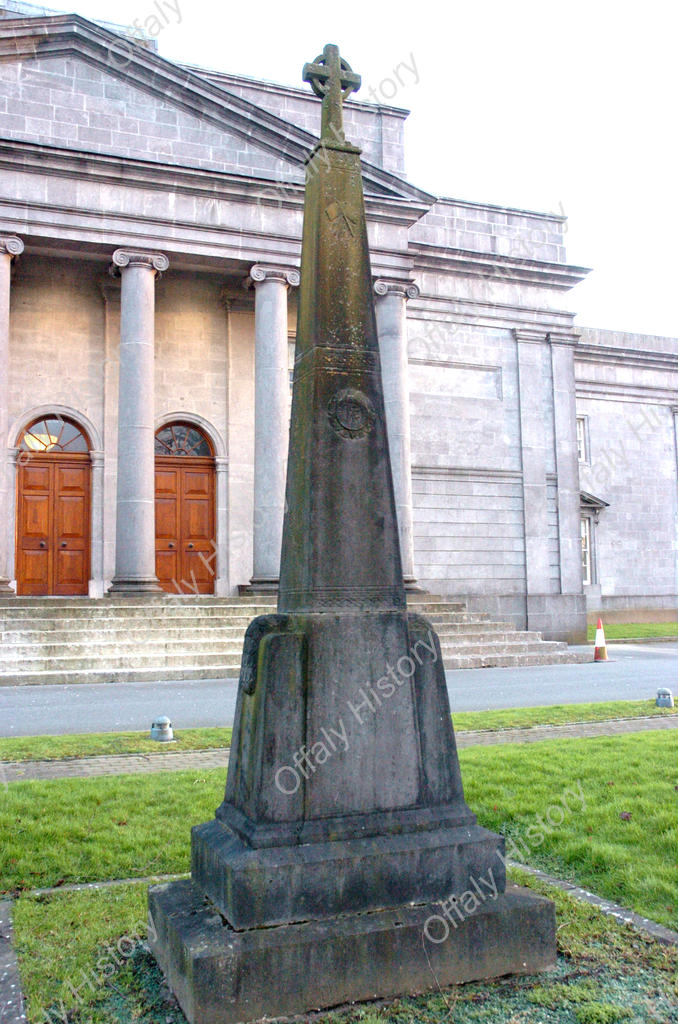
War of Independence Memorial Tullamore, unveiled in 1953
Everywhere in the world today, the role and validity of public art, particularly statues of historical figures, is under scrutiny. At the same time it is the policy of our new Government to place an increased emphasis on urban quality-which presumes the installation of even more public art. This could be a recipe for conflict but much can be learnt from an examination of the history and experience of the provision of sculpture in County Offaly, and its errors and successes.
Manchester Martyrs Memorial Birr 1894
The Three Tests
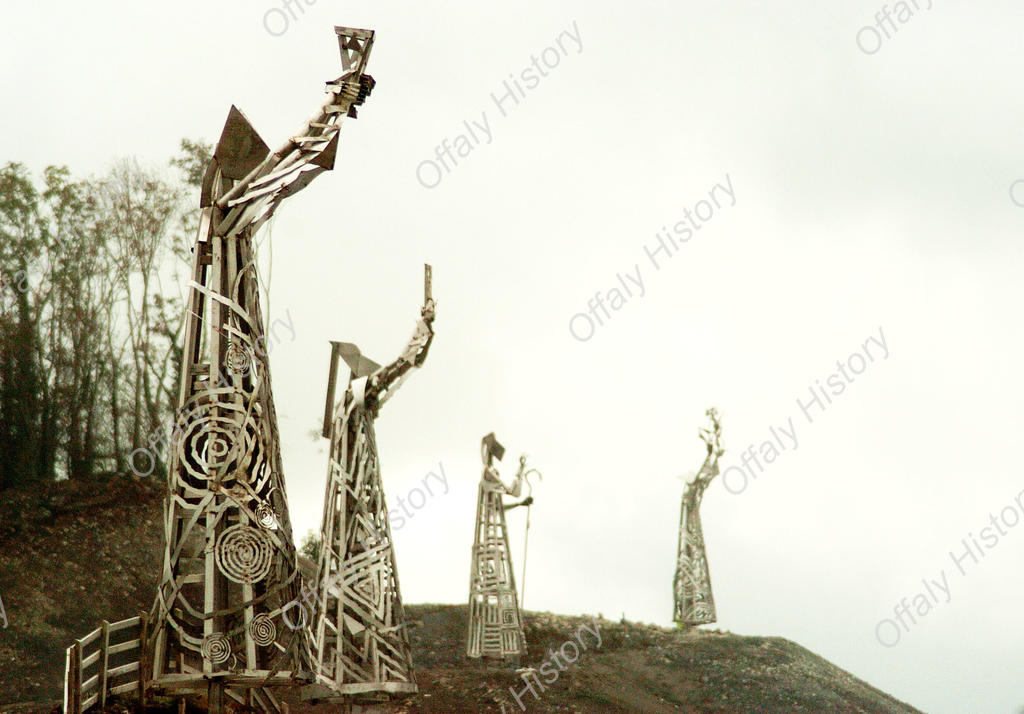
I suggest that three criteria, all of which are of course totally subjective, apply to any reconsideration of the role of public art. The first is the continuing historical acceptability of the person or event which is commemorated. In Offaly, it is beyond doubt that the Manchester Martyrs Memorial in Birr or the War of Independence Memorial at the Courthouse in Tullamore would pass that test. The second is the intrinsic artistic quality of the work and ‘Saints and Scholars’ by Maurice Harron on the Tullamore bypass is generally agreed to be both striking and imaginative. Finally, there is the work’s contribution to a planned urban ensemble and in this respect both the Downshire Memorial in Edenderry and the Barnes-McCormack Memorial in Banagher which close vistas or reflect their settings, would qualify. It gets a lot trickier however when a work satisfies some of the criteria but not all.
Maurice Harron’s Saints and Scholars Tullamore 2009
For example, in our capital city the statue of Daniel O’Connell, the ‘Liberator’, marks the entrance to the fine boulevard which bears his name and having been designed and executed by the greatest Irish sculptor of his day John Henry Foley, it clearly fulfils all three criteria of artistic worth, civic design contribution and an historically enhanced reputation.
However, further along the same street the statue of Horatio Nelson failed the public acceptability test and along with its beautiful and blameless Doric pillar, was blown up in 1967.
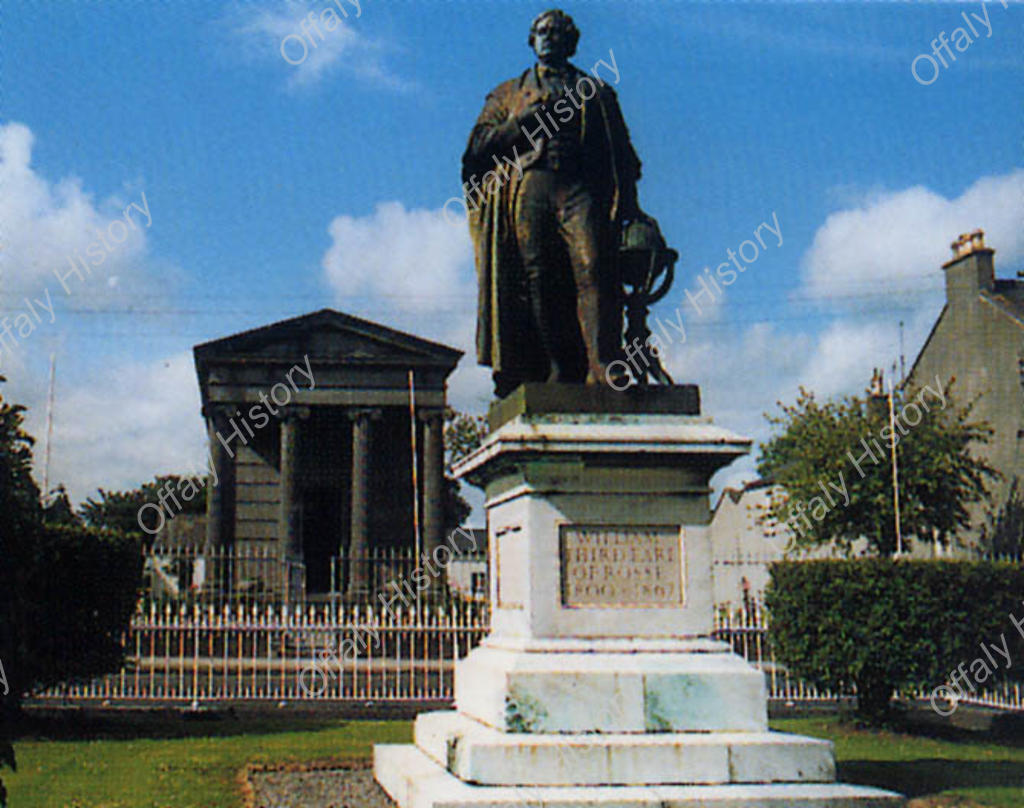
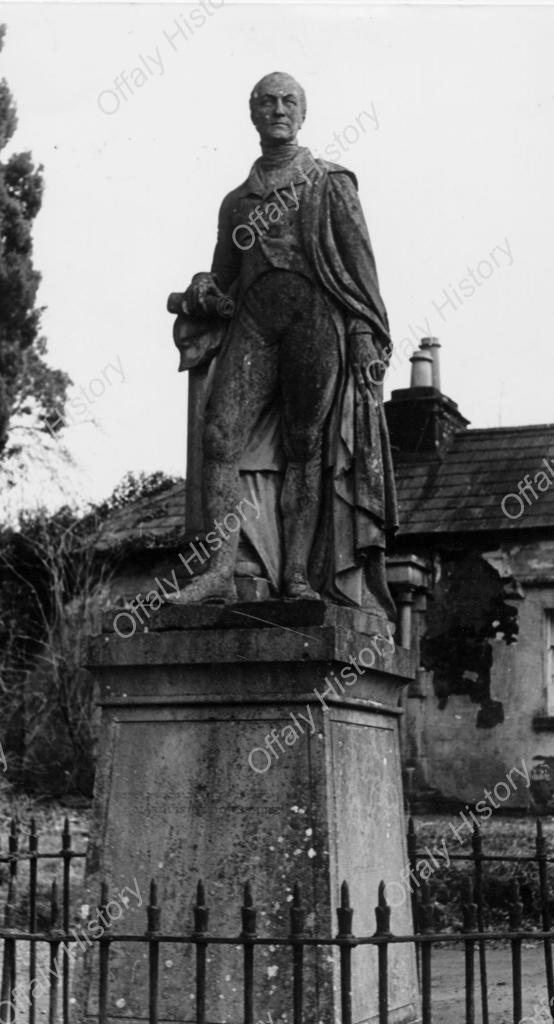
Foley’s Third earl unveiled in 1876
Interestingly, Birr provides a precisely similar scenario. The image of the third Earl of Rosse in John’s Mall is also a fine example of Foley’s skill, and the reputation of ‘The Astronomer Earl’ has grown over the years. The statue, by virtue of its scale and location, is an integral part of a well-designed public space. Thus all three criteria are fulfilled.
In nearby Emmet Square stands the finest urban ensemble in Offaly and the only extant example in Ireland of the use of a central column as a focus for a public plaza. Whatever about the artistic merit of his statue which stood atop its elegant Doric pillar, the brutal reputation of the Duke of Cumberland was anathema to many and the discovery of a crack gave a valid excuse for its removal by Birr Town Council in 1915. Had Dublin Corporation adopted the same approach, the column upon which Nelson stood and which contributed to the scale and architectural character of O’Connell Street, might still be with us but as in Birr, we would probably still be debating a suitable replacement to cap it.
The Duke is gone but the column has survived – 1747
Pure Dynamite
The issue of whether existing public art is still relevant and making a contribution to its locality can sometimes be contentious, but the location and nature of new public art is always pure dynamite, as the persistent vandalism of the Luke Kelly statues in Dublin (whether for aesthetic reasons or not) demonstrates.
Ideally public art requires public consensus and the smaller communities of Offaly who have got together to commission and install works of high artistic quality to celebrate their own local heroes or legends have shown the way in this regard and their approach deserves study and emulation.
Killeigh commemorates its famous local greyhound ‘Mick the Miller’ with a beautiful bronze piece by Elizabeth O’Kane. Cadamstown remembers local boxer Dick McRedmond in a lovely stone bust by Dermot Scully. In Ballycumber the wonderful little ‘Pilgrim’ trudges wearily to Clonmacnoise along the Erry Way in a delightful work by local artists Gerry Dooley and Lorie Quinn.
It is acknowledged by everyone that in Offaly both semi-State and local authorities have been to the forefront in providing good public art. The ambitious installations provided by Bord na Mona in the Lough Boora Discovery Park make it one of the best sculpture parks in Europe and it is the calling card of Offaly Tourism. Through its operation of the Percent for Art scheme, Offaly County Council has provided many imaginative and successful works in every part of the county, most recently Holger Lonze’s ‘Cruinne’ in Geashill and the ‘Marker Stone’ on top of Croghan Hill by Ciaran Byrne.
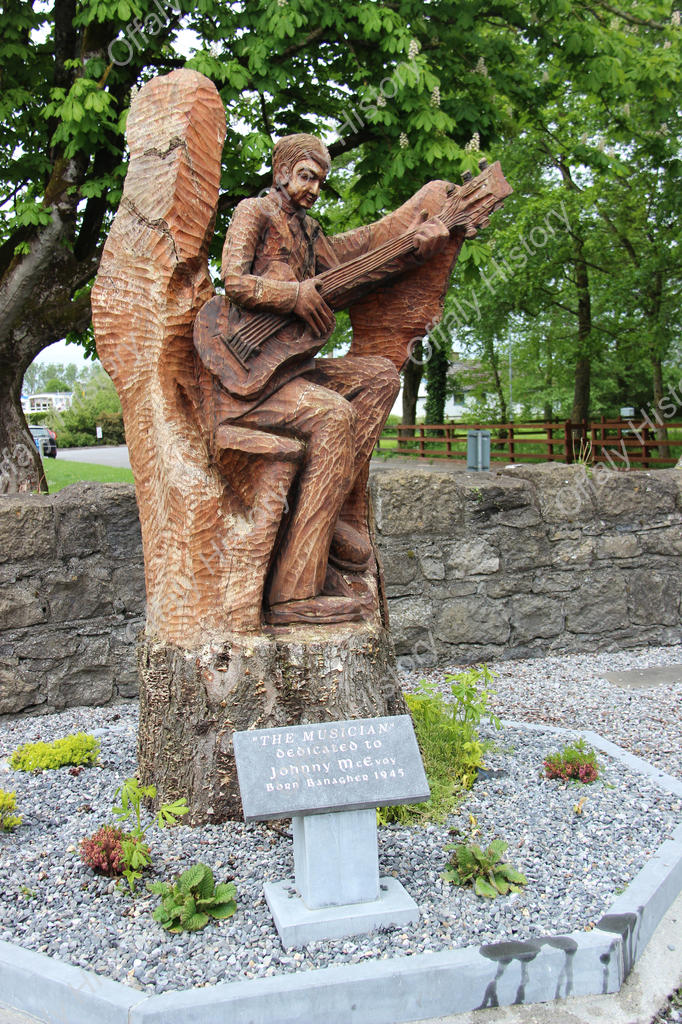
A son of Banagher – Johnny McEvoy
The elephant in the room however, is that almost all of these are in rural, village or remote locations and therefore their theme and siting is relatively uncontentious. A proposal to install a major piece of sculpture in the centre of any of the principal towns of the county on the other hand would immediately raise the questions of where, who, why, by whom and at what cost and inevitably cause a row. Nonetheless, busy central public spaces, both existing and planned, should now be the first choice locations for new artwork and these issues must be faced and a reasonable public consensus sought.
Edenderry’s progressive landlord – the third marquis of Downshire – 1845
The county capital, Tullamore town centre has only three significant sculptural works, the two long established War Memorials and the 1999 ‘Pot Stills’ in Market Square by Eileen McDonagh. The recent Street Enhancement Scheme which might have provided the opportunity for the installation of a significant new work, instead inexplicably and without giving public notice, required the removal of the Memorial to the Dead of the Great War from O’Connor Square, despite its designation as a Protected Structure. Following an outcry and Ministerial intervention, it was saved but its generous planted setting vanished and it now stands looking a little lost and unhappily compromised by car parking. A more considered and consultative approach to our urban heritage is urgently required
Pot Stills in Market Square 1999
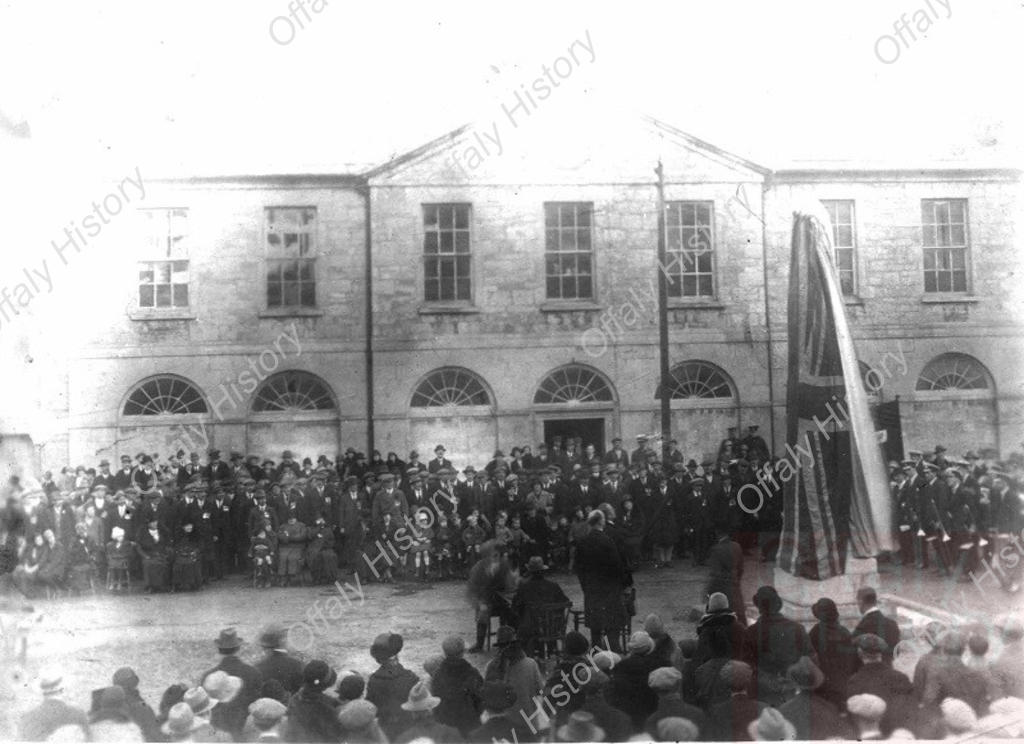
Unveiling the Great War memorial in Tullamore in 1926 Widows of those killed were seated
A Phoenix arises?
The installation of a fine new piece of sculpture to adorn the historic centre of Tullamore is long overdue and the imminence of a new town plan presents the opportunity for its delivery. Hopefully, unlike its predecessor, the new plan will include a coherent vision for the preservation and enhancement of the town’s architectural heritage.
It might also follow the lead of other local authorities and outline the role that urban art would play in making the centre more attractive and even suggest where new sculpture or installations might be placed. The Offaly County Council Public Art Working Group could then initiate a debate as to appropriate subjects. One relatively uncontentious idea that has been around for years and which would certainly stimulate the imagination of a talented artist, would be that of the Phoenix- the symbol of the town.
This is now the time to start the debate on how Tullamore can celebrate its history, remember those who made a contribution to it and furnish its historic centre with new and exciting public art.
I once more visited by friends in Tullamore, Killoughy and Banagher after an unexpected gap of almost six months. Young Covid intervened and I did not get down from my perch in D4 until ten days ago.
Upper East Side Tullamore
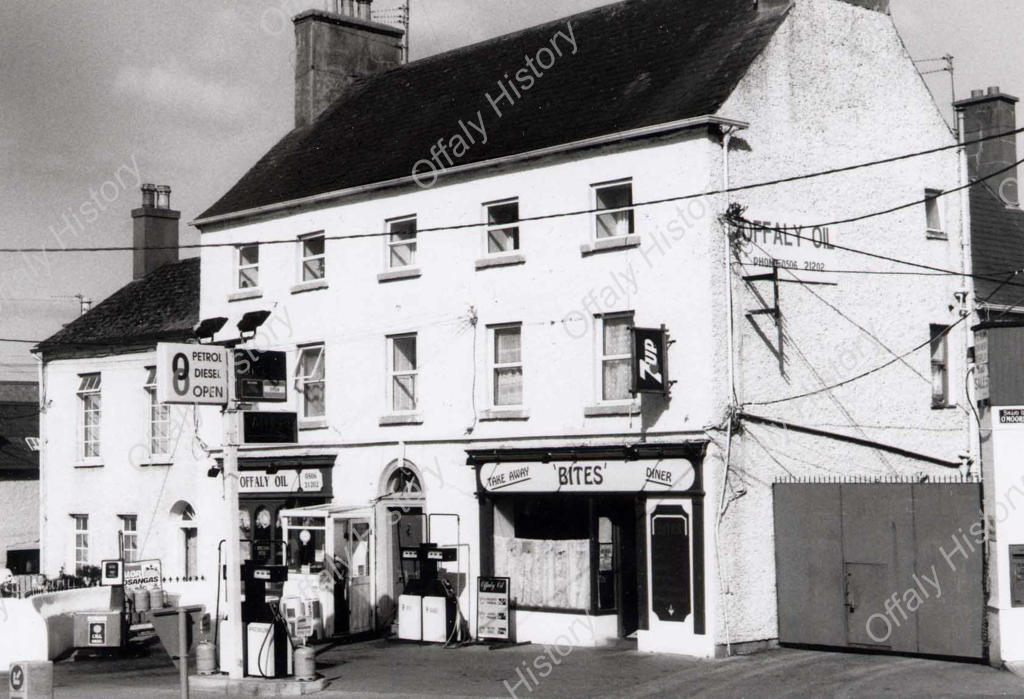
It was great to see my old town looking so well and all the works in the square and from High Street to Kilbeggan Bridge almost finished. Walking from the railway station down to the square brought me back to the 1950s and 1960s when I lived in the town and the High Street was a busy spot. The footpaths are wide now but there were few walking and even on Saturday the street was quiet. I see no space to park for my mother (if she were alive God rest her) to pull up in the old Prefect that she had. Sure that is progress. Maybe the plan for High Street got mixed up with O’Connell Street or Grand Parade! Anyway, today I am writing about the east side of High Street, what I will call ‘Upper East Side’, and I will talk about the west side of the street on another visit – if the pause button is not changed to stop!








 offalyhistoryblog