Arthur Griffith died of a heart attack, or stroke, in Dublin on 12 August 1922. He was only 51 and had given a lifetime of service to his country at huge personal cost. To mark the centenary of his death we recall an important contribution from Richard Barry (1880–1978) in 1970 where he set out some of the cultural history of Tullamore in the period before the Rising and the War of Independence. Barry was greatly influenced by the writings of Arthur Griffith in the United Irishman and also by the earlier contributions of William Rooney (1873–1901). Rooney met Griffith probably in 1888 and both were members of the Parnellite Leinster Literary Society, and after 1892 of the Celtic Literary Society. When the United Irishman was launched in 1899, with Griffith as editor, William Rooney was the main contributor and, working together, developed Sinn Féin policy. Rooney’s early death at the age of 27 was a devasting blow to Griffith. William Murphy in the short life of Rooney in DIB cites Michael Collins as describing Rooney in terms normally associated with John the Baptist: ‘Rooney spoke as a prophet. He prepared the way and foresaw the victory’ (Path to freedom, 150).
This year’s That Beats Banagher Festival will take place over next weekend Friday to Sunday, 22 to 24 July with a multiplicity of literary, heritage, cultural and sporting events including a food and craft fair in the Bridge Barracks Yard at the West End on Saturday, 12 noon to 4.30 p.m. craft workshops, children’s events, water events, children’s outdoor cinema and other surprise events. We are a day early with the blog to help promote this interesting festival.
Book Launches
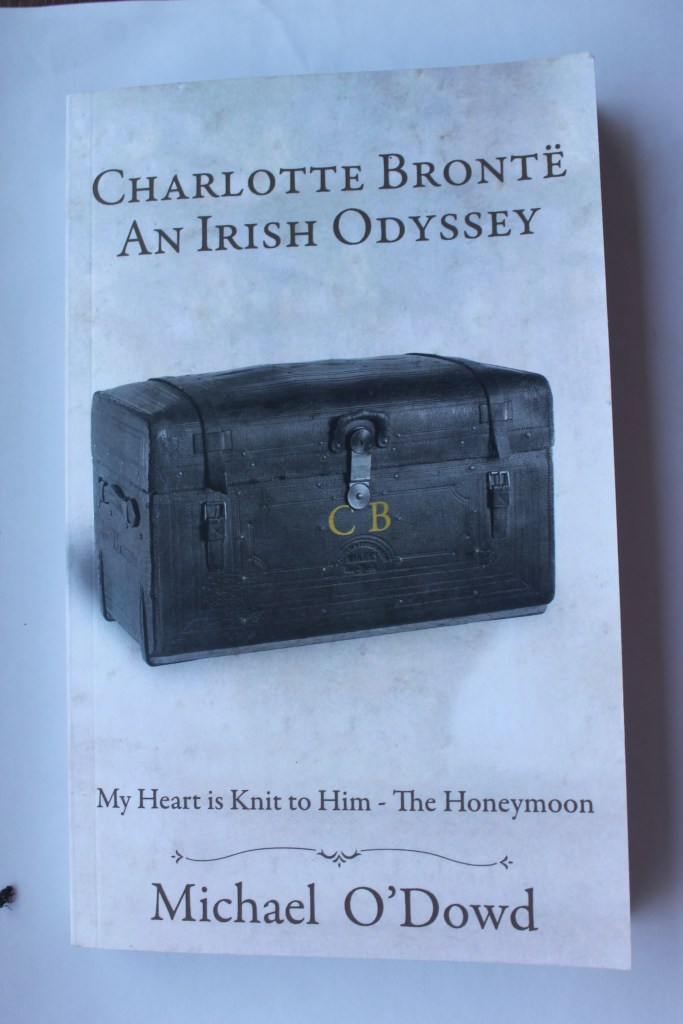
The programme is particularly strong on literary events with the launch of two books on Charlotte Brontë’s honeymoon in Ireland, the first called Arthur & Charlotte, by Pauline Clooney (published by Merdog) and the second, Charlotte Brontë: An Irish Odyssey by Michael O’ Dowd (published by Pardus Media). Pauline & Michael recently spoke with much acclaim at the prestigious Bradford Literary Festival under the title No Net Ensnares Me: Charlotte Brontë Abroad. The event will be held at 6.30 p.m. on Friday 22nd July in the Long Room in The Crank House.
Contributed by Offaly History to mark the Decade of Centenaries
We saw in previous articles in this series the lead up to the civil war notwithstanding the outcome of the general election in June in which the vote was substantially in favour of supporting the acceptance of the Anglo-Irish Treaty of December 1921. In Laois-Offaly all four pro-Treaty candidates were elected with Labour, who preferred to look at the social rather than the Treaty question securing almost fifty percent of the vote. But among the soldiers of the IRA, particularly in Offaly, there was a reluctance to accept the Treaty outcome. Some were of the view that the people would follow where the military led.
The burning of Tullamore courthouse, jail and the former military barracks (in Barrack Street, now Patrick Street) on 20 July 1922 was one of those momentous historic occasions the impact of which had an almost a numbing effect on the people of Tullamore and the county. The completion of these buildings in 1716, 1830 and 1835 were all major steps in the progress of Tullamore. Now all were destroyed in one night for no tangible military benefit by the departing Republican IRA.
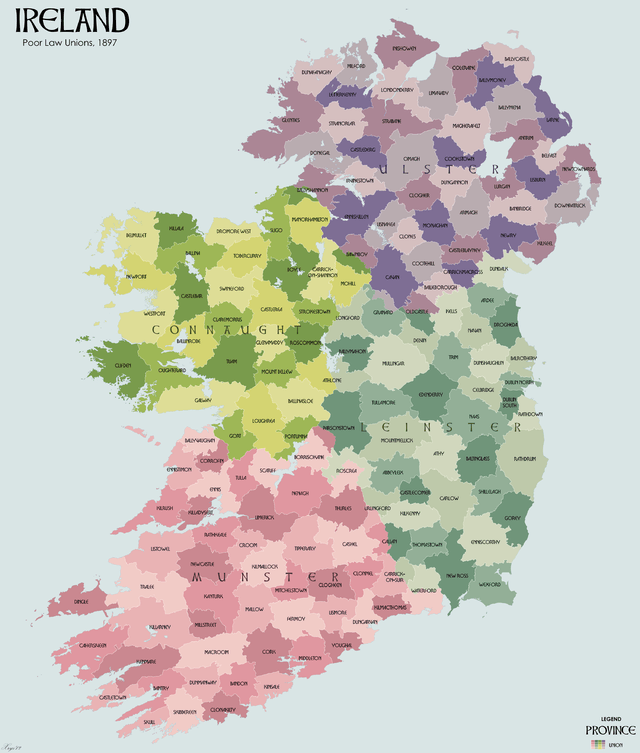
Since the early 18th century public healthcare in Ireland had been funded by voluntary donations. The first hospitals in Ireland were founded in the 1720s. The dispensary doctor was formally established by legislation in 1805 under an Act of Parliament. The amount from voluntary donations was matched by county grand juries from local taxation. The Poor Law Act of 1838 improved the distribution of dispensaries and divided Ireland into 130 administrative units known as Poor Law Unions, with their own workhouse, governed by the Poor Law Guardians, who were elected by the local rate payers.
The Poor law unions at the end of the nineteenth century. Courtesy Wiki Commons
The dispensary doctor became the mainstay of healthcare in rural Ireland as many people lived too far from medical help in workhouses. The position of the dispensaries was clarified in the 1851 Medical Charities Act, which introduced a state-funded dispensary system to provide free medical aid to the poor. These were to be funded from local taxation and were subsidised by the Poor Law Commission. To attend the dispensary, a person needed to have a colour-coded ticket, dispensed by the committee. The Poor Law Commission was replaced by the Local Government Board in 1872.
Today 14 July 2022 marks one of the most significant centenaries of the year in County Offaly, the burning of Birr Barracks in Crinkill. While the barracks started to go into decline towards the start of the twentieth century, it was still a vital provider of local trade. When the town council requested Lord Roberts station an infantry regiment in the barracks in 1897, local trade from the barracks was valued at £40,000 or around €3.5 million today. While not totally abandoned, troops were stationed in the barracks during the Second Boer War and during the WW1.
On duty at Birr Barracks about 1910
With the signing of the Anglo-Irish Treaty and the evacuation the barracks was handed over to the National Army, Commandant General Michael McCormack taking command of the barracks. The last of the British Army to leave had been a detachment of the Northamptonshire Regiment, which stayed to oversee an auction of government property, which ultimately never took place. The deport staff of the Leinster Regiment, had left several days before, bound for Colchester, which would act as the depot until the regiment was disbanded in June 1922.
Now in the hands of the National Army, the barracks was to act as the headquarters for the 3rd Southern Division. As the rift in the army occurred those in favour of the Anglo-Irish Treaty left the barracks leaving behind the anti-treaty forces, which sealed the faith of the barracks.
Dr Richard Butler will showcase the building of Offaly’s courthouses and prisons in the years between roughly 1750 and 1850 in a lecture at Offaly History Centre, Bury Quay, Tullamore and via Zoom on Tuesday 12 July 2022. The presentation will place individual buildings in Tullamore, Birr, Daingean and elsewhere in the context of changing political and social events throughout Ireland in these years, highlighting local agendas alongside those of the British administration in Ireland. Illustrated with historic architectural drawings, old and new photographs, the lecture will also highlight schemes that were never built as it traces the ways in which the appearance of Offaly’s towns was transformed in these years by new public architecture. The lecture will incorporate new research on Offaly’s history undertaken in recent years by historians based in the county such as Michael Byrne alongside volumes such as Andrew Tierney’s new Buildings of Ireland guide for Central Leinster and the speaker’s recently published book, Building the Irish Courthouse and Prison: A Political History (Cork University Press, 2020).
Charles William Francis Bury, the fourth Earl of Charleville, came of age on the 16th of May 1873. Celebrations were delayed to the end of May so as to confine the party and the guests staying at the castle to one week and ending with the marriage of the earl’s sister to Captain Edmund Hutton on 5 June 1873. As stated in article no. 5 in this series the young earl died in New York on 3 November 1874 without marrying and was succeeded as fifth earl by his uncle Alfred. The latter died childless on 28 June 1875 and so the Charleville title died with him. The fourth earl’s sister, Lady Emily, succeeded to the estate while yet a minor. She married in 1881 but was a widow by 1885. Lady Emily died in 1931 having spent much of her widowed life abroad and was succeeded by her only surviving child Lt Col. Howard Bury (died 1963 aged 80). He inherited Belvedere, Mullingar from his cousin Brinsley Marlay in 1912 and sold the contents of Charleville Castle in 1948. As Lt Colonel Bury died childless the estate went back up the line to the children of Lady Katherine Hutton née Bury (died 1901). The celebrations of 1873 were poignant and the speeches full of irony. That the family had an excellent relationship with the Tullamore townspeople is clear from the speech of the parish priest Fr McAlroy who had succeeded O’Rafferty in 1857. Alas so little material has survived by way of letters or diaries of the speech makers of that exciting week in the history of Tullamore. As noted in the no. 5 blog the original address of Dr Moorhead on behalf of the town commissioners was donated by Professor Brian Walker to Offaly History. The late Brigadier Magan donated an important photograph of the 1873 wedding and pictures of the Hastings of Sharavogue in what we now call the Biddulph Collection in Offaly Archive.
The Hastings and Westenras of Sharavogue were among the guests at the Charleville wedding as also was Lord Rosse (the fourth earl) and the Bernards. Lords Digby and Downshire, the other big landowners in the county were absentees. This copy from Rathrobin and the two Irelands (Tullamore, 2021) available from Offaly History.(more…)
In these days when there is so much of war and pestilence it is good in looking at the Decade of Centenaries in Ireland to focus on the positive. Things that were done the good of which is still with us. So it is with technical education. Today we look at the early efforts and how positive and innovative were the early pioneers. Our own founder of Offaly History in 1938-9, James Rogers, was one who contributed. So too did those unsung heroes E. J. Delahunty and Willie Robbins. In regard to technical, or what is sometimes referred to as practical education, the earliest attempt in the county to provide such a facility was made at Birr about 1841 when the Parsonstown Mechanics Institute was established in, or to the rear, of the memorial hall at John’s Mall.[1] It was not a success. There were other experiments in agricultural education and model schools, but the first real attempt to provide children and adults with opportunities for technical or practical education came with the passing of the Technical Instruction Act, 1889. A further important stimulus was the passing of the Agricultural and Technical Instruction Act. 1899, which led to the setting up of a new department of agriculture and technical instruction. As a result of the two acts over fifty committees throughout Ireland were working to promote agriculture and technical instruction by early 1900.[2]
At a time of economic stringency, the architect Michael Scott delivered several elegant retail buildings for a prominent midlands business family. These were executed in a Modernist style and incorporated natural materials in an innovative fashion.
D.E. Williams
In a recent Offaly History blog, Michael Byrne described the expansionary retail strategy of the notable Offaly commercial firm of D. E. Williams in installing high quality shops and pubs in virtually every town and village across the county in the period 1884-1921.
This courageous approach had not deserted the go ahead commercial family when during the Second World War, then modestly referred to as ‘The Emergency’, they ambitiously embarked on the redevelopment of their most prominent retail outlets in Dublin, Athlone and Birr and and most importantly, delivered a flagship shop and public bar in Patrick Street in Tullamore. To implement their progressive strategy they turned to Michael Scott.
My internship at the Offaly Archives finished in March and I will go home with a suitcase full of experiences, knowledge, and impressions I gained about Irish life and heritage. I am an archivist student from the University of Applied Sciences in Potsdam, Germany. In our college a practical experience of the duration of 22 weeks (5.5 months) is a mandatory element of the undergraduate degree course in Information Sciences.
After my Abitur (the German form of the Leaving Cert), I went to explore Ireland on a year abroad with the organization WWOOF (Worldwide Opportunities on Organic Farms). Eventually, I landed in Offaly, more precisely on Mount Briscoe Organic Farm near the village of Daingean, a place full of history. The beech-lined avenue, the country house with its walled garden and the quarry with a lime kiln are dating back to the beginning of the 19th century. Through the interest of the family in the local history I got to know about the Offaly Historical and Archaeological Society and visited some of the evening lectures.



 offalyhistoryblog