Tullamore is a well-preserved town and is the county town of Offaly since an act of parliament in 1832 displaced Philipstown (Daingean) which had been the county town since the shiring of Offaly as part of the new colonial government policies in 1557. The new county to be known as King’s County was then comprised of the baronies reflecting the Gaelic lordships of the O’Connors and that of the O Dempseys. The king in question was none other than Philip II of Spain married at that time to the tragic Queen Mary of England (1553–58) hence the new forts of Philipstown and Maryborough (Portlaoise). The county was extended about 1570 to include the territory of the O Molloys (now to be the baronies of Ballycowan, Ballyboy and Eglish) and also that of the Foxes in Kilcoursey and the MacCoghlans in what would be called Garrycastle. In 1605 the territory of the O Carrolls (to form the baronies of Ballybritt and Clonlisk) was added, as also was the parish of Clonmacnoise (1638) at the behest of Terence Coghlan of Kilcolgan. Those looking for an exciting seventeenth-century history for Tullamore will be disappointed as the surviving evidence of town growth in that troubled century is thin. This week we continue to series to mark the 400th anniversary of Tullamore as a town.
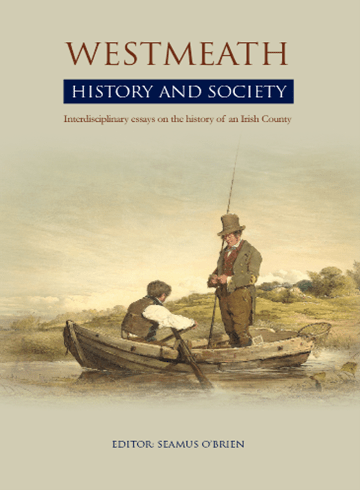
The Mullingar and Athlone launches of Westmeath History and Society have provided two interesting and original addresses on the status of local history in Westmeath, our neighbouring county. The Offaly History and Society volume was published in 1998 and is long out of print. A few copies were secured by Offaly History some years ago and are offered for sales as scarce titles. We thank our friend Dr Harman Murtagh for a copy of his address on 31 3 2022 and we have added some pictures for our readers. Enjoy the address in Athlone and you can get the book at Offaly History Centre and online at www.offalyhistory.com, over 900 pages, hardback, €60.
My friends,
This is the south Westmeath launch of this magnificent volume, Westmeath history and society.
A week ago it was launched in north Westmeath by the archbishop of Dublin, the very Reverend Dr Farrell; south Westmeath must make do with the most irreverent Dr Murtagh.
The book is 900 pages long. As the archbishop observed in Mullingar, it’s about the size of a concrete block: in my view, its only fault is that it’s rather heavy to hold in bed.
Westmeath history and society is one of a series of county books – incredibly it’s the twenty-ninth in the series. The series has been appearing at the rate of a volume a year since 1985.
The series founder, general editor and manager from the start is Dr Willie Nolan, aided and abetted by his wife, Theresa. Their contribution to Irish society and to local studies is without equal. In France they would undoubtedly be awarded the Legion of Honour; in Britain surely Sir Willie and Dame Theresa? In Ireland, and here in Athlone, we can offer at least our enormous admiration for their magnificent achievement – twenty-nine county volumes of this size down, and only three to go! Wow!
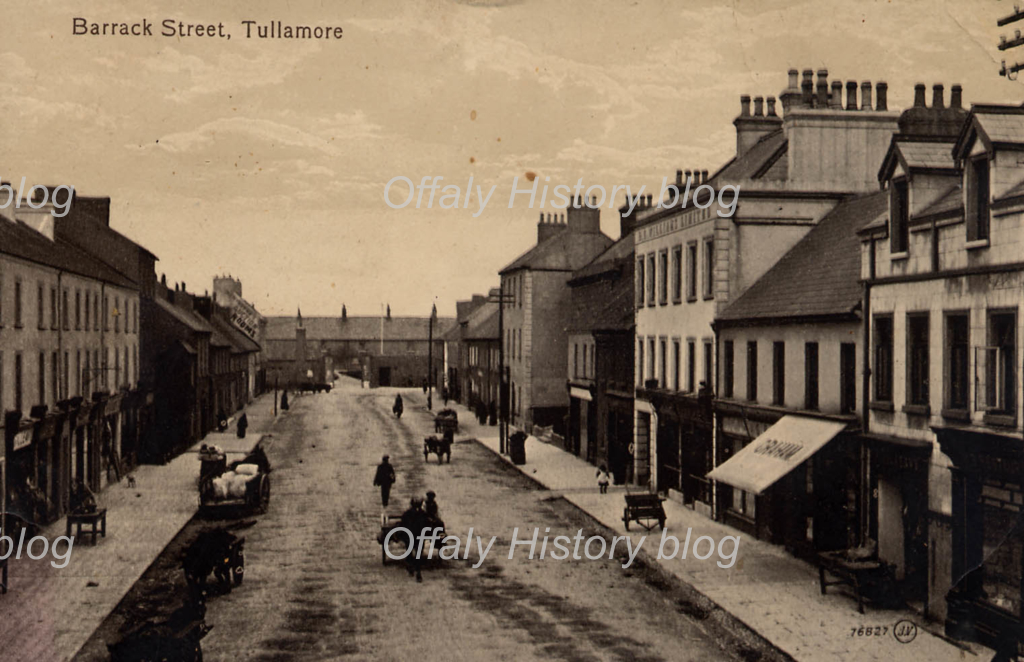
The barracks of 1716 was at the western end of Patrick Street and Hayes Hotel, dating to 1786, at the eastern end on the corner with Church Street and Bridge Street (now Boots Pharmacy). The barracks was destroyed in July 192 2on the retreat of the Republican soldiers from the town during the Civil War. Within fifteen years the site was fully taken up with urban council housing and a garda station built here in 1937 and rebuilt in 2002. The military barrack of 1716 brought about 100 soldiers to the town and is thought to have been a major factor in the town’s growth because of the increased demand for goods and services that followed its construction. After the 1870s, soldiers were stationed at Tullamore only at infrequent intervals.
Barrack/Patrick Street, Tullamore about 1910. The barracks dated to 1716 and destroyed in 1922.
The police moved into the old barracks about the year 1899. The building was occupied by the old I.R.A. in March 1922 when the British army quit the town as part of the Treaty settlement and was destroyed some four months later as the Republican soldiers left town in the course of the Civil War and before the arrival of the Free State army. Parts of the old walls survive and one can see the star-shaped fort pattern in the part of the wall opposite DNG Auctioneers.
Part of the old star-shaped fort style for the new barracks of 1716 erected in Tullamore(more…)
The memorial to the Offaly Volunteers who fought in the War of Independence was unveiled on the lawn of the county courthouse, Tullamore in 1953. It was Peadar Bracken (1887–1961) former OC Offaly Brigade and from 1922-3 the Tullamore district court clerk who ensured that the IRA Volunteer monument was placed on the lawn of the courthouse. Besides, a site in O’Connor Square was not an option from 1926 when the war memorial was completed. Given that it was principally to the Tullamore courthouse that the feared judges of the assizes would arrive it has strong symbolism. The Volunteer monument was completed in 1939 but not unveiled until 1953 due to the difference between the Free Staters (National Army) and the Republicans.
Memorial to members of the Old IRA at the county courthouse, Tullamore
As noted in an earlier article in Offalyhistoryblog the last of the assizes was held in July 1921 with Judge Wiley presiding and a large force of military to protect him as the symbol of the British state. Now with the marking the 100th anniversary of the Treaty and the departure of Crown forces from Ireland it seems appropriate to look again at the twice-annual display of British power in the assize towns of Ireland.
On the 1809 map of King’s County by William Larkin, one can easily fail to spot the tiny T-shaped symbol about 1 mile northwest of the town of Tullamore. There is no description to inform the reader what the object represents. Its shape and its location, however, leave no doubt as to what it symbolizes. It is the first post-Reformation Catholic church in the parish of Tullamore. Erected in 1775 in the townland of Ballyduff, the chapel’s out of the way location some distance from the town of Tullamore seems peculiar today. Another look at the 1809 map provides at least a partial clue to its location. Not more than about a hundred metres from the chapel is a quarry, probably one of the earliest limestone quarries to be opened in the area and almost certainly the source of the stone of which the chapel was built. The chapel was presumably built by the workers and tradesmen of the local quarries. Today the ruins of the Ballyduff chapel are located in the middle of the Axis Business Park accessed from the Clara Rd.
This short article is the first in a series designed to look at the growth of Tullamore over the period from 1622 and to take key dates in the development of the town. Suggested dates will include 1622, 1716, 1764, 1785, 1804, 1835, 1900, 1923, 1948, 1966 and 2000. These dates coincide with particular events, or the availability of documentary sources that may allow us to draw some conclusions about the state of Tullamore at varying times over the last four centuries. Rather than take matters in chronological order we are going to look for some key moments in the stages of growth. One such was the completion of the canal to Tullamore in 1798 and its extension to Shannon Harbour in 1804. During that six years Tullamore had served as the depot and terminus for the new waterway to the west and south. The opening to Shannon Harbour and the link to the Shannon may have been seen by some as marking the end of the new canal hotel and harbour in Tullamore with business moving further west and travellers no longer having to stop over in the town. That was not the case. The hotel client base weakened to almost nothing by the 1840s and so did passenger traffic. Commercial traffic was continued on until 1960.
On Monday 21 February 2022 Offaly History will host a public lecture on the photographic work of Middleton Westenra Biddulph (1849–1926) of Rathrobin, Tullamore. The lecture will also be streamed via Zoom and will start at 8 p.m. at/from Offaly History Centre. Biddulph’s photographs of Offaly and midlands interest together with Big Houses in Ireland have been published in Michael Byrne, Rathrobin and the two Irelands (Tullamore, 2021).For the link to Zoom email info@offalyhistory.com. There is no charge.
The new large format book has over 300 photographs with context and captions and is available for €25 in hardback. The publication was supported by the Decade of Centenaries and took fourteen months to prepare.
Middleton Westenra Biddulph was born on 17 August 1849 at Rathrobin, Mountbolus, King’s County. He was one of six children and the eldest surviving son of Francis Marsh Biddulph (1802–1868) and Lucy Bickerstaff (d. 1896). She was born in Preston, Lancashire and they married in 1845 when F.M.B. was 45 and Lucy 24.[1] The Bickerstaff connection was to be an important one for the surviving sons of F.M.B. and led to a substantial inheritance in the 1890s for Middleton W. Biddulph (M.W.B.) and his brother Assheton who lived at Moneyguyneen, Kinnitty. F.M.B. was of a large family of eleven children. All were girls save their one surviving brother. F.M.B. lived with at least three of his sisters at Rathrobin, few of whom married and at least three emigrated to Australia or the United States.
In person and online. For link email info@offalyhistory.com(more…)
Early 1922 saw just two local organs of public opinion in Offaly – the Midland Tribune and the King’s County Chronicle. The Tribune was owned by the long-term nationalist Mrs Fanning, widow of the late Dr Fanning and herself active in regard to Sinn Féin policy on amalgamation of the workhouses. Her editor was James Pike from Roscore, long-term supporter of Sinn Féin who was now ready to recommend acceptance of the Treaty. So also was Archie Wright, owner of the Protestant and unionist Birr-based Chronicle. The Offaly Independent was more representative of North Offaly, but its printing works had been destroyed by crown forces in November 1920 and did not re-emerge until late spring 1922. During the course of 2022 we plan to bring you articles on the evolving situation in Ireland and Offaly in 1922 and we will be looking into the Offaly Archives, Offaly History Centre and Offaly Libraries to dig deeper for the nuggets.
This famous phrase or exclamation or some version of it has been in use for hundreds of years. There are few instances if any in the English-speaking world where a placename appears in this manner. In all cases it was used dramatically to emphasise in a humorous way what has been said or written. The phrase was seldom if ever employed in a derogatory sense. It was regularly used by public speakers such as members of parliament or lawyers and judges in court. While it was often referred in Great Britain, and indeed in other countries throughout the world, the most common usage was by people at all levels of society in Ireland and it was very much an Irishism. It appears in the works of many famous writers such as AnthonyTrollope, William Carelton, W.B.Yeats, Joyce’s Finnegans Wake and Plunkett’s Farewell Companions. It also featured regularly in newspapers and on other media as can be seen in the selection below:
Pauline Clooney’ Charlotte & Arthur, an imaginative recreation of the Charlotte Brontë’s honeymoon in Wales and Ireland, is an exciting combination of fact and fiction. The extensive historical research which preceded the writing of the book is evident throughout and this coupled with the creation of less historic characters and the weaving in of more fictional nuances ensures a work that is at once refreshing and convincing. While the sources of history are comparatively plentiful for this episode due to Charlotte’s prolific letter writing and an abundance of biographies of the two main characters, it is the richness of Pauline Clooney’s writing that makes the work engrossing and appealing.



 offalyhistoryblog