
The grand jury system in Ireland was a precursor to the county council or local authority system we know today, and the records generated by the grand jury and its offices reveal the history of towns, cities and boroughs all over Ireland. Unfortunately this body of records suffered significant losses during the twentieth century. On 25 May 2021, Beyond2022:Virtual Record Treasury of Ireland in association with Local Authority Archivists and Records Managers (LGARM) hosted a research showcase to mark the centenary of the burning of the Custom House during the War of Independence, an event which resulted in the destruction of the archive of the Local Government Board for Ireland. This event was echoed just over a year later with the destruction of the Public Record Office of Ireland at the beginning of the Civil War and whose losses in terms of documentary destruction is being valiantly and virtually rebuilt by the Beyond2022 team. The top floor of the PRO was where the grand jury records from all over the country were kept and ultimately perished during that terrible fire. Between the fire in the Custom House and the more well known 1922 PRO(I) fire, vast quantities of records relating to local government were destroyed.
(more…)Category: Archival collections
-
The 1821 census and the town of Birr: exciting opportunities for exploration of town, family and social history 200 years ago. By Michael Byrne. Blog No 290, 26th May 2021
Birr sometimes called Parsonstown
In the Pigot directory of 1824 Birr was described ‘as far the most considerable of any of the towns in the King’s County. It is situated on the river Birr [Camcor], and adorned with a fine castle, built by the family of the Parsons, the residence of the second earl of Rosse, the proprietor of the town. This town it was said has since been rebuilt by the present earl’. Birr was the leading town in the county from the 1620s until the 1840s but began to loose out because of the lack of an easy and direct link with Dublin, and it being that bit more distant from the capital and less central for local administration. The decline would accelerate after 1900 with the loss of political and administrative influence. By the 1820s Birr had new Protestant and Catholic churches (the latter nearing completion at the time of the census and the publishing of the Pigot directory), two Methodist chapels and a Quakers’ meeting house. The charitable institutions of Birr, were a fever hospital and dispensary, supported by county grants and annual subscriptions; a Sunday school for children of all denominations; a free school for boys, and another for girls. Birr had a gaol and a courthouse (from c. 1803), where the sessions were held four times a year. The prisoners were sent to Philipstown, which was the county town until 1835 for trial for serious crimes. From 1830 when the new gaol was built in Tullamore Birr prison was more a holding centre only. The ruins of the old church near the castle wall are still visible. One mile from the town were the barracks, ‘a large and elegant building, capable of holding three regiments of soldiers’. Birr has two large distilleries and two breweries, which, it was said, gave employment to the poor of the town.
(more…)
-
Marking the opening of the first public library in Tullamore: May 1921. By Michael Byrne. Blog No 283, 28th April 2021
For many the habit of reading started with the local library and has never left us. Recollections of the several libraries we have had in Tullamore remind us that so far as reading and comfort goes we have never had it so good. This is the time to recall the first public library in Tullamore started in May 1921, just 100 years ago. For that we have to thank an unsung hero E. J. Delahunty, a native of Clonmel, who was in charge of technical education in the county from 1904 to 1930 and died in 1931. He organized the first ‘students’ union’ in Tullamore and a superb lecture series on the great issues of the day in the 1916–21 period, and with mostly well-known speakers with a national reputation. The Midland Tribune gave the opening of the library an editorial and regretted that the lecture series had to be abandoned that year. Delahunty was shrewd and had the Tribune editor, Seamus Pike, on side. Another unsung hero of the revolutionary decade was Revd John Humphreys, a Tullamore-based Presbyterian minister, and great advocate for technical education. These are three people who need to be included in the Offaly Dictionary of Biography.
(more…)
-
St Mary’s parish church, Geashill: a personal history. By Sylvia Turner. Blog No 277, 7th April 2021
Geashill parish church
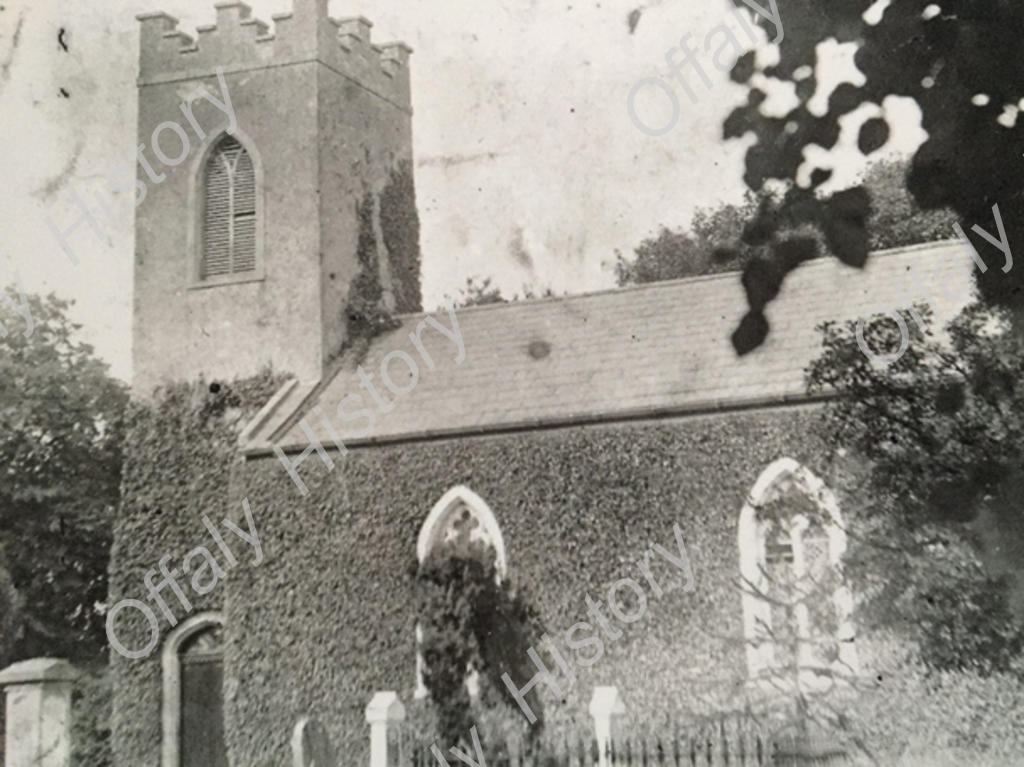
On a walk recently, listening to the crows squawking, I was reminded of a visit to Geashill parish church, dedicated to St Mary, in the diocese of Kildare and county of Offaly just over a year ago and hearing the same sound from the trees by the path to the church.

I have become very attached to the church as it is where my great–grandparents and grandparents were married and where many of my great–aunts and great–uncles were baptised and buried, sadly in unmarked graves. As the world comes to terms with the Covid–19 pandemic, I think of my grandmother, Elizabeth Kerin née Evans (1881–1967) who was born in Geashill. She lived through the tuberculosis epidemic of the early 20th century that killed her father and ten of her twelve siblings, the 1918–1919 influenza pandemic and the War of Independence (1919–1921), a particularly dangerous time for Protestants such as her remaining family in Geashill and her growing family living nearby in Clara.
My grandmother’s early life up to the 1920s was little known to her children and it is only in comparatively recent years that the tragedy she encountered in Geashill has been fully realised. Her only known relatives were her parents, two sisters and two brothers. Access to further information came to me 16 years ago when I contacted the incumbent of Geashill and Killeigh parish at the time, the Revd J. Leslie Crampton. He transcribed all the births and deaths he had for the family. The information concerning the true number of siblings she had and how many had died of tuberculosis, many as young adults, was truly shocking to my grandmother’s daughters and grandchildren. However, it has enabled us to appreciate all the more that the loving and caring person we knew who was sustained by her family and her faith. We realise now she also held the qualities of strength and resilience.
(more…)
-
T.M. Russell (1868–1932): a huge loss to Offaly in the early years of Independence. By Michael Byrne. Blog No 274, 27th March 2021
The now permanent release online with free access of some 11,000 lives in the Dictionary of Irish Biography (DIB) will be a huge bonus to historical research. And yet there will be many people at county level who will not feature but deserve to have their work recorded in dictionaries of county biography. Offaly History began this process in its publication Offaly Heritage 9 (2016) but more so in the recent issue of Offaly Heritage 11 (2020) where the following ‘Brief Lives’ were recorded by way of:
Short biographies of revolutionary figures in Offaly, 1912–23
P.J. Bermingham (1872–1975), 2–3.
Eamonn Bulfin of Derrinlough, 26–7
Father Thomas Burbage (1879–1966), 42–5
Revd Philip Callary (1849–1925), 73–4
Cumann na mBan in Offaly, 80–81
Thomas Dunne (1884–1968), 90–91
James Perry Goodbody (1853–1923), 134–5
Catherine Mahon (1869–1948), 157–8
Patrick McCartan (1878–1963), 179–80
Seán McGuinness (1899–1978), 189–90
T. M. Russell (1868–1932), 205–6
These short essays of less than 1,000 words each were contributed by independent scholars – Brian Pey, Michael Byrne, Margaret White, Ciara Molloy and Lisa Shortall.

Offaly Heritage 11 – a bumper issue of 450 pages with the brief lives It is to the final life in that recent collection we focus on here. It was that of T.M. Russell, a man with huge potential, which remained unrealised when the opportunity came for a revolutionary change in local government in June 1920. This was following on from the election of the first Sinn Féin controlled county council and the implementation of self-reliance and breaking with the Dublin Castle based Local Government Board.
(more…)
-
The golden era of housing in Tullamore from the 1930s to the 1950s: Clontarf Road, Pearse Park and Marian Place, but Dr Moran, P.P. has reservations. By Fergal MacCabe. Blog No 273, 24th March 2021
An Architect Revealed
On Monday 16 February 1953, a Banquet was held in Hayes Hotel Tullamore to celebrate two very significant achievements; the completion of the 74-house Pearse Park and the cutting of the sod for a further 106 houses later to be named Marian Place. These two estates, whose very names evoke the atmosphere of the period, would be joined in 1965 by Kearney Park dedicated to the well-known local politician Joe Kearney.The three schemes together represent a high point in local authority housing not just in Offaly, but in Ireland.
The large attendance that day included the Minister for Local Government Paddy Smith, the cream of Tullamore society; the clergy, politicians, administrators, police and solicitors, as well as those involved in the delivery of the estates. Buried at the bottom of the extensive list which appears in an entertaining frontpage account of the event in the Offaly Independent of the following Monday, but unidentified as such, was the designer of the schemes, the architect Donald Arthur ‘Bob’ Tyndall M.R.I.A.I. (d.1975). Tyndall who had spent his early career in Shanghai was also engaged to deliver the Tullamore County Clinic and is credited with several housing schemes in the Offaly area. In 1971 his practice became Tyndall Hogan Hurley and went on to become one of the most successful in Dublin, specialising in office and residential developments.
Tyndall was the latest in the line of designers used by Tullamore Urban District Council to implement an admirable housing programme over the previous fifty years.
(more…)
-
The Mother and Baby Report – ‘P.F.I.’ and the view from Britain. By Declan McSweeney. Blog No 267, 28th Feb 2021
The report of the Commission of Investigation into the mother-and-baby homes has received huge coverage in the British media, reflecting, no doubt, the number of survivors of the homes who settled in Britain. This is the third and final blog looking at this important report for Irish social history in the 20th century. Here Declan McSweeney looks at the reception of the Report in Britain
It is a reminder of the days when so many Irishwomen were referred to as ‘PFI’ (Pregnant From Ireland). One of the most shocking aspects of the report was the reference to women who had moved to cities like London or Liverpool and were effectively kidnapped by their families and forced back to hellish institutions, as outlined here: Mother and Baby Homes: State paid for 2,400 pregnant women to be repatriated from England
Mother and Baby Homes: State paid for 2,400 pregnant women to be repatri… Aoife Moore and Elaine Loughlin Many pregnant single women that travelled to Britain found it was less welcoming than they had hoped It is also a salutary reminder of the fact that Britain, for all its faults, has long been a haven for Irish people from ill-treatment of one kind or another.
The recent announcement by the Irish Government of its Diaspora Strategy has featured a recognition that many were effectively forced out of Ireland down the years.
(more…)
-
Sources: Researching the War of Independence at Offaly Archives. Blog No 263, 17th Feb 2021
Archives in Offaly covering the War of Independence period are varied and interesting. This blog will give a short overview of archival material in Offaly Archives in collections of local government records and private papers, drawn from both the collections of Offaly County Library and Offaly History. Links will be provided to online descriptions and digitised resources on the online catalogue offalyarchives.com This will also include links to the catalogue of the Rosse Papers at Birr Castle, another local repository of important source material.
Local government archives, such as the records of the county council and of the urban and rural district councils, record the massive political change following the establishment of Dáil Éireann in January 1919. By the time the local elections of 1920 were held, Sinn Féin had the majority of seats on the County Council. King’s County Council was renamed Offaly County Council in June 1920 and allegiance to the new Dáil was ratified by many of the district councils, e.g. Tullamore Rural District Council recorded the following motion on 2 October 1920: (more…)
-
Valuation records for family and town history: Luker’s Pub, Shannonbridge, Ireland. By Laura Price. Blog No 261, 10th Feb 2021
Shannonbridge A History of Raghra c.1600-c.1900 was published in 2019. Research for it began many years ago when I decided to learn more about my family and family home in Shannonbridge, County Offaly. That interest spread to other houses in the village. When Brendan Ryan and I decided to write a book about Shannonbridge I concentrated on the genealogy of those who lived there in the past. Gradually the history and stories of families emerged. My main goal in writing the book was to pull the names of the people of Shannonbridge out of the past. Sometimes we found interesting stories but often we just learned their names and the bare facts of their lives. However it felt wonderful to put those names in a book, to prove those people had been there, to acknowledge their existence. They all played a part in the story of a village. Oh, they had hard lives! And yet, many survived and thrived. Their descendants span the globe. What struck me most in learning about them was that often their stay in the village was short-lived. Many of the families who settled in the village only stayed for a generation or two and are long gone now. Keeping track of people moving in and out was a challenge.
(more…)
-
Frank Gibney: A visionary Irish architect and planner. A new source for some of the finest midlands housing schemes. By Offaly History. Blog No 245, 9th Dec 2020
The architect and town planner Frank Gibney (1905-1978) is today recognised as one of the most talented, influential and prolific housing designers of mid-20th c. Ireland.
Responsible for almost six thousand local authority dwellings in every part of the country, his deep concern for human scale and for good living standards delivered homes of a quality which have stood the test of time, while today many of their contemporaries have been altered or demolished.
Principal amongst his many achievements are the six Midland bog villages built in the 1950s for Bord na Mona workers, which were inspired by the aspirations of Patrick Pearse and Eamon de Valera for national self-sufficiency and which have been described by the Yale University Press/Royal Irish Academy volume on Irish architecture as ‘models for rural living’. These beautiful urban set pieces are cherished by their proud present day inhabitants and beg the question as to why contemporary housing policies have not emulated their success.

Gibney designed housing estate at Clarecastle, County Clare Gibney’s numerous and extraordinarily ambitious town planning schemes founded on Garden City and Beaux Arts principles, were less successful, being proposed at a time of cultural conservatism and financial stringency. His passion for plans based on aesthetic principles which would preserve the best of towns while creating new and beautiful public areas found little local response. Nonetheless, he was engaged by many Irish towns and cities including Waterford and Drogheda to chart their future and elements of his proposals are still capable of fulfilment today.
(more…)
 offalyhistoryblog