David Beers Quinn’s collaboration and lifelong friendship with Robert Dudley Edwards is described in Telling the Truth is Dangerous, one of the first biographies of a modern Irish historian. Author Neasa MacErlean, Edwards’s granddaughter, looks at a relationship that helped modernise the study of Irish history.
(more…)Category: Archival collections
-
That Beats Banagher and Banagher Beats The Devil! Offaly History – a very special Bangs Banagher book launch on Friday 27 June. No 18 in the Offaly History Anniversaries Series. Blog No 724, 23rd June 2025
Two local historians have collaborated to create a new lavishly illustrated book exploring the meaning behind the regularly used phrase ‘That Beats Banagher! and Banagher Beats the Devil! The book was written by Kieran Keenaghan, a retired businessman and engineer living in Banagher and James Scully, a retired primary school teacher originally from Tullamore and now living just outside of Banagher in Clonfert, Eyrecourt, County Galway.
The book, designed and printed by the Guinan Brothers, Ciarán and Diarmuid, at Brosna Press, Ferbane, explores the Banagher phrase that dates back to 1787 and how history formed the saying which became a humorous expression of amazement used since all around the country, throughout Britain and across several continents.
(more…)
-
The drawings of Birr town and buildings in Cooke’s Picture of Parsonstown (Dublin, 1826) By Michael Byrne. No 7 in a series on the paintings and drawings heritage of County Offaly, 1750-2000, explored through the works of artists from or associated with County Offaly. Offaly History Blog No 723, 21st June 2025
Thomas Lalor Cooke, the Birr solicitor and historian, would be the last to consider himself an artist, but when pressed he was generally a good deal less self-deprecating. He published his first history of Birr in 1826 without adding his name to the title, rather akin to the ‘silver fork’ novelists fashionable at that time. Yet, there can be few in Birr or among the learned who did not know that it was Attorney Cooke of Cumberland (now Emmet) Street who was the author. No doubt he also provided signed copies for friends. And in Cooke’s own copy of the Picture he has recorded that he had two tokens (p. 109) and at p. 210 referred to one of the coins as ‘now in the possession of Mr Cooke of Parsonstown’.
(more…)
-
Fore, Co Westmeath and its History. By Rory Masterson. Offaly History tour. Blog No 722, 18th Jun 2025
Saturday 21 June Visit to Westmeath and Fore with Rory Masterson. Depart Tullamore at 10. a.m. Car sharing from Bury Quay let us know your needs.
St. Féichín’s Church by Rory Masterson, our guide
The walk will consist of a walk to St. Féichín’s church that was the church of the old monastery founded in the seventh century.
The Anchorite’s Cell
This will be followed by a visit to the Anchorites Cell. Anchorites were hermits who enclosed themselves in a cell for the rest of their lives in order to attain greater sanctity. The last recorded anchorite was at Fore in the closing decades of the seventeenth century. I am hoping to get the keys so that we can get access to the cell.
The North Gate
After the coming of the Anglo-Normans, Fore became a chartered borough. In the 15th century the borough came under attack from the neighbouring Gaelic Clans the O’Reillys and O’Farrells. So it received a murage grant to enable it to charge a tax on all good coming and leaving the town to cover the cost of building town defences
St. Feíchín’s Mill
Dating from the time of the early monastery founded by St. Féichín the mill is referenced at still in operation when the Normans arrived and is mentioned by Gerald of Wales in one of his stories The mill, like the church was an area that women were forbidden to enter as referenced by Gerald of Wales in the thirteenth century.
The Benedictine Priory
The large Benedictine priory of Fore that as commented by many looks more like a fortress than a monastery. Founded by Hugh de Lacy before his death in 1186 (at Durrow in Offaly) i’’s mother house was in Normandy in France. It was richly endowed by de Lacy but fell on hard times during the hundred years war. During that era England and France began to see themselves as separate (though most English nobility and kings continued to speak French as their everyday language until the end of the fifteenth century) as so the Benedictine priory came to be seen as ‘alien property’. As a result the monastery was taken into royal custody during the war and drained of as much of its resources as possible.
In the fifteenth century the priory was run down and with the Gaelic resurgence a change of government policy occurred. Instead of seeing the priory as French property they now came to see it as vital for the defence of the Pale from the Gaelic Irish. The priory was granted to a series of loyal local Anglo-Normans who seem to be responsible for the addition of the two towers to the priory. In fact the priory became a fortress cum monastery with both sharing the same space. The priory was dissolved in 1539
St. Féichín, the founder of the Gaelic monastery at Fore, Co. Westmeath, was born in Billa, in the townland of Collooney in Co. Sligo. A student of St. Nathí of Ardconry he is associated with a number of foundations in the west of Ireland, including Cong in Mayo, Omey and High Island in Galway as well as Termonfeckin in Co. Louth. However, Fore in Westmeath is considered as his most successful establishment. He is said to have died in 665 of the Yellow Plague or Buidhe Chonnail. While we cannot be certain what the disease was it is reputed to have lasted for almost ten years and was followed by leprosy. The name ‘Yellow’ suggests that it was some form of jaundice. Three ‘lives’ of St. Féichín have come down to us, one in Latin and two in Irish. In addition we have Colgan’s commingled Latin life of the seventeenth century. Lives of the Irish saints were not historical biographies of the saint in question actual life. Written long after the subject under discussion had died, their purpose was to promote the sanctity of the founder as his or her value as a saint to venerate. Details of relics of the saint, real or fabricated, which the monastery retained, were interwoven into the saint’s live to demonstrate their powers.
(more…)
-
Sir Richard Colt Hoare, Journal of a Tour in Ireland A.D. 1806 (London, 1807). The earliest drawing of Srah/Sragh Castle, Tullamore and another of Charleville with building well advanced. By Michael Byrne. No 6 in a series on the paintings and drawings heritage of County Offaly, 1750-2000, explored through the works of artists from or associated with County Offaly. Offaly History Blog no. 720, 11th June 2025
Sir Richard Colt Hoare’s account of his visit to Ireland in 1806 is of interest to us in County Offaly for his comments on the progress of building at Charleville and the two surviving drawings of the Srah and Charleville castles in a book of drawings of Colt Hoare’s in the RIA. These drawings are important for the catalogue of topographical drawings and paintings of King’s County/Offaly interest and hence their inclusion here. Srah/Sragh Castle can be described as Tullamore’s oldest surviving house and was erected in 1588. The fortifed house has attracted the interest of antiquarians since the 1800s. The Colt Hoare drawings are among the earliest and certainly that is so for Tullamore where paintings and drawings of topographical features are scarce until the contemporary artists began to fill the void.
(more…)
-
Christopher Maye of Tullamore and Mullingar: a man for others and loved by all. An appreciation Article , Offaly History. Blog No 717, 31st May 2025
It is rare that it can be said of a businessman that he was loved by all. In the case of Christy Maye it is true he held the loyalty, respect and love of all who came to know him, whether as an employee, customer, supplier or competitor. He was a successful businessman, builder, hotelier but above all an entertainer. And more than that he was a great leader in the Tullamore community without ever wanting thanks or recognition. This was best exhibited in his championing and leading the Tullamore Show since he largely founded it in 1991, inspired at the time by the Mullingar Show. He was a member of the Tullamore Lions Club since it started in Tullamore fifty years ago.
(more…)
-
Thomas Lalor Cooke the Mr ‘B’ of Birr with his Dublin Penny Journal article of 1834 on Seir Kieran. No. 16 in the 2025 Offaly History Anniversaries Series. Blog No 715, 28th may 2025
John O’Donovan was in Birr in early 1838 and having obtained a copy of The Picture (1826) by Thomas Lalor Cooke thought better of him as a scholar, but one subject to some foolish ideas after the school of Charles Vallancey. O’Donovan identified Cooke as ‘B’ in the Penny Journal articles he wrote and one of these was on the monastery of Seir Kieran at Clareen. It is interesting to compare the article in the 1834 issue of the DublinPenny Journal with that in the 1875 publication. Also of interest is to take into account the manuscript annotations to the Picture of 1826, now in Birr Castle Archives. And if that was not enough Cooke has letters and other MS sources in the RIA, NLI and the National Archives. In his letters of 1850 to the Cork antiquarian, John Windle (now in RIA) he tells Windle that he was the author under the pseudonym ‘B’ of articles in the Penny Journal and under his own initials of articles in the Dublin Evening Post. Despite the published work of George Petrie on the Round Towers (1833 and 1845) Cooke continued to put forward the Vallancey-style notion that the origin of the round towers lay in early times and were temples of fire.
Read more: Thomas Lalor Cooke the Mr ‘B’ of Birr with his Dublin Penny Journal article of 1834 on Seir Kieran. No. 16 in the 2025 Offaly History Anniversaries Series. Blog No 715, 28th may 2025 (more…)
-
Thomas Lalor Cooke (TLC) ‘the only antiquarian now living’ according to John O’Donovan in letters from Birr in 1838. The first in a series of articles to mark Cooke anniversaries. No. 15 in the 2025 Anniversaries Series from Offaly History. By Michael Byrne. Blog No 714, 21st May 2025
Thomas Lalor Cooke’s Picture of Parsonstown was first published in 1826 and a revised edition by his son William Antisell Cooke in 1875. So this year marks the 150th anniversary of the revised issue and in 2026 we mark the 200th anniversary of T.L. Cooke’s first and now rare book, the Picture of Parsonstown. A reprint of the 1875 greatly expanded history was issued by Esker Press in 1989 with a new introduction by Margaret Hogan. It is now also out of print. A reissue of the 1826 book is now under active consideration.
(more…)
-
Bernard Delaney (1854-1923): Offaly piper conquers America. ‘He put the music right under their feet’ – Francis O’Neill (1913). By Frank Kelly. 2025 Anniversaries Series. Blog No 707, 9th April 2025
Do come to the lecture and musical event on 12 April, 3 p.m. Saturday at Offaly History Centre, Bury Quay, Tullamore (beside New Aldi and Old Warehouse)
Bernard Delaney (1854-1923) – Offaly piper conquers America
Bernard Delaney was an extraordinary man, a superb musician and above all a survivor. Birr Historical Society presented the story of piper Bernard (Barney) Delaney in January and we are glad to confirm a further lecture and musical afternoon to recall his life and contribution to Irish traditional music. This time in his home town of Tullamore. Delaney suffered the loss of three of his four children and his wife in the late 1870s and was forced to leave his country in search of hope and a better life in the New World. Delaney was a master of the Uileann Pipes. The Talk will focus on his life, the story behind his enrolment into the elite Irish Music Club of the Chicago Police Department and his legacy.
Short presentations will be given by both Frank Kelly and Seamus Kelly.
Delaney’s musical heritage will be played at the event by Frank Kelly and musical friends.
Frank Kelly is from Lusmagh and has written articles about Delaney for the Fleadh Cheoil Clár and the Comhaltas magazine Treoir.
Seamus Kelly is from Kildare with Birr connections. He has researched Barney’s life and written the book Bernard ‘Barney’ Delaney (1854-1923) Offaly and Chicago Piper. Copies available from Offaly History Centre.
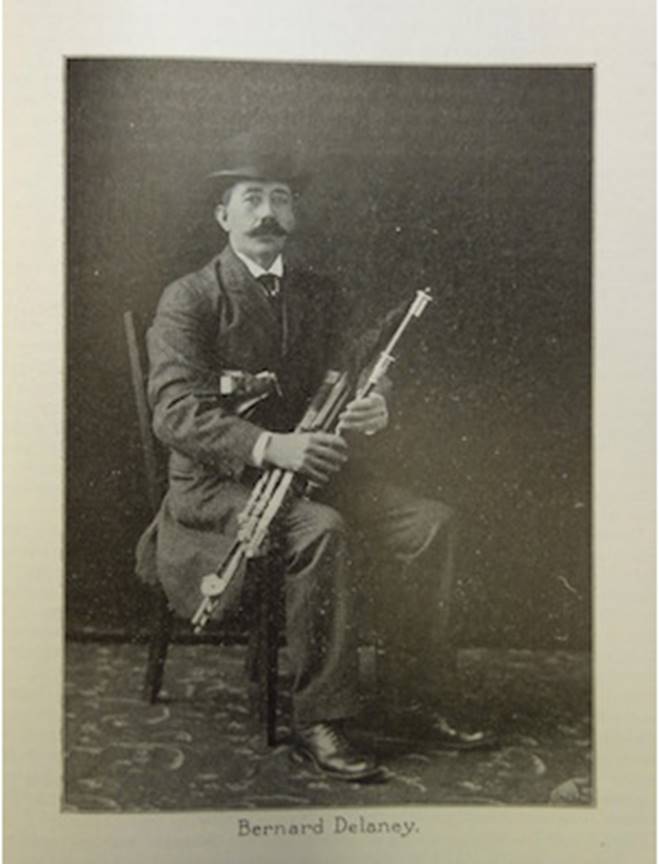
Bernard Delaney, Source: Francis O’Neill, Irish Minstrels and Musicians (1913)
‘We are more or less indebted to Bernard Delaney for the introduction of many fine tunes to our community. His well-deserved reputation as an Irish piper did much to spread the local knowledge of his music among local musicians, as well as to promote the popularity of Irish music in general.’ Source: Francis O’ Neill, Irish Folk Music (1910)
Ahead of Fleadh Cheoil ns h-Éireann 2009, I researched the life of Bernard (Barney) Delaney of Killeigh so as to publish a piece on him in the Fleadh brochure. Offaly has a rich Traditional-Music Heritage and a multitude of All-Ireland champions since modern competitions began in Fleadhanna in the 1950s. However, our folklore is filled with records in the oral and written traditions of musicians dating back to the courts of our Gaelic Chieftains, our famed monastic settlements and music even has filtered through to us from the Celtic mists of ancient Ireland.
Due to the devastating famines of the 1840s and the following poverty in the 1860s and 70s when the people’s main motivation was pure survival, our musical heritage fell away among the general population. It fell to the immigrant classes to carry their music and song with them to the far-flung places where they could find work and sustenance.
Bernard Delaney of Killeigh was typical of these survivors. Unlike many of his fellow immigrants, he had a “magic wand” in his pocket in the form of a penny whistle and all the melodies that instrument could conjure up. Melodies that would provide his sorry Irish comrades with hope, joy, and the happier memories they may have associated with these tunes.
Following my meagre scraping of the surface in 2009, a hero emerged in the form of Seamus Kelly of County Kildare who dug deeper Delaney’s life. Then, with the backing of Attracta Brady; the soon-to-be Uachtarán of Comhaltas Ceoltóirí Éireann, local researcher, Brendan Berry and Seamus’ own team of sleuths, the life of Bernard or Barney Delaney was uncovered. Before the launch of this delightful publication, few in Offaly or Killeigh would have known much of the life of the once-celebrated uilleann piper of Chicago and American fame. Now, it’s about time Barney was given the recognition he truly deserves. The following are a few snippets of background from Seamus Kelly.
Frank Kelly
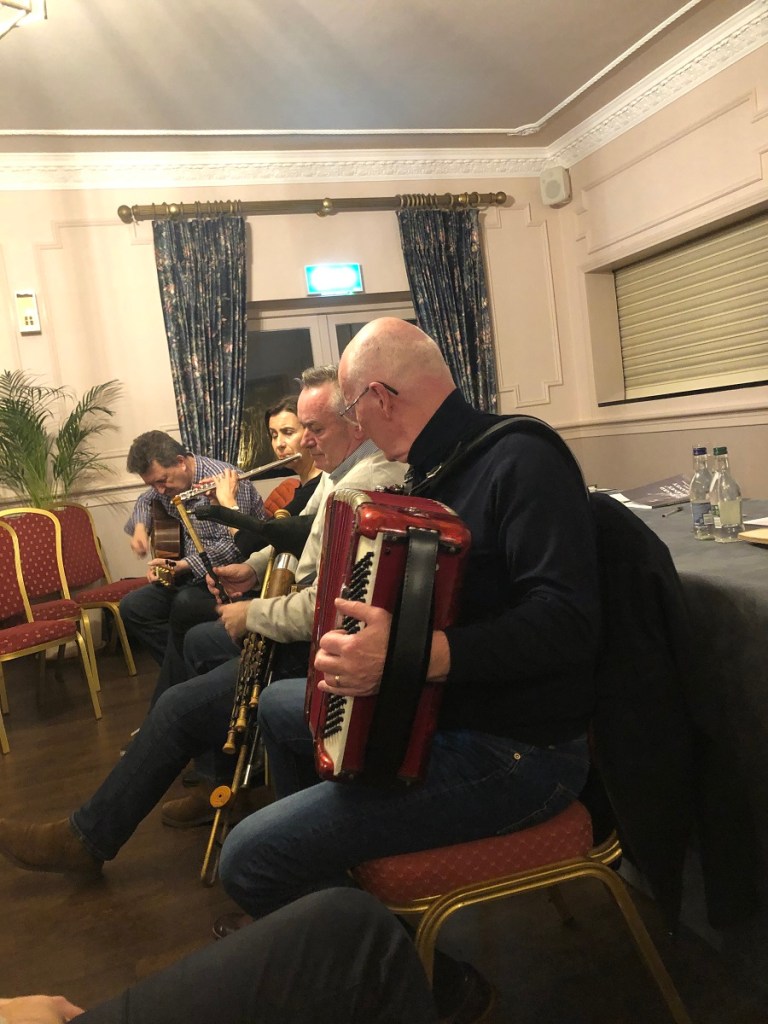
The musicians at the Birr Historical Society event in January 2025. 
Courtesy Bantry Historical Society Seamus:
Frank Kelly’s article in Treoir outlined some of Barney’s background and early life in Ireland. Without Frank Kelly, and his many Offaly contacts, my publication would not have seen the light of day. The support of Attracta Brady, now President of Comhaltas Ceoltóirí Eireann (CCE), was also crucial.
The Offaly Independent (18 September 1992 stated that Offaly has a tradition of excellence in music and added that ‘Offaly can also boast one of the great Irish pipers in Barney Delaney who was born in the Tullamore area about 1860…’. He was, in fact, born there in 1854.
The book was brought to fruition by three Kellys – Seamus, Frank and Michael. Michael Kelly and Brendan Berry’s pioneering work in following up on Delaney’s family in Ireland has made a real difference to our knowledge of the ‘Offaly piper’. An article by John Ennis in The Gael magazine (February 1902) also provided us with a wonderful photo of Delaney.
Francis O’Neill wrote in 1910 that he was delighted that Bernard Delaney brought himself and his tunes from Offaly ‘Here, indeed was a prize and what a repertory of unfamiliar tunes he had from Tullamore, his native place! Chief O’Neill, mentioned that Barney was from around Tullamore. Well, could we be more specific? Yes, we can.
Finding out that his father’s name was Patrick (from Bernard’s passport application in 1919) was a start. Frank Kelly’s article entitled ‘The Offaly-Chicago connection from Scrubb, Killeigh, to Ocean Springs, Mississippi’ (Treoir, 2009, 2020) tried to identify Barney Delaney’s birthplace. Brendan Berry was able to pinpoint Patrick Delaney’s plot to Meelaghans instead of Scrubb.
The Killeigh Co. Offaly Delaney connection was further confirmed by the excellent research of Michael Kelly. Aileen Saunders accessed the transcript of Bernard Delaney’s baptismal record. It informs us that Bernard was from the Parish of Killeigh, just south of Tullamore. The name was misspelt ‘Delay’ on this electronic record which was unhelpful. It gives us Bernard’s mother’s name as Eliza Dinn (possibly Elizabeth Dunne). It also gives the date of his baptism, in Killeigh, as the 25 May 1854.That date is reliable although it conflicts with other records. For example, in the 1900 US Census Barney gave his birth date as August 1852. His police record says he was born on 24 March 1854.
Bernard had a family of his own, in Offaly, before he emigrated to America in the early 1880s. Aileen Saunders noted from US Census records that Bernard Delaney had a daughter Elizabeth. Barney was around 20 years old when he married Mary Farrell on the 23rd October 1874. Bernard’s age was given as 20 while Mary was 24. They were married in Tullamore. Mary Farrell, from Tullamore, worked as a servant and was the daughter of Charles Farrell who was a carpenter. Bernard’s father Patrick had died before the wedding. Throughout this period (1876–1882) Bernard Delaney is described as a labourer. The children of Mary and Barney Delaney:
Thanks to Michael Kelly’s research we know when the Delaney children were born and when they died. Bernard and Mary lived in Charleville Road, Tullamore but mostly after that they were in Distillery Lane until at least May 1882. Their first child Patrick was born on 25 March 1875 at Charleville Road in Tullamore. Soon after they moved to Distillery Lane in Tullamore where most of the children were born. Second son John was born there on 6 September 1876. Their first daughter Mary arrived in April 1879 followed by Elizabeth on 2 July 1880. Their last child, Ellen was born in February 1880. Five children in five years!
Note: ‘The Tullamore Piper’ title is still accurate in the sense that he lived as a young married man in Tullamore though he was a native of and was baptised in Killeigh; RC parish. A tune in O’Neill’s Music of Ireland (1903) (Number 1773) is called The Tullamore piper. The title can only refer to one man!
Tragically, all of the Delaney children, except Elizabeth, died young between 1879 and 1882. Patrick died from typhoid fever on 1 March 1877, aged 2. Mary died (aged 1 year), John died (aged 6) and Ellen (aged 3 months). Barney’s wife Mary Farrell died from measles, pneumonia and heart disease in Tullamore Union Workhouse or the infirmary attached to it, on 21 May 1882, aged 30.
Their youngest child Ellen had died the day before. Mary died 8 days after her son John died from measles.
The family struggles must have been traumatic. Mary Delaney must have suffered terribly. The losses of his wife and four of his children must have taken its toll on Bernard. These very harsh family circumstances probably influenced his very rapid decision to emigrate, and may have impacted on him later in life.
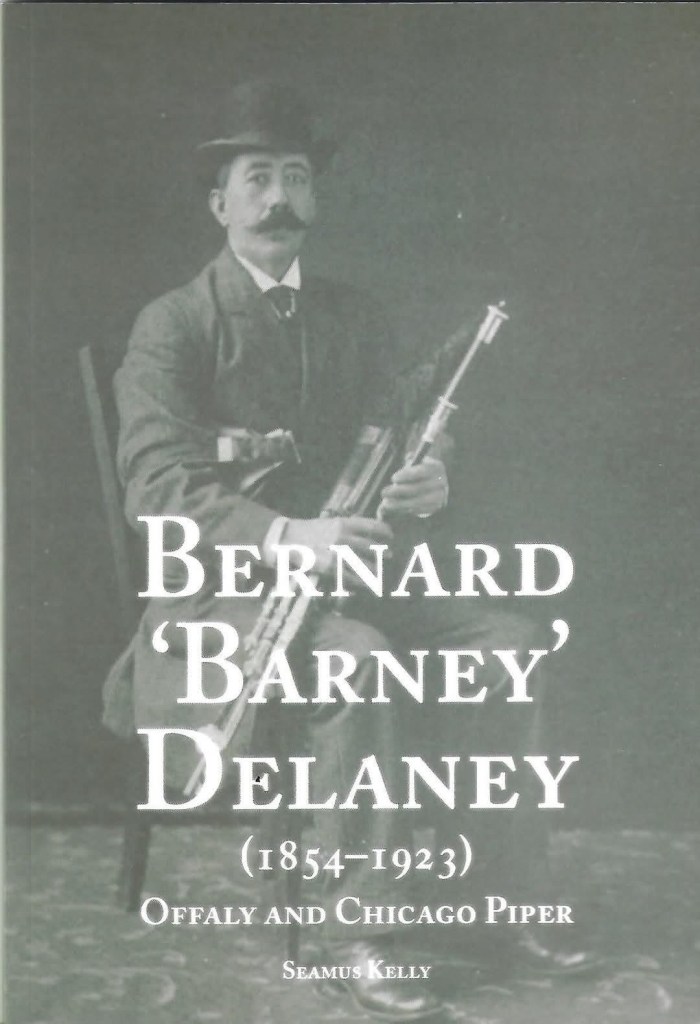
The full publication is available in the Offaly Historical Society book shop on Bury Quay.
Frank Kelly

Venue for the Saturday lecture and music session, Bury Quay (beside New Aldi and Old Warehouse restaurant).
Published as part of the County Offaly 2025 Commemorative Programme with the support of Department of Tourism, Culture, Arts, Gaeltacht, Sport and Media

-
Michael Scott: his Midland Connections and Networks. By Fergal MacCabe. No 2 in a series on the paintings and drawings heritage of County Offaly, 1750-2000, explored through the works of artists from or associated with County Offaly. Blog No 705, 2nd April 2025
The Murals Bar Cultural life in 1950s Tullamore centred around ‘The Murals’ bar. This was where us local artists, actors, historians and writers drank, clutching our copies of ‘Ulysses’ in its concealing brown paper cover while engaging in fevered and sparkling debates on cubism, existentialism, atonality and Marxism.
I may be exaggerating somewhat, but ‘The Murals’ really was our Deux Magots, our Cafe de Flore. The bar was the meeting place of what passed for an intelligentsia in Tullamore at a time, which, though it is now regarded as restrictive and obscurantist, I remember as stimulating and progressive. Maybe I was lucky.
The attraction of ‘The Murals’ was its design which was quite unlike any of the more traditional pubs of the town which were usually small, dark and poky. With its high ceiling, stripped down design, timber veneering, bright red stools, it was cool and elegant and above all- modern.
(more…)

