Tullamore in the Sixties was launched to great acclaim on 6 December. Most of the contributors living in Ireland participated in the proceedings with three to five minute talks. The book was launched by architect, town planner and artist Fergal MacCabe. A few of his own watercolours grace the contents of this 450 page book with extensive essays (from 18 writers) and 350 pictures. The book is available from Offaly History Centre, Bury Quay, Tullamore and Midland Books and the pop up at Bridge Centre. It can also be ordered on line.
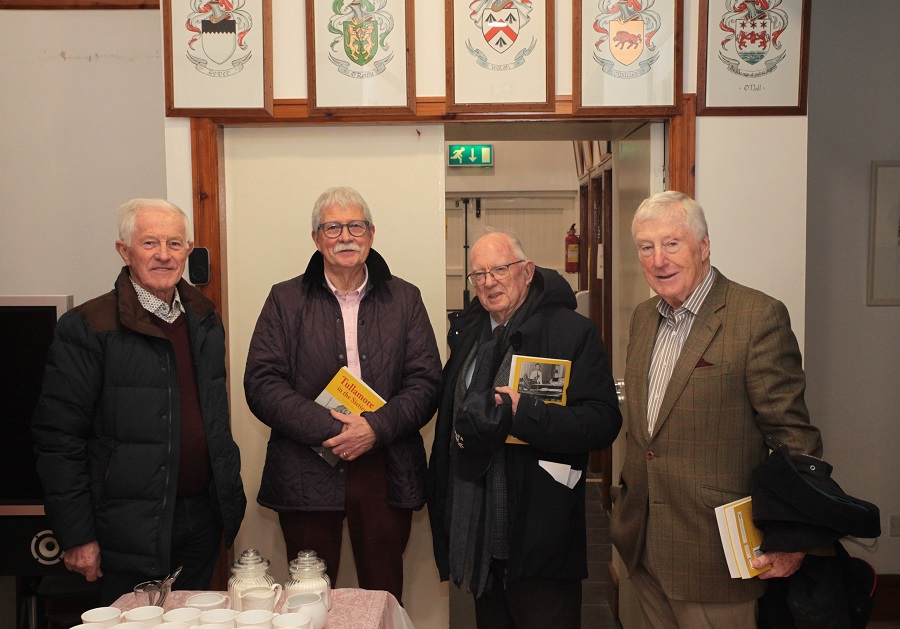
Some of the contributors to Tullamore in the Sixties
This volume of essays brings together the contributions of eighteen people who kept a keen eye on developments in Tullamore in the 1960s. Perhaps none more so than the late Joe Kenny who came to Tullamore in the 1950s as a vocational schoolteacher and was held in high esteem for his sound judgement and abilities as an impartial chairman. In that capacity he was the inaugural president of Tullamore Credit Union in 1963. Fergal MacCabe, as a Tullamore native, with a professional life in architecture and town planning in Dublin, brings a unique contribution by way of his recollections of Tullamore in the 1950s and his review of the first town plan of the 1960s. The same can be said of Vincent Hussey as a planning officer with Offaly County Council with his recollections of Tullamore since the 1960s. Niall Sweeney, an engineer and former Offaly County Manager, takes a close look at the provision of public infrastructure in Tullamore over the period from the 1960s to 2014. The late Jack Taaffe, as town clerk in Tullamore in 1970–72 demonstrates just how underfunded urban authorities were in those years. He went on to become county manager in Westmeath presiding over the progress of the county from 1981 to 1988. Michael Byrne looks at the history of business in Tullamore and sought to cover the principal enterprises of the 1960s in manufacturing, distribution, shopping, entertainment and dancing. Noel Guerin, as a former employee of ‘the bacon factory’, was able to write of a company that employed up to 100 people in Tullamore over forty years and made the name of the town famous for the Tullamore sausage. Ronnie Colton, from his own extensive involvement in the motor business brings a knowledge from the garage floor and sales yard that few others can match.
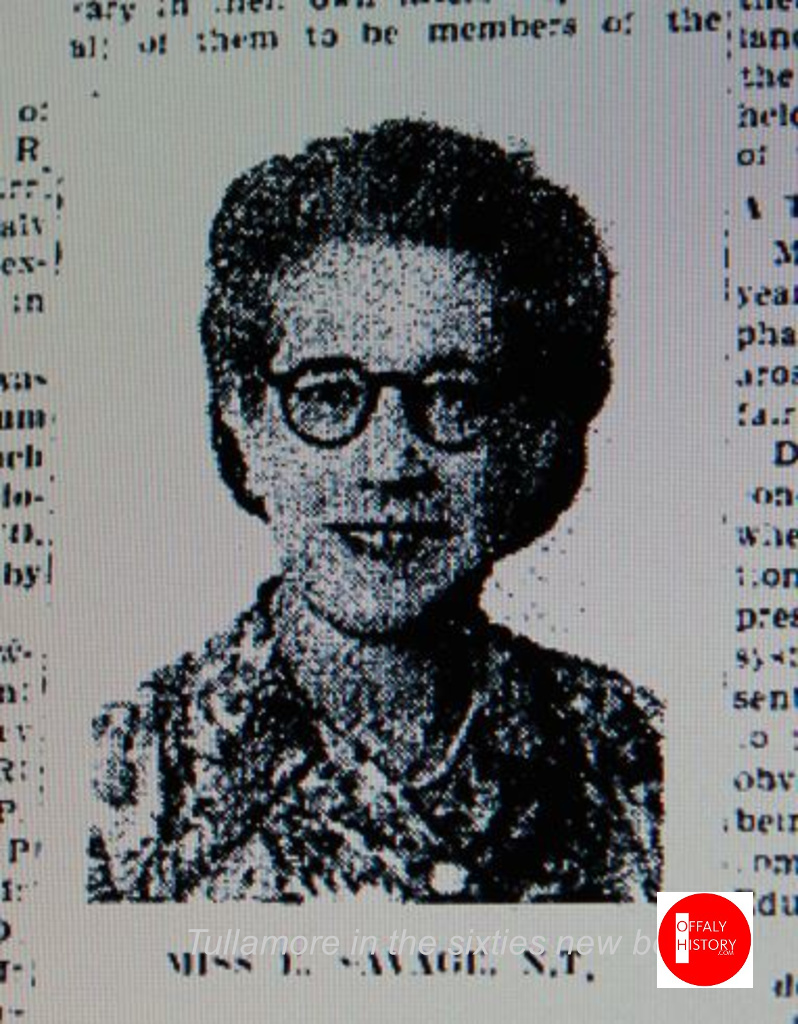
Miss Savage, a well-loved teacher in the Mercy primary school
Alan Mahon, as the grandson of an innovative cinema proprietor, recalls two cinemas in Tullamore whose cultural contribution is perhaps forgotten now but was all important to the people of Tullamore and district over a period of sixty or seventy years, if one takes it from the commencement of the Foresters cinema (later the Grand Central) in 1914.
Sport, so important to so many, brings us to the essay by Kevin Corrigan who looks at a formative decade leading on to the GAA Senior Football All-Ireland victories in the 1970s. Kevin had the challenging job of reducing to a short essay what could fill twenty books were one to address in detail each of the sporting activities that came to the forefront in the sixties.
At one time I didn’t think, but now I definitely do think, that the pleasantest way of seeing Ireland is from a seat in a bus. I do not mean one of those eight-day bus tours, conducted and excellent and comfortable as they may be, I mean the couple of hours spent bussing from one country town to another. [So announced Lennox Robinson in an article first published in the Irish Press and later in his compilation I sometimes think (Dublin, 1956). He would possibly have been amused to know that bussing has another meaning nowadays when students get together in a college dorm. Robinson was not inspired by some of the women who joined his Tullamore to Banagher and Birr bus. Now read on.]
If you travel in a friend’s car, you are cribbed and confined, he or she has to make talk with you and you have to return the ball of conversation; a train nearly always looks for and finds, the most poor and uninteresting country to travel through, and when it reaches an interesting town, Portarlington, for instance, is careful to stop a mile away from the place, John Gilpinish.
But a country bus swirls along, is very swift, and yet can be leisurely, picks up a parcel here and delivers a bundle of papers there.
We are, back in the old coaching days : the conductor knows everyone-or nearly everyone-and has a friendly word for each on-comer or down-getter. He sets down Mrs. Maloney at the Cross and helps an old Jack who is off to spend the day, his pension-day, in the town: yet he can be severe and inexorable on the question of accepting bikes.
I am beginning slowly to fall in love with the midlands slowly, because there is nothing tempestuous or flashy about them. The vivacity of Kerry and Donegal, the cuteness of Cork and Antrim-these are lacking, and instead there is a lovely autumn-afternoon placidity, golden and Veronese-woman-like atmosphere. The very names of sleepy; they are bees in August Lime-trees: Birr, Clogher, Ferbane, Clara, Mountrath.
The changing face of Offaly towns in the early 1900s: An illustrated history edited by Michael Byrne with contributions from Paul Barber, Stephen Callaghan, Grace Clendennen, Kevin Corrigan, Michael Goodbody, Ger Murphy, John Powell, Laura Price, Ciarán Reilly and Brendan Ryan (Offaly History, Tullamore, 2024, 368 pp). Available from Offaly History Centre and Midland Books Tullamore and online at www.offalyhistory.com. ISBN 978-1-909822-38-2 (hard back), €27.99. The book will be launched at Offaly History Centre, Bury Quay, Tullamore – beside the new Aldi and Old Warehouse. It is already available at the Centre, online at http://www.offalyhistory.com and at Midland Books, Tullamore. If you cannot attend in Tullamore we have a launch at Giltrap’s of Kinnitty on Thursday 21 Nov. at 7. 30 p.m. We will have copies in Bridge Centre for the Christmas Sale 14 to 24 December.
What we construct and what we take down is often the most significant indicator of the nature and health of our society. Also, the choice of an aesthetic style for a new building tells us much about the values of its proposer. Government or religious institutions will seek to emphasise their role and power by providing substantial and prominent structures, often using ancient architectural styles to suggest their continuity and permanence. Successful businesses or go-ahead institutions will express their vitality and cosmopolitanism in a more modern manner. Home builders may wish to attract respect for their taste and sophistication.
Would you like to know more about public sculptures in Birr and Offaly? Who commissioned them and what do they tell us? Author, Architect and Town Planner Fergal McCabe will focus on the sculptures in and around Birr town, The Maid of Erin, The Column in Emmet Square, the Hurler, the third Earl and the Tullamore Road entrance piece ‘Looking to the Future’ with some other examples from the county. He will be joined by photographer Paul Moore who documented the sculptures in 2023 and he will talk about his experience of how the images were photographed and the story behind each sculpture. This illustrated talk will be on Monday 15 January 2024 at 8 p.m. in County Arms Hotel, Birr. Signed copies of the new book Faithful Images will be available on the night for €20.00. All are welcome.
For those who believe that the setting of public art is the key to its artistic success or failure, Birr offers five of the very best examples.
Faithful Images: public art in County Offaly, will be launched on Monday 11 December at 8 p.m. at Offaly History Centre, Tullamore by Eddie Fitzpatrick, cathaoirleach of Offaly County Council. Faithful Images is a welcome addition to the growing library on the cultural patrimony of County Offaly. Thanks to Creative Ireland and Offaly County Council for their support. The new book is in full colour and is €20. It can be purchased at Offaly History Centre, Bury Quay (beside the Grand Canal and the Old Warehouse) and at Midland Books, and online at http://www.offalyhistory.com. You will be welcome to attend the launch and to purchase a signed copy.
The Turf Man – capturing working on the bog for over a century
The combination of Fergal MacCabe as architect/town planner/water colourist with that of Paul Moore as photographer makes for an excellent outcome. Fergal MacCabe has an eye to the broad sweep of architectural history from his having studied and practised the subject over sixty years. He has been looking at buildings with an admirable curiosity since his teenage years. By the 1970s this had blossomed into his being a superb watercolourist especially when it came to places associated with his childhood years in the midlands. Living in Dublin now he can return to his native place bringing with him a fresh perspective. We had the pleasure of working with him on Tullamore: a portrait in 2010, attending several of his exhibitions, and several of his lectures including those on the rediscovered Frank Gibney.
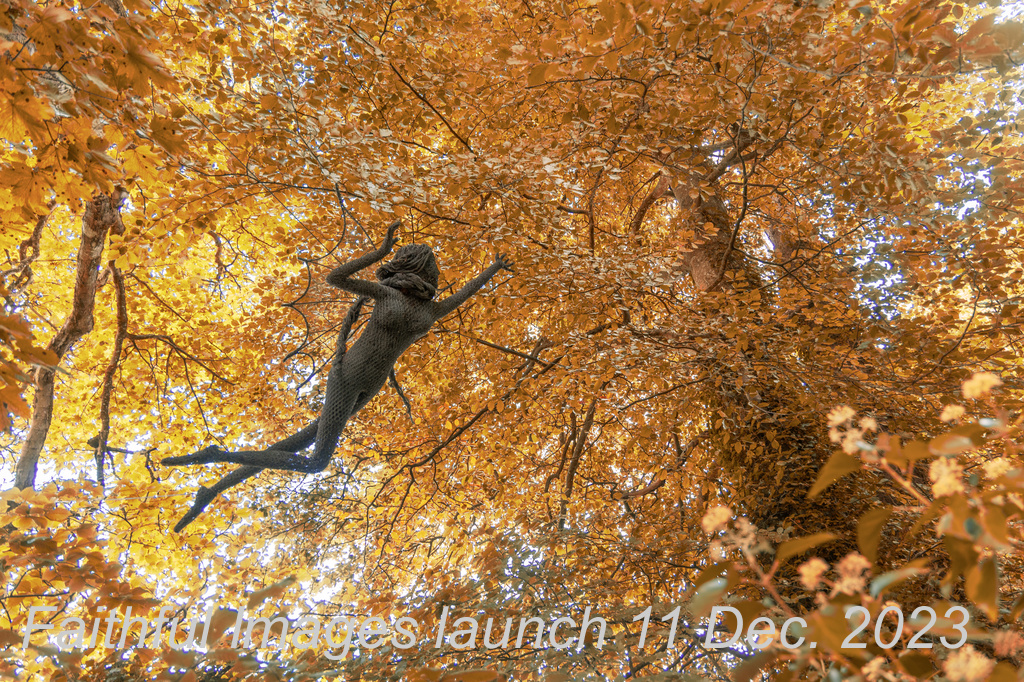
Aisling – the spirit of the trees, Geashill(more…)
Over a series of articles, it is intended to examine the evolution of the ‘market place’, Tullamore to the fine square it is today. It is intended to look first at the evolution of the square over the period from 1713 to 1820 with additional comments on the building history in the last 300 years in the second article. This will be followed with analysis of the return for the 1901 and 1911 censuses and thereafter case studies of two of the houses in the square. Both are public houses, the Brewery Tap and The Phoenix, and business is conducted in the original houses albeit that both have been extended. Both are well known with the Brewery Tap one of the oldest pubs in Tullamore and The Phoenix the newest. The Brewery Tap house can be dated to 1713 and The Phoenix as a house to 1752.
As the town changes and my own perceptions and values alter, the visual image of Tullamore that I hold in my head is continually refined.
Little by little I have begun to realise that buildings which I dismissed as mundane are more important than I had first considered, while others which I once revered are now probably not all that good after all. There is also the fear that several much-loved landmarks I believed timeless may soon disappear.
My visits to the town have become more infrequent and I find that when I try to summon up its civic character in my mind in order to make a drawing, it tends to coalesce into an amalgam in which some buildings and landscapes take centre stage while others recede. In this capriccio I have tried to corral my memories into an ensemble which has some underlying unity, but inevitably selection distorts scale and some of the juxtapositions may seem overly bizarre.
Of late, three particular parts of the town have begun to take a hold of my imagination – two real and one imaginary. The stretch of Cormac Street from the railway station to O’Moore Street gets better on each revisit while O’Connor Square is at last beginning to reveal its potential to be one of the finest urban spaces in the country. On the other hand, the Harbour is as inaccessible and decaying as it ever was. Its unknowable future has always fascinated me – as I’m sure it does many.
It was cold, dark and rainy that November 2017 night as we left the Embassy. My mood did not fit the weather. The warm glow of a job well done wrapped itself around my stomach and spread out to envelop my whole being. It was all hard to believe that my scribbling had brought me here.
I had started to write to commemorate my father way back in 1976, a few poems to inscribe his memory onto paper. The first one was printed in the Midland Tribune on the anniversary of his death in 1977. I was delighted to see my words in print, a feeling that persists to this day! I returned to my university and thought no more about it until I fell in love. That led to more poems, some I laugh at now but some I’m glad I wrote and, who knows, some may even have had an impact on my future wife.
So forty years later there I was sitting in a restaurant with two of my sisters and one of my daughters, all of whom had flown over for the big event. My wife and other two daughters were abroad, unavailable. The conversation floated by me a little as my mind was back in the embassy room with the Irish Tricolour and the European blue flag forming a backdrop to my poems. The whole situation was a little surreal.
The words from that beautiful, sad, song by Tommy Sands, ‘There were Roses’, floated unbidden into my mind. ‘It’s little then we realized the tragedy in store’. Now, I admit, ‘tragedy’ may be a little strong, thankfully, to describe the events that were shortly to unfold.
Five months after my uplifting evening in the Irish Embassy I found myself in the less salubrious surroundings of a psychiatric ward here in Luxembourg city. A crash due to depression had stolen up on me and twisted my mind into such a state that I needed hospitalization. For two weeks I wondered what had happened, how could I exchange the Irish Embassy for a psychiatric bed in a matter of months? How had this happened? What exactly had happened?