
Polo traces its origins to the game of Chovgan, an equestrian team sport played by the aristocracy of the Persian Empire. It spread across Asia evolving along the way. By the 1400s it had arrived in India, supposedly introduced during the Muslim conquests of the subcontinent. During the Mughal period polo was dubbed the ‘Sport of Kings’ and the emperor Jalal ud-din Akbar introduced a set of rules governing the sport in the 1560s. In 1859, British soldiers and tea planters serving in India established the Calcutta Polo Club and the game was quickly introduced to Britain. When Carlow hosted Ireland’s first polo match in 1872, the local press referred to it as ‘Hurling on Horseback’. A year later the All-Ireland Polo Club was founded, with its grounds at the Nine Acres in the Phoenix Park. In 1875 the Hurlingham Polo Committee in London drew up a set of rules which would shape the polo in the century which followed. In the same year polo had migrated once again and in time the scions of Argentina’s richest families would establish that countries position as the global powerhouse of the game.
(more…)Category: Aviation
-
Airships Over Ireland 740 AD to 2027. By Kevin Reid. Blog No 700, 12th March 2025
According to the Irish Aviation Authority (IAA) there are no airships currently registered in Ireland. However, this was not always the case when as far back as 740 AD there were reported sightings of airships over County Offaly and for the duration of World War 1 these hydrogen-filled lighter than air (LTA) craft were a common sight over the coastal regions of Ireland.
(more…)
-
When turkeys could fly: Irish Christmases in England. By Sylvia Turner. Blog No 556, 20th Dec 2023

During the twentieth century a tradition arose of a Christmas bird, usually a turkey, being sent from Ireland to extended members of the family who had emigrated to the Britain. They arrived in a canvas bag packed in straw. The Second World War disrupted the tradition. It did not resume immediately after the War as the British Government thought that birds would be traded on the black market in contravention of food rationing as explained by the New Ross Standard 22nd October 22nd 1948.
(more…)
-
A rare item for Offaly Archives: Hibernian Magazine for the year 1785. By Michael Byrne. Blog No 460, 31st Jan 2023
Offaly History have a vacancy for a qualified archivist at Offaly Archives (see our blog of 6 Jan. 2023 in regard to the post). Arriving for interview by air balloon would strike a chord. Speaking of which the balloon fire of 10 May 1785 is perhaps the best-known event in the history of Tullamore and yet there are few surviving accounts.
First there were almost no local newspapers serving the midlands at the time. Neither have diaries or letters survived of any of the townspeople of that period save one letter of 12 May 1785 published by way of reportage in the Hibernian Magazine of the fire that occurred on the fair day. This would have been on Tuesday 10 May 1785. The letter from the Tullamore correspondent is clearly the most useful and more informed than similar reports in Finn’s Leinster Journal and Faulkner’s Dublin Journal. Some of these reports put the loss at 130 houses and not 100 as advised to us by the letter writer. One other short note was penned by Molly Burgess (née Pennington) of the Methodist Community who lost their church (dated to 1760) in Swaddling Lane off Barrack/Patrick Street. This lane was also known as Ruddock’s Lane and post 1905 as Bride’s Lane. After the fire the Methodists build a new chapel or preaching house on the site of the present-day church. The current church was build 101 years after the first
on that site.
(more…)
-
Early Aviation in and around Offaly by Guy Warner. Blog No 122, 23 Feb 2019

No 2 Squadron at Limerick in 1913. In 1910, about six weeks before the first successful powered flight in Ireland by Harry Ferguson in Co Down, the King’s County Chronicle reported as follows, ‘Mr Michael Carroll, cycle mechanic, conducted experiments in aviation in the hills adjoining Birr reservoir. An apparatus constructed from calico and bamboo made one or two fitful attempts to ascend. The incredulous may laugh at his efforts but it should not be forgotten that every great invention has its beginning in failure.’ One week later it was noted that the Engineering and Scientific Association of Ireland [founded in Dublin in 1903] had been discussing aviation, ‘The opinion was expressed that flying through the air was not an accomplished fact, though eventually it would be, that flying was not of any practical use and that men now engaged in a series of experiments in aviation would not die in their beds.’
-
Offaly and the First Air War: Joe Gleeson. Blogs No 119, 02 Feb 2019
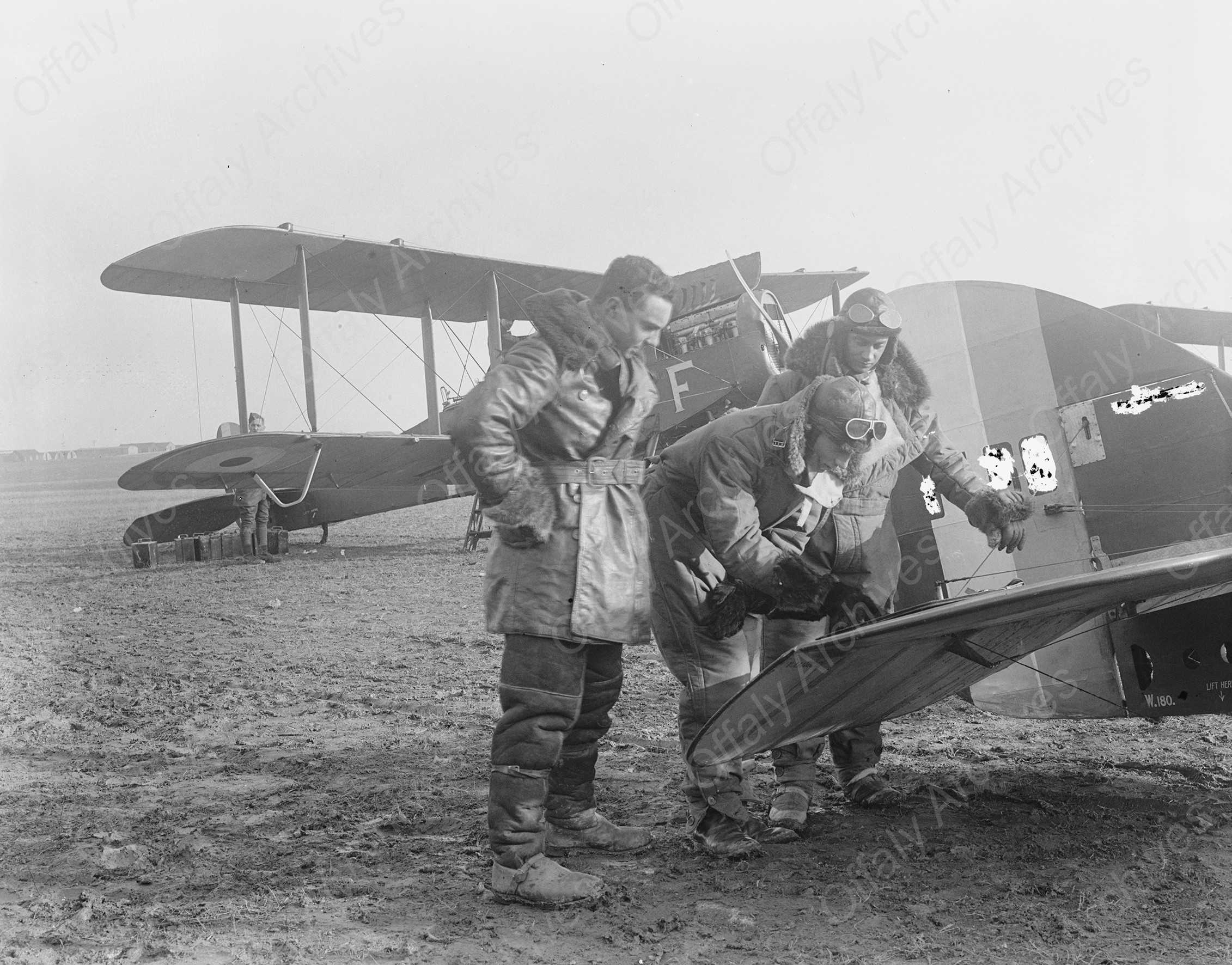
2. D.H.4 bomber, aircrew posing with map (IWM, Q12021) Offaly had a small but significant part in the early years of military aviation. In September 1913 Offaly was an important base for some of the earliest uses of aircraft in the annual British Army manoeuvres; some of the Royal Flying Corps’ earliest crashes took place in Offaly during those operations. Approximately 85 men who served in the Allied flying services were born or from Offaly, but their impact was far greater than would be expected. Ferbane hosted an operational wartime base at ‘RAF Athlone’, and there was a landing ground at Birr during the 1918-1920 mobilisation period.
 offalyhistoryblog