Thomas Lalor Cooke, the Birr solicitor and historian, would be the last to consider himself an artist, but when pressed he was generally a good deal less self-deprecating. He published his first history of Birr in 1826 without adding his name to the title, rather akin to the ‘silver fork’ novelists fashionable at that time. Yet, there can be few in Birr or among the learned who did not know that it was Attorney Cooke of Cumberland (now Emmet) Street who was the author. No doubt he also provided signed copies for friends. And in Cooke’s own copy of the Picture he has recorded that he had two tokens (p. 109) and at p. 210 referred to one of the coins as ‘now in the possession of Mr Cooke of Parsonstown’.
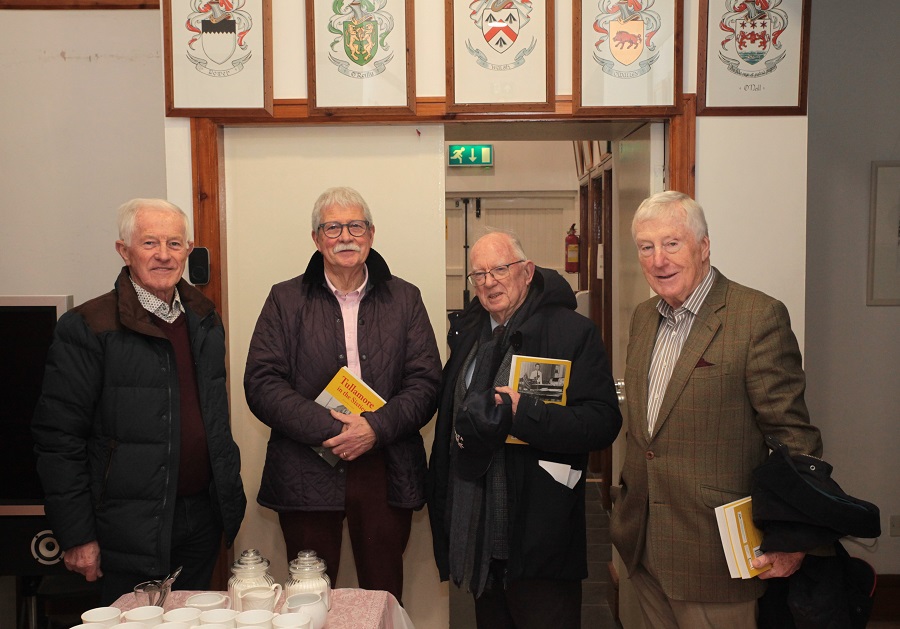
Tullamore in the Sixties was launched to great acclaim on 6 December. Most of the contributors living in Ireland participated in the proceedings with three to five minute talks. The book was launched by architect, town planner and artist Fergal MacCabe. A few of his own watercolours grace the contents of this 450 page book with extensive essays (from 18 writers) and 350 pictures. The book is available from Offaly History Centre, Bury Quay, Tullamore and Midland Books and the pop up at Bridge Centre. It can also be ordered on line.
Some of the contributors to Tullamore in the Sixties
One of the essays in the new book on Tullamore in the Sixties to be launched on Friday 6 December 2024 at 7.30 p.m. at Offaly History Centre (beside the new Aldi store in Tullamore, all welcome) is that by Terry Adams on his beloved Cormac Street, Tullamore where his family have been located for 150 years or thereabouts. Terry’s is an evocative piece and one of 29 essays in this new book on Tullamore with over 300 pictures.
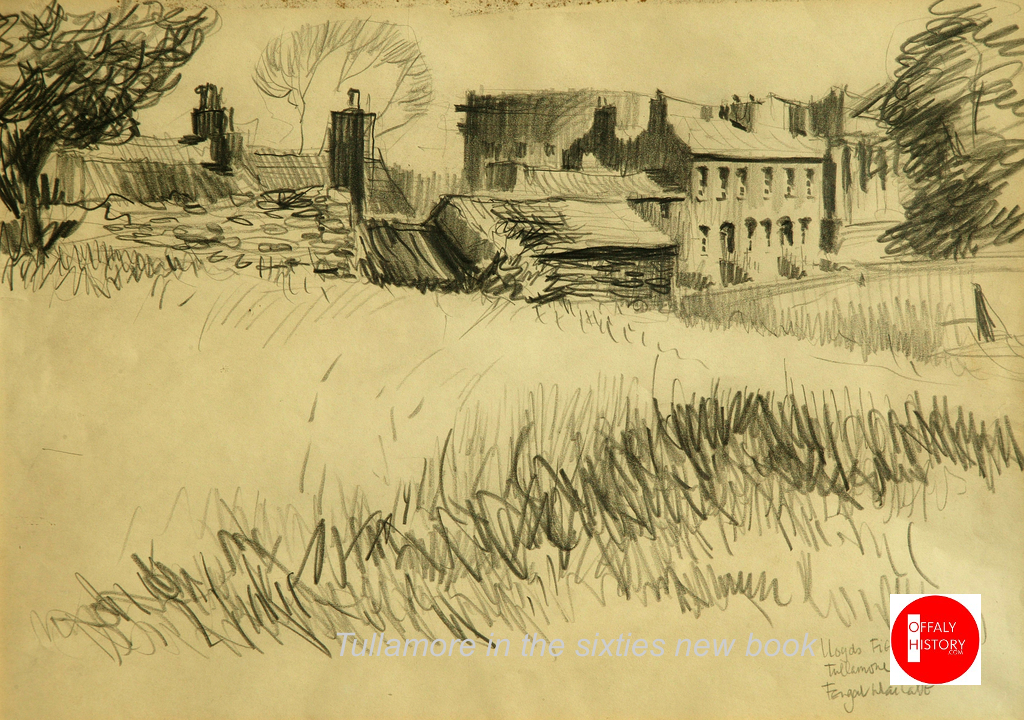
I stood with my back to Lloyd’s field, surrounded by memories of childhood and family. On my left, back towards the town, my Grandmother Egan’s family home, The Hall, now the municipal council offices, nestles behind its railings and garden. Opposite, on the junction of Cormac Street and O’Moore Street, stands the building I was born in, now home to my brother Brian. My Adams grandparents’ house faces me across the street. Further along the imposing old courthouse and jail buildings sit in their solemn majesty.
The view from Kilcruttin Hill courtesy of Fergal MacCabe
Cormac Street, my street, even if I have not lived here since 1981. When I think of home it is to this street, to these buildings, my mind roams. It is a major part of me, of my identity, of who I am, of who I always will be. I look back towards the town centre, the street has changed little since my childhood. The house exteriors, excluding The Hall, have not been radically altered but most of their old occupants have left us: my father, also Terry, Frank and Carmel Egan, Ray and Sylvia Courtney, Ray and Emer McCann, Mr and Mrs McNeill, Mr and Mrs Brennan, Bridie Byrne, Jimmy and Marcella Byrne, Mrs Behan, Paddy and Mrs. Lloyd……
This volume of essays brings together the contributions of eighteen people who kept a keen eye on developments in Tullamore in the 1960s. Perhaps none more so than the late Joe Kenny who came to Tullamore in the 1950s as a vocational schoolteacher and was held in high esteem for his sound judgement and abilities as an impartial chairman. In that capacity he was the inaugural president of Tullamore Credit Union in 1963. Fergal MacCabe, as a Tullamore native, with a professional life in architecture and town planning in Dublin, brings a unique contribution by way of his recollections of Tullamore in the 1950s and his review of the first town plan of the 1960s. The same can be said of Vincent Hussey as a planning officer with Offaly County Council with his recollections of Tullamore since the 1960s. Niall Sweeney, an engineer and former Offaly County Manager, takes a close look at the provision of public infrastructure in Tullamore over the period from the 1960s to 2014. The late Jack Taaffe, as town clerk in Tullamore in 1970–72 demonstrates just how underfunded urban authorities were in those years. He went on to become county manager in Westmeath presiding over the progress of the county from 1981 to 1988. Michael Byrne looks at the history of business in Tullamore and sought to cover the principal enterprises of the 1960s in manufacturing, distribution, shopping, entertainment and dancing. Noel Guerin, as a former employee of ‘the bacon factory’, was able to write of a company that employed up to 100 people in Tullamore over forty years and made the name of the town famous for the Tullamore sausage. Ronnie Colton, from his own extensive involvement in the motor business brings a knowledge from the garage floor and sales yard that few others can match.
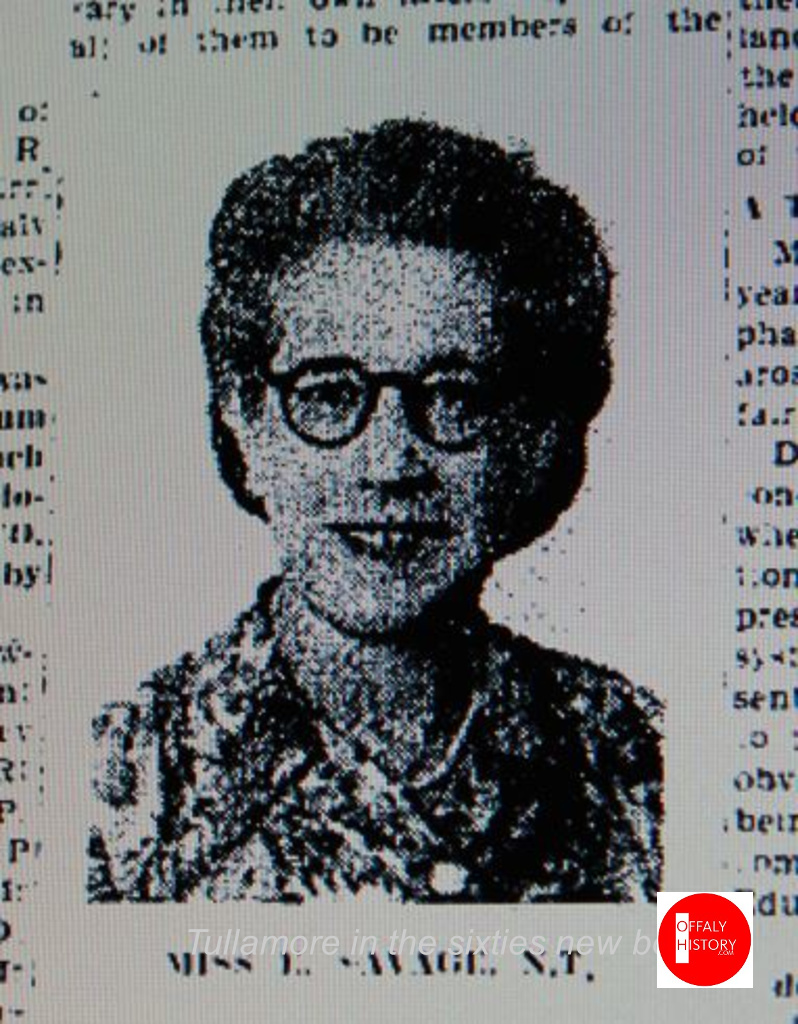
Miss Savage, a well-loved teacher in the Mercy primary school
Alan Mahon, as the grandson of an innovative cinema proprietor, recalls two cinemas in Tullamore whose cultural contribution is perhaps forgotten now but was all important to the people of Tullamore and district over a period of sixty or seventy years, if one takes it from the commencement of the Foresters cinema (later the Grand Central) in 1914.
Sport, so important to so many, brings us to the essay by Kevin Corrigan who looks at a formative decade leading on to the GAA Senior Football All-Ireland victories in the 1970s. Kevin had the challenging job of reducing to a short essay what could fill twenty books were one to address in detail each of the sporting activities that came to the forefront in the sixties.
John Flanagan the well-known builder and advocate for Tullamore and County Offaly died on 9 May 2024. He was the modest man from the Meelaghans, Puttaghan and Bachelors Walk, Tullamore who invested his whole life in making Tullamore a better place for people to live, work, bank and even pray in. In 2018 he was awarded the Offaly Person of the Year Award. John Flanagan was a realist in the Lemass mode. His focus was on getting things done. At the time Lemass came to be Taoiseach in 1959 John Flanagan was just 28 years old. It was ten more years, in 1968-9, before he got his first major break with the purchase of the Tanyard Lane property in Tullamore from the P.&H. Egan liquidator. The Bridge House, also owned by the Egan firm, was bought soon after by Christy Maye, and thirty years on Tullamore had two fine hotels, developed by the new entrepreneurs of the 1960s and 1970s, on lands that had been part of Egan’s extensive portfolio.
Over a series of articles, it is intended to examine the evolution of the ‘market place’, Tullamore to the fine square it is today. It is intended to look first at the evolution of the square over the period from 1713 to 1820 with additional comments on the building history in the last 300 years in the second article. This will be followed with analysis of the return for the 1901 and 1911 censuses and thereafter case studies of two of the houses in the square. Both are public houses, the Brewery Tap and The Phoenix, and business is conducted in the original houses albeit that both have been extended. Both are well known with the Brewery Tap one of the oldest pubs in Tullamore and The Phoenix the newest. The Brewery Tap house can be dated to 1713 and The Phoenix as a house to 1752.
A contribution to Tullamore 400 and the Heritage Council’s Historic Towns Initiative.
The Hibernian Bank opened in Tullamore’s Bridge Street in 1864. The footprint of the original site was the Ridley leasehold of 1786. In 1948 the bank was extended by the inclusion of the Berrill shop on Bridge Street. About 1970 the Wakefield shop was added to the property portfolio and soon after the second Ridley leasehold in O’Connor Square being the ‘Brick Building’ erected by T.P. & R. Goodbody in 1871. We had a blog article on 12 O’Connor Square in June 2022 under the title The ‘flamboyant three-storey Ruskinian Gothic warehouse’ in Tullamore. Today we are looking at no. 10, 11, and 12 Bridge Street
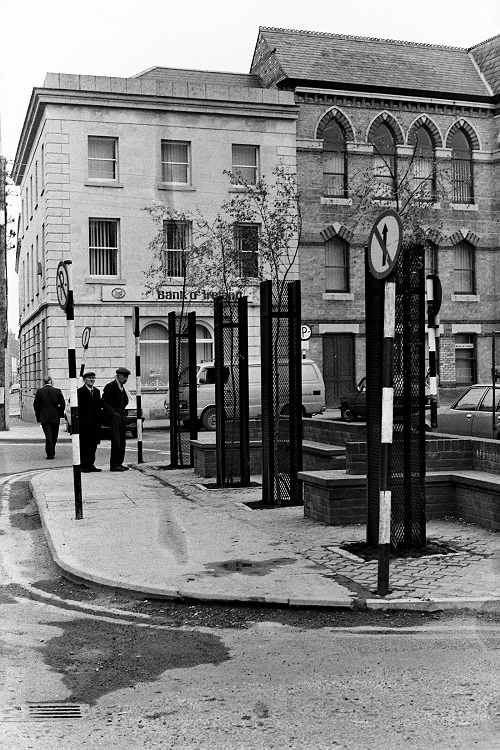
As part of the Tullamore 400th series and also in the context of research as part of a survey of Tullamore’s heritage in O’Connor Square and High Street, Tullamore we are pleased to present this article on one of the most attractive of the buildings of O’Connor Square. This is the building described by Andrew Tierney in Central Leinster in the Buildings of Ireland series (Yale 2019, p. 628) as ‘a ‘flamboyant three-storey Ruskinian Gothic warehouse’. The number 12 is from that in Griffith’s printed valuation of 1854 (GV 12). The number 71 (noted below) was part of the running series for the entire town of Tullamore in the manuscript valuation of 1843. the brick building was the first in Tullamore to be restored as to the facade (but not the interior) and incorporated in the Bank of Ireland Tullamore branch in 1979. It set a high standard for such work and wile not residential at least is well used and contributes to the streetscape, and very much so since one-third of O’Connor Square has now been pedestrianised.
O’Connor Square in 2020
To cite the Heritage Council’s own words on the Historic Towns Initiative:
Many of our city, town and village centres are historic places with their own distinct identities. Sustaining these is a complex process that in many cases involves the conservation and re-use of existing buildings, the care of public spaces and the provision of community facilities. The conservation and interpretation of this heritage makes our towns interesting, unique and attractive to residents and visitors. In support of the Town Centres First policy set out in the Programme for Government: Our Shared Future (2020), the Historic Towns Initiative (HTI) is a joint undertaking by the Department of Housing, Local Government and Heritage and the Heritage Council which aims to promote the heritage-led regeneration of Ireland’s historic towns.
I once again visited my old friends in Tullamore in the last few weeks. I was down from D4 to sort out a charity account with Bank of Ireland in O’Connor Square. I had to make my way through the bollards with the footpath widening. I came on the train of course (thanks Charlie, nice one). I was reminded by a customer that the Bank of Ireland opened in Bridge Street in the summer of 1979. At the time of my visit I was too busy to pay attention because between money laundering forms and this new GDPR stuff I was fit to be tied. And the account is 60 years old. What is all the fuss about small money. Now the new bank of 1979 is so different to the one I remember in High Street where Hoey & Dennings are now.



 offalyhistoryblog