
Those not overly familiar with military history will be still aware of famous battles, probably none more than Waterloo, where Napoleon was defeated by Wellington and his allies in 1815. As today is the 207th anniversary of this decisive battle, we will look at some of the men who were present at this battle who now lie buried in Birr. There are at least four men buried in the town who were present at the battle with many more who fought during the Peninsular Wars, which is a topic for another post. A sad observation is that other than the officers, the other brave men mentioned below are all buried in unmarked graves.
(more…)Category: Biography/memoir
-
The limestone quarries of Ballyduff, Tullamore. Part 3: From Tullamore to Tasmania. By John Wrafter, Blog No 388, 4th June 2022
In the second article on the quarries and stonecutters of Tullamore, I wrote about members of the Bracken family that left Ireland with their stonecutting skills and brought them to Australia. That was around 1910. However, stonecutters from the Ballyduff quarries had been emigrating and practicing their trade abroad for many years before that. Australia, in particular, was the destination for many. In this article, I will focus on two families, the Molloys and the Cronlys, and their involvement in stonecutting both at home and abroad.
(more…)
-
Remembering Bridget O’Neill (née Conroy) of Greatwood, Cloonagh and Mucklagh, Tullamore, with a note on attending at ‘the French nuns’ Convent’, Ferbane, and the Banagher Royal School prize. By Timothy P. O’Neill. Blog No 387, 1st June 2022
My grandmother was Margaret Lambe from Greatwood, Killoughy. Her sister married Thomas Lawless of the pub at the Blue Ball. Margaret married Timothy Conroy of Cloonagh. My mother Bridget(1904-87 , was her eldest child. She was the eldest of nine sisters and one brother, the youngest of the family who died in his infancy, and she was reared by her grandmother in Greatwood from a very young age. Margaret, my grandmother, died in 1916 after childbirth from postpartum bleeding. My mother was sent as a boarder to the convent in Ferbane run by “The French nuns” as they were known [The French missionary order of the Sisters of St Joseph of Cluny who came to Ferbane in 1896.] In my mother’s time some of the nuns in residence were born in France and still spoke French to each other. The records of her time there survive and she was an outstanding student. In November 1918, Stanislaus Murphy, Secretary to the Commissioners of Education in Ireland wrote to her, “Miss Bridget M. Conroy, The French Nuns Convent, Ferbane”, informing her that she had won, what was known as, the Banagher prize. The money paid her fees for that year in the school in Ferbane. The full title of the prize was the Diocesan Schools and Banagher Royal School Endowments.[1] My mother was very proud of her Banagher prize and she retained the letter from the Department as a prized reminder. In her old age she did put the laconic comment; “She must have had brains once!” on the back of the letter telling her of the award.
(more…)
-
Shops and pubs designed by Michael Scott in the 1940s for D.E. Williams. By Fergal MacCabe, Blog No 385, 25th May 2022
At a time of economic stringency, the architect Michael Scott delivered several elegant retail buildings for a prominent midlands business family. These were executed in a Modernist style and incorporated natural materials in an innovative fashion.
D.E. Williams
In a recent Offaly History blog, Michael Byrne described the expansionary retail strategy of the notable Offaly commercial firm of D. E. Williams in installing high quality shops and pubs in virtually every town and village across the county in the period 1884-1921.
This courageous approach had not deserted the go ahead commercial family when during the Second World War, then modestly referred to as ‘The Emergency’, they ambitiously embarked on the redevelopment of their most prominent retail outlets in Dublin, Athlone and Birr and and most importantly, delivered a flagship shop and public bar in Patrick Street in Tullamore. To implement their progressive strategy they turned to Michael Scott.
(more…)
-
The Visit of the Hon. Hugh Mahon to Ireland in 1922 and the Mahon family reunion in Charleville Demesne, Tullamore in August 1922. By Dr Jeff Kildea, Blog No 384, 21st May 2022
As the decade of centenaries draws to a close, one centenary not on the government’s list of official commemorations is the 1922 visit to Ireland of the Hon. Hugh Mahon, a former cabinet minister in the Australian government. Nevertheless, at a local level, the people of County Offaly may find more than a passing interest in this event from one hundred years ago.
Born in 1857 at Killurin, six kilometres south of Tullamore, Mahon was forced to leave his native land in 1882 and emigrate to Australia to avoid being arrested for his activities in the Land League. Forty years later he returned to Ireland for the first time, visiting family and friends in and around Tullamore. The years in between had been eventful for Mahon, leading to one of the most contentious episodes in Australia’s political history. And the return visit to his homeland also was not without controversy.
(more…)
-
Partying in Tullamore in 1873 for the coming of age of the fourth earl of Charleville and the marriage of his sister Katherine Bury. By Michael Byrne. No.5 in the Tullamore 400th series, Blog No 379, 4th May 2022
The summer of 1873 was marked in Tullamore with a great outpouring of support for the coming of age of Charles William Francis, the fourth earl of Charleville (1852–74). He had been an orphan for fourteen years and taken care of by his uncle Alfred Bury (1829–75). The fourth earl’s parents, Charles William George and Arabella Case, had both died at a young age in 1857 (countess of Charleville) and 1859 (the third earl). He was only 37 and left five young children of which the fourth earl was born 16 May 1852. His sister had been killed in an accident on the stairwell at Charleville Castle in 1861 and his younger brother John died in 1872 when only 21. Now the young earl had reached his maturity and his 21st year. He could mark the occasion with his two sisters Lady Katherine and Lady Emily. The celebrations ought to have been on 16 May 1873 but the party had been deferred for a few weeks so that the coming of age could be celebrated at the same time as the marriage of Lady Katherine to Captain Hutton A.D.C. The celebration in the town with triumphal arches and fireworks was the last such for the earls of Charleville. Over the period from 1782 to 1873 there had been three such Welcomes from the Tenantry. Lady Emily inherited Charleville under the will of the fourth earl who died in 1874 aged only 22. Emily came into possession on the death of her uncle Alfred in 1875 childless. She was still a minor and there was no official welcome. Lady Emily married Captain Kenneth Howard in 1881 but was a widow by 1885. The Land War began in 1879–80 and cast a shadow over landlord and tenant relationships permanently. Lady Emily died in 1931 and the estate passed to her only surviving child Lt Col. Kenneth Howard Bury (died 1963 aged 80).
The address of Dr Michael Moorhead in his capacity as chairman of the town commissioners at the celebration dinner in 1873 is replete with irony given that the young earl died in a little over a year after on a fishing and hunting trip near New York.
(more…)
-
Alderborough Nursery Geashill, Offaly: Reamsbottom & Co., Geashill and West Drayton & Alderborough St. Brigid Anemones. Blog No 378, 30th April 2022
The story of Alderborough Nursery, Geashill is a must have for delightful summer reading. This book tells the story of Reamsbottom & Co., Alderborough and West Drayton, and the development of the Alderborough strain of the St Brigid Anemone which made it famous around the world. Geashill was for decades at the center of Irish horticulture with an international reputation for the quality of its plants. Alderborough Nursery competed with the best nurseries in the world, winning awards, medals and accolades from judges and gardening publications. From 1890 to the 1980’s Anemones and a wide range of plants were exported from Geashill. Archives of all the important horticultural shows in Ireland and Britain record that Reamsbottom & Co. exhibited their produce and won prizes, particularly for their St. Brigid Anemones. By 1907, Reamsbottom & Co., had won 33 medals for Alderborough St. Brigid Anemones, including four gold. [This is a beautiful book and adds to the growing Geashill library of attractive volumes reaching a wide and enthusiastic market.]
(more…)
-
The grant of Tullamore in 1622 to Sir John Moore of Croghan: the 400th anniversary of the beginning of township in Tullamore. By Michael Byrne, Blog No 376, 23rd April 2022
Tullamore is a well-preserved town and is the county town of Offaly since an act of parliament in 1832 displaced Philipstown (Daingean) which had been the county town since the shiring of Offaly as part of the new colonial government policies in 1557. The new county to be known as King’s County was then comprised of the baronies reflecting the Gaelic lordships of the O’Connors and that of the O Dempseys. The king in question was none other than Philip II of Spain married at that time to the tragic Queen Mary of England (1553–58) hence the new forts of Philipstown and Maryborough (Portlaoise). The county was extended about 1570 to include the territory of the O Molloys (now to be the baronies of Ballycowan, Ballyboy and Eglish) and also that of the Foxes in Kilcoursey and the MacCoghlans in what would be called Garrycastle. In 1605 the territory of the O Carrolls (to form the baronies of Ballybritt and Clonlisk) was added, as also was the parish of Clonmacnoise (1638) at the behest of Terence Coghlan of Kilcolgan. Those looking for an exciting seventeenth-century history for Tullamore will be disappointed as the surviving evidence of town growth in that troubled century is thin. This week we continue to series to mark the 400th anniversary of Tullamore as a town.
(more…)
-
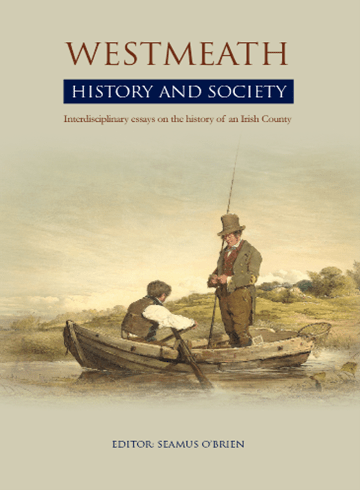
A new chapter in Westmeath historiography: the recent publication of Westmeath History and Society, an address by Dr Harman Murtagh at the launch in Athlone.’ Without doubt, this is the greatest book ever published on Westmeath. It’s a monument to our county’s culture, history, society and creativity – and an expression of Westmeath’s very distinctive identity.’ Blog No 374, 16th April 2022
The Mullingar and Athlone launches of Westmeath History and Society have provided two interesting and original addresses on the status of local history in Westmeath, our neighbouring county. The Offaly History and Society volume was published in 1998 and is long out of print. A few copies were secured by Offaly History some years ago and are offered for sales as scarce titles. We thank our friend Dr Harman Murtagh for a copy of his address on 31 3 2022 and we have added some pictures for our readers. Enjoy the address in Athlone and you can get the book at Offaly History Centre and online at www.offalyhistory.com, over 900 pages, hardback, €60.
My friends,
This is the south Westmeath launch of this magnificent volume, Westmeath history and society.
A week ago it was launched in north Westmeath by the archbishop of Dublin, the very Reverend Dr Farrell; south Westmeath must make do with the most irreverent Dr Murtagh.
The book is 900 pages long. As the archbishop observed in Mullingar, it’s about the size of a concrete block: in my view, its only fault is that it’s rather heavy to hold in bed.
Westmeath history and society is one of a series of county books – incredibly it’s the twenty-ninth in the series. The series has been appearing at the rate of a volume a year since 1985.
The series founder, general editor and manager from the start is Dr Willie Nolan, aided and abetted by his wife, Theresa. Their contribution to Irish society and to local studies is without equal. In France they would undoubtedly be awarded the Legion of Honour; in Britain surely Sir Willie and Dame Theresa? In Ireland, and here in Athlone, we can offer at least our enormous admiration for their magnificent achievement – twenty-nine county volumes of this size down, and only three to go! Wow!
(more…)
-
The Public Role of Personal Commemoration. Remarks on the Decade of Centenaries, the Great Flu and the scourge of TB. By Sylvia Turner, Blog No 350, 22nd Jan 2022
On January 7th this year, we raised a glass to commemorate what would have been my mother’s 100th birthday. Born in Kilcoursey Lodge, Clara, she had always said that she was born on a special day, being the day, the Anglo-Irish Treaty was signed in the Dáil. Her explanation to me as a child was that ‘it split Ireland in two and caused a lot of trouble’.
This example of family commemoration running parallel to the national one, relates to one of the aims on The Decade of Centenaries Programme to ‘focus on the everyday experience of ordinary people living in extraordinary times, as well as on the leaders and key actors in these events’
The Decade of Centenaries Programme has led to a great variety of commemorative events and literature, both at a national and local level. The Decade has been commemorated by Offaly History through a variety of media, no longer limited to monuments and the written word, as technology has enabled visual and auditory means to be retained through the use of videos and podcasts.
(more…)
 offalyhistoryblog