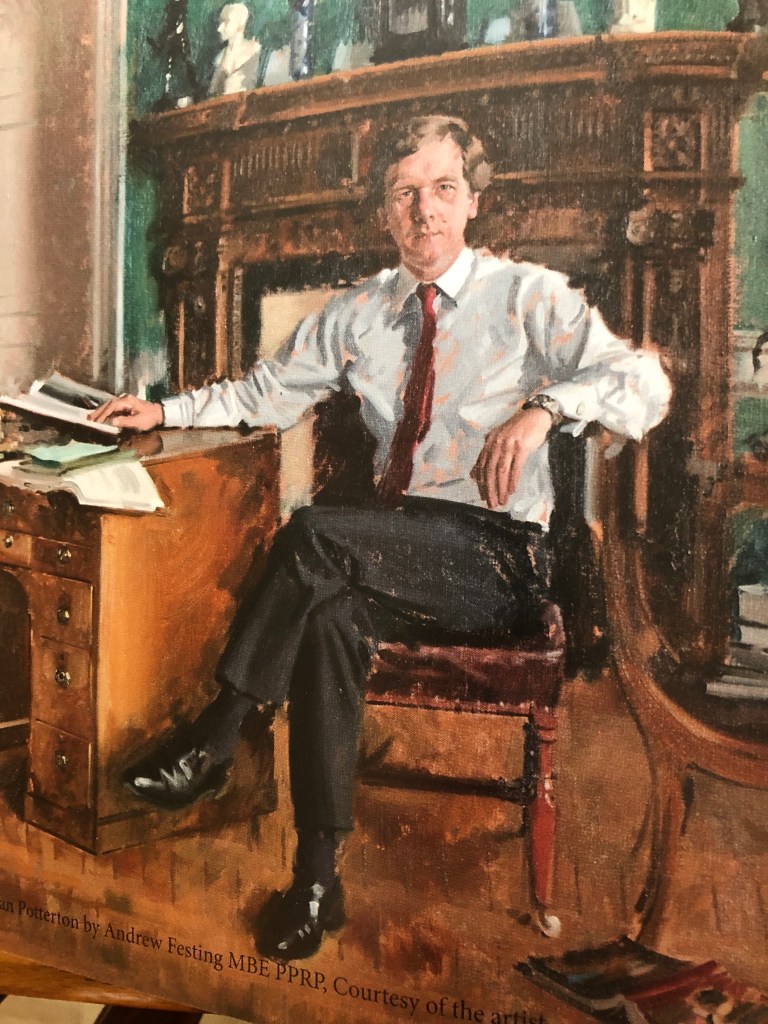
The Homan Potterton sale on 7 September 2021 at Adam’s, Dublin features three painters with Offaly connections. But first a word about Potterton. After secondary education at Kilkenny College and Mountjoy School he began studying to be a solicitor, but (great for him ) he switched to art history at Trinity with the formidable Anne Crookshank. He was the youngest director of the National Gallery of Ireland ever appointed (1979) but stayed for only eight years. He retired in 1988 out of frustration with the bureaucracy, the bullying Charlie Haughey, and his being unable to secure much needed funds for the gallery. That was back in the difficult 1980s. Had Potterton remained he would have been able to oversee the wonderful gallery there is today. All the great institutions saw money flow in from the 1990s with the support of EC funds and the lift in the economy from 1993. While he took over the editorship of the Irish Arts Review in the 1990s (then an exciting annual event) he later moved to France and we heard no more of him save for several family histories, a memoir and a novel.
The jacket of Potterton’s memoir of 2017 with the arresting painting in the great classical style by Festing.(more…)
Over the years, Tullamore has been known as ’Towllaghmore’,‘Tullaghmore’ or ‘Tullymore’ -all anglicizations of ‘Tulach Mhór’ and most likely deriving from the high land to the south of the river. By the middle of the 19th c. the name of the now extensive town had morphed into ‘Tullamoore’- reflecting the influence of the Moore and later the Bury families and their ownership of all the lands around.
As urban developers, these skilled entrepreneurs with cultural pretensions reached their highest point during the overlordship between 1785 and 1835 of Charles William Bury, the first Earl of Charleville. Whether motivated by commercial considerations, a desire for social prestige and the admiration of his peers or by pure aesthetic sensibility, the development of Tullamore as promoted by Charles William, resulted in a coherent urban form which survived without much amendment into the middle of the 20th c., largely still exists today and will influence any future reconfiguration of the town centre.
Offaly History welcomes this contribution from Pat Nolan and is delighted to be able to include it in our Fifty Blogs for the Decade of Centenaries. This story, and much more, will soon be uploaded to our new Decade of Centenaries platform on www.offalyhistory.com. The portrait is from chapter one of Pat Nolan’s ‘The Furlongs – The Story of a Remarkable Family’, published by Ballpoint Press in 2014. Our thanks to Pat and his publisher.
At around midday on a Thursday afternoon in July 1921, up to 20 IRA members parked their bicycles not far from New Ross post office. A number of them surrounded the building on all sides while others filed inside, dressed in their civilian clothes and without any form of disguise. The staff had just finished sorting the morning mail and the town was relatively quiet. At first they didn’t pay any heed to the men, presuming they were linesmen – post office officials who had charge of the telegraph system. However, when they drew out their revolvers and yelled “hands up” the innocence of the staff’s initial impression was laid bare.
The administration of law in Ireland in 1914–19 was pervasive with petty sessions’ courts across the county in the smallest villages and towns. These were attended to by paid resident magistrates and on a voluntary basis by local gentry and merchants, both Protestant and Catholic, who had been deemed suitable by Dublin Castle for the conferring of a commission of justice of the peace. After 1916 it was becoming a doubtful honour and many nationalists, including P.J. Egan of Tullamore (chairman of the town council 1916-24 and managing director of a large business), resigned the commission when the War of Independence in 1919-21 intensified. The country had been subject to the Defence of the Realm Act (DORA) since 1914 but it was not much invoked in Offaly before 1916 and the civil courts of petty sessions, quarter sessions and assizes (usually held in Tullamore, but often held in Birr from mid-1916 to 1921) continued in the county. The Sinn Féin courts will be the subject of a later blog.
When renowned Offaly archaeologist Caimin O’Brien, cited Sir Edmund Spenser’s inclusion of a verse on Croghan Hill in his most famous poem, The Faerie Queene, in Stories from a Sacred Landscape: from Croghan Hill to Clonmacnoise; the curiosity bells began to ring. This was an amazing revelation and posed questions as to how Spenser was familiar with Croghan Hill and its religious history? Had he visited the area? When did he visit? What were the circumstances pertaining to his visit? And latterly, the question arose as to whether it was possible that this visit influenced him in some distinctive way? And furthermore, whether that influence was positive or negative?
There are many people of note from Clara, but two particularly can be seen as associated with the period of Partition; David Beers Quinn and Vivian Mercier. Despite the ongoing War of Independence, the British government passed the Government of Ireland Act in December 1920, providing for the setting up of two parliaments in Ireland. The 3rd May 1921 marked the formation of the United Kingdom of Great Britain and Northern Ireland, so partitioning the island of Ireland. Vivian Mercier and David Beers Quinn had just reached their 2nd and 12th birthdays respectively. Although born a decade apart, in terms of Protestant identity, they represent different socio-economic backgrounds, illuminating what it was to be Protestant and Irish in the South of Ireland.
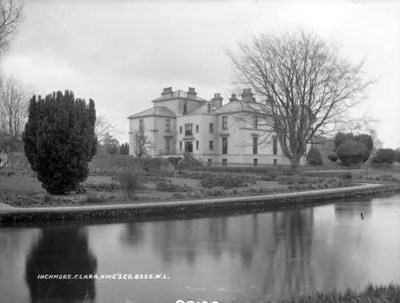
Inchmore where David Quinn worked as a gardener.
David Beers Quinn’s father, also named David, was a member of the Church of Ireland from Tyrone, He was employed as a gardener at the Goodbody house, Inchmore. His mother, Albertina Devine was also a member of the Church of Ireland from Cork with English parentage. Mercier’s father was from a Methodist family of Huguenot origin and his mother from a Church of Ireland clerical background from Monaghan. They lived in Cork Hill, Clara. The Mercier family, like the Goodbody family, were millers. Mercier’s father was born in Durrow, near Abbeyleix, Laois and was employed as a commercial clerk in jute manufacture at the Goodbody mills.
Vivian Mercier
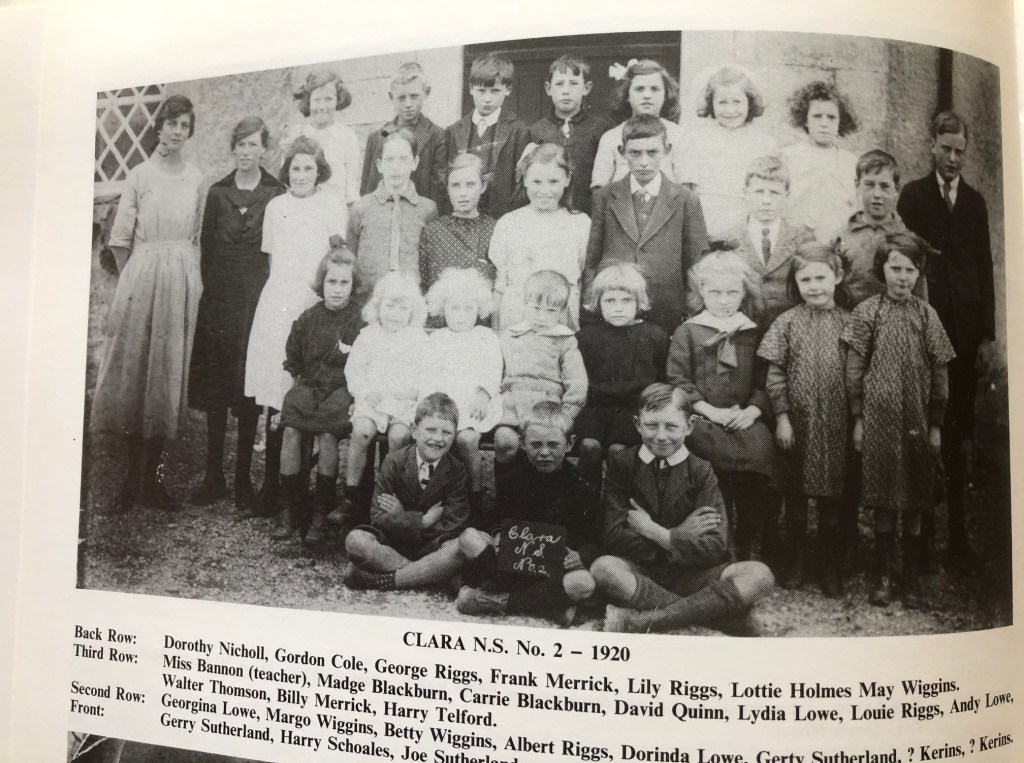
The partition of Ireland affected the education of Quinn and later Mercier. Quinn and Mercier attended Protestant National Schools, Quinn attending Clara No 2 Protestant school and Mercier, Abbeyleix South National School. Why Mercier attended school in Abbeyleix is unknown as the Clara National School was still under the tutelage of Miss Bannon who taught Quinn. However, it is known that Mercier corresponded regularly with Mrs Thompson, a later teacher at the school in Clara. Possibly the Mercier family had moved out of Clara due to unrest to the comparative safety of his father’s family home in Abbeyleix, approximately 60km south.
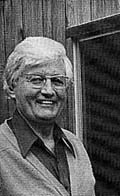
David Beers Quinn taking a look at one of his editions of Drake’s Voyages for the Hakluyt Society.
Quinn’s parents came to realise that their son was gifted. Finding good Protestant Irish education for a child from a working-class family was almost impossible if they stayed in rural Southern Ireland. The family moved to Belfast in 1922 where his father gained employment and in 1923 Quinn was able to attend the prestigious Royal Belfast Academical Institution. He continued his studies as an undergraduate at Queen’s University, Belfast between 1927 and 1931.
Mercier similarly left the South for Northern Ireland for his secondary education, attending the Portora Royal School in Enniskillen, one of the Public Schools founded by Royal Charter in 1608 by James I. Samuel Beckett (1906 –1989) was a former pupil. Critique of Beckett’s writing, particularly ‘Waiting for Godot’ was to shape much of Mercier’s career. Mercier and Beckett shared an affluent background and Huguenot descent in common.
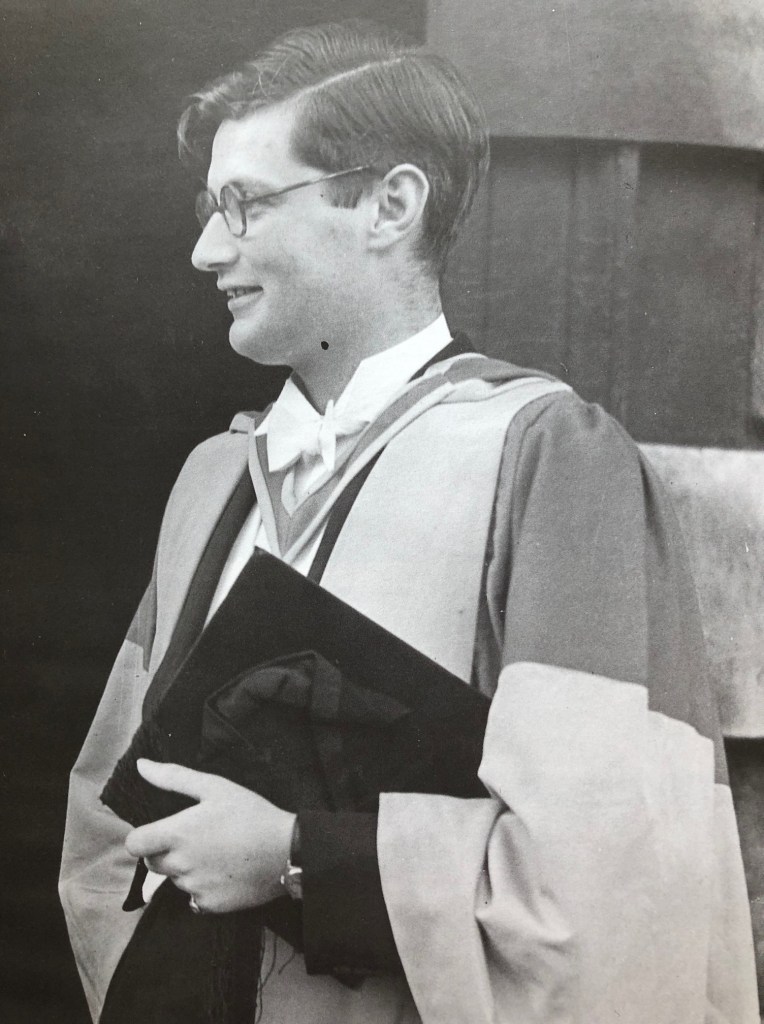
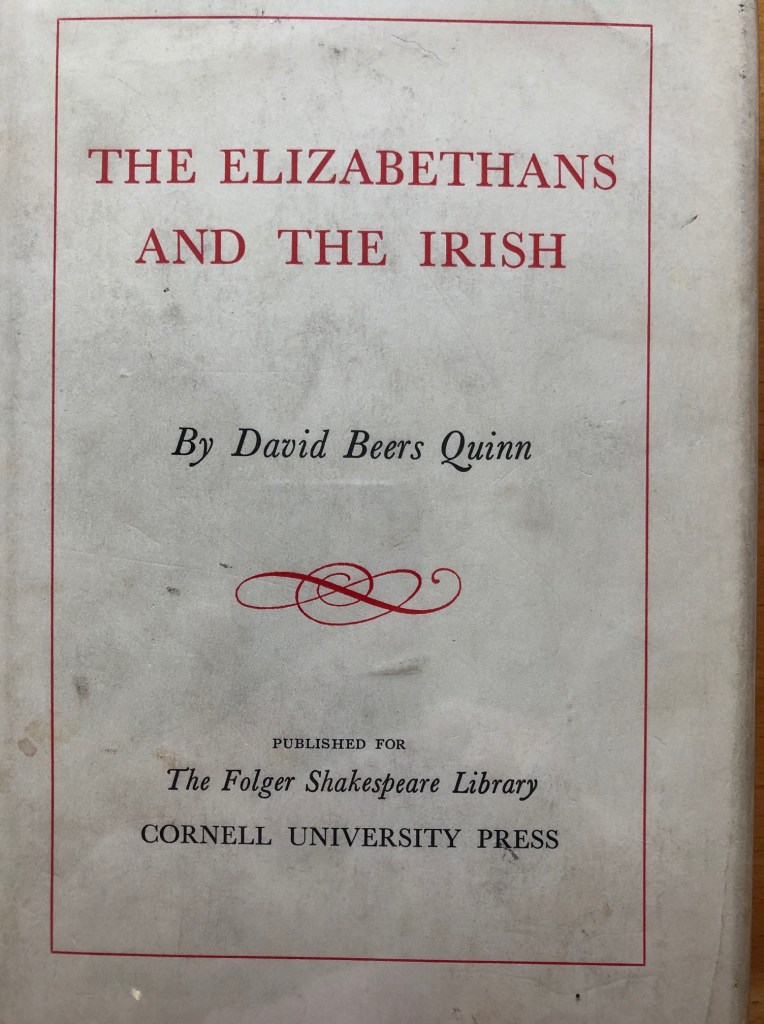
Quinn attended Queen’s College, Belfast (QCB) from 1927 to 1931 and then went to London University for his Masters’ Degree which he was awarded in 1934. There followed an academic career starting at Southampton (1934–9) and QUB (1939–44). After wartime secondment to the BBC European Service in 1943, Quinn moved to University College, Swansea the following year where he remained until 1957 when he moved to Liverpool university until 1976. Between 1976-1978 and 1980-1982 he was Senior Visiting Professor at St Mary’s College of Maryland. Alongside his academic teaching career, he wrote extensively on the voyages of discovery and colonisation of America. Many of his publications appeared as volumes of the Hakluyt Society. However, he continued to engage with Irish history writing The Elizabethans and the Irish (1966). Quinn also contributed substantially to both the second and third volumes of the New History of Ireland series (1987, 1976). However, his enduring influence on Irish history has been to link England’s involvement in Ireland with concurrent adventures in the Atlantic. Quinn married Alison Robertson whom he met whilst at Southampton in 1937. They were both politically active in radical politics. Alison worked with him particularly after their children grew up. She moved beyond indexing his work to becoming co-author and co-editor of several of his later publications.
One of Quinn’s first books. Still well thought of and now rare.
Mercier attended Trinity College, Dublin between 1936 and 1939. In 1940 he married American, Lucy Glazebrook. Whilst studying for his PhD, he worked as a journalist for the Church of Ireland Gazette and contributed to the Bell, a magazine of literature and taught at Rosse College. Mercier pursued an academic career at Bennington College, Vermont City (1947–8) before moving to City College, New York, where he taught English 1948–65. He married Gina di Fonzi in 1950. He became known as an academic who enjoyed teaching. He co-edited, the anthology A thousand years of Irish prose (1952), which became a standard teaching resource. He also compiled Great Irish short stories (1964). During regular visits to Dublin in the 1950s, Mercier studied Irish with Trinity and UCD academics. These studies gave rise to The Irish comic tradition (1962), dedicated to Gina, which broke new ground by combining Irish-language and Anglo-Irish material in support of its central thesis that comedy preceded tragedy in Irish literature and that it was possible to trace a degree of continuity between work in both languages, paying particular attention to Swift and Beckett. Although initially receiving a hostile response, the book is now generally regarded as a key text in the development of Irish studies. In 1965, due to Gina’s declining health, Mercier moved to the University of Colorado as professor of English and comparative literature. Gina died in 1971. In 1972 Mercier was visiting lecturer at the commemoration by the American University of Beirut of the fiftieth anniversary of the publication of Ulysses. Mercier married the Irish author, Eilis Dillon in 1974 and took up his last academic position as professor of English at the University of California, Santa Barbara. During these years Mercier and Dillon moved between California, Italy, and Dublin. Mercier retired in 1987 and he and Dillon moved permanently to Ireland. Here he reviewed books, contributed to literary journals and was a popular speaker at summer schools. He was writing a summative two-volume study of Modern Irish Literature when he died and his wife edited it and had it published in 1994.
Vivian Mercier
Quinn’s obituary in the Irish Times at the time of his death in April 2002 suggests his initial interest in the history of colonisation may have derived from his childhood years. He came from a Church of Ireland ‘colony’ within a ‘colony’ of the Quaker Goodbody family set inside a predominantly Catholic town. In 1998 Quinn wrote an affectionate account of his childhood years growing up there, explaining the relationships between different sectors of the community.
Mercier similarly was influenced by growing up in Clara, believing his experience of going to school ‘under the curious gaze of Catholic contemporaries whose world differed so widely from his own’ as separating him from the Protestant populations around Dublin who were confident in their own identity.
David Quinn at School through the Fields, Clara 1920with Miss Bannon (teacher) and a former OH member May Wiggins. The roll books are now in Offaly Archives.
David Quinn died 19 March 2002, predeceased by his wife Alison who died in 1993. He was survived by his three children. Mercier died whilst on a visit to London on 3 November 1989. He was buried with his parents in Clara after an ecumenical funeral service at St Patrick’s cathedral, Dublin. He was survived by his wife and three children. Quinn and Mercier had diverse careers but it would seem that growing up as Protestants in Clara at a time of when religious communities were divided, influenced the work of them both. Their legacy to Irish scholarship is significant.
Sylvia Turner, May 2021 with thanks to James Gibbons for additional material
Bibliography
N. Canny and K. O. Kupperman, ‘The scholarship and legacy of David Beers Quinn, 1909–2002’, The William and Mary Quarterly, lx (2003), 843–60; ODNB
For many the habit of reading started with the local library and has never left us. Recollections of the several libraries we have had in Tullamore remind us that so far as reading and comfort goes we have never had it so good. This is the time to recall the first public library in Tullamore started in May 1921, just 100 years ago. For that we have to thank an unsung hero E. J. Delahunty, a native of Clonmel, who was in charge of technical education in the county from 1904 to 1930 and died in 1931. He organized the first ‘students’ union’ in Tullamore and a superb lecture series on the great issues of the day in the 1916–21 period, and with mostly well-known speakers with a national reputation. The Midland Tribune gave the opening of the library an editorial and regretted that the lecture series had to be abandoned that year. Delahunty was shrewd and had the Tribune editor, Seamus Pike, on side. Another unsung hero of the revolutionary decade was Revd John Humphreys, a Tullamore-based Presbyterian minister, and great advocate for technical education. These are three people who need to be included in the Offaly Dictionary of Biography.
We posted this blog on 21 April 2021 and reproduce it today to mark the passing of John Flanagan, the well-known builder and advocate for Tullamore and County Offaly. Up to that time we seldom wrote a blog on a living person but we made an exception for John Flanagan, the modest man from the Meelaghans, Puttaghan and New Road, Tullamore who has invested his whole life (so far) in making Tullamore a better place for people to live, work, bank and even pray in. We in Offaly History occupy offices at Bury Quay rebuilt for us in 1991-2 by the John Flanagan firm and now we also occupy Offaly Archives, another Flanagan development located at Axis Business Park, Tullamore. Perhaps his greatest achievement was the building of Tullamore Court Hotel. Great in that it was against the odds and had been talked about in Tullamore for thirty years but nothing was done.
As long ago as 1977 the Midland Tribune in a review of Tanyard Industrial Estate commented that John Flanagan was a man whose vision and initiative has given the Tanyard its new lease of industrial life. John Flanagan had by then been 24 years a-building so successfully that John Flanagan and Sons Ltd. was one of the best known contracting firms in the Midlands.
He purchased the Tanyard from Messrs. P. and H. Egan in the late 1960s, established his own offices there (modest of course with no frills) and almost immediately set about using some of the six-acre site to provide facilities for other local people to set up business and projects of various kinds. Some of the buildings on the property were suitable for conversion to new usage but John Flanagan also embarked on his own programme of factory construction. He subsequently purchased other premises in the same area from Messrs Tarleton. With about eleven firms thriving in the Tanyard already, about 3³/8 acres remain available for further development and Mr. Flanagan will be ready to respond to demand as it arises. The whole area was redeveloped in the 1990s and is now emerging as a retail sector in Tullamore, well adapted to the changing economy.
John Flanagan extreme right and beside him is loyal foreman, the late Jim Larkin – in late 1984 after the fire of 31 10 1983 at Tullamore Church.
While his industrial estate has been steadily expanding, so too had his own business as a contractor. In the 1970s his major undertaking included construction of R.T.E transmitting Station at Ballycommon; Tullamore Vocational School; the Post Office in Portlaoise; Farm Centres in Edenderry and Portlaoise; Housing Carlow (a scheme of 57 houses); factories for Messrs Paul and Vincent; in Tullamore and Irish Cables, Athlone.
The old Tanyard Lane c 1996 with the first block of apartments on the right completed and a new carpark under construction
Jobs in hands in the late 1970s included a scheme of 40 houses in Clara for Offaly County Council; the Bank of Ireland premises at Bridge St. O’Connor Sq., a Welfare Home in Edenderry; reconstruction work at St. Loman’s Hospital, Mullingar.
‘Mr Flanagan – who incidentally is Chairman of Banagher Concrete was actively in recent formation of a Chamber of Commerce in Tullamore and is the inaugural President of a body which is expected to make a very significant impact on the industrial and commercial life of the town and district.’
Teresa Wyer was born in Ballykeenaghan, Rahan, Tullamore, County Offaly on 29 November 1868. She was the third youngest of eleven children of Michael and Anne Mary Wyer. Teresa Wyer went to Rahan National School and thereafter to Killina Secondary School. She joined the Convent of Mercy Athy, County Kildare on 22 February 1890 where she was called Sr Mary Baptist. She left the convent in 1900 and ran a shop and public house at No 6 Church Street bought by the first author’s grandfather, Owen Wyer, brother of Teresa Wyer, from Abraham Colton, the Tullamore auctioneer and hotelier in early 1901. Owen Wyer was also a Sinn Féin activist and chaired a great Sinn Féin meeting in Rahan in September 1917.
Drama in Tullamore from the Gaelic League, c. 1906 with a backdrop of a painted view of William/Columcille Street. Owen Wyer is second from the right in the back row.
Church Street was a busy commercial street at that time with at least five public houses, a hotel and a number of private residences. Wyer’s neighbours included the long-established Warren family drapery stores with two shops. In 1901 Teresa Wyer (then describing herself as 30) was living with her brother over the public house and they had a shop assistant and servant living with them. Owen Wyer was a maltster with the Egans of Tullamore and she a publican. By 1911 she described herself as a grocer and aged only 36, single and with four assistants living over the shop. Teresa Wyer married James Wyer from Ard, Geashill on 24 February 1914.
James Lyle Stirling was born 16 May 1858 to Thomas Lyle and Anne Stirling of Tullamore. He was a business man who ran several businesses in Tullamore, between the years of 1880 and 1898, and is best remembered for his mineral water manufacturing company.
His father, Thomas Lyle Stirling, was a brewer and merchant in King’s County, who ran most of his business in Church St., Tullamore. He was also an active Tullamore town Commissioner and sometime acted as an agent for Mary Anne Locke of Locke’s Distillery Kilbeggan. Thomas Lyle Stirling married Anne Jane, daughter of William and Catherine Commins of Cappincur, Tullamore, they had six children, all born in Tullamore except the youngest, Thomas who was born in Dublin. The children were Margaret (born 1857), James Lyle (1858), William (1860), Catherine (1862), Isabella Elizabeth (1863) and Thomas (1866).
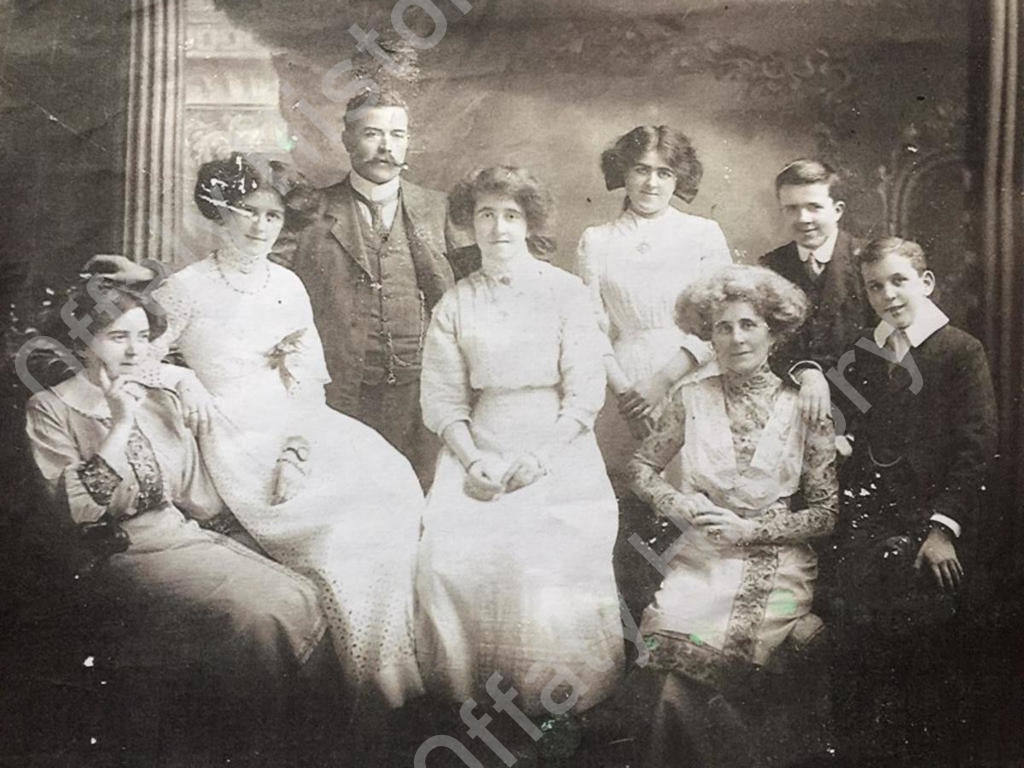
James Lyle Sterlingand family
Anne Jane, James’s mother died shortly after Thomas was born in 1866 and his father Thomas remarried later the same year to Helena Reamsbottom, widow of Thomas Reamsbottom Esq. of Bellair Lodge, after she had lost a child and her husband early that year. Thomas Lyle and Helena Stirling, now married, lived in Bellair Lodge, Ferbane, and they went on to have two more children: Elizabeth Helena (born c.1869) and Thomas Francis Lyle (1872). In 1876 Thomas Lyle died, leaving a young James as his heir. As James was too young to take charge of his businesses, his estate was run by his executors, John Tarleton and Constantine Quirke. It would be another four years in 1880 before Stirling was old enough to take over his father’s business.
James Lyle Stirling married in Dublin to Gertrude Bridget Murphy (born c.1864), a daughter of Patrick Murphy a trader from Athy, Co. Kildare. They had six children at Church Road, Tullamore: Genevieve, Mary Margaret (born 1888), Eithel Mary (1889), Blanche Loretto Lyle (1891), Ida Mary Gertrude (1892), Joseph Allen (1893), and Raymond Gordon (1896). The family later moved out to Cloonagh House, just outside Tullamore.



 offalyhistoryblog