The square proper never had a public house until that in GV 5 in recent times, while the Brewery Tap on the western side at GV 3 High Street has served the public for well over 100 years. It was only in 2018 that a new public house and night club was opened at GV 5, now known as The Phoenix. The great garage of G.N. Walshe (GV 1 High Street) replaced the Goodbody hardware store which was in business from the 1840s to 1930 and with a tobacco factory at the rear until 1886.
In 1961 I joined B. Daly & Co Ltd and two years later SI was transferred to Irish Mist (another wholly owned Williams company) to supervise the production line in the Bond Store. I joined up with Joe Scally, and I was still with him until I finished in 1985 over 22 years later. Joe and I were always involved in Production. We overcame many difficulties in the area over the years due to expansion and increased demand for output, with changes in packaging and design etc. I started on the middle floor of the Bond Store. We shared the building with Tullamore Dew. We had a staff of about 12 at the time, with no machinery as the output was small. Within a short time later, in 1966 due to increased demand, we had to move to the top floor. We became much more mechanised and we saw a dramatic increase in output, and also a big increase in staff numbers. We also saw the introduction of the Figurine, Blue decanter, the pocket Flask, the Waterford Glass decanter, and many more display packs, introduced onto the market. In 1966 a new office block was built, along with a new laboratory and a compounding unit.
Ireland has been associated with the loss of its people through migration for centuries. The analyses by the Central Statistics Office identifies that the famine of 1845 – 52 led to a peak in migration and changed the country’s demographic, political, and cultural landscape. Related themes of endemic poverty and religious intolerance were reasons why others left Ireland’s shores trying to find a better life. Literacy rates in 1841 were 47% but by 1911 had risen to 88%. Limited literacy hindered emigrants maintaining contact. Migration could mean that when someone left, they were gone for good and it was unlikely they would ever again speak to or see friends or family back home. Apart from emigration, Irish demographic anomalies, such as late marriage and large families led to people being dislocated from their families. The age gap between parents, particularly fathers, and children was frequently such that being orphaned in childhood was common. Often, there was also a large age gap between older and younger siblings, with the latter hardly knowing brothers or sisters who had left home or emigrated while they were still in infancy. [i]
This context helps me to understand a phrase my mother used when she reminisced about her family life with three sisters and parents, growing up in the Midlands as workers at the ‘big houses’. They would join friends and listen to fiddle playing in the evening occasionally. When I asked her about someone she had described and what happened to them, she would sometimes say ‘Oh, he just walked’ often adding ‘it was very common then’.
So far we have looked at the 1821 and 1901 censuses for Castle Street, Birr together with traders in the street in the nineteenth century (see previous articles by going to the blog section on http://www.offalyhistory.com.) There were a lot of new families in Castle Street in 1911 when compared with 1901 based on the surname of the occupiers – not always a reliable guide. Families where there was continuity included that of John Wall, James Sammon, Patrick Connors, Laurence Kennedy, Owen Gaffney and Elizabeth Watterson.
In my previous article (Part 4) on the history of the Ballyduff quarries I looked in more detail at one of the Wrafter families involved in stonecutting at far back as at least 1807. In this article I will relate the story of two other Wrafter families of stonecutters. Members of these families are still active in the cutting, carving and sculpting of stone.
Wrafter family #2
This Wrafter family were also from Ballyduff and were heavily involved in the stonecutting trade at least from the 1850’s onwards. Between 1850 and the 1950’s at least 12 men from three generations of this family were stonecutters and most of them had at one time or another lived in Ballyduff and learned their trade at the nearby quarries. The lack of older records makes it impossible for me at present to say to what extent this family, and indeed even the other Wrafter branches, were involved in stoneworking before 1800.
Belonging to the earliest generation of stonecutters were Thomas (b. 1835, d. before 1882) and Patrick (b. ab. 1842, d. 1889). Five sons of Patrick Wrafter and his wife Katherine (nee Walsh) became stonecutters (John, Patrick, Jim, Joseph and Alec). After learning their trade in Tullamore Jim, Joseph and Alec practised their trade for extended periods in Cork and Dublin.
John worked a quarry of his own in Ballyduff in the late 19th – early 20th century. Patrick worked a quarry together with some employees in the neighbouring townland of Arden until at least 1928. Alec returned to Tullamore and also worked part of the Ballyduff quarries up to the 1950’s.
Stonecutters from this Wrafter family worked on the building of the new Catholic Church in Tullamore circa 1906. In 1908, they carved the stone tracery for a new stained-glass window for St Catherine’s Church (Church of Ireland) in Tullamore. Several of the Celtic cross grave monuments at Clonminch cemetery in Tullamore bear the names of John and Patrick Wrafter, and can arguably be considered works of art.
Clonminch, Tullamore 2
Fig. 1. Celtic cross headstones sculpted by John Wrafter (1866-1941). Erected in or around 1910 in Clonminch cemetery, Tullamore. The monument in the photo on the right (2) was made by John for his own family; three of his children and his wife are named on the headstone.
Four of the Wrafter brothers (John, Jim, Alec and Joseph) were active in the Stonecutters’ Union of Ireland, a trade union for stonecutters. The photo below is of representatives of various branches of the Stonecutters’ Union of Ireland, as well as of the union’s central organisation. The picture was taken about 1905. Two of the brothers feature in the photo:
John Wrafter (b 1864), representative for Tullamore and Alec Wrafter (b 1879), representative for Dublin.
Fig 2. Photo of members of the Stonecutters Union of Ireland (obtained from Barry Wrafter). Alec Wrafter (Dublin) back row, 2nd from the left. John Wrafter (Tullamore) back row, 2nd from the right.
James (Jim) Wrafter (b 1872) was Treasurer of the Union (perhaps the Dublin Branch) about 1909.
Joseph Wrafter (b 1882) was elected Annual Auditor of the Stonecutters’ Union of Ireland in 1907. Joseph was not living in Dublin at the time so involvement in the union would have meant regular trips by train to Dublin to attend meetings in Capel St. Several years later Joseph moved to Dublin and by 1932 he had been elected the General Secretary of the Stonecutters’ Union of Ireland. He died in Dublin in 1936.
Among the members of the Tullamore Company of the Irish Volunteers in 1916 were several stonecutters and masons from the Bracken, Wrafter and Molloy families. Joseph Wrafter was an active member and played a big part in the events of 20 March 1916, which became known as the “Tullamore incident”. In a skirmish, shots were fired and a bullet from the gun of Peader Bracken (another stonecutter) hit police sergeant Ahern. Joseph and his fellow volunteers were tried by a military court and ultimately released without conviction. Joseph was the father of the late Sister Oliver, who was a Presentation nun in Rahan and a keen local historian.
Recurring issues at the Union meetings reported by the press were demands for the use of Irish limestone in construction and the employment of Irish stonecutters in quarrying and dressing stone. Another demand was that available jobs should go to trade union stonecutters.
In 1896 stonecutters of the Stonecutter’s Union at the Ballyduff quarries went on strike over demands for higher wages and a half-day on Saturdays. The strike was short-lived as a settlement was promptly reached. Three decades later in 1922, there was another dispute over wages. This time the settlement resulted in a reduction of wages of stonecutters by 5 shillings to £3-10s, and of quarrymen by 2 shillings to £3. This may have reflected a decrease in the demand for quarried stone. In the early years of the 20th century concrete blocks began to replace stone for construction purposes, a development that was much criticized by the Stonecutter’s Union.
Several of the next generation of the Wrafter family entered the stonecutting trade. I will mention just two of them here. Patrick Joseph, born c. 1899, son of James, emigrated to America. He states his occupation as stone carver on his wedding certificate of 1922 in Albany, New York State.
John born 1891, son of John (b 1864), became a stonecutter/sculptor in Tullamore. By the 1930s he had left the stone trade and became a grocer and publican, with premises on Harbour Street (Wrafter’s Harbour Bar).
The latter half of the 20th century saw the continuing decline of the stonecutting trade. The carving of headstones was one of the few activities that survived for the employment of stonecutters. Among the Wrafters of Tullamore the trade died out. Four or five decades passed without a Wrafter putting his signature to a piece of stonework. Then in the late 1990s the Wrafter name appeared once again in connection with stonework. Barry Wrafter, the great-grandson of stonecutter John Wrafter, born 1864, and grandson of John Wrafter of the Harbour Bar, revived the family tradition, and has made a name for himself as a sculptor and stone carver.
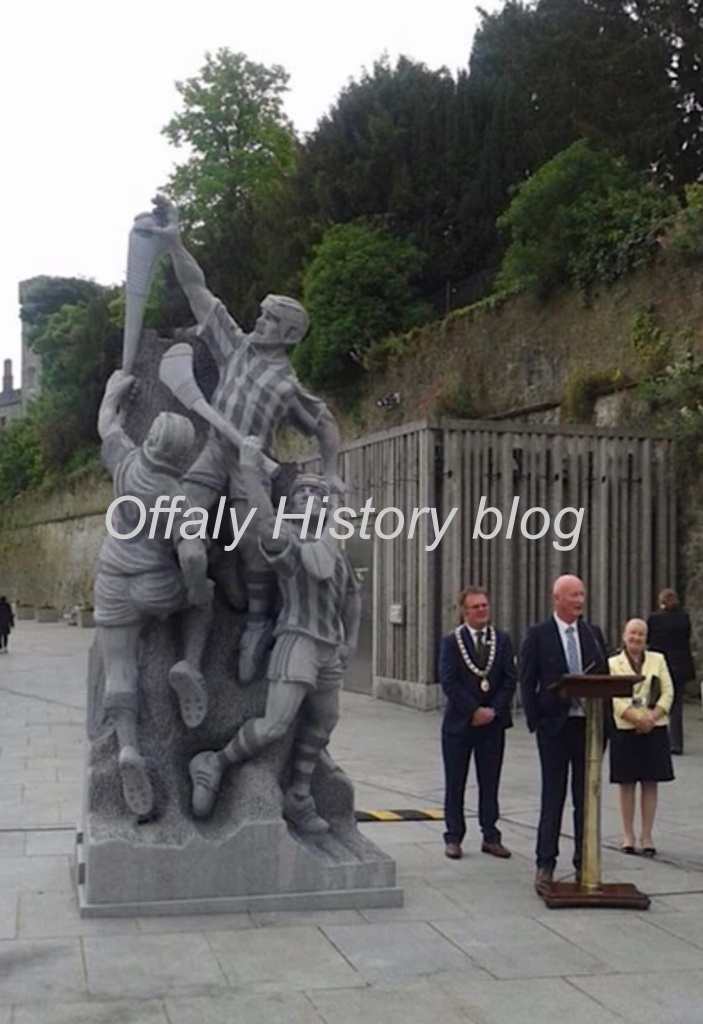
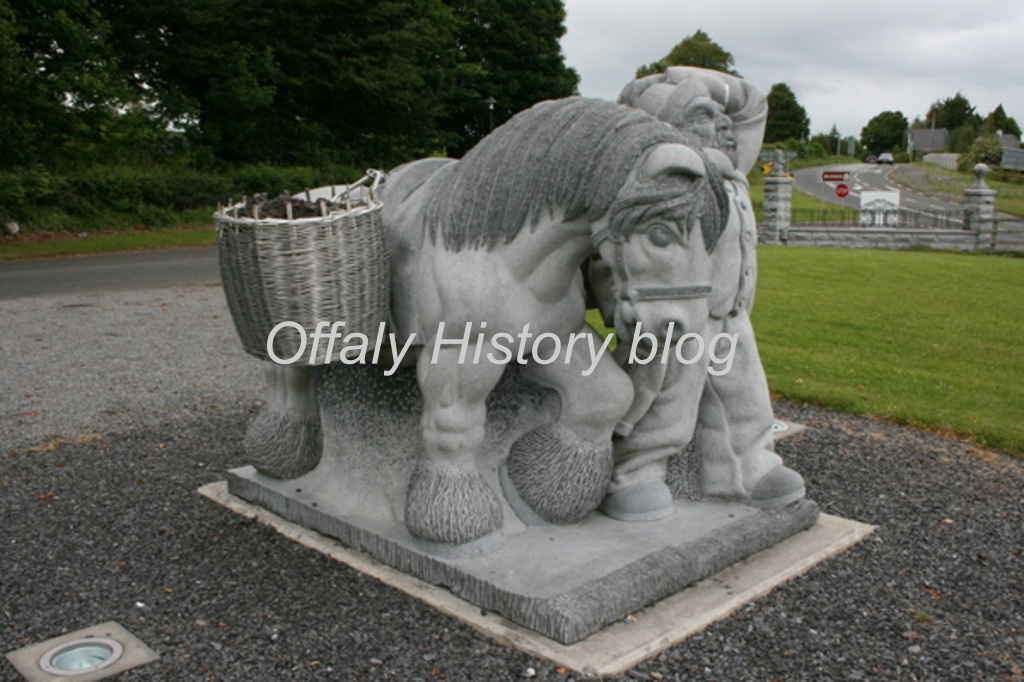
Growing up in Ennis, Co Clare, Barry returned to the trade of his forefathers as an outlet for his creative talent. He became interested in stone carving and sculpting after learning about the history of stonecutting in his family. Barry is one of only a few stone carvers using traditional methods and skills operating at the current time in Ireland. Since 1999 he has been commissioned to produce several public works throughout Ireland. His most ambitious work to date is undoubtedly the hurling sculpture in Kilkenny city (Fig 2), which he worked on in 2016-17. Closer to the home of his ancestors is “The Turf Cutter” from 2007, which is to be seen at the entrance to Belvedere House Garden and Park, near Mullingar (Fig 3).
Fig 3. Barry’s major work, the Kilkenny Hurling sculpture in Irish limestone completed in 2017. (Photo: http://www.barrywrafterart.com)
Fig 4. The Turf cutter sculpture at the entrance to Belvedere House and Gardens. (Photo: http://www.mckeonstone.ie)
More recently (in 2022), Barry was employed in the restoration of the Primark store (also called The Bank Buildings) in Belfast. The building, made of red sandstone from Scotland and completed in 1900, was ravaged by a fire in 2018. Some of his work can be seen in the photos below.
Fig 5. Pieces of carved sandstone ready for mounting into place in the Primark department store in Belfast. (Photo: Barry Wrafter)
Fig 6. Part of the facade of the Primark department store in Belfast during restoration. (Photo: Barry Wrafter)
Wrafter family #3
The third Wrafter branch involved in stonecutting may have started with Timothy Wrafter, born about 1804. Timothy, who lived in Aharney (a townland about 6 km northwest of Tullamore), was a stonecutter and farmer. He married Bridget Houghran in 1839 and had a large family; they had at least 11 children between 1840 and 1861.
At least two of the sons became stonecutters. John, born 1840, had settled in Chicago by 1880. He was married to Mary Molloy. He died in Chicago in 1904, age 65, occupation “Stone cutter”.
Another son, Timothy, born in 1849, married Anne Somers in 1877 and emigrated with his wife and two young children to Australia in 1883. They settled in the Brisbane area, where Tim continued his trade as a stonemason. Before leaving Ireland he probably worked for John Molloy at the Ballyduff quarries.
Timothy’s nephew, also called Tim, was a stonecutter according to the 1911 census. He was living with his parents in Ballykillmurray, close to Tullamore and the quarries, according to the same census. A couple of years later, in 1913, Tim made the same journey as his uncle had done 30 years earlier. He arrived in Brisbane, Queensland on 19 December 1913 on the ship Perthshire. Working with his uncle Timothy, the younger Tim learned the ropes of the trade.
Timothy eventually procured the business from his uncle and together with his two sons, Denis and Joseph, who were apprenticed as stonemasons, they founded the firm, T. Wrafter & Sons in Brisbane. It is still owned and run by the Wrafter family. They are the fifth or sixth generation of this Wrafter family involved in stonecutting. The company produces monuments, memorials, public works, and carries out church work, stone artworks and heritage restorations.
One of their most recent works is a 5-meter-tall Celtic cross standing on the grounds of Nudgee College in Brisbane. The monument, erected in August 2021 to mark 130th anniversary of the college, celebrates the school’s Irish Catholic heritage. Peter Wrafter, Company Director and a qualified stonemason, is a former pupil of the school. The material sought after for the cross was one that would exhibit good weathering properties and would have a colour resembling crosses in Ireland. Australian black granite was chosen and after a sandblast finish resembles the colour of Irish limestone. This beautiful work of art is a testament to the legacy of the Ballyduff stonecutters.
Fig 7. A recently erected Celtic cross on the grounds of Nudgee College in Brisbane made by T Wrafter and Sons, Stonemasons. (Photo: https://twstone.com.au)
Fig 8. An example of one of many public works in stone designed and produced by T Wrafter and Sons, Stonemasons., Brisbane. (Photo: https://twstone.com.au)
Given the prevalence of the name Timothy in this family there may be a link with another Timothy Wrafter who died in 1815 and whose headstone can be found in the graveyard of the old Church of St Carthage in Rahan. The tombstone is ornately carved as can be seen below.
Fig 9. The gravestone of Timothy Rafter who died in 1815, aged 33, in the graveyard of the old Church of St. Cartage in Rahan. (Photo: Paul Stafford. From booklet Offaly Tombstone Inscriptions. 1. Rahan Graveyards)
Thomas Wrafter is another Wrafter stonecutter that emigrated to Australia in the 19th century. Thomas ran a quarrying business on the outskirts of Adelaide in South Australia in 1880. He employed several stonecutters. He may be the same Thomas Wrafter that emigrated from Ireland and arrived in Brisbane in 1866. I have not been able to link him to any specific branch of the Wrafters.
Conclusion
In my research into the quarries and stonecutters of Ballyduff and Tullamore a picture has emerged that shows that the limestone quarries of Ballyduff produced some of the finest building and monument stone in Ireland. Moreover, the stonecutters that originated in Tullamore were widely recognized as some of the best in the country, and those that left Ireland (mainly to Australia) found that their skills were highly valued in their new homelands.
Many thanks to John Wrafter for these articles. Great research and we look forward to a printed publication in due course, Ed.
The 1901 census noted twenty-seven buildings in Castle Street, Birr (five less than in 1821, see our recent blog) of which six were unoccupied commercial properties, eight were shops including two public houses, four were boarding and lodging houses, and ten were private dwellings. Women were ‘head’ of house in six of the twenty-one dwellings. There was only one ‘dwelling’ where there was no more than one occupant and the largest household was thirteen. Only one house was divided between two families. Almost all those with stated occupations in the head of house category were in shops and craft industries with the exception of a bank porter, a retired teacher, and an Ordnance Survey employee. The latter family was Anglican as was Mrs Ellen Morahan and all other residents on the street were Roman Catholic. In 1821 perhaps up to one-third of the residents were other than Roman Catholic. The other significant change was the almost entire absence of domestic servants in 1901 and in 1911. This is a longish blog to accommodate the 1901 census. Next week we look at the street in 1911. If you have material to pass on email us info@offalyhistory.com.
In 2022, Barry Wrafter, sculptor and architectural stone carver, was interviewed about his work on Clare FM local radio. Among other things, he talked about the value of using traditional methods and skills in working with stone. Barry is the latest in a long line of Wrafters who have made their living by working with stone. The Wrafter involvement in quarrying and stonecutting in Ballyduff and Tullamore goes back almost certainly to the 18th century which means that the Wrafter name and its association with stonecutting has spanned four centuries.
I have identified three distinct branches of the Wrafter family that were involved in quarrying, stonecutting, and stone carving. In this article, I look more closely at one of these families. The other two branches will be dealt with in a separate article.
In earlier blogs for Offaly History (March 19 and April 20, 2022) I mentioned my great-great-grandfather John Wrafter (b 1794) and his role as sculptor in the building of the county gaol in Tullamore, in 1826. I mentioned his involvement in the making of the windows of the Catholic church in Birr in 1842, and the windows of St Laurance O’Toole church in the centre of Dublin in 1848. John was also contracted to build the workhouse in Tullamore in 1841. I also touched on his son John (b 1828) who, among other things, provided chiselled stone from Ballyduff qurries for a Presbyterian church in Mountmellick. Below I take a closer look at their involvement in stonecutting and the Ballyduff quarries.
Castle Street, Birr comprises a mix of about thirty commercial and residential properties close to the Camcor river to the south, Main Street and the old parish church to the north, and to the west Birr Castle. On the east at the Market Place or Market Square the street opens into Main Street, Bridge Street and from the 1880s into the new Brendan Street. The market house stood from the 1670s where the memorial to the Manchester Martyrs was placed in 1894. Surprisingly, when the market house was taken down in the late 1700s it was not replaced with a new building in a less disruptive location.[1] The new courthouse and jail of c. 1809 took care of the legal functions, while two plots were reserved in Castle Street for the markets.
Francis Edward Biddulph was born in Congor, County Tipperary, the son of Nicholas Biddulph and Catherine Lucas. His mother died shortly after his birth. Francis was cared for by his aunt, and later by his stepmother Isabella Digges la Touche. He was to have nine half-siblings, many of whom would later live in Birr.
In 1861 he married Annabella Kennedy in Southsea. He was then a lieutenant in the 19th Regiment. They had fourteen children, six of whom survived to adulthood. The family moved from England to Burma and India, and back to England.
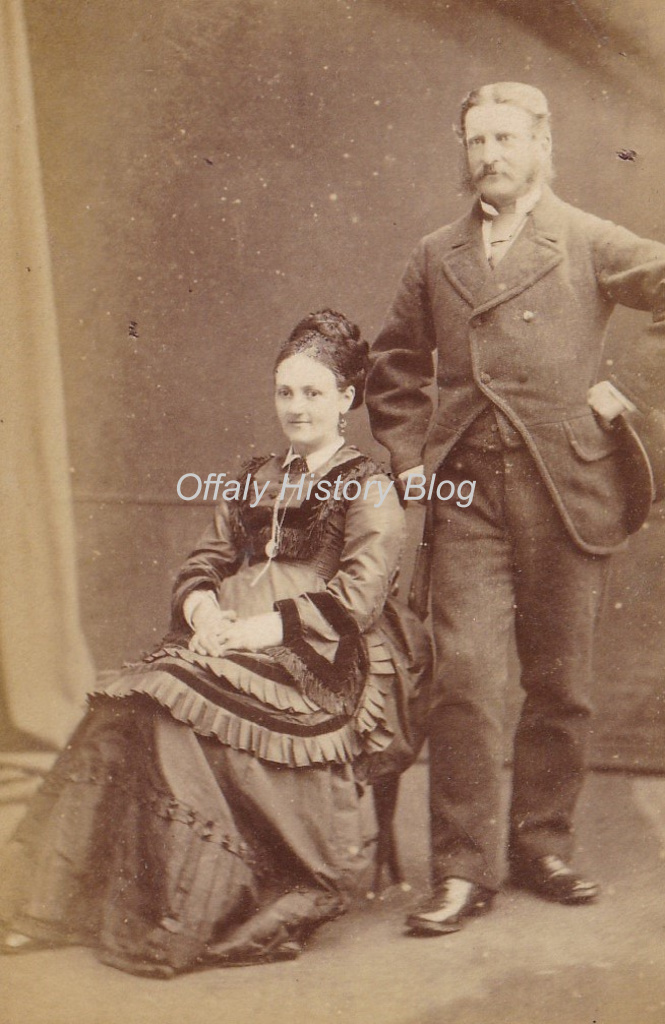
Francis and Annabella, Pembroke Dock, 1873. (Private Collection)
Their eldest daughter, Catherine Mary (Kate), had died in Bangalore, India aged 8. On their return to England they lost four more children. They are buried together in Llanion Cemetery, Pembroke Dock, Wales.
On his retirement from the army, Francis and Annabella returned to Ireland with their sons Nicholas, Charles, Hugh and Arthur, and their daughter Amy who had been born in Aldershot in 1875. Another daughter, Alice, died in Kilmainham, in 1877 and is buried in Grangegorman Military Cemetery. They took up residence, first in John’s Mall, and then in a house called St. Kilda’s, in Birr, then known as Parsonstown after the Parsons family who lived in Birr Castle. The two youngest daughters, Beatrice and May, were born in Birr. Arthur was later to die in Congor aged ten.
Francis became a Justice of the Peace. Later he became chairman, when Lord Rosse was away, of the Board of Guardians, and was on the Board. Then, in the church, he was the Rector’s Churchwarden, also teaching in Sunday school. For eleven years he belonged to the Unionist Association, and for the same length of time he was secretary of the tennis club.
Amy, the eldest surviving daughter, described living on John’s Mall as a child, and being taken for walks on Sunday afternoons with Francis and Annabella in the demesne of Birr Castle‘a glorious park, with miles of walks and rivers and a huge lake where water lilies abounded in summer, which I am ashamed to say often came home hidden under our coats as we were not supposed to pick them.’ Here she would play with her friend Emma McSheehy, daughter of the stipendiary magistrate, climbing the big trees, watching the fish in the river and scampering around what was at that time the biggest telescope in the world. Francis and Annabella would be asked to dinner parties and Lord Rosse would take the guests out to look at the stars and moon on a clear night, which they told Amy was a very wonderful sight.
She also gave an account of a terrible accident on the lake at Birr Castle:
In winter the lake froze and when the noble earl considered it safe for skating it was thrown open and there at seven I learned to skate. How I loved it – one part of the lake was not as safe as it was supposed to be and a bad accident happened – two sisters who were skating together happened on the thin part and one went through. The other tried her best to save her but alas, by the time others had come with ropes she had gone under altogether and I don’t think her body was recovered ‘til the ice melted. After that much greater care was taken and next year parts of the lake were roped off. We also used to skate when it wasn’t thought to be safe on some flooded fields near the barracks and that always ended in tea and lovely hot toast swimming butter in the depot mess, before a huge fire.’
In 1883 the family moved from John’s Mall to St. Kilda’s. The house was close to Crinkill barracks where there was always a regiment. The Leinster Regiment had their depot in Crinkill Barracks. Amy went to sleep every night to the sound of the Bugler’s Last Post, and woke to the Morning Reveille.
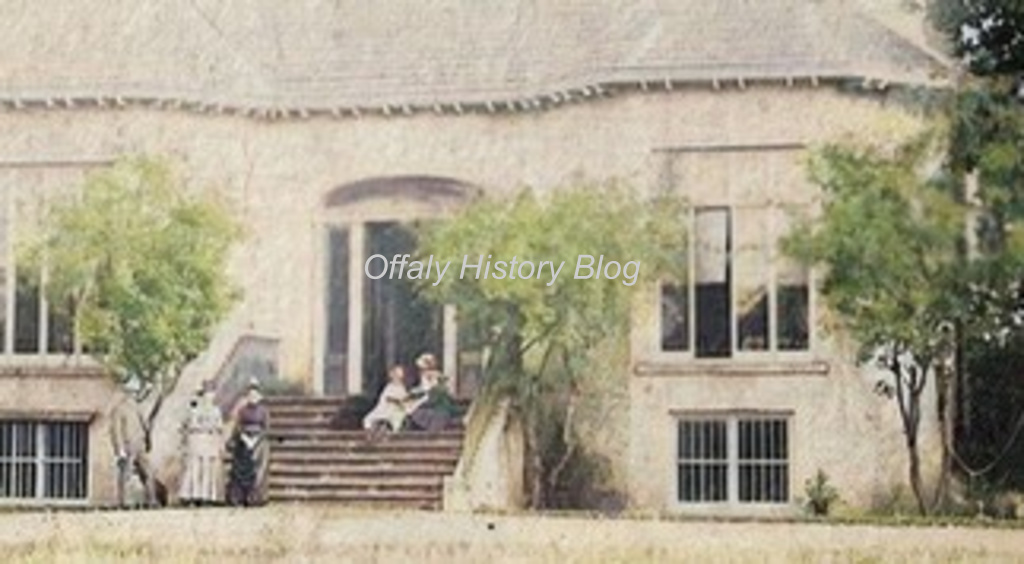
St Kilda’s, Birr, Co. Offaly (Private collection)
While the older Biddulph boys were away, Nicholas in Egypt with the army in Egypt, Hugh and Charles at boarding school in Aravon House, Bray, County Wicklow, the girls remained at home. Amy and the younger girls received an education from a governess. In Amy’s own words:
‘A governess came daily for a couple of hours to give me and my two sisters lessons. Education wasn’t much thought of for girls. As long as we could read, write a good hand and add up a few sums and have a smattering of history and geography. With me they went a bit further and I had painting lessons in the town and a master for music. The others didn’t get that far except what our governess could teach them.’
All three sisters attended Sunday school in Birr.
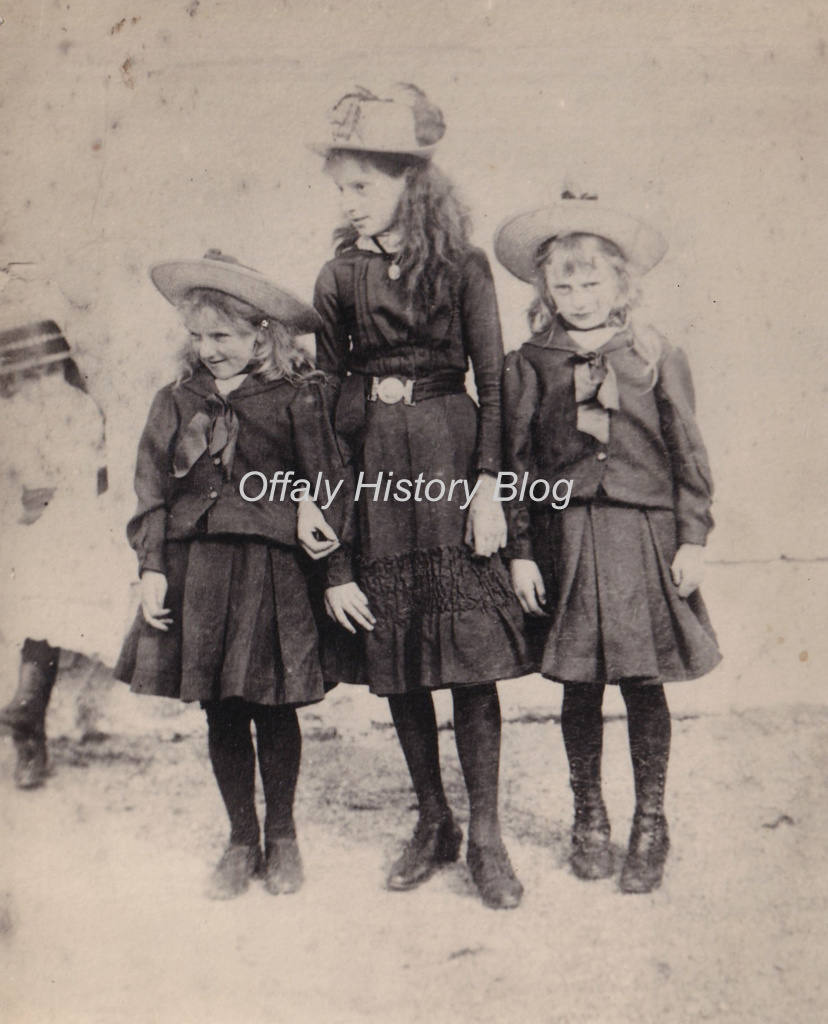
Beatrice, Amy and May Biddulph (Private collection)
Amy had dancing lessons in Birr Castle, with the children of Lord Rosse. They also frequently visited nearby Kinnity where their relatives, Assheton Biddulph and his wife Florence, together with their daughters Kathleen, Ierne, Norah and Ethne, and their son Robert, lived in Moneyguyneen, close to Kinnity Castle. Born between 1881 and 1891, the children were close enough in age to be playmates for the two younger Biddulph daughters, May and Bea. Assheton’s brother Middleton Biddulph lived and farmed at the Biddulph family home of Rathrobin with his wife Vera. They had no children.
Francis Biddulph’s younger half siblings Annie, Mary, James and William were all living in Parsonstown at this time. Annie lived at Birr View. There is a memorial window to Annie in Ardcroney church but the church itself is now located in Bunratty Folk Park. Mary and James lived at Bunrevan, Parsonstown.
James Digges La Touche Biddulph was the second son of Nicholas Biddulph, and the first son of his second wife Isabella Digges La Touche. His sister Mary was born the same year of 1842. It seems likely that they were twins but there are no surviving baptismal records. The church records for Ardcroney were destroyed in 1922.
James Biddulph died in Parsonstown in 1895 from general debility according to his death record. He was fifty years old. His sister Mary Biddulph was present at the death.
BIDDULPH – October 14, at Bunraven, Parsonstown, J. Digges la Touche Biddulph, son of the late Nicholas Biddulph, Congor, Borrisokane. Funeral at 9 o’c. tomorrow (Thursday) morning for Congor.
William was a Church of Ireland clergyman and married to Rebecca Clarke.
Amy described St. Kilda’s as her very happy home – ‘there was a large garden at the back of the house and at the end of it large apple and pear trees – one of these which I claimed as my own had very good branches for climbing and many a day when my two young sisters would be off playing their own games I would sit up for hours partly reading and partly watching the lambs which adjoined our place. How they skipped and jumped – she wrote – especially on old roots of trees which abounded – and then suddenly rushed off like mad things when their mothers called them. They were my delight, and also the rabbits, especially the tiny ones when they first came out of their burrows of which there was a lot in our fields.’ Her brothers, however, caught them in traps and shot them. They were a most useful addition to the menu.
‘The avenue which was more than half a mile long, opened off the Barrack Road.
There was a very high hill covered with big trees on one side and a pretty little lake on the other. When my brothers were home for the holidays they made a rustic bridge and a boat – and the island was always a sort of misty place inhabited by fairies and gnomes.’
Among Amy’s childhood memories were some involving her donkey Yankee. She described him as being almost human. ‘When some of the officers would come over from the barracks one of us would jump up on Yankee with just a stick in our hands to guide him, no saddle or bridle, and canter him round and then we would invite one of them to get on which they would do while we stood at its head. Then we’d say ‘Gee-up, Yankee’ and round he would go, kicking and jumping and arching his back ‘til the unlucky victim would fly off. How we trained him to do that trick I don’t know, but it was an unfailing one.’
But while Amy’s life was happy, these were troubled times. From the age of nine Amy began to hear of the Land League. Francis read the newspapers out loud every day for the benefit of Annabella. Just after the shooting of the Chief Secretary Lord Frederick Cavendish in the Phoenix Park, her brothers were walking along one of the roads in the town near their house with two policemen walking in front of them. They saw a flash out of one of the houses and one poor young policeman fell dead almost at their feet. There was constant anxiety about Francis. As a J.P., a landlord and an army man he was a marked man. One day he received a letter containing a picture of a coffin with his name on it.
In spite of this, for the three girls growing up in Birr, there was a lively social scene.
On the 1st January 1890, according to an item in the Irish Society (Dublin) of the 11th January 1890, the Countess of Rosse and Lady Muriel Parsons held a children’s fancy dress ball in Birr Castle.
‘Dancing commenced soon after 8 o’clock in the beautiful drawing room of Birr Castle, and was continued throughout the evening with the greatest possible spirit and enjoyment. Supper was served at 11 o’clock in the dining room, which was brilliantly illuminated with electric light.’ Miss Amy Biddulph attended as a Russian Tambourine Girl, Miss May Biddulph, as a Watteau Shepherdess, Miss Beatrice Biddulph, an Ice Queen. Miss Kathleen Biddulph, aged 9, daughter of Assheton Biddulph, was Little Bo-Peep.
As the three sisters grew older they played an active part in the life of the town..
May was a keen cyclist. Her name appears in an account of the Bog of Allen Club Bicycle Gymkhana which took place in July 1897. She was clearly an enthusiast of the bicycling craze which swept America and Europe at this time and promised greater freedom for women.
The Annual Gymkhana, promoted by the Bog of Allen Club, came off successfully at Oldtown, Naas, in tropical weather, and in the presence of a large and fashionable concourse of spectators. The Band of the 5th Battalion Royal Dublin Fusiliers played a fine selection of music during the afternoon, under the baton of Mr. Colvet.
She took part in the Hallow Eve Race (for Pairs) with Rev. L. Fletcher, and also in the Bending Race (for Ladies). Her sister Bea also took part in the Bending Race. The final race of the day was a One-legged Race (Ladies and Gentlemen). It’s not known if either May or Bea took part.
Amy Biddulph and her aunt, Miss Biddulph of Bunrevan, took part in a Birr Barracks Entertainment, an account of which appeared in the Midland Counties Advertiser of the 27th October 1892. Amy was seventeen years old.
‘Miss Biddulph, of Bunrevan House, next contributed a pleasing number ‘Saved from the Wreck’ which was very favourably received…Miss Amy Biddulph, St. Kilda, the eldest of the pretty daughters of Colonel Biddulph was, in the absence of Mrs Frend, requested to furnish a song, and greatly pleased her audience by giving a charming rendering of ‘The old home beyond the hill.’ The youthful vocalist fully sustained the musical reputation of her respected family, and she made a most favourable impression. Possessing a voice of singular power and sweetness and under perfect control, this young lady gives every promise of becoming a valued addition to local musical circles.’
Amy played tennis, sometimes mixed doubles with her brother Charlie, sometimes with Emma McSheehy. One year the annual tennis ball was held in St. Kilda’s. ‘It was a lovely moonlight night high in midsummer and the hay had just been cut and put up in heaps to dry and next day we had a great time discovering hankies and fans etc., at a great distance from the house – even on the island which told a tale! Also we weren’t very pleased to find the haycocks had been flattened.’
However this life couldn’t last. Francis had commuted his pension to fund the purchase of the 50-acre farm. When the farm failed through a combination of the agent’s deliberate mismanagement, Francis’ lack of competency, and the difficulties arising from the agrarian unrest, together with the refusal on the part of one of his half sisters to help him financially, the original entail inheritance having been broken to support his half sisters. He had borrowed money at an exorbitant rate from Joyce the moneylender in Dublin, and he was bankrupt. The family was forced to leave St. Kilda’s. All their horses were rounded up to be taken away and sold, though the donkey Yankee and the old pony Countess were later saved. Amy ran until she came to the wishing well and lay on her face on the mossy bank and cried her heart out. Amy’s brother Charlie helped to save some silver and jewellery by packing them into his uniform cases. Bea and May carried out pictures and hid them in an old derelict lavatory in the bushes. Next day they left St. Kilda’s forever and stayed in lodgings in Birr.
Francis and Annabella moved first to Dalkey in County Dublin. Their youngest daughter Bea, went with them and trained to become a nurse. There was worse to come when Charlie died of typhoid on the 26th of June 1900 in Queenstown, South Africa.
May married Charles Francis Pease in Belfast in 1904. He was ‘a well known Irish cyclist’ and the son of Charles Clifford Pease of Hesslewood, Yorkshire.
Amy travelled to Belfast to become a companion to an elderly relative. She married Surgeon-Captain James Walker in Belfast in 1906. By a strange twist of fate he had served in Crinkill Barracks, in Birr. They had seen each other but had never met. He died of pneumonia 18 months later in Jacobabad, India.
Bea would later marry Archibald Mateer, stepson of John Parnell, whose brother Charles Stewart Parnell had founded the Land League.
When Sr Dolores Walsh returned to Tullamore in the early 1970s to take over as principal of the Sacred Heart School she brought with her a wealth of ideas influenced by her years in California.
The Sacred Heart School (or SHS as it has always been known by its pupils past and present) is believed to have been the first school in the country to introduce a Student Council, a concept that did not become the norm nationally until 1998.
The 50th anniversary of the Student Council in the SHS was the perfect opportunity to celebrate a concept that was decades ahead of its time and to mark the school’s role “at the heart of education, at the heart of the community,” so it was decided to publish a book.
Initial meetings were enthusiastic and optimistic and as time marched on it became obvious it was going to be more than a labour of love and was going to be a publication of some heft as contributions began to pour in.
The book’s coordinator Jacinta Gallagher Carroll cajoled and persuaded past pupils from the 1970s through to 2023 to put pen to paper and recall their Student Council and SHS experiences. The contributions varied from succinct recollections to albums of newspaper cuttings to poems and sometimes poignant essays.





 offalyhistoryblog