As the town changes and my own perceptions and values alter, the visual image of Tullamore that I hold in my head is continually refined.
Little by little I have begun to realise that buildings which I dismissed as mundane are more important than I had first considered, while others which I once revered are now probably not all that good after all. There is also the fear that several much-loved landmarks I believed timeless may soon disappear.
My visits to the town have become more infrequent and I find that when I try to summon up its civic character in my mind in order to make a drawing, it tends to coalesce into an amalgam in which some buildings and landscapes take centre stage while others recede. In this capriccio I have tried to corral my memories into an ensemble which has some underlying unity, but inevitably selection distorts scale and some of the juxtapositions may seem overly bizarre.
Of late, three particular parts of the town have begun to take a hold of my imagination – two real and one imaginary. The stretch of Cormac Street from the railway station to O’Moore Street gets better on each revisit while O’Connor Square is at last beginning to reveal its potential to be one of the finest urban spaces in the country. On the other hand, the Harbour is as inaccessible and decaying as it ever was. Its unknowable future has always fascinated me – as I’m sure it does many.
It was cold, dark and rainy that November 2017 night as we left the Embassy. My mood did not fit the weather. The warm glow of a job well done wrapped itself around my stomach and spread out to envelop my whole being. It was all hard to believe that my scribbling had brought me here.
I had started to write to commemorate my father way back in 1976, a few poems to inscribe his memory onto paper. The first one was printed in the Midland Tribune on the anniversary of his death in 1977. I was delighted to see my words in print, a feeling that persists to this day! I returned to my university and thought no more about it until I fell in love. That led to more poems, some I laugh at now but some I’m glad I wrote and, who knows, some may even have had an impact on my future wife.
So forty years later there I was sitting in a restaurant with two of my sisters and one of my daughters, all of whom had flown over for the big event. My wife and other two daughters were abroad, unavailable. The conversation floated by me a little as my mind was back in the embassy room with the Irish Tricolour and the European blue flag forming a backdrop to my poems. The whole situation was a little surreal.
The words from that beautiful, sad, song by Tommy Sands, ‘There were Roses’, floated unbidden into my mind. ‘It’s little then we realized the tragedy in store’. Now, I admit, ‘tragedy’ may be a little strong, thankfully, to describe the events that were shortly to unfold.
Five months after my uplifting evening in the Irish Embassy I found myself in the less salubrious surroundings of a psychiatric ward here in Luxembourg city. A crash due to depression had stolen up on me and twisted my mind into such a state that I needed hospitalization. For two weeks I wondered what had happened, how could I exchange the Irish Embassy for a psychiatric bed in a matter of months? How had this happened? What exactly had happened?
In the last blog we noted that the August 1923 General Election in Laois-Offaly was remarkably peaceful given that the civil war had only ended in May. Offaly was still strong in support for the Republicans as was clear from the fact they gained two seats, but, of course, were committed to not entering the Dáil. Labour’s William Davin continued to have a strong vote but not nearly so much as in June 1922. Tullamore’ Patrick Egan gained a seat on Labour transfers. Egan polled only 9 per cent of the first preferences.[1] In Laois-Offaly the Republicans outpolled Cumann na nGaedheal, but the latter won the by-election of 1926 created by the disqualification of Republican John or Séan McGuinness.[2] Overall Cumann na nGaedheal secured 38.9 per cent of the 1923 vote as to anti-Treaty Sinn Féin’s 27.4 per cent.[3] The Sinn Féin vote was secured in difficult circumstances with many still in prison or in hiding. As Joe Lee recorded the outcome was a resounding success for anti-Treaty Sinn Féin and a loss for Labour. Cumann na nGaedheal secured 63 seats, but that was a gain of only five in a Dáil enlarged from 128 to 153 seats. This was the election in which the franchise was extended to all women over the age of 21, thereby expanding the electorate from 1.37 million in 1918 to 1.72 million in 1923.
Father Grogan was born on June 14th, 1873, in Brocca, Screggan County in Offaly. His parents were Joseph Grogan and Mary Molloy. He received his early education at Mucklagh National School, Saint Columbus School, Tullamore and Saint Finian’s College Navan. At the solicitation of his uncle, the Reverend, Anthony J. Molloy of the New York Archdiocese, came to the United States and was admitted to Saint Joseph Seminary then located in Troy, New York. He continued his studies there and at the new St. John’s Seminary in Dunwoody, where he was ordained on May 27th, 1899. He celebrated his first mass at Saint Peter’s church in Yonkers, NY, where his uncle was the Past
His first assignment was to Rosendale, NY for one year. He was transferred to the Mission of Our Lady of the Rosary, where he remained uninterruptedly serving as assistant until 1922.
To mark Heritage Week 2023 we have two articles on St Catherine’s Church, Hop Hill, Tullamore. This week the background from the 1700s to the completion of the new church in 1815. When coming to Tullamore by boat or rail the two most prominent sites to greet the visitor are the spire of the Catholic church completed in 1906 and that of St Catherine’s church, built on the mound known as Hop Hill and completed in August 1815.
We take the presence of the Cof I churches of St Catherine’s, Clara, Shinrone, Geashill, Edenderry and St Brendan’s in Birr (to name a few) for granted. The upkeep is great and the contributors few.More will need to be done to structure support for the upkeep of these buildings.
A Francis Johnston plan with the burial crypt of c. 1808-10. Courtesy of the Irish Architectural Archive
Hop Hill site a brave choice
The Hop Hill site was a brave choice as there was work to be done to make it suitable for building and the adjoining ground was soft and prone to flood, especially in the years before the two Brosna drainage schemes of 1850 and 1950. The Tullamore town landlord, Charles William Bury (1764-1835), had reserved the large distillery plot (now the Granary apartments in Market Square) for a church, from about 1800 to 1806. In the latter year then rector, Ponsonby Gouldsbury, and the vestry opted for the Hop Hill site and the new church was largely completed in August 1815. Soon after the old church off Church Street, erected in 1726, was demolished and the site of the church and, possibly an adjoining graveyard, were used for the Shambles or meat market and the remaining land incorporated into the new Market Square or Corn Market. The new Bachelors Walk was worked on from about 1812 as an attractive avenue to the new church from the High Street and from the town’s owner’s new residence, Charleville Castle. The architect for the church was Francis Johnston and for the new avenue, or Bachelors Walk was John Claudius Loudon, the distinguished landscape architect and designer of demesnes.
The young Charles William Bury when aged 28 and just seven years into his estate. He married in 1798 and died in 1835. His best years were up to the completion of the castle. He contributed about £4,000 of the £8,000 it cost to build St Catherine’s.(more…)
If walls could talk and archives survived, what would we learn about GV no. 48 High Street, Tullamore. A lot over its 275-year history so far. The number in the first printed valuation map of 1854 was no. 48. It is convenient to use this as the street was built by 1820, except for the Presbyterian church of 1865.
O’Connor Square and High Street were the principal streets in Tullamore from the 1740s to the 1960s. Charles Moore, the second Lord Tullamore, and from 1757 to his death in 1764 earl of Charleville, gave leases for substantial houses in High Street and these included the former Motor Works, the Round House, Mr Price building and Colonel Crow’s (no GV 48).
Most of the surviving houses in High Street date from the 1740s to the first fifteen years of the 1800s. Yet there is evidence of the commencement of a street here from 1713 with the building of houses GV 1, 2 and 3, followed in the 1740s and 1750s by GV 4, (O’Connor Square west for our purposes, from Bridge Centre entrance to the G.N. Walshe shop) and GV 5 and 6 High Street (Conway and Kearney and Guy Clothing). Both the northern and southern ends of High Street face important open spaces: the northern end forms the west side of O’Connor Square, and the southern end broadens out to form a triangular open space at the junction of O’Moore Street and Cormac Street.
High Street has been known by its present name since the early 1700s. However, until the early-nineteenth century High Street also included what is now Bridge Street. The street is uniformly wide throughout even allowing for the fact that some of the houses had railed-in areas to the front. Most of these, but not all, were destroyed by the 1970s.
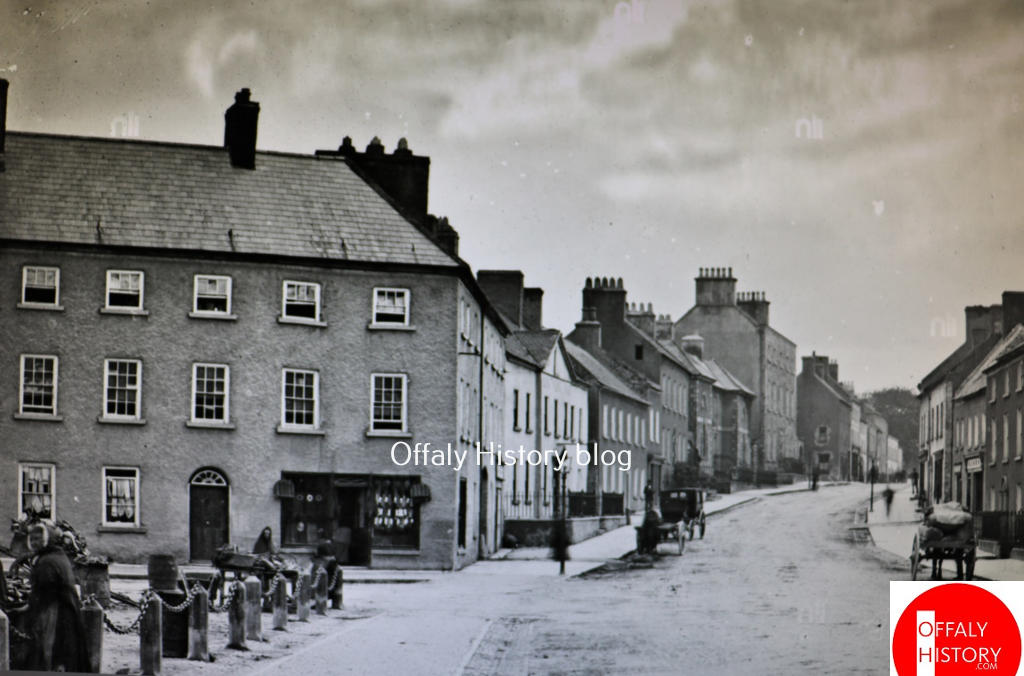
This photograph of O’Connor Square and High Street was taken about 1900, or a little earlier (and preserved courtesy of the National Library) and shows the fine corner building erected by the distiller Joseph Flanagan in 1787 with its original glazing bar/windows and Georgian doorcases. This is the large building from the former Willie and Mary Dunne’s shop (GV 49) to the William Hill bookmaker’s office, beside Gray Cunniffe Insurance. Like the Adams-Tullamore House at the junction of O’Moore Street and Cormac Street it is a substantial three-storey house closing off the square on the southern side with some ten bays to O’Connor Square and six to High Street. The building was carefully planned as can be seen from this lovely old photograph, courtesy of the National Library of Ireland. This is the earliest surviving view of the building. South of it is no. 48 (with carriage outside).
Col. Crow’s is a fine three-storey, seven-bay house with a Gibbsian door-case and open-bed pediment. The building, for many years known as Colton’s Hotel, has now two shopfronts and the original railings and low wall fronting the basement were removed in the mid-1970s.The building has lost its original glazing bars. From the early Lawrence photograph of c. 1900 we can see that a third storey was added soon after the existing hotel was purchased by Abraham Colton. It was then that a pediment to the roofline was removed and the third floor added. It was not so unusual to add a floor and there are examples of it in Columcille Street with Galvin’s and Dolan’s.
This house was built in 1750 for Colonel Thomas Crowe and survived intact until about 1974. Part of the large garden was used in the building of the Rose Lawn housing scheme in the late 1980s. The house to the south was demolished in 1940 to make way for the new Ritz Cinema, opened in 1946 and demolished in 1980. Roselawn of 21 houses was completed about 1990.
The abolition of Tullamore Town Council in 2014 evoked many memories for me of my years covering that body and its predecessor, Tullamore Urban District Council (UDC) from 1988 to 2007 for the Offaly Express, and for a year and a half before that for the Offaly Independent. I also covered a number of meetings as a freelancer for the Express following my ill-fated return from England.
When I first covered the council, I had the advantage of knowing all the councillors. Six of those early councillors are now deceased – Ernie McGuire and Lar Byrne of Labour, Billy Bracken of Fine Gael (FG), Ann Fox of Fianna Fáil (FF) and independent representatives May Keeley (who, in 1974, was the first woman ever elected as a councillor in Tullamore) and Anne O’Toole.
The 1937 Pulitzer Prize winning book and subsequent Oscar winning movie were set in Clayton and Atlanta, both in Georgia, during the American Civil War and Reconstruction Era. It depicts the struggles of young Scarlett O’Hara, the spoiled daughter of a well-to-do plantation owner, who must use every means at her disposal to claw her way out of poverty following Sherman‘s destructive March to the sea.
The author of Gone with the Wind was Margaret Mitchell. While Margaret Mitchell’s Irish heritage is well known, most of the focus has centered on her maternal great-grandfather, Philip Fitzgerald. It’s believed Philip emigrated from the Fethard area of Tipperary and eventually settled on a plantation near Jonesboro, Georgia; where he had one son and seven daughters with his wife, Elenor McGahan, who was from an Irish Catholic family.
We are drawing to the end of a period of remembrance and reflection on the events that took place during the period 1912–1923 and the emergence of the Irish state as we know it today. These commemorative events have been referred to as the Decade of Centenaries (www.decadeofcentenaries.com)
As we proceeded through the decade of commemoration, it became apparent that little was known or reported about the many women who were active throughout this period, with some notable exceptions such as Constance Markievicz and Mary MacSwiney, but including thousands of other women. Mary McAuliffe has pointed out that there has been a failure to see the women of 1916 and the subsequent years as historical figures. An additional strand has been added to the Decade of Centenaries online resource. ‘Mná 100’ is an online women’s initiative for the final phase of the Decade of Centenaries Programme and continues to work in highlighting the role of women in the revolutionary period (www.mna100.ie). Caitlín Kingston was one such woman.
Caitlín Brugha (nee Kingston)
Caitlín Kingston was born in Birr, Co Offaly, in 1879 to William Kingston and Catherine Roche. The Kingstons were quite prosperous and owned a large store in Main St, Birr dealing in groceries, spirits and delph. They also owned land outside the town. Caitlín had two brothers, John was a Holy Ghost priest in Rockwell College and Charles was Offaly County Secretary during the difficult period of 1900 to 1921, steering the county through the minefield that was local government during the transition from British rule to Irish rule. She had two sisters, Máire who went to live with Caitlín and helped her raise her family after the death of her husband, Cathal Brugha, and Hanoria/Nora who joined the Sacred Heart order of nuns in Roscrea. Caitlín herself was educated in Roscrea. On the death of her father William in 1904, Caitlín helped her mother to run the business. However, they sold that business in 1910 and moved to Dublin.
The Christian Brothers have enjoyed a mixed press in Irish history. Earlier generations tended to ‘canonise’ the order, founded by Blessed Edmund Ignatius Rice, while in later years the tendency has been to ‘demonise’ it. Much of the criticism has, of course, related to issues around the alleged sexual abuse of boys attending residential institutions such as Letterfrack and Artane, while the order has also been accused of taking an excessively nationalist line. Getting a balanced picture of its contribution is not easy, but there is no denying the success achieved by many of its past pupils and the hurt caused to others.
In Tullamore, the order first came in 1862 and after withdrawing for some years due to a dispute with the parish priest over accommodation, returned in 1912, locating at St Columba’s Classical School, a building neighbouring the Parochial House. The building later became the De Montfort Hall, a parish building, and later an apartment block.
By the time I was a pupil of the old primary school in 1968-73, and the secondary in 1973-78, the Brothers were located at High Street, in a prefabricated structure built by Kenny’s Bantile in 1960. An extension was built in the 1980s but it, along with the bulk of the prefabricated structure, was demolished in 2011 to make way for the present school building.
The school was opened in 1912 at Bury Quay and catered for first and second level boys from the middle classes.This was the first boys’ second level school built in Tullamore. The first National for girls and boys was in 1832-4. For the original school of c. 1874 catering for the senior level primary boys see last week’s blog from Dr Moran. The building now serves as an apartment block.(more…)





 offalyhistoryblog