
In this article John Gibbons talks about the value of oral history and the importance of making the recording. John started recording in Offaly in conjunction with the Offaly History in December 2014. Since then over forty people have volunteered to be recorded. You do have a story so why not contact John or we can put you in touch via Offaly History. John has contributed material to Offaly Archives which will prove very useful in years to come. A story worth telling is a story worth saving.
(more…)Category: Biography/memoir
-
Building Improvements in Birr town since the 1850s. By Michael Byrne. Blog 422, 17th Sept 2022
Despite the low level of industrial activity in Birr in the latter half of the nineteenth century building contractors did well with a surprising amount of progress made in this area. This was in contrast to Tullamore where few new structures were erected until after the 1900s. The extent of the building activity tends to confirm the view that Birr owed its lack of industrial activity to want of entrepreneurs rather than want of capital. Among the public buildings and monuments to be erected or improved upon was St. Brendan’s Catholic Church which was completed in 1824-5. It was now remodelled and enlarged. Improvements were carried out at St. Brendan’s Church of Ireland church in 1879 under the supervision of Mr (later Sir Thomas) Drew, architect. The church was enlarged by extending the eastern gable. The organ was removed as also were the horse-box pews. In 1885 the stone was laid for a new Presbyterian church at John’s Place, beside the house of the parish priest, Dr. Bugler. The new church here was part of the redevelopment of the southern side of John’s Place. The old Crotty meeting house in Castle Street was sold for secular use in 1885.
(more…)
-
A length of material and other memories of Clara in 1919–23 and its aftermath: some recent changes for the better By Sylvia Turner. Blog No 421, 14th Sept 2022
Michael Byrne’s recent blog article ‘The Gill Drapery Store in High Street Tullamore, 1900–22’ reminded me of the significance of drapery stores in the early 20th century and the Clara of my mother’s time. Amongst the correspondence between members of her family, frequent mention is made of the buying of material. The most common form of correspondence would seem to have been the postcard. Below, on the reverse of a postcard that depicted the ruins of Geashill Castle is an example sent on 27th of May? 1924. It was to my grandmother from her sister living in Clara and concerned the buying of material for ‘M’, May, her eldest niece.
(more…)
-
Exploring the family history of the Bagley family in Offaly: Clara and Toberdaly. By Fourth great-granddaughter, Ginny Birmingham Haen. Blog No 418, 3rd Sept 2022
Several of my ancestral families came from Ireland in the early to mid 1800s. They came from Counties Dublin, Armagh, Tyrone, Westmeath and King’s (now Offaly) and surrounding midlands counties. The one common factor was that they all migrated to Quebec, settling in several small communities in the area just southeast of Quebec City across the St. Lawrence River.
After a generation, many of those families moved to western Canada or the United States, often settling together. Many went to Wisconsin and Michigan where they worked in the logging industry and farmed. In the next generation, some married into other Irish families, so studying one’s family gradually evolved into studying several. My families were among those settling in Jacksonport, Door County, Wisconsin.
I had always wondered how and when these Church of England/Ireland families got to Ireland from England and Scotland, then migrated to the same places in North America. What did they have in common? There are no relevant ship manifest lists for British Isles migrants going to Canada since it is a part of the British Commonwealth, and it was not like going from one country to another.
I have an old family Bible with some information, but for the most part all I had to go on was Canadian census records or church records which gave a child’s birthplace and age, indicating approximately when the families left Ireland, and if I was lucky, a more specific birthplace. Usually, specific meant only a county. Family lore told of one or two Bagley children being born in Clara, Kings County. Other names of the Quebec families appeared in the Irish Midlands, so I concentrated my research there.
(more…)
-
The Gill Drapery Store in High Street Tullamore, 1900–22. From Gills to Guy Clothing. Recalling also the Mills and Muller families. By Michael Byrne. Updated by John Wrafter. Blog No 416, 27th August 2022
Marking Tullamore 400th, Decade of Centenaries and Sustaining the country towns in the 21st century
August 1922 was a wicked month with the death of two Irish leaders, Arthur Griffith and Michael Collins. At local level we had the death in July 1922 of the Ulster Bank manager Tullamore in the course of a robbery and at Bunaterin the death of a Free State soldier, Matthew Cullen, on 29 August 1922. Raymond Cullen wrote about this in our blog last week and in July we carried a blog on the Ulster Bank robbery by the Republican IRA. The Republicans departed Tullamore on 20 July 1922 just before the Free State army reached the town. Before leaving the barracks, courthouse and jail were burnt. Later in the month and in August it was the turn of the Big House owners including Screggan Manor, Geashill Castle and Brookfield. Thucydides (d. 400 BC) wrote of how civil war exhibited a tendency to extremism. We were fortunate in Ireland that things, while bad, was not by any means on a par with the American of Spanish Civil Wars. That said the killings in the North of Ireland were terrifying. But enough of that lets go back to our story for today which is about shopping in Tullamore in the early 1900s, living over the shop and the tragedy of early death for the family of the owner Michal J. Gill in September 1922.

High Street late 1940s with Gill’s as a ruin, third from left Affable is a word I find myself using to describe the business people of High Street over the last 50 years from J.J. Horan, to McGinns, Daly’s shop, John Clifford, Midland Books, Kilroys Matty Coyne, Paddy Cleary, P.J. Carragher, Tom Lawless and so many more one could mention. In the course of a family wedding recently I had the pleasure of being ‘fitted out’ by Anthony Kearns, his ‘affable’ father, and the staff of the shop. Now I am revisiting, but today to look back at the history of the store and the building here since the 1750s, but more especially in the time of Gill’s Drapery from 1901 to c. 1922. This was a good time for drapers and opposite Gill’s (on the corner) was the Rafter drapery. In William/Columcille St. was Tullamore Drapery and Scally’s (to become a massive new store in 1912), and of course there was Morris’ shop in Patrick Street and later Church Street.
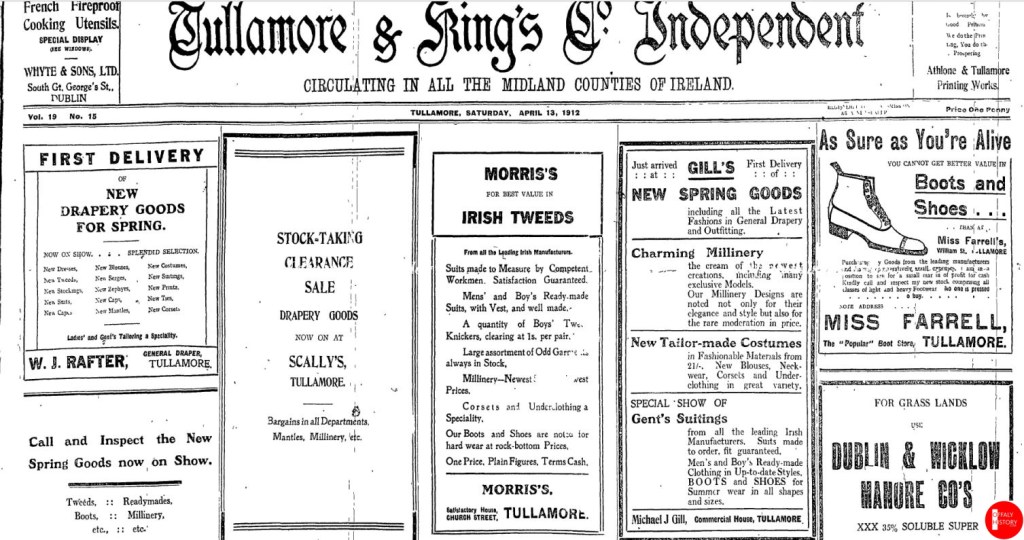
The drapers of Tullamore were all to the fore in this issue of 13 April 1912. Thanks to Irish Newspaper Archive. GV 6 and 7 High Street, Galvin’s ladies’ drapers, now Guy Clothing

Guy Clothing in recent times The modern Guy Clothing shop was erected in the early 1960s by P. & H. Egan Limited in a contemporary style and replaced a five-bay, two-storey house erected in 1753. Why the old house had been allowed to go to ruin in the 1940s is not known. It seems to have been a fire in the 1930s. For many years in the 1940s all that survived was a high wall. By the way the number of the shop, GV 6 and GV 7, comes from Griffith’s Valuation (GV) of 1854 and settled the numbering of these houses for many years.
The layers of transactions in regard to GV 6 & 7 certainly confirm the many layers in leasehold properties and the use they were put to in order to shore up income maintenance for investors. In April 1753 Lord Tullamore leased to Robert Mills, a farmer, the dwelling house adjoining John Nightingale. Mills also held, by a lease of three lives, twenty-six acres of arable land and four acres of bog at Spollanstown. The lives inserted were those of John Mills, Thomas Mills and James Mills, annual rent £3, and double that figure in the event of Mills selling to a papist.[1] He mortgaged the Tullamore property to John Finlay of Dublin in 1758 and in 1767 – the latter for a loan of £113.

Gill’s with the rolls of Cloth outside. Courtesy of NLI, c. 1905. Sergeant Ahern in picture. Miss Mills and Sergeant Major Muller strike up a match
This Mills family of Tullamore were recalled in a story in 2001 in connection with the marriage of a daughter to a soldier in the King’s German Legion (KGL) some of whom are buried in Kilcruttin graveyard.That the KGL settled in Tullamore and were popular is evident from matches that were made including that of Anne Mills, a Tullamore farmer’s daughter to Sergeant Major Muller and who were married at Middleton County Cork in November 1806. She died at Osnabruck in 1845. The story of Anne Mills was told to the Irish Times journalist, Richard Roche in 1961 while on a press visit to Germany by his guide to Berlin, a descendant of the same Anne Mills. He noted in his Irishman’s Diary article of 9 January 2001 that Anne Mills was still remembered in her adopted Osnabruck but wondered was she remembered in her native Tullamore?[2] Her name does not appear in the Tullamore parish registers of the Church of Ireland but other members of KGL feature in 1807 and 1808. A daughter was born to the ‘Germans’ in December 1806 and baptized at the old church in Church Street in July 1807 while a marriage is recorded on Feb. 29 1808. On 30 November 1808 is recorded a birth outside marriage to a KGL captain and an Irish girl. Was the child sent to the Foundling Hospital in Dublin as was usual at that time?[3]
In 1790 William Finlay, administrator of John Finlay’s will sold the property to Samuel Bollard of Farthingston, Westmeath.[4] By 1843 the house was subdivided, the northern end of the building was occupied by Thomas Mullen (?McMullen) and later Robert Galbraith, possibly a draper. In 1854 it was occupied by Thomas Kenny and let at £12 a year. In 1843 the southern end of the house was occupied by Matthew Warren who ran an eating house, later Mary Bolan, and in 1854 John Flanagan.[5] Flanagan had cabins to the rear as shown on the 1838 5 ft scale town plan.
The first valuation in 1843
6. (24)
Thomas McMullen to be let(Robert Galbraith) [James Kenny, James Bollard]. This house was let at £12 a year. The rere is small, enclosed with a lock up gateway – no garden, situation good.F.21, H.20, Q.L. 1B – YR (£14.0.0) LR (£10.4.0)
7. (25)
Matthew Warren eating house(Mary Bolan)[Rob Flanagan from James Bollard. Warren holds from Susanna Smith of Wm. St. – there is no rere – and the house very inconvenient – part of the lower story is occupied by a poor tenant – the rent was £14 but reduced. The situation good.F.17, H.20, Q.L. 1B (1.C+) Y.R –£ 9.0.0 [L.R
9.0.0]Kevin Fergus Egan sold the Egan interest in GV 7 to the Egan company in 1927 arising from an interest acquired in 1908. It is noted on the title to the property that Robert Bollard died a bachelor farmer, aged 64, in 1898. Meanwhile the occupancy was with Patrick O’Hanrahan from 1886 and subsequently Denis Fitzpatrick of Cappancur. Fitzpatrick was adjudicated a bankrupt in 1895 and the 99-year lease from 1886 was assigned to the Egan firm in 1896. By 1898 the property was tenanted by drapers Richard J. Ranson and Thomas J. Adams and was known as ‘The Mart’. In 1901 it was leased to Michael J. Gill for £60 a year. Gill had been a draper with Malachy Scally in Columcille Street and opened on his own account. He was from Castlerea and has worked in Fitzgibbon’s drapery. Mrs Scally was a Fitzgibbon and there is the link. Anyway it was severed in 1901 when Gill went out on his own. After his death in 1922 his widow surrendered the lease to Egan’s in 1927/ and or sold the contents of the shop to McFaddens of Patrick Street. A second part of the High Street property was tenanted by John Flanagan and James Kenny. Flanagan had a 999-year lease from 1880. Egan’s acquired this or another 999-year interest in the property in 1940.
Strange to say the 1901 census entry was not found in High Street or Charleville Square. Michael Gill, drapery manager, was living in William Street over Scally’s shop. An entry at no, 5 may mean this property was vacant in April of 1901 at the time of the census.
The census for 1911 census High Street (no. 59), GV 6 and 7 really shows us what living over the shop meant and how the drapers of those years had inhouse staff to make suits and other clothing. The Gill Family lived in what the census people called a 1st class private dwelling in a house/Shop with seven windows to the front. The house had three out-offices which were two stables and one shed. The household was comprised of the husband, wife, four sons, one daughter, six employees (four milliners and two draper assistant) and two servants (one female nurse and one servant). It was largely a family concern with no less than seven family members and eight support staff to help in the house and the shop.
The Gill shop on census night in 1911
Gill Michael J Head of Family RC 40 Draper M Co Roscommon Gill Elizabeth Wife RC 30 – M Co Longford Gill Martin Son RC 7 – S King’s Co Gill Margaret Daughter RC 5 – S King’s Co Gill Eugene Son RC 3 – S King’s Co Gill Michael Son RC 2 – S King’s Co Gill William Son RC – S King’s Co Smyth Patrick Draper’s Assistant RC 19 Draper’s Assistant S Co Westmeath Marron Patrick J Assistant RC 41 Draper’s Assistant S Co Louth Carolan Lizzie Milliner RC 17 Milliner S Co Longford Colgan Kate Milliner RC 18 Milliner S King’s Co Bastic Bridget Milliner RC 16 Milliner S Co Westmeath Butler Kate Milliner RC 17 Milliner S Kings Co Lawlor Mary Servant RC 20 Servant S Co Westmeath Owens Lizzie Servant RC 38 Nurse Domestic M King’s Co Michael Gill died at 51 in 1922 and his family departed for the United States. Michael Gill died at 51 in 1922 and was buried in Clonminch. His obituary noted: The death took place at his residence, High St., Tullamore, of Mr. Michael J. Gill, draper. The deceased was a native of Castlerea and served his apprenticeship in the drapery establishment of the late Mr John Fitzgibbon, in that town. He came as assistant to the drapery establishment of Mr. Malachy Scally, Tullamore, about 35 years ago. He was a man of kindly genial disposition, and a citizen for whom there was great regard and esteem….[6] Mrs Gill carried on the business until the mid-1920s. It was closed by 1927 when the upper floor was used by Cumann na nGaedheal for the 1927 general election. It appears that Mrs Gill sold her interest in this property to McFadden drapers of Patrick St. for £1,200 in 1929 (MT, 23/2/29) which conflicts with surrendering the key.
Gill’s wife and ten children emigrated to New York in the late 1920s. A few of the children were back in Tullamore in the 1950s and 1960s In 1953 Rita Ryan née Gill attended a dinner for friends of the Old IRA. Ten years later Michael J. Gill, a son of the draper, visited Tullamore.[7]
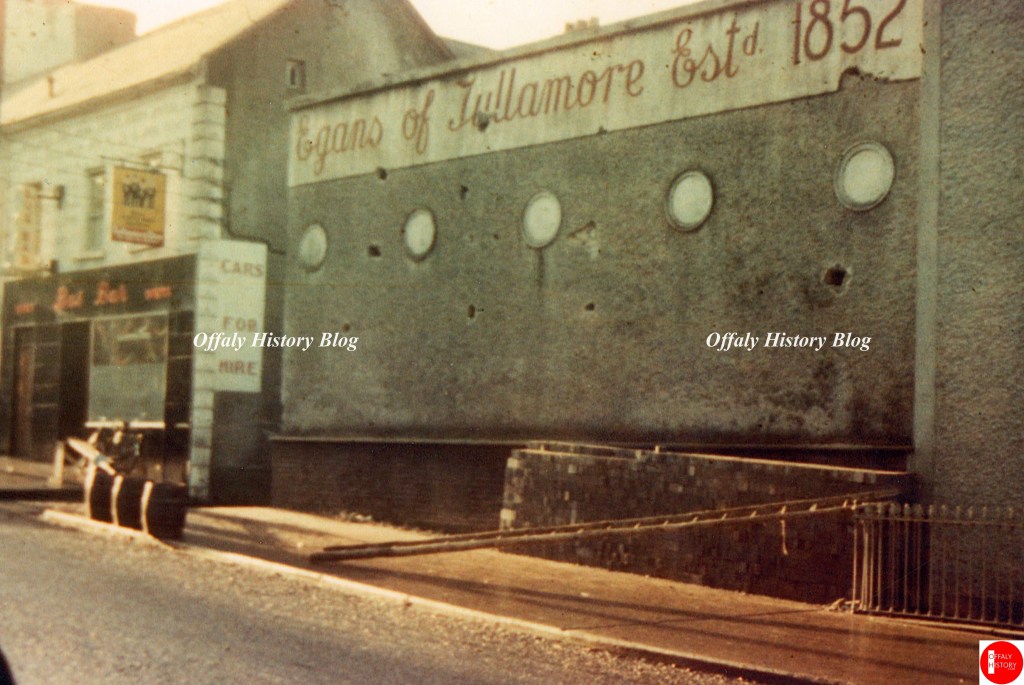
Gill’s site c. 1952. Bus Bar to left. The building appears to have been vacant from 1927 or soon after (more information needed here) and was taken down by P.& H. Egan Ltd in 1952. It was then left for eight years as a walled in yard. In 1961, and to a very modern style, a newly constructed shop was opened by that firm as a hardware store focusing on electrical goods and the new products in demand in the early 1960s for the modernised home.[8] It was sold in the late 1960s with the winding up of the Egan firm and was acquired by Joe Galvin, the auctioneer, for offices on the first floor and ladies fashions on the ground floor. The new store, Galvin’s Ladies Drapery, was under the direction of Joe Galvin’s wife, Mrs Lily Galvin, having moved to much larger premises from her former shop in Harbour Street, established in 1957 twelve years earlier.[9] Joe Galvin was from a distinguished Tullamore-based business family headed by his father Michael (of the gravel business, later Readymix), and brothers John and Andy, and Brendan (among others) also in business in Tullamore. Joe Galvin died at the early age of 54.[10] His auctioneering business was continued for a time by his brother Andy and Enda Soden.
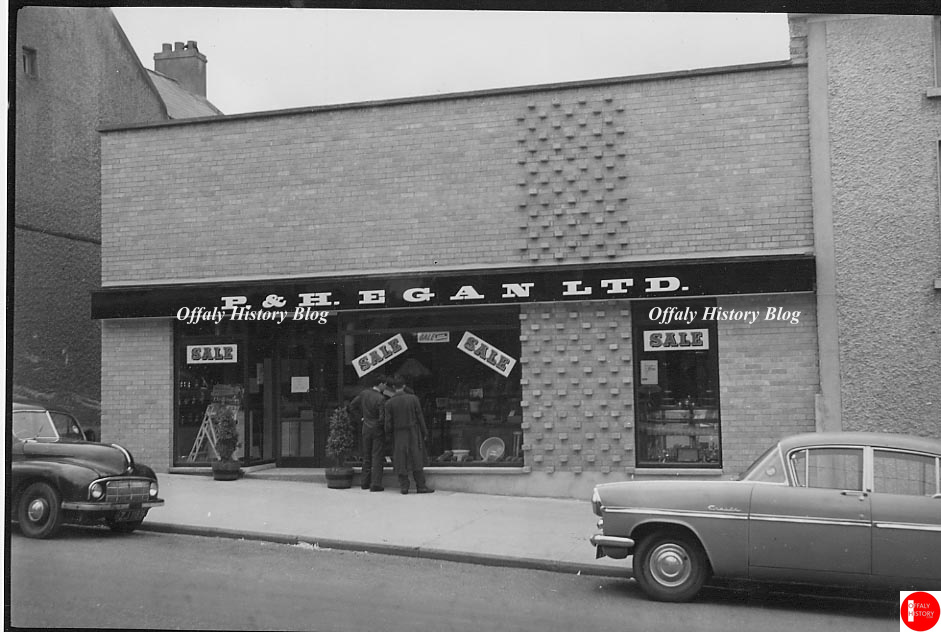
The new store of c. 1961. Fergal MacCabe, the architect and town planner has commented on this article and the new building: ‘A very interesting addition to the study of the urban heritage of High Street. The 1961 shopfront was the first post war building in Tullamore in a modern style. Designed by the Tullamore born architect Paul Burke-Kennedy, its simple form and use of concrete bricks as a finish is reminiscent of contemporary Scandinavian architecture which was briefly popular with younger architects at this time. The contrast between the horizontal fascia and its modern lettering with the vertical panel of projecting bricks was well executed and was a device used by the Athlone based architect Noel Heavey also.’ Galvin for Ladies closed in 2014 after forty-five years in this location of which twenty-eight years was under the direction of John Galvin. In appearance the building has been changed radically on two occasions since the time of the Gill ownership from 1901 to 1922. The first was in 1961 for Egan’s and the second about 2007. The store was continued as a drapery for younger women in a new location.
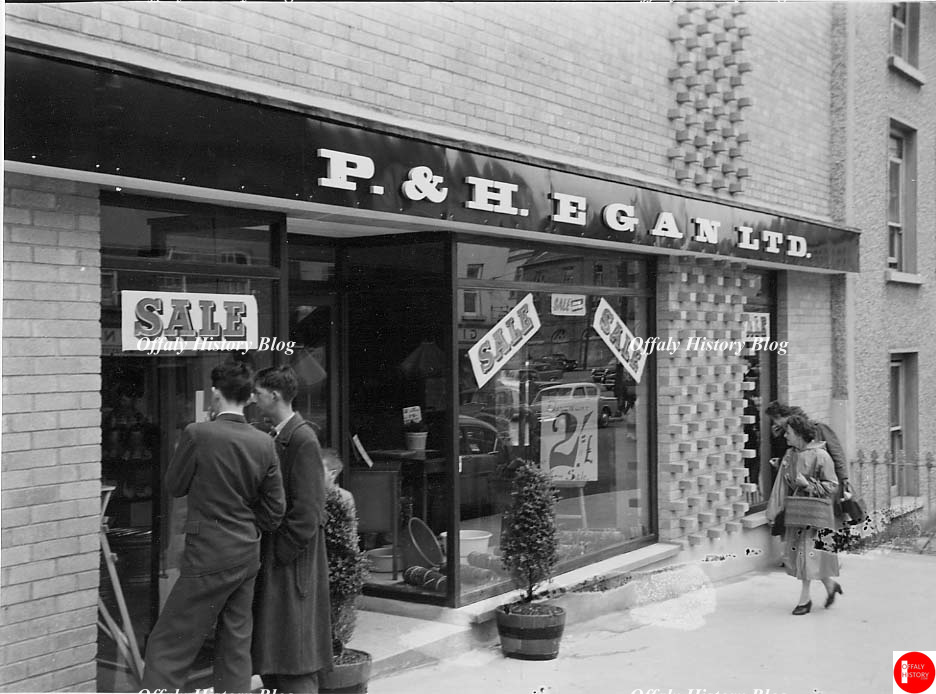
The lovely new consumables of the early 1960s. Tullamore was a lead town in the midlands in that decade. What Tullamore child of the 1960s has not climbed those bricks? The High Street store got a new lease of life with the opening of Guy Clothing by Anthony Kearns and Kara Kearns in October 2014. Their fine store has brought new business to High Street after the closure of Kilroy’s (both stores in 2007). We wish them well.
If we had letters and diaries from the 1750s what a story could be told of this one house in High Street. We did hear that some members of the Gill family from the Unites States called to the town council about ten years ago and would hope to make contact. The same can be said to the Mills Muller family in Berlin. Maurice Egan has written in two books now of the Egan family and others in Tullamore.
If you have a story to tell why not email us info@offalyhistory.com. For over 400 stories so far see Offalyhistoryblog. They are nicely organised on our website www. Offalyhistory.com. There are about sixteen houses in O’Connor Square and over forty in High Street. Every building has a story. Have you archival material, memorial cards, photographs, diaries, letters? Why not call us. Offaly history is about saving memories. Visit our website and that of Offaly Archives. Our thanks to Offaly County Council, Decade of Centenaries and the Heritage Council. Only 55 more stories for High Street and O’Connor Square!! Thanks to Offaly History Centre for so much help with this one.
[1] Offaly Archives/4/36, 6 Apr. 1753; RD, 154/592/107558. Charleville to Robert Mills; fee farm grant, 11 June 1880, RD, 1880/40/216.
[2] Irish Times, 9 January 2001. This article first appeared in The Irish Sword in 1971, x, p.73. A Mills family lived at Spollanstown and were farmers and had property in High Street, Tullamore. Lord Tullamoore granted a lease to Robert Mills of Tullamore, a farmer, in 1753 (Registry of Deeds memorial Book 154-592-107558). A later deed of 1773 (Registry of Deeds 308-478-206673) refers to a Spollanstown address for Robert Mills and James Mills.
[3] Church of Ireland parish registers, Tullamore. Index with OHAS, Research Centre, Tullamore
[4] RD, 6 April 1753, Tullamore to Mills, memorial no., 154/592/107558; 10 March 1767, Mills to Finlay, memorial no., 297/637/196497; 4 November 1758, Mills to Finlay, memorial no. 199/346/132431; 13 September 1790, Finlay to Bollard, memorial no., 416/493/277814.
[5] MS valuation, Tullamore, property nos, 24-5; Slater, Directory (1846), p. 93.
[6] Midland Tribune, 30 Sept. 1922.
[7] Offaly Independent, 8 Aug. 1953, 2 Nov. 1963.
[8] Offaly Independent, 3 June 1961.
[9] Tullamore Tribune, 29 Sept. 1979.
[10] Midland Tribune, 16 June 1984.
John Wrafter writes from the United States
Enjoyed reading your recent blog re the Gill’s of High Street. Surprised that anybody remembered them.
The Gill family were longterm friends of my own family (Wrafter) – resident at 9 Church St. in those days
and the connection continued for decades after their departure to the U.S.It’s my understanding that four of the Gill boys served, during WW2, in the U.S. army. All survived.
Attached is a photo of Michael Joe Gill at Montecassino in Italy. You will be familiar with that famous
battle I am sure !.

Here also are a couple of photos of Michael Joe in later life. One chatting with my late mother (Mona W.),
the other with my uncle, P.A. Wrafter, late of 9 Church Street, where the Gills would usually stay during
their occasional visits to Tullamore. Both photos were taken at Michael Joe’s residence in New York
sometime in the late 1960’s.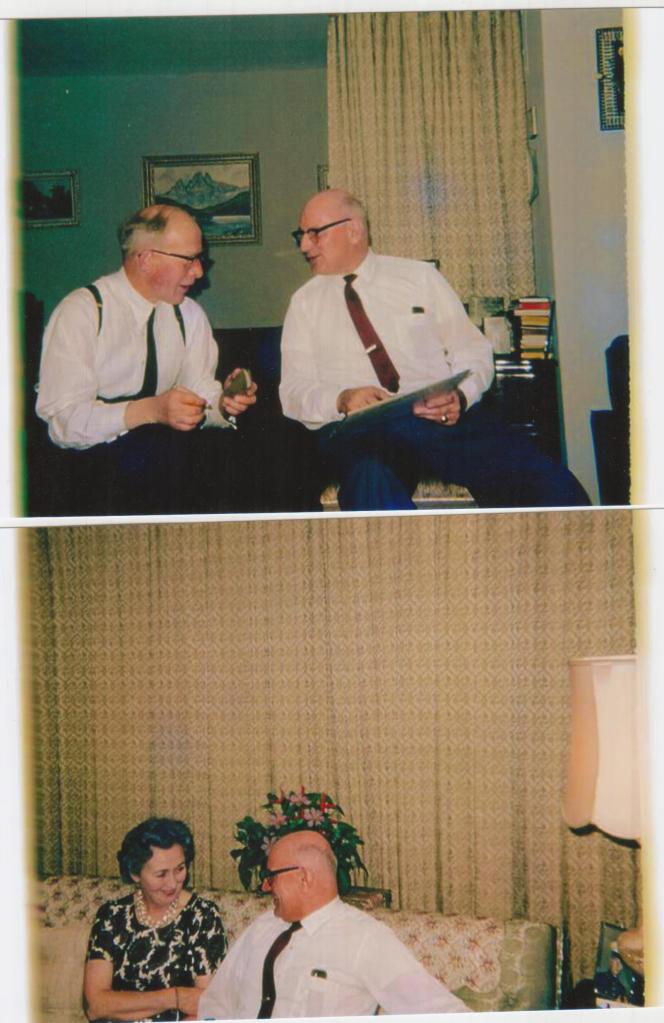
Best regards,
John Wrafter,
(Late of O’Moore St, Kilbride St, Church St, and Ballyduff.)
-
Geashill and the Legacy of William Steuart Trench, 150 years after his death. By Mary Delaney. Blog No 414, 24th August 2022
“Those haters of the Celtic race
The above words appear in the poem Mucker written by the poet Patrick Kavanagh and reflects the legacy of William Steuart Trench and his two sons Thomas Weldon, and John Townsend Trench and how they managed landed estates in counties Monaghan, Offaly and Kerry in mid -Victorian Ireland.
As we reach the 150th anniversary of the death of William Steuart Trench, we must ask whether this is a true assessment of the character of the man and of the realities experienced on the estates he managed.
Trench and his two sons came from a professional type of land agent. Their roles included that of magistrate, accountant, architect, agriculturalist, engineer and innovator. Trench was also a landowner himself, as well as an author. His most famous piece of work was Realities of Irish Life which was published in London in 1868. Were his realities the same realities experienced by the people of Geashill, Monaghan and Kenmare?
James Godkin, a contemporary of Trench described Realities of Irish Life as one of the most misleading books on Ireland published for many years, claiming it had made false impressions on the public minds in England. He went on to say “The mischief would not be so great if the author did not take so much pains to represent his stories as realities, essentially characteristic of the country.”
Trench was employed as agent on the Digby estate in Offaly (King’s County) from 1857 to 1871. Prior to and parallel to this appointment, William Steuart Trench had been employed in Co. Monaghan. He was appointed by Lord Shirley in 1843 and by Lord Bath in 1849. He also acted as agent on the Lansdowne Estate in Co. Kerry. There are most definitely common trends in all three counties and similar memories as to how Trench is remembered on the estates he managed.
There is no doubt that he transformed and enhanced the physical landscape in all three counties. Throughout the 1860s Trench, on behalf of Lord Edward St Vincent Digby embarked upon a major project of house improvement and land drainage in the barony of Geashill. While a great number of new houses were constructed between 1857 and 1872, for example, new treble cottages were built in the village of Geashill in 1861, Trench thought it more profitable and less expensive to improve existing dwellings.
In fact, much of the present form of what is now Geashill village and its surrounding areas, owes its origin to the work carried out in the 1860s. A new school was built in 1862. New roads were constructed including one linking Geashill to Tullamore. Improvements were made to the Village Inn and to other buildings in the village and barony.
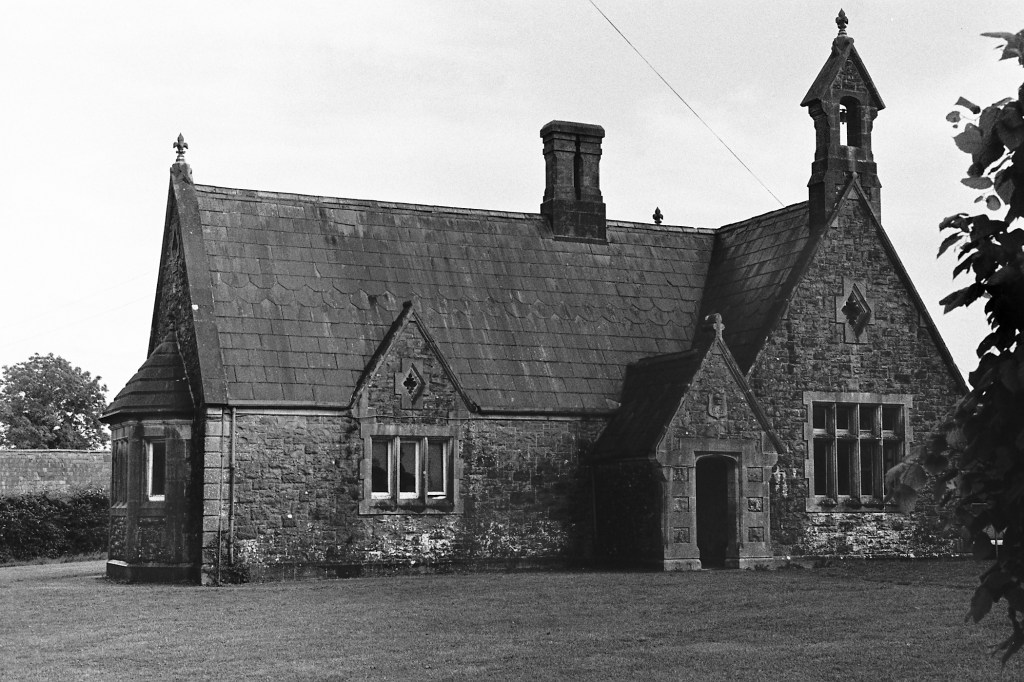
The school at Geashill, erected about 1862 The success of such schemes of house building and repairs not only enhanced the appearance of the barony and improved the living conditions of the tenants, but it also earned Lord Digby recognition both at home and abroad. His schemes proved so successful that the Digby estate won the gold medal offered by the Royal Agricultural Society of Ireland for the best labourers’ cottages in the province of Leinster. The estate also boasted of holding the Duke of Leinster Challenge Cup for the best labourers’ cottages in Ireland for three successive years.
Cottage at Geashill before and after renovation

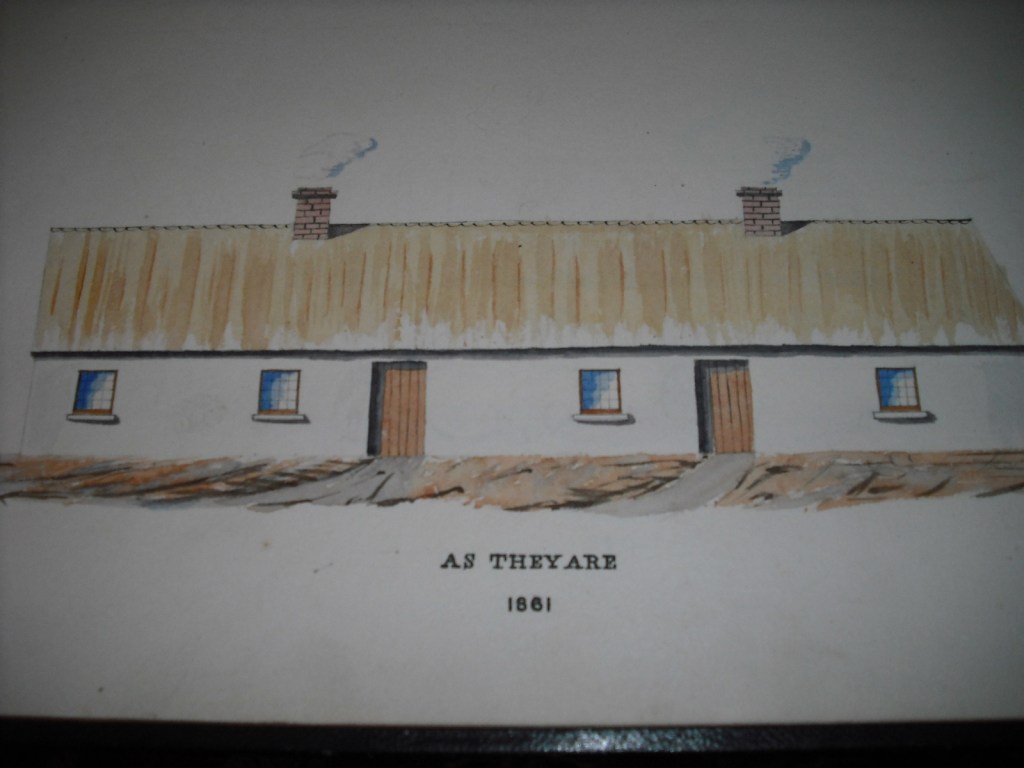
Lord Digby was thus awarded the gold medal for the province of Leinster for six well-finished cottages which were deemed the more comfortable. He was also successful at an international level when at the Paris Exhibition of 1857 he was awarded a bronze medal for cottages constructed in Geashill.
While working for Lord Bath, Trench also had a number of farmhouses improved and a number of new schools built, all of which had carved over the door the letter “B” and the year of construction. These display similar designs to some found in Geashill.
The town of Kenmare and the Lansdowne Estate were also improved which has been well documented by Gerard Lyne. He noted how Trench even had a clock erected in the main square to ensure the workers always turned up on time.
Present Day Kenmare with town clock, erected by Trench

William Steuart Trench is also credited with land reclamation projects on the estates he managed and could be considered to be a man ahead of his time. In order to restore the land to full productivity, the land at Geashill was levelled and planted with good quality grass seed to allow it to regain it nutrients. Trench had Peruvian Guano applied to improve its fertility. This proved successful, resulting in large scale production of turnips, potatoes, wheat, oats and later, rape seed. In fact, rape seed continues to be produced on this section of land up to the present day. Although costly at the time, it seems that these schemes paid for themselves in the long run. Land which was previously let at a rent of four shillings per acre, now earned between twenty-five and thirty shillings per acre.
Trench was thrifty and perhaps well ahead of his time in maintaining workers to ensure all improvements were carried out. It was suggested at the Paris Exhibition that he construct a moveable ‘Russian Village’ to house his workers. Twelve timber cottages were constructed with timber countersunk at the corners and laid one on top of the other, thus forming walls. In this way, Trench secured a permanent well-trained workforce, who along with their cottages could be transported at a “trifling cost to any district in which they may be required”. The Russian Village, a modern day portacabin, enabled Trench to carry out work all year round with a steady supply of men.
William Steuart Trench and his management of the Digby Estate, King’s County 1857-1871
While Trench and his sons have been credited for such improvements by many authors over the last 150 years, one must wonder to what extent the landlords were involved. In the case of Geashill, the then Lord Digby, Edward St. Vincent Digby, was the grandson of Thomas Coke of Norfolk, who was noted for his contribution to the agricultural revolution in Britain in the eighteenth century. Like his grandfather, he was interested in renovating the appearance and improving the quality of the estate at Geashill.
When examining the demographic patterns in Offaly, Monaghan and Kerry during the Trench era, there was a dramatic decrease in the population of all three counties. Trench and his two sons considered the poorer classes, especially those who lived in mud huts or those tenants in arrears or tenants who demanded a reduction in rents to be a burden to the estates he managed. He also saw them as a barrier to the improvements he wished to carry out.
Trench was noted for the implementation of assisted emigration schemes, regarding such schemes as an economical and efficient way to improve the estate.
According to him, “this clearing process would stabilise rates, consolidate holdings, and improve the life changes of the people themselves”.
Did such a scheme benefit those who were forced to leave Ireland or were they merely to facilitate Trench’s plans at improving the estates he managed? In some cases, people were lucky. Others were less fortunate.
While acting as an agent for Lord Lansdowne in Kenmare, Trench embarked upon a policy of what he called ‘voluntary’ emigration. He cleared Kenmare workhouse by offering the occupants their full passage to America. In fact, by 1869 there was a ward in a New York hospital called the Lansdowne ward because so many impoverished people from Kenmare died in it. According to the Geographer, Dr. Paddy Duffy they had arrived there half-starved, disease-ridden and penniless. Trench introduced similar plans on the Bath and Shirley estates. He admitted in his book Realities that it was cheaper for him to pay for their emigration than to support them at home in Monaghan. Trench maintained that depending on how much the tenant could afford they were given their full passage or a contribution towards their passage and money towards food and clothes. Duffy also points out that many of the tenants who left Monaghan for America or Australia had to go through the port of Liverpool. The agent there commented on the appearance and condition of the tenants who arrived from Monaghan. In fact, it seems they were such an embarrassment to the estate in 1849 that Trench was reprimanded by the Carrickmacross clerk who hoped that such ‘a ragged pack may never appear here again’. Trench, of course, claimed that the tenants’ chief device was to hide their good clothes which had been furnished to them and to appear in their worst rags.
It seems that in Monaghan the tenants were not leaving as quickly as Trench would have wished, so by the late 1840s he began to speed up the process by forced evictions, where mud huts and cabins were knocked and tenants were left without food or shelter. In some cases, people were threatened and bribed to knock down their own dwellings or that of their neighbours.
Did the agency of William Steuart Trench alter the population trends on the Digby Estate? An examination of the census of both 1851 and 1871 suggests that the population totals and distribution altered significantly during the two decades. In fact, the total population declined from 6,221, in 1851 to 3,712 in 1871 resulting in a percentage decline of 40.3 per cent for the period. Many of those who left emigrated to Australia and some to America. They may not have secured their fare from Trench as he claimed. In fact, in the 1864 annual report to Lord Digby, he admitted that sons and daughters of small farmers and labourers had emigrated to America having had their passage paid by friends and relatives who had gone before them. Other emigrants from the barony were aided by a scheme introduced by a Fr. Paddy Dunne, a native of Daingean parish, who liaised with the Queensland Emigration authorities. Dr. Jennifer Harrison in her work titled From King’s County to Queensland, explains how Fr. Dunne became aware that “the able-bodied poor with their families were being evicted from the estate at Geashill and were crowding into the streets of Tullamore for shelter”. They were homeless, penniless and near starvation. The parish and community were powerless to help them in their plight. Fr. Dunne addressed meetings and ascended pulpits whenever he was allowed, as sometimes there was strong opposition from the clergy. He arranged the funding and the safe passage of many tenants from the Geashill area by chartering ships such as Erin go Breagh, which brought many emigrants from Geashill and its surrounding hinterland to the new world.
Dr. Harrison attributes easy access to the Midland and Great Western Railways, as well as access to the Northern Railway as a major factor in facilitating movement to Queenstown (Cobh) from where many emigrant ships set sail. The Midland and Great Western Railway passed through Geashill and a railway station was opened just outside the village in 1854 which operated for passenger travel until 1963.
Population Decrease in Geashill during the Trench Era.

Trench believed that many of the social problems at Geashill could be attributed to the peasants, whom he saw as ‘lazy and thriftless’ and who acted as a barrier to his plans for improvement. As a result, he adopted a hardline authoritarian style of estate management.
Some of the following strategies employed by both William and Thomas Trench seem to back up this theory. Their first task was aimed at eliminating the numerous squatters, who under previous regimes had been allowed to establish themselves on the estate and who had not paid rent for more than twenty years. Their names, in fact, had never appeared on a rent book. These people had usually squatted along the side of the roads and lived in mud hovels with no windows and a hole in the roof, out of which stuck a piece of wickerwork, which made a chimney. These vulnerable people put up little or no resistance and according to Trench were less difficult to remove than he had anticipated. He claimed, he enticed them to leave by offering them money. He suggested that they were quite happy with this arrangement. However, certain sources suggest that the Trenches adopted ruthless tactics to clear the estate of small tenants and beggars, in order to create larger holdings with better drainage and more advanced farming methods.
Thomas Weldon Trench’s treatment of a woman in Geashill village on Christmas Eve, 1861 illustrates this fact. While he was working on his estate in the village and acting in his capacity as local magistrate, he had an elderly woman, Jane Egan, aged seventy- two, arrested for begging for a halfpenny. It seemed that Trench constantly kept watch for vagrants and even carried a Bible in his pocket in order to put under oath anyone whom he might wish to interrogate on suspicion of begging. The case of Alice Dillon (Delin), well documented by Michael Byrne, illustrates just how ruthless Trench was. On the same day as Jane Egan was arrested, he noticed another elderly woman entering a local premises. On questioning the householder, he learned that the woman had asked for a cup of sugar. He immediately had the woman, Alice Dillon, who was seventy-nine years old, arrested and incarcerated in Tullamore gaol, where she died a few days later while serving her sentence. An inquest into her death followed. The inquest was held in Tullamore gaol on 3 January 1862.
It is worth noting that all members of the jury were tenants at will (yearly tenants) on the Digby Estate and perhaps a more objective jury would have found Trench guilty of misdemeanour in this matter. Mary Pilkington quotes how the Dublin Morning News called on parliament to intervene in order to secure Trench’s dismissal as a magistrate. She suggests that his strong links with Dublin Castle ensured that he remained a Justice of the Peace. Interestingly, Trench failed to mention the Dillon case in any correspondence to Lord Digby nor did he refer to it in Realities of Irish Life.
Forced emigration was the main method Trench used on the Bath, Shirley, Lansdowne and Digby Estates for those he deemed a threat to his management. However, in Monaghan he also ordered public hangings. In fact, in his book, he refers to how a man named Traynor on the Bath Estate had narrowly escaped hanging for not paying his rent and refusing to give up his land. It seems the man escaped from the local gaol before Trench had time to execute him.
The other common methodology of Trench’s style of management was his use of spy networking. He specialised in spying on the Ribbonmen in Geashill and the Molly Maguires in Monaghan. He had similar spies operate in Kenmare. It seemed that the actions of the Trenches swiftly led the tenants at Geashill and in Carrickmacross to turn to societies such as the “Ribbonmen”. This was a Catholic association set up in 1808. It was particularly active in the middle of the nineteenth century. The main aims of this society were firstly, to prevent any landlord, under any circumstance whatever, from depriving any tenant of his land and secondly, to deter, “on pain of almost certain death” any tenant from taking land from which any other tenant was evicted. Their actions were carried out with great severity and aimed at wealthy landlords and humble cottiers alike. The local Ribbonmen in Geashill began to devise a method of getting rid of Trench. In his annual reports to Lord Digby, he writes that “Conspiracies for various subscriptions were set on foot to pay for the murder of myself and my son”. William Trench and his son were to be made aware of this fact by informers or as he put it himself “secret friends”.
Godkin attributes many of Trench’s victories over his tenants on the Geashill estate to the spy network he had created. Ribbon activity had increased and seemed rife in the district in 1860.
Trench also feared for his life in Monaghan and as in Geashill became aware through his spy network of a plot to murder him. This became more worrying after an event in Magheracloone.
In 1843, the tenants on the Shirley Estate, of which Magheracloone was a part, refused to pay their rent until their complaints had been addressed by the landlord. Attempts by the bailiffs to seize cattle or goods from the tenants, who would not pay, were stopped by the activities of local Ribbonmen known as ‘The Molly Maguires’.
Trench, along with the bailiff on the Shirley Estate and escorted by local police, marched towards the church in Magheracloone. The intention was to post a notice of eviction to several tenants on the door of the church. They were met by a large crowd who tried to block their path. As the troops tried to advance they were met by a shower of stones. The troops began to shoot at the crowd which resulted in the death of a young servant boy. This episode resulted in a Coroner’s inquiry. Unsurprisingly, the enquiry could not establish who shot the boy nor could it prove that the police were in danger at the time of the shooting.
After this, it seems the “Molly Maguires” upped their activity by staging surprise attacks on the “grippers, keepers and drivers”. The grippers were the people who were directed by Trench to arrest tenants, the keepers were employed to watch the crops for fear the tenants would remove them, and drivers were those who drove the livestock to the pounds until the tenants paid up their rent. As in Geashill, Trench was made aware by informers of a plot to murder him. Large subscriptions were being collected to pay the murderer who would consent to shoot him. Two men were appointed, Hodgens from Castleblaney and an individual called Thornton, who was described as a good for nothing who lived between Carrickmacross and Inniskeen. If fact, the Ribbonmen went as far as putting up a notice in a local church which read “Trench considered a doomed man”. After this episode, Trench never left the house unless accompanied by two men, one of whom was his son. All three were well armed and ready to fire at a moment’s notice. Both Hodgens and Thornton along with a third man called Breen were later arrested for attempting to murder the bailiff, Paddy MacArdle. Trench had both Hodgens and Breen executed by public hangings in Carrickmacross, while Thornton who had informed on his friends walked free.
So how do Trench and his sons deserve to be remembered over the last one hundred and fifty years?
The folktales of Co. Monaghan paint a dark picture of Trench. For example, they tell how when Trench died, the rats devoured his corpse before it could be buried.
They are remembered in much the same way by the people of Geashill. A local man, Thomas Davis, remembers a rhyme told by his grandmother.
There’s grace on the pulpit
There’s wit on the bench
But there’s nothing but dirt,
Can be found on Trench.
From such stories, it is fair to say that the Trenches exercised huge control over the lives of their tenants, not only economically but also socially. It is claimed that in both Monaghan and Kerry no tenant could marry without the consent of Trench. This is reflected in a ballad about the Shirley Estate:
Oh Girls of Farney it is true
That each true hearted wench
Before she weds, must get consent
From Pious Father Trench.
Both Trench and his son Thomas Weldon died within a few days of each other in 1872 and were buried in Dunamoyne cemetery in Co. Monaghan.
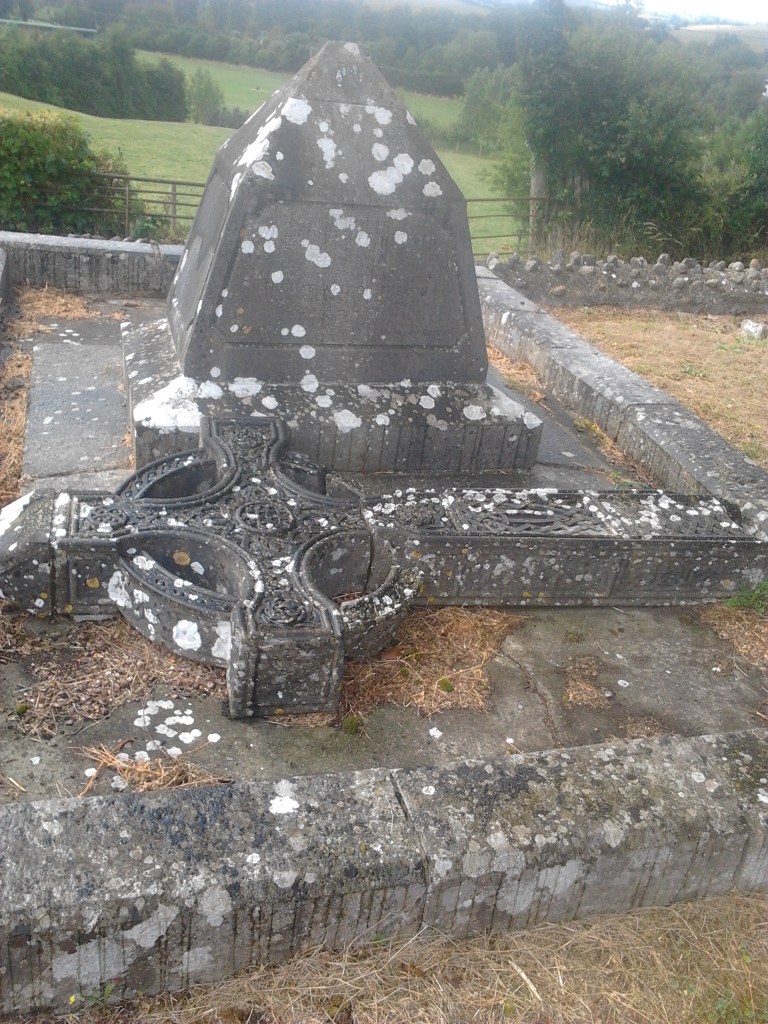
Their legacy is reflected in the fact that their headstone has been vandalised and defaced.
The Defaced Headstone of William Steuart Trench, Dunamoyne Cemetery, Co. Monaghan
William Steuart Trench’s physical legacy in Offaly, Monaghan and Kerry is that of an agent who created a golden age of prosperity in the barony. Down through the years this physical legacy has been greatly overshadowed by the REALITIES of an agent who systematically broke leases, demolished people’s homes and banished the poor from the countryside. It is clear that his management style was ruthless in the extreme. The legacy of William Steuart Trench, his two sons and many other land agents of the time, including Trench’s nephew George Adair are aptly epitomised by Patrick Kavanagh as
“Those haters of the Celtic race”.
Mary Delaney
Local Historian & Author of William Steuart Trench and his management of the Digby Estate, King’s County 1857-1871
We have added some Geashill books [ed.]

We have added this blog to our Decade of Centenaries because of the profound influence the legacy of Trench had IRA leader and county councillor Tommy Dunne. See also some further reading. Some copies of Mary Delaney’s book and that of Rachel McKenna are available from Offaly History and Midland Books. The Photographic record is out of print and hard to get.


-
The Discovery of the Bronte Family Portrait in Hill House in Banagher, Ireland in 1914. Blog No 407, 10th August 2022
The Offaly Heritage Office and Amanda Pedlow have been working with Dr Maebh O’ Regan of National College of Art and Design supporting a project with the Banagher Crafting Group exploring the Banagher and Bronte connections. Some of you may have attended events at the recent That Beats Banagher Festival.
One of the outputs is a short fifteen-minute film about the discovery of the Bronte Family Portrait in Hill House in Banagher in 1914 and an interview with Dr Sarah Mouldon of the National Portrait Gallery London who care for it now. Please see the video link for you tube of a very fine presentation adding greatly to our knowledge of how the portrait was received when first presented to the public in 1914. We attach some background material on the discovery of the painting at Hill House, Banagher and how it came to be there from an earlier Offaly History blog. Our thanks to Amanda Pedlow and all concerned with this fine and informative production.
This is one of the projects supported by Offaly County Council through the Creative Ireland programme.
(more…)
-
Richard Barry, Tullamore Celtic Literary Society, William Rooney and Arthur Griffith. A contribution from Offaly History to mark the Decade of Centenaries and the death of Arthur Griffith, 12 August 1922. Blog No 406, 6th August 2022
Arthur Griffith died of a heart attack, or stroke, in Dublin on 12 August 1922. He was only 51 and had given a lifetime of service to his country at huge personal cost. To mark the centenary of his death we recall an important contribution from Richard Barry (1880–1978) in 1970 where he set out some of the cultural history of Tullamore in the period before the Rising and the War of Independence. Barry was greatly influenced by the writings of Arthur Griffith in the United Irishman and also by the earlier contributions of William Rooney (1873–1901). Rooney met Griffith probably in 1888 and both were members of the Parnellite Leinster Literary Society, and after 1892 of the Celtic Literary Society. When the United Irishman was launched in 1899, with Griffith as editor, William Rooney was the main contributor and, working together, developed Sinn Féin policy. Rooney’s early death at the age of 27 was a devasting blow to Griffith. William Murphy in the short life of Rooney in DIB cites Michael Collins as describing Rooney in terms normally associated with John the Baptist: ‘Rooney spoke as a prophet. He prepared the way and foresaw the victory’ (Path to freedom, 150).
(more…)
-
Going to UCD in 1978: the experience of one Tullamore man. By Declan McSweeney. Blog No 405, 3rd August 2022
I recently found myself reminiscing about the experience of moving from Coláiste Choilm, Tullamore, to University College Dublin in 1978.
In many ways, there was a sense of culture shock, it was like moving to a foreign country, though I suspect the transition would be less for today’s students.
I was moving from what was then a small secondary school where I knew all my classmates to a university which even then had around 10,000 students.
As you were in different classes with students for different subjects, it was obviously very difficult to get to know many of your classmates.
Nowadays it has over 33,000 students!
(more…)
 offalyhistoryblog