This short article is the first in a series designed to look at the growth of Tullamore over the period from 1622 and to take key dates in the development of the town. Suggested dates will include 1622, 1716, 1764, 1785, 1804, 1835, 1900, 1923, 1948, 1966 and 2000. These dates coincide with particular events, or the availability of documentary sources that may allow us to draw some conclusions about the state of Tullamore at varying times over the last four centuries. Rather than take matters in chronological order we are going to look for some key moments in the stages of growth. One such was the completion of the canal to Tullamore in 1798 and its extension to Shannon Harbour in 1804. During that six years Tullamore had served as the depot and terminus for the new waterway to the west and south. The opening to Shannon Harbour and the link to the Shannon may have been seen by some as marking the end of the new canal hotel and harbour in Tullamore with business moving further west and travellers no longer having to stop over in the town. That was not the case. The hotel client base weakened to almost nothing by the 1840s and so did passenger traffic. Commercial traffic was continued on until 1960.
Recently nominated by the Irish Times as amongst the twenty best places to live in Ireland, Tullamore earned the accolade because of its central location and its excellent recreational amenities and services. However, neither its built or natural environment figured as deciding factors in the survey.
Regrettably, my home town lacks the physical drama of Kilkenny and Lismore dominated by fortresses standing on cliffs, the waterside charms of Kinsale and Carrick on Shannon, the mystery of the mediaeval alleyways of Galway and Carlingford or the suave urban quality of Westport, Clonakilty and Birr. Nevertheless, it’s qualities, modest as they are, have always inspired me and I have often tried to capture them in drawings. Tullamore’s few architectural setpieces were my first introduction to the notion that a town or a village could be a beautiful artefact as much as a painting or a piece of sculpture.
Why has there been so little public interest in the conservation of the architectural heritage of Tullamore?
Sharing a pot of tea in the Brewery Tap in the early 1980s with a well-known local builder, I remarked that demolition and redevelopment rather than conservation and reuse always seemed to be the first choice option. His reply, which I have never forgotten, was that new buildings which responded to modern needs were always preferable because ‘Tullamore is a good business town’. Change had always brought benefits and the future held more attraction than the past.
I understand that sentiment. Unlike Birr or even Edenderry, Tullamore has always been seen to be go ahead and dynamic; looking forward always and never backwards. That progressive approach was sustained by active business organisations and extended to the areas of arts, culture and local history also. It created a vibrant, attractive and always interesting atmosphere.
Nonetheless, little concern was ever publicly expressed for the protection of the town’s architectural heritage and the role it might play in its advancement. This derived partly, I believe, from a perception that since there were no buildings earlier than the mid 18th century, the fabric of the town was relatively new and was therefore of little or no artistic interest or value. This attitude was reflected in the non-existence, even to the present day, of any local civic group or architectural preservation society or even an Offaly branch of An Taisce. Birr might have its Chapter of the Irish Georgian Society, Tullamore despite its large inventory of 18th c. buildings, didn’t follow.
There’s no shortage of very ordinary towns in Ireland but Tullamore certainly isn’t one of them. How could it be? After all it has its proud legacy as one of the original trading and transport hubs on the Grand canal from its arrival in the town in 1798. That early advantage over competing centres like Birr and Daingean was reinforced with the coming of the railway in 1854, allowing Tullamore to build on its status as an important transport hub and retail, administrative and merchant centre. On this basis, the town maintained at least the appearance of prosperity up to the present era. This early pre-eminence is reflected in the town’s exceptionally fine architectural legacy including an assemblage of late Georgian town houses, the civic space at O’Connor Square and individual gems such as the Tullamore Dew Whiskey Heritage Centre along with J.B. Keane’s Neo-Classical Courthouse.
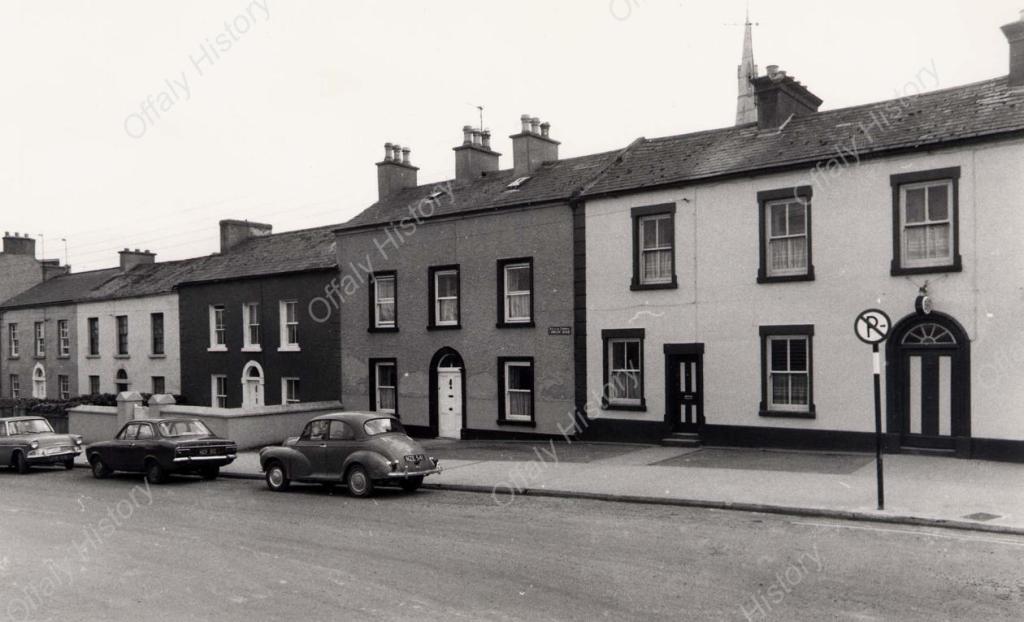
Late Georgian Terrace at Bury Quay/Convent Road, Tullamore. Mid1970s
So, while future prospects are certainly influenced by the legacy of the past, for urban centres like Tullamore factors such as economic performance and civic leadership will figure as the more immediate drivers.
There are only a few studies available on the development of retailing in Ireland, either of a general nature or in connection with particular firms. It is well known that in the first half of the nineteenth century and up to the Famine years retail outlets were not widely available and many in the smaller towns were no better than huxter shops. There were exceptions and that is clear from the photographs of c. 1900 of shops such as Williams. Egan, Goodbody and Lumley (in Tullamore); O’Brien in Edenderry and O’Meara and Fayles in Birr. In looking at the revolutionary period from 1912 to 1921 to mark the decade of centenaries it is also worth looking at revolutions in other areas such as transport, energy and shopping. Like the political revolution retailing exhibited signs of stress after 1921 and did not recover until the coming of the supermarkets to the provincial towns in the 1960s.
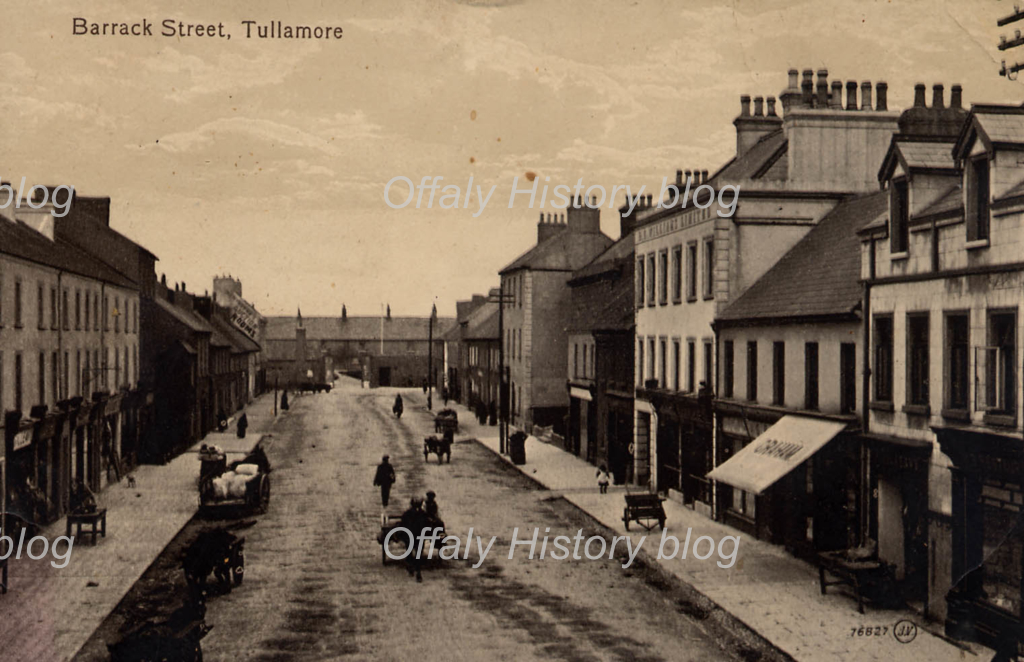
The Williams head office with the Barrack Patrick Street shop to the right before more intensive motorised transport from 1915.Branch house managers were appointed of which the last under the old system (before the switch to supermarkets) was T.V. Costello.
The trade directories, and from the 1840s the valuation records, will facilitate investigation of retail outlets. By the 1860s living standards had improved and this is reflected in the increasing number of shops; per capita tobacco consumption rose to English standards about 1870 and per capita consumption of tea was not far off the English level by the end of the 1870s. The considerable economic progress of the early 1870s, began to slow down by the end of that decade. The 1880s is looked on as a period of industrial crisis with industries closing down in all the principal towns, or destroyed by fire as with the Goodbody tobacco factory in Tullamore and the Birr distillery in 1889.The railways and the canals (especially in the midlands) facilitated the easy removal of heavy goods and livestock from towns all over Ireland, but it also left it easier to import foods easily and cheaply. As a result, the Irish industrial base (such as it was, especially in southern Ireland) receded while the retail and services sector began to grow albeit slowly.
Long, long ago, a rocky outcrop on the bed of the river allowed local farmers to herd their livestock across to graze on the small hill on its southern bank. Over time, longer distance routes began to converge on the ford and a small village grew up to cater for travellers, an inn to change horses perhaps, a blacksmith possibly, but this is all conjectural as no traces or records remain.
In 1609 the soldier/settler John Moore bought a half share in the nearby but now long vanished castle and watermill of the Molloys and began to hold an annual fair. By the late 17th. century, ‘Tullymore’ as the old maps called it, was most likely a rural scene of some thatched cottages, an unpaved track and maybe one or two substantial houses (illus.).
A conjectural view of Tullamore in the 1620s when it was said to have a castle watermill and ten cabins. The castle was in ruins by the 1630s but the town then had two watermills on the river.
In time the ford was replaced by a bridge. This gave the small village a certain strategic importance, so in 1716, a military outpost was established to guard it. The security this brought and the provisioning needs of its garrison, attracted new settlers whose residences and businesses were facilitated by the ability of the river to receive household and commercial waste and provide a source of raw material and power. Soon, several flour mills, tanneries, breweries, distilleries and a linen industry had been established. Downstream of the bridge, the river channel was diverted into a large semi-circle, creating a mill stream to power even more industries.
Clara’s engagement with the textile industry may go back 100 years before the Goodbody jute factory. As one of the smaller towns and villages in the county places such as Clara, Ferbane, Kilcormac and Shinrone are less clearly associated with the early plantations by contrast with Daingean, Tullamore and Birr. Clara was prosperous in the 1770s and from the weakening of textiles in the 1820s must have suffered a good deal until the hand loom business progressed after the mid-1850s and the jute factory from the mid-1860s.The Goodbody firm continued as a prosperous concern for another hundred years. Clara was the only town in Offaly to see expansion of its population in the second half of the nineteenth century. And so in the economic cycle it may be that the post 1820s to the 1860s were lean years as has been the period since the 1970s. These are generalisations and will need to be revised in the context of detailed research on Clara businesses, employment, housing and infrastructure.
I started collecting bottles a little over a year ago, interested in their origins and local history. I’ve picked a small collection of the type of breweriana bottles that were used in the day to day lives of the people of Tullamore and surrounding towns in the late 19th and early 20th century. I’ve provided a brief description of the types of bottles I’ve mentioned. Most of the dates provided are approximate and offered with the best knowledge I have at this moment. As I get more accurate information, the dates will be reviewed. I started off with some basic background information on bottles.
Carbonised mineral bottle It is widely known amongst bottle collectors that Joseph Priestly discovered how to make carbonised mineral water in 1772. It was prepared by dissolving carbon dioxide in water. By 1860, it had become easier to manufacture and was being flavoured with fruit syrups, lemons and limes. It was retailed by grocers, wine and spirit merchants, as well as chemists. At first the new drink was stored in earthenware bottles, but the gas escaped through the skin and so the drink became flat. Manufacturers switched to glass bottles. However, corks were still used to seal the carbonised mineral water drinks, and if they were allowed to dry out, they tended to loosen which allowed the gas to escape. If the bottles were stored on their side, this was less likely to happen.
It’s six months now since William Grant announced the closing of the old Bonded Warehouse Visitor Centre at Bury Quay, Tullamore. The company that makes the world-famous and second largest selling Irish whiskey, Tullamore DEW is going to concentrate its energies on a new visitor centre at the 2014-17 purpose-built Tullamore DEW distillery at Clonminch and understandably so.
D E Williams’ 1897 warehouse
The idea of a visitor centre at Bury Quay was conceived in the early1990s as a way of attracting visitors to Tullamore town. Tullamore had been designated an industrial heritage town in 1990 and EC tourism funds were available. The idea that a new distillery would open in Tullamore was not on the radar. Thanks to the work of Irish Mist (Bill Jaffray), Cantrell & Cochrane (owners of the DEW brand from 1993 to 2010), Tullamore Town Council and Offaly History the idea came to fruition in the year 2000 and the visitor centre was opened. C & C had put in about £500,000 plus the building (the late Frank McGovern and Tony O’Brien being the captains here), Bord Failte £300,000 and the council the balance with the total costs at £1.2m. This included a liquor licence for £90,000. Two County Managers and a Town Clerk played great developmental roles to ensure it was successfully completed as did the staff and franchisees subsequently.
Chapel Lane, Tullamore, County Offaly. A distinguishing 1800s feature of urban living in the provincial towns throughout Ireland were the lanes. The houses along these lanes were generally of poor quality, all of them thatched with mud and daub walls. They faced the narrow lane in terraces and in many instances housing upwards of 140 people along a length no greater than three hundred feet. The midlands town of Tullamore was no different, there was: Tea Lane, Water Lane, Chapel Lane, Meath Lane, Distillery Lane, Gas House Lane, Ballalley Lane, Market Lane, Brides Lane and so on.1